THE SIGNAL IN ONE SENTENCE
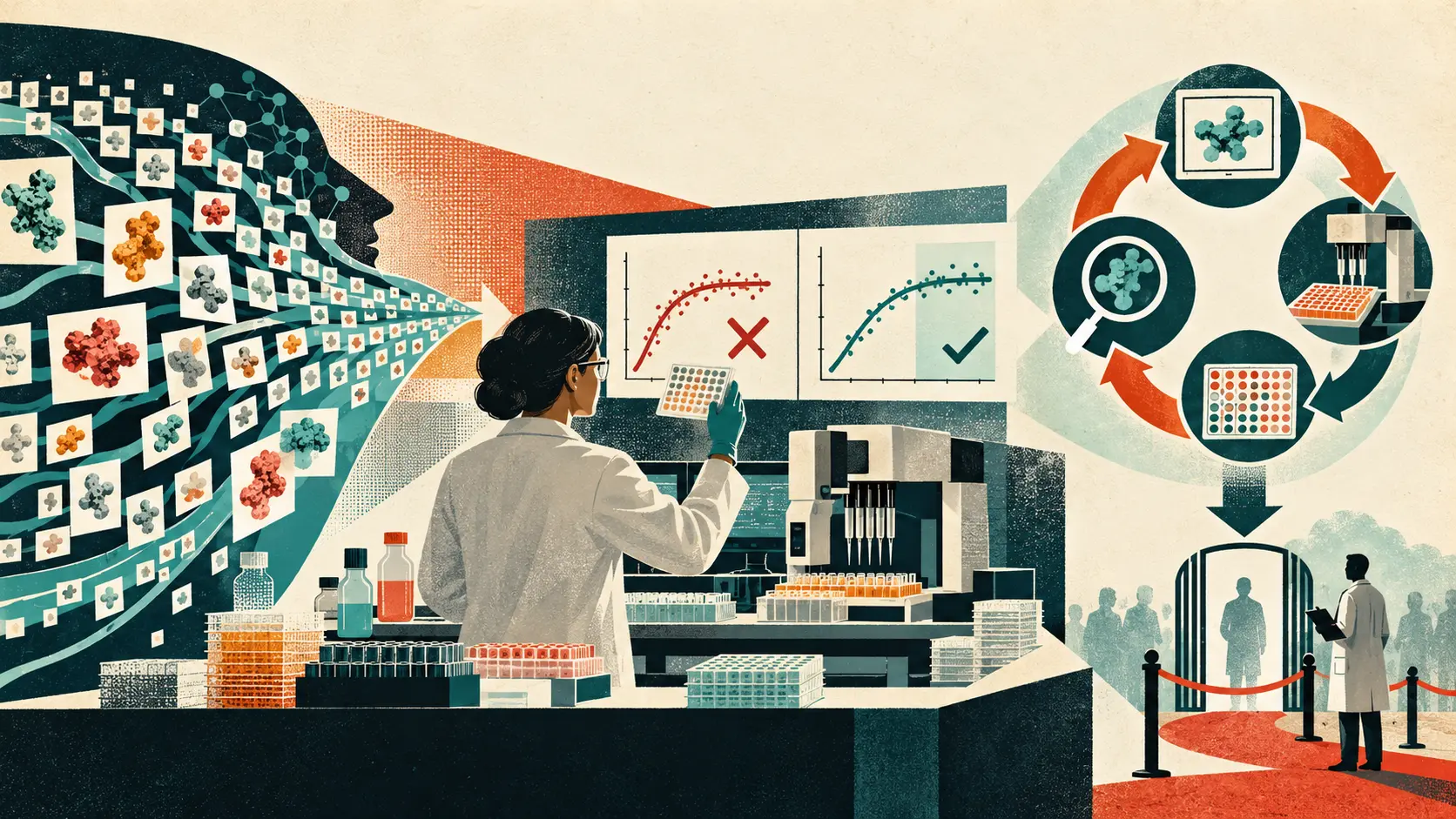
The model did not discover a medicine. It proposed molecules. Scientists made them. Instruments measured them. Most of the promise still sits on the laboratory side of the clinic door. That less dramatic version is also the more interesting one. Anthropic has published an update on work with six drug-development organizations: BigHat Biosciences, Bristol Myers Squibb, Divergence Labs, Enveda, Generate Biomedicines and The Column Group. The projects cover different pieces of the long path from a biological question to a possible therapy. The clearest examples come from BigHat and Generate because both partners have released technical detail about what people, models and experiments actually did. With BigHat, one Anthropic researcher used Claude to propose changes to two antibody fragments. One was a VHH that binds albumin. The other was an scFv that binds mesothelin. Claude could query BigHat's Reccy data system, examine experimental results and suggest the next batch. BigHat's automated laboratory then built and tested those suggestions. Across roughly ten weeks and seven rounds, the collaboration tested about 1,010 unique variants in 1,232 samples. Each round contained 176 variants, with results generally returning in nine or ten days. That loop matters more than the headline number. The model did not merely produce a long list and wait for applause. When early measurements of stability and clumping looked inconsistent, the team went back to the raw curves. Claude helped propose alternative metrics and changes to the assay protocol. The laboratory then tested whether those interpretations held up. According to Anthropic and BigHat, the main predictions did hold. The final selected antibody fragments bound their targets six to nine times more tightly than their starting points, stayed stable at temperatures eight to eighteen degrees Celsius higher and resisted clumping better. Some individual binders exceeded a tenfold affinity improvement. Those are laboratory properties of engineered antibody fragments. They are not evidence that a medicine is safe, reaches the correct tissue, survives in a body, avoids unwanted immune effects or helps a patient. BigHat also describes about 150 Claude-designed variants that sat ten to thirteen mutations away from the starting molecules. That is a meaningful search distance. It is also a reminder that an improvement inside a narrow assay is not the same as a useful therapeutic profile. Binding, thermal stability and aggregation are important. Drug development has many more trapdoors. Anthropic discloses that it paid BigHat for the laboratory work. That does not invalidate the results. It does mean the financial relationship belongs beside the measurements, not in a drawer marked boring details. Generate Biomedicines ran a different kind of experiment. Six scientists used Claude Code while redesigning the intracellular signaling domain of a chimeric antigen receptor, usually shortened to CAR. This is the portion inside an engineered immune cell that helps decide what happens after the receptor recognizes a target. The team screened 186 initial designs in Jurkat cells, then moved selected designs into donor-derived primary T cells. Its final compact design, nicknamed Happy Stoat, used a 45-amino-acid signaling domain, about 70 percent shorter than the standard design it was compared with. Generate reports better receptor expression and target-cell killing in laboratory tests. In a model for delivering CAR instructions directly with targeted lipid nanoparticles, the design produced comparable B-cell depletion at a lower messenger-RNA dose across samples from five donors. Again, the verbs are doing important work. The researchers designed, screened, measured and compared. The model helped them write code, inspect results, generate candidates and continue the loop. The published work does not establish safety or benefit in human patients. This is where the useful signal lives. Scientific agents can compress the distance between a measured result and the next testable design. They can also produce a large pile of plausible explanations, tidy charts and confident suggestions that never deserve a place in a living system. The protection is a discovery ledger. Begin every candidate with provenance. Record who or what proposed the design, the exact model and software version, the prompt or task state, the data available at that moment and every constraint applied. If a scientist edited the proposal, keep the original and the revision. Do not flatten model and human work into a sentence saying that the team designed something. Then record the build. A proposed sequence is not an experiment. Link it to the material that was actually synthesized, the sample identifier, the protocol version, the reagent lots, the instrument settings and any deviation from plan. BigHat says Reccy tracks molecules, samples, instruments, protocols, raw output and quality control. That source-of-truth approach is the right shape. The important part is that the chain remains inspectable after a result becomes exciting. Preserve raw measurements. The BigHat collaboration is especially instructive because the team questioned the first stability and clumping metrics. A summary score can hide a poor fit, a bad baseline, an instrument limit or a curve that does not mean what everyone hopes it means. Keep the raw curve beside the derived value. Record the analysis code and threshold. If the metric changes, rerun the earlier rounds and show how the ranking changes. Separate prediction from observation. For every proposed design, state what the model predicted before the assay and what the laboratory observed after it. Do not let a later explanation quietly replace an earlier failed prediction. Failures need equal billing. The candidates that expressed poorly, bound weakly, aggregated or broke an assay are not discarded clutter. They define the boundary of the system and can reveal whether later rounds learned anything. Track the denominator. If ten variants improved, report how many were designed, built, passed quality control and completed each assay. If a sample disappears between stages, explain why. A top performer without the attrition table is a magic trick with a laboratory coat. Lock evaluation rules before the final round. Teams can explore freely while developing a method. Once they claim improvement, they should score the final candidates against frozen criteria and a held-out comparison. Blinding the analyst to design origin is better when feasible. Use external replication as a gate, not a decorative future plan. A second lab should be able to rebuild the selected candidates from the recorded sequence and protocol, then reproduce the important measurements. If the result depends on one instrument, one batch or one analysis choice, the ledger should make that visible. Keep biological meaning separate from optimization success. An antibody fragment that binds more tightly may still clear too quickly, bind something else, trigger an immune response or fail when converted into a full therapeutic format. A shorter CAR signaling domain may express better in one system and behave differently inside a patient over time. Each transition needs a new test. Add a clear claim ladder to every update: computational suggestion, successful synthesis, assay result, replication, animal evidence, manufacturing evidence, regulatory review and human clinical evidence. Never jump a rung in the title. Finally, assign stop authority. An agent can recommend the next round. It should not quietly redefine the objective, widen access to sensitive data, order an unsafe experiment or promote a candidate past a human gate. The laboratory needs named people who can pause the loop and a record of why they did. The companies describe unusually fast cycles. BigHat calls the work the fastest similar experiment it knows and says the cycles were three to five times faster than conventional approaches. Those are company comparisons, not independent measurements of the entire field. Speed still matters. A shorter design-build-test loop can let scientists explore more of a useful neighborhood, correct a bad assumption earlier and spend less time moving results between disconnected tools. But drug development is not a race to produce the most candidates. It is a long sequence of increasingly expensive attempts to be wrong less dangerously. The strongest evidence in these projects is not that Claude sounded scientific. It is that physical samples returned results, some predictions failed, measurements were reconsidered and the next round changed. Keep that order. Model suggestion first. Lab result second. Clinical promise much, much later.
01
WHAT ACTUALLY CHANGED
Anthropic reported early drug-development work with six biotechnology and pharmaceutical organizations
BigHat and Anthropic tested about 1,010 unique antibody-fragment variants across roughly ten weeks and seven laboratory rounds
The BigHat team revisited raw assay curves, changed measurement methods and tested the revised predictions in later rounds
BigHat reports selected variants with six to nine times tighter binding, eight to eighteen degrees Celsius greater thermal stability and improved resistance to clumping
Generate scientists screened 186 compact CAR signaling designs and advanced selected designs into donor-derived primary T-cell tests
Generate reports a 45-amino-acid signaling domain that is about 70 percent shorter than the standard comparator
02
WHY THIS MATTERS
Agents may shorten the loop between an experimental result and the next testable design
Direct connections to laboratory data can make model suggestions more specific and easier to falsify
Raw measurements can overturn a convenient summary metric and redirect a project
More rapid iteration can expose failed assumptions earlier but can also multiply weak candidates and selective reporting
Preclinical improvements in binding, stability, expression or cell killing do not establish human safety or benefit
A useful scientific agent needs traceable proposals, fixed evaluation gates and human stop authority
03
WHERE IT COULD HELP
- Record the model, prompt, available data and human edits behind every proposed design
- Link each proposal to the exact synthesized material, protocol, reagent lot and instrument run
- Store raw assay curves beside every derived score and analysis threshold
- Freeze predictions before measurements arrive and preserve failed predictions
- Report the full denominator from designs through quality control and completed assays
- Lock final evaluation criteria and use held-out comparisons where feasible
- Blind analysts to candidate origin when the experiment permits it
- Require an independent laboratory to reproduce pivotal measurements before promotion
- Separate computational, laboratory, animal and clinical claims on a visible evidence ladder
- Name the people authorized to pause the agent and document every stop decision
KEEP A HAND ON THE WHEEL
The reported antibody and CAR work is preclinical and comes from Anthropic and participating companies, not an independent multi-laboratory validation or a human clinical trial. Anthropic paid BigHat for the laboratory work. Company statements about speed, novelty and performance should be treated as partner-reported until reproduced. Better binding, stability, expression, cell killing or donor-sample performance does not establish safety, dosing, durability, manufacturability or patient benefit. Watch for complete technical artifacts, failed-candidate denominators, frozen evaluation protocols, independent replication and evidence from animal and human studies.
04
TERMS WORTH KEEPING
SOURCES AND VERIFICATION STATUS
This article was written from the materials below. Product claims and dates were checked against those sources on October 28, 2026.
PUBLICATION RECEIPT: The article treats performance and speed comparisons as company reporting, includes Anthropic's payment disclosure and keeps all reported results on the preclinical side of the evidence ladder.
THE PUBLICATION ENGINE
WANT A SIGNAL OF YOUR OWN?
We build source-grounded publications, private briefings, and editorial systems for organizations with something useful to say.
WORK WITH US