THE SIGNAL IN ONE SENTENCE
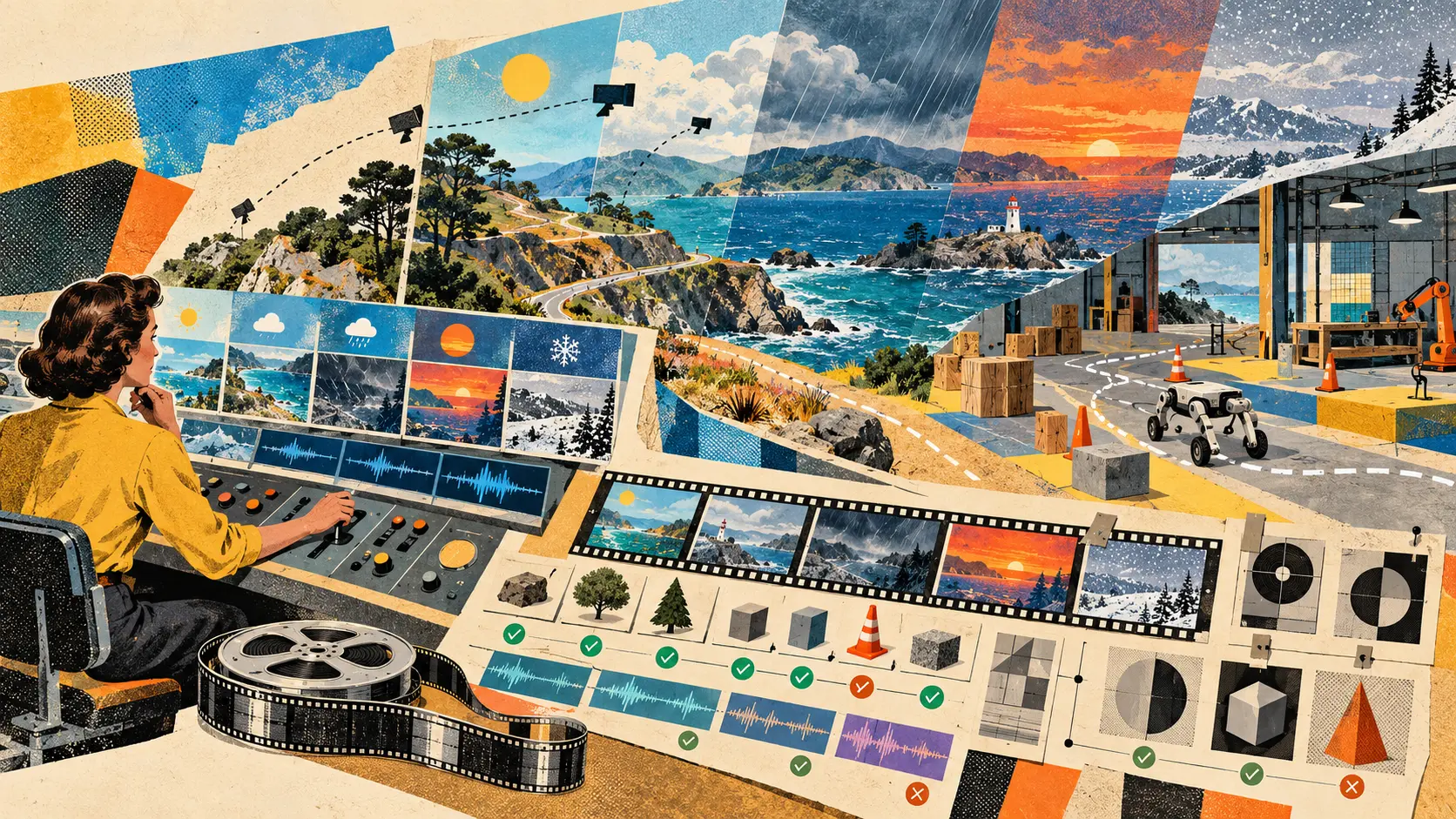
A world model can make a convincing puddle. It cannot tell you whether your delivery robot will hydroplane through one. That distinction matters this morning because Google DeepMind has introduced Genie 4, an experimental system for generating interactive worlds in real time. The demos look less like a video generator waiting for another prompt and more like a place that keeps running while you interfere with it. A person can navigate with ordinary keyboard controls. They can type a change, such as moving the camera, changing the weather or introducing a new object, while the scene continues. The model generates the visual world and its audio together. Ambient sound, music and dialogue can respond as the simulation changes. Google says Genie 4 builds on Gemini models. Gemini Omni helps anchor appearance and behavior. A separate Gemini 3.8 Flash agent watches the scene, turns a goal into steps and checks incoming frames to see whether those steps happened. In another demonstration, Gemini 4 Argon directs a Genie 4 simulation of an Apptronik Apollo humanoid playing checkers. That is a meaningful change. Earlier generative worlds were good at producing a short, impressive path through a scene. Genie 4 is presented as a system that can accept intervention during the path, preserve enough state to continue and add sound and dialogue without stopping the world. The practical applications are easy to see. A filmmaker can test camera positions, lighting and dialogue before building a set. A game designer can walk through a visual concept before writing an engine. A teacher can turn an archival photograph into an explorable scene. An engineering team can generate a rough scenario for a robot or agent and observe how the system responds when conditions change. Google is already working with trusted testers in creative industries, journalism, education, gaming and engineering. Access remains limited. The company says the preview will later reach Google AI Ultra subscribers through Project Genie and early partners through the Gemini API and Google AI Studio. The limited rollout is not a boring footnote. It is the boundary of the evidence. Google has published selected recordings and a description of the system. It has not published a public benchmark that lets outside researchers compare physical accuracy, object persistence, audio synchronization, spatial consistency or prompt obedience across repeated trials. The company also names the cracks plainly. Genie 4 can keep a coherent environment for a short session, but visual details and object permanence may drift as the session runs longer, after several complex edits or while the camera moves through the scene. Complex physical interactions, spatial accuracy, real-time audio accuracy, legible text and long-term consistency remain active research problems. That list is the story. A photorealistic simulation can look like a measurement even when it is improvising. If a generated chair quietly changes shape behind the camera, a film prototype may survive. If a simulated forklift forgets a pallet, a safety test has failed before anyone notices. If a historical photograph becomes an interactive street, every invented face, sound and event risks being mistaken for recovered history. The prettier the world becomes, the more disciplined the receipt must become. Start with the source. Record the initial image, prompt, reference material, model version, interface version, controls and every mid-session edit. A viewer should be able to tell what came from evidence, what came from a human instruction and what the model invented to keep the world moving. Then preserve the run. Store the seed or closest available run identifier, timestamped prompts, camera path, keyboard inputs, generated frames, audio, Gemini planning steps and any safety intervention. A highlight reel is not a test record. The failed takes matter most. Next, define the invariants. If the simulation is meant to represent a warehouse, list the objects that must not move, the dimensions that must stay fixed, the allowed friction range, the expected line of sight and the stop conditions. If it is a historical scene, list the verified architecture, clothing, signage and known absences. If it is a creative draft, mark the details that are intentionally fictional. Check those invariants frame by frame. Object permanence should not mean that a table looks similar most of the time. Give each critical object an identity and track whether its location, shape, material and relationships survive camera movement and prompt edits. Measure when a constraint breaks, how long the error persists and whether the guiding agent notices. Separate visual plausibility from physical validity. A splash can look right while its mass, momentum and timing are wrong. A robot arm can appear to finish a task while its joints pass through an obstacle. A person can walk naturally while the floor plan quietly changes. For engineering use, compare the generated trajectory with a trusted simulator, a physical model or real measurements. Report the difference. Do not let a human rating of realism substitute for collision counts, geometry or force. Test the edits too. Genie 4 is interesting because the user can change the world while it runs. Build a repeatable edit suite: change the weather, insert an object, move the camera, interrupt a dialogue and reverse a previous instruction. Count which earlier facts survive, which new facts appear without instruction and how performance changes after the tenth edit rather than the first. Audio needs its own ledger. Measure whether footsteps match contact, whether dialogue stays attached to the speaker, whether ambient sound follows the environment and whether a generated warning arrives at the correct time. A beautiful soundtrack can hide a late safety cue. For robotics and agents, keep the generated world behind a gate. Synthetic scenarios can expand training coverage and expose a policy to rare situations. They can also teach the policy the generator's mistakes. Tag every generated episode, keep a real-world holdout and test whether gains survive a different simulator and physical hardware. Never promote a policy because it mastered the world that created it. For journalism and education, add a more visible label than a technical watermark. Google says all Genie 4 video and audio will carry SynthID, its imperceptible watermark. That supports provenance detection. It does not explain which objects are documented, reconstructed or fictional. A published experience should carry an ordinary human-readable note, a source list and a clear separation between archival evidence and generated continuity. For creative work, preserve rights and consent. The ability to create responsive people, voices and places raises ordinary questions about likeness, performance, source material and labor. Teams need a record of reference assets, permissions, model terms and human contributions before a draft moves into production. Finally, compare multiple runs. One impressive world tells you what the model can produce once. Repeated runs tell you whether a workflow can depend on it. Use the same prompt and interventions across several sessions, then score constraint survival, drift, latency, audio alignment and the frequency of manual rescue. That is the simulation receipt. World models are valuable precisely because the real world is slow, expensive and sometimes dangerous to test. They let a team explore more possibilities before committing people, machines or money. But the generated world is not a cheaper copy of reality. It is a new instrument with its own errors. Genie 4 makes that instrument more interactive, more sensory and more persuasive. The next job is not to admire how real it looks. The next job is to record where it stopped being true.
01
WHAT ACTUALLY CHANGED
Google DeepMind introduced Genie 4 as a limited research preview for real-time interactive world generation
Users can steer a running simulation with text prompts and ordinary navigation controls
The model generates native ambient sound, music and interactive dialogue with the visual world
Gemini 3.8 Flash can act as an in-loop planner that watches frames and adapts a multi-step plan
Google demonstrated Gemini 4 Argon directing a simulated humanoid task inside Genie 4
All generated video and audio will carry SynthID according to Google
02
WHY THIS MATTERS
Interactive worlds could shorten early creative, game and engineering prototyping
Synthetic scenarios could broaden training environments for robots and agents
Photorealism can make generated behavior look like validated physical evidence
State drift can quietly invalidate a safety, historical or educational scenario
A guiding agent may keep a scene moving without proving that the underlying world is correct
Useful deployment requires provenance, repeatability and comparison with external reality
03
WHERE IT COULD HELP
- Record the source image, prompt, model version and every live intervention
- Preserve the full run, including failed takes and guiding-agent decisions
- Define critical objects, geometry, physics and facts before generation begins
- Track object identity and constraint survival across camera moves and prompt edits
- Compare generated motion with a trusted simulator or physical measurement
- Run repeated sessions with identical prompts to measure variance and drift
- Score audio synchronization and warning timing separately from visual quality
- Keep generated robot training episodes tagged and maintain a real-world holdout
- Label historical reconstructions with documented, inferred and fictional layers
- Audit likeness, voice, reference assets and production rights before release
KEEP A HAND ON THE WHEEL
Google describes Genie 4 as an early, experimental research preview. The published evidence consists of selected company demonstrations and tester descriptions, not an independent benchmark. Google says visual details and object permanence can drift over time, particularly after complex edits or navigation, and identifies complex physics, spatial accuracy, audio accuracy, legible text and long-term consistency as open problems. Access is limited to trusted testers, with wider Project Genie and developer access promised later. Watch for reproducible evaluation sets, run-level provenance, independent physics tests, creator-rights controls, public latency and cost data and evidence that synthetic training transfers to a different simulator and physical hardware.
04
TERMS WORTH KEEPING
SOURCES AND VERIFICATION STATUS
This article was written from the materials below. Product claims and dates were checked against those sources on October 28, 2026.
PUBLICATION RECEIPT: The article treats Google demonstrations and performance descriptions as company reporting, preserves the limited preview status and centers the limitations Google discloses.
THE PUBLICATION ENGINE
WANT A SIGNAL OF YOUR OWN?
We build source-grounded publications, private briefings, and editorial systems for organizations with something useful to say.
WORK WITH US