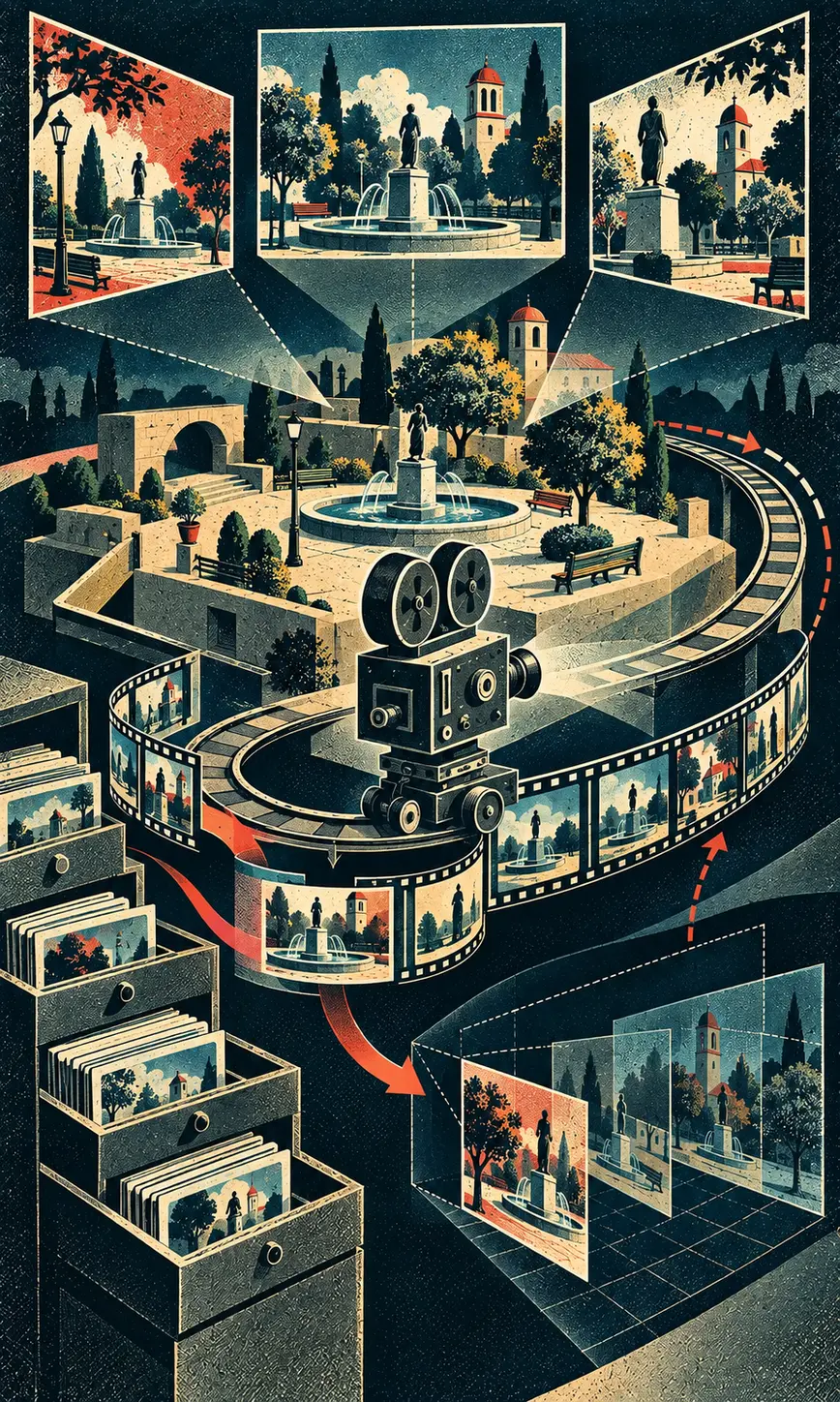
THE SIGNAL IN ONE SENTENCE
Researchers at Westlake University built a system that can take an ordinary video, move a virtual camera around the recorded event, and remember how previously generated views looked when the camera returns. It does this without retraining the underlying video model, but the public code currently covers only part of the full method and needs a very large GPU.
01
WHAT ACTUALLY CHANGED
On September 10, Chenxi Song, Yanming Yang, and Chi Zhang of Westlake University's AGI Lab posted World in World, a method for exploring the moving scene inside a source video from new camera positions. The awkward part is not producing one handsome alternate angle. It is keeping the people, objects, motion, layout, and event timing consistent as the camera travels somewhere the original lens never visited and later returns.
The team does not retrain its underlying 14-billion-parameter LingBot-World 2.0 model. Instead, World in World converts different kinds of control into visual evidence the frozen model already knows how to read through self-attention. Source frames preserve appearance and event timing. Depth-based projections place known pixels in the requested view. Rendered geometry offers a rough proposal for newly exposed surfaces. Earlier generated states provide a record of what the model previously decided the unseen world should look like.
That last record solves the headline problem. A causal video model usually keeps only a rolling cache of recent states. Look away for long enough and the first view falls out of memory. World in World archives finalized visual features after they leave the cache, ranks the stored states by how well they cover the returning viewpoint, and retrieves a small relevant set. The model can then consult its older invention instead of inventing a second, incompatible fountain, face, or doorway on the return trip.
The interface also tries to control where each piece of evidence applies and how loudly it should speak. Correspondence-guided attention routing uses tracked points and camera geometry to connect a new image region with the matching place in the source video. Evidence-wise attention guidance adjusts the contribution of projections, geometry, and history separately. In plain terms, a reliable observed patch can lead, a rough geometric guess can stay quiet, and the base model can fill the gaps.
The authors tested camera-controlled rerendering on videos from DAVIS and OpenVid-1M against six published methods. Their table reports the best average across seven VBench dimensions, the lowest camera rotation and translation errors, and the strongest or tied image-similarity results among those comparisons. An ablation test found that removing the target-view warp caused the largest performance drop. These are author-run experiments in a new preprint, not independent validation or evidence that every scene survives a dramatic camera move.
02
WHY THIS MATTERS
Video generators are excellent at producing a convincing next frame and surprisingly willing to renovate the room while nobody is looking. A world that changes its furniture, body shape, or architecture whenever the camera turns is not very useful for filmmaking, games, robotics, or simulation. Persistent visual evidence gives the generator something closer to continuity notes instead of asking it to improvise the set again.
The training-free design is the clever bit. Control features often require a new adapter, a specialized model, or another expensive training run. World in World treats control as an evidence-formatting problem. If camera information, depth, geometry, and history can all be translated into states the existing model already reads, one frozen backbone can support several tasks without rebuilding its weights for each one.
This suggests a practical division of labor. Geometry handles where observed things should land. The source video anchors what actually happened. The model's learned prior imagines surfaces the camera never saw. Memory asks it to remain loyal to those earlier inventions. None of the pieces is sufficient alone, but together they can make a generated world feel less like a stack of unrelated clips.
For creators, this could turn one recorded take into a small virtual production space. A director could try an arc, a pan, a stabilized view, or a frozen-moment camera move after the shoot. Editors could alter an object in the first frame and carry the change through the clip. Game teams could explore whether a video model can provide consistent visual prototypes before anyone builds the final environment.
For embodied agents, consistency is more than an aesthetic preference. A robot or simulated agent needs an environment where turning around does not erase the evidence behind it. World in World is not a verified physical simulator, and it can invent unobserved regions. Still, its separation of observation, geometry, generated history, and retrieval is a useful blueprint for making visual imagination answer to memory.
03
WHERE IT COULD HELP
- Reframe a recorded performance along a new virtual camera path
- Create bullet-time shots by freezing an event while the camera continues moving
- Stabilize or revise camera motion after footage has already been captured
- Carry a first-frame visual edit through a short video while preserving the scene
- Prototype persistent visual environments for games, virtual production, and embodied-agent research
KEEP A HAND ON THE WHEEL
World in World is a September 10 arXiv preprint and has not been peer reviewed. Its benchmarks, comparisons, and demonstrations come from the authors. The public repository is a partial release: it includes the warping-based camera, bullet-time, and editing pipeline, while the 3D body proxy, long-video frustum memory, cross-model memory sharing, streaming, and motion transfer remain on the roadmap. The current code says moderate camera moves work best and warns that far turns expose regions the model must invent from text. It requires roughly 86 GB of model weights and was tested on an 80 GB A100 with about 72 GB peak memory. The repository uses a noncommercial CC BY-NC-SA 4.0 license, and the published metrics do not establish physical accuracy, causal understanding, production reliability, or safe robotics use.
04
TERMS WORTH KEEPING
SOURCES AND VERIFICATION STATUS
This article was written from the materials below. Product claims and dates were checked against those sources on September 11, 2026.
PUBLICATION RECEIPT: Revision 1. Published September 11, 2026.
THE PUBLICATION ENGINE
WANT A SIGNAL OF YOUR OWN?
We build source-grounded publications, private briefings, and editorial systems for organizations with something useful to say.
WORK WITH US