THE SIGNAL IN ONE SENTENCE
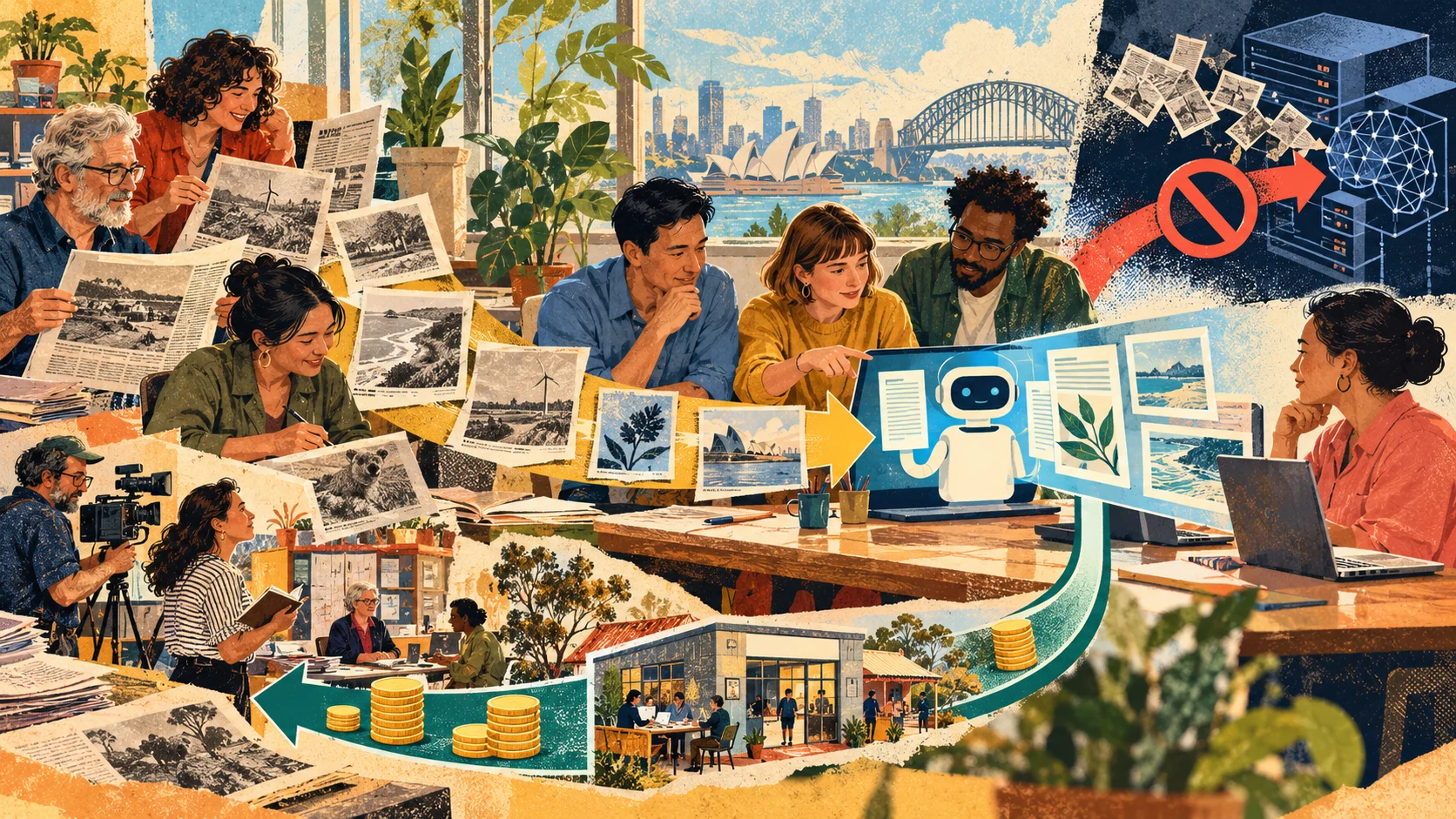
A lot of workplace AI policy begins one step too late. It asks whether the answer is accurate, whether the employee checked it and whether confidential information escaped. Those are important questions. There is another one sitting quietly at the front of the queue. Did the employee have permission to paste the source material into the prompt in the first place? Commonwealth Bank of Australia has now purchased a practical answer for part of that problem. The bank signed a Copyright Agency Business Licence that permits its people to include eligible Australian newspaper text and other covered content in prompts for workplace generative AI tools. The agreement was announced October 2 by both CommBank and Copyright Agency. CommBank says it is the first major Australian bank to sign this version of the licence. The plain signal is not that every copyright argument around AI has been solved. It is that a very ordinary office action has become licensable. An employee can take eligible content and ask an approved workplace tool to summarize it or help turn it into a presentation or another document. Licence fees are intended to flow back to creators and publishers, including local news media. The boundary is just as important as the permission. The agreement does not allow the licensed material to train, create or improve an AI model. This is a workplace-use licence, not a model-development licence and not a universal pass for anything involving news. That distinction tends to disappear when AI is discussed as one large machine. Training changes a model by using material to develop or adjust its capabilities. Prompt use supplies material during a particular interaction. Retrieval can fetch material for a response without permanently teaching it to the underlying model. Fine-tuning changes a model for a narrower purpose. These activities may look similar to the person uploading a file, but they carry different permissions, records and risks. The CommBank deal draws a bright contractual line around one of them. It extends Copyright Agency's existing Annual Business Licence. That licence already covers everyday workplace copying and sharing of material such as news articles, research papers and extracts from books. The new permission recognizes that copying no longer happens only through email, photocopiers and shared drives. It also happens inside a prompt box. That sounds almost comically mundane. Good governance often does. The employee who asks an AI assistant to compare two articles is not running a frontier-model laboratory. The marketing team that turns licensed reporting into a briefing is not training a new foundation model. Yet each workflow still reproduces and processes somebody else's work. Collective licensing exists because negotiating separately with every writer and publisher would make routine use nearly impossible. A licensing body gathers permissions, sells a common licence and distributes money to participating rights holders under its rules. For a large employer, the attraction is administrative clarity. Instead of telling thousands of workers to make a fresh legal judgment every time they paste an article, the organization can define a covered set of material and a permitted set of actions. The worker still needs to follow the rules, but the rule can be operational rather than philosophical. This is allowed content in an approved tool for an approved purpose. That is much more useful than a poster saying respect copyright. Copyright Agency says the workplace habit is already widespread. Research performed by Fiftyfive5 for the agency in 2025 found that 64 percent of surveyed white-collar employees had used generative AI for work. Among those users, 47 percent said they included third-party material such as published text and images in prompts at least weekly. Those figures are survey results commissioned by the organization selling the licence. They describe reported behavior, not an independent audit of every Australian workplace. Still, the underlying behavior is easy to recognize. People paste things into tools. They paste reports, customer messages, meeting notes, journal articles, news stories, contracts, images and spreadsheets. Sometimes the tool is approved. Sometimes it is the fastest browser tab available. Sometimes the employee assumes that because the text can be read online, it can also be copied into any system. The prompt has become a new copying surface. CommBank's agreement makes that surface visible enough to govern. The bank's December 2025 AI report describes a broader system of risk ownership, model approval, testing, monitoring, human accountability and decommissioning. It also says employees should remain in control of decisions when using AI in their work. But the report explicitly says it does not address employee use of AI or employee-created internal assistants. The new licence enters that practical gap from the copyright side. It does not fill the whole gap. A copyright licence answers whether covered content may be used in a covered way. It does not prove the AI tool is secure. It does not say whether the vendor retains prompts, uses them to improve a service, sends them through subcontractors or stores them outside Australia. It does not verify the model's summary. It does not protect customer information accidentally pasted beside the article. It does not make a generated presentation fair, accurate or useful. Permission is one control, not the control room. CommBank therefore needs an implementation layer around the licence. The first task is a content map. Employees need to know which Australian newspaper text and other material is eligible, which works are excluded and how to check an uncertain source. A licence that exists only as a PDF in the legal department will not change behavior at the prompt box. The prompt interface itself can help. An approved workplace tool could ask the employee to identify the material type and source before upload. It could display the permitted uses, warn when a source appears outside the licensed set, preserve a citation and record which licence applied. It could block files carrying customer data or confidential classifications even when the article inside is licensed. The record should follow the output. If a summary becomes a board paper, customer briefing or public presentation, reviewers should be able to see which sources were supplied, when they were accessed, what the employee asked, which model handled them and who checked the result. This is not surveillance for the thrill of collecting logs. It is provenance. Without provenance, a polished paragraph can move through an organization until nobody remembers whether it came from a reporter, a model, an analyst or all three wearing one trench coat. The licence also creates a useful separation between approved prompt use and prohibited model development. That boundary needs technical enforcement. An employer cannot rely only on an employee remembering that the licensed article may be summarized but not added to a fine-tuning dataset. Approved tools should disable provider training where the contract permits, isolate licensed source collections from development datasets and require a separate review before content is used for retrieval systems, evaluation sets or model customization. The words training and improvement deserve precision. Some vendors promise not to train a base model on customer data while still retaining prompts for abuse monitoring, quality analysis or service improvement. Some enterprise contracts offer stronger controls than consumer accounts. Some internal systems copy prompt material into logs, analytics stores or evaluation pipelines. The organization has to inspect the full path, not stop at the vendor's largest privacy sentence. Australian policy gives this deal additional weight. The Attorney-General's Department says the government is not considering a text and data mining exception. Its Copyright and Artificial Intelligence Reference Group is examining fair and legal avenues for using protected material, including licensing arrangements, while also considering uncertainty around AI outputs and lower-cost enforcement. Australia's current Copyright Act contains specific fair-dealing exceptions for purposes such as research or study, criticism or review, reporting news, professional advice, parody and satire. It is not a general workplace exemption for copying whatever makes a prompt better. The CommBank agreement does not rewrite that law. It gives the bank a negotiated permission for defined business uses. That is why the deal may matter beyond banking. Hospitals, law firms, consultancies, insurers, universities, engineering companies and government contractors all move published material through knowledge work. Their employees want AI tools to compare evidence, produce briefings and create first drafts. Rights holders want payment and control. Security teams want fewer mystery uploads. Legal teams want a rule that can survive contact with a deadline. A collective licence can make one slice of that problem repeatable. It can also fail quietly if the economics and coverage remain opaque. Neither announcement publishes the price CommBank paid, the number of employees expected to use the permission, the participating publications, the calculation used to distribute fees or the amount an individual journalist might receive. The public material does not explain how usage is measured or audited. Copyright Agency says fees will flow to creators and publishers. Readers should treat that as the purpose of the arrangement, not evidence that the payment has already reached every contributor whose work may be used. The difference matters most for freelancers, photographers, small publishers and local newsrooms. A licensing system is only as credible as its repertoire, reporting and distribution. Creators should be able to understand what they authorized, which uses produced revenue, how money was divided, what administration cost was deducted and how to challenge a missing payment. Businesses need comparable transparency. They should know what content is covered, what actions are permitted, whether citations must be retained, how excluded works are handled, which AI environments qualify and what happens when a publisher changes participation. The public announcements leave those operational details open. There is another caution. Paying for prompt permission does not buy truth. An AI tool can misread a licensed article, flatten uncertainty, join two facts that never belonged together or invent a quotation. News content itself can be corrected after publication. A summary may lose the distinction between reporting, analysis and opinion. The employee remains responsible for checking the source and the output. CommBank's own responsible-AI framework says human oversight is necessary and accountable employees should be identified across an AI system's lifecycle. That principle should apply with extra force when licensed journalism is used to inform a financial decision, customer communication or risk assessment. The most practical workflow is simple enough to teach: Identify the source. Check that it is covered. Use only an approved tool. Keep customer and confidential data out. State the purpose. Preserve the citation. Review the output against the original. Record who approved the final use. If the task moves from summarization into a retrieval database, evaluation set, fine-tuning job or model-development pipeline, stop and obtain a different permission. That last sentence is the whole deal in miniature. Workplace AI does not need one giant policy that says yes or no to everything. It needs small, visible gates that match the activity. CommBank and Copyright Agency have created one gate for eligible Australian journalism in prompts. It is narrow. It is incomplete. It may even be boring. It is also the kind of boring machinery that turns responsible AI from a slogan into something an employee can actually do before lunch.
01
WHAT ACTUALLY CHANGED
Commonwealth Bank signed a Copyright Agency Business Licence covering eligible Australian newspaper text and other included material in workplace generative AI prompts.
CommBank says it is the first major Australian bank to adopt this version of the collective licence.
Employees may use covered material for tasks such as summarization or help creating a presentation or other document.
Licence fees are intended to flow to creators and publishers, including local news media.
The permission extends an existing business licence for ordinary workplace copying and sharing into prompt-based use.
The agreement explicitly excludes using the licensed material to train, create or improve an AI model.
02
WHY THIS MATTERS
Pasting an article into a prompt is a form of workplace content use that many organizations have not translated into a clear operational rule.
Collective licensing can replace thousands of case-by-case permission questions with a defined content set and permitted workflow.
The deal distinguishes prompt use from model training, retrieval, evaluation and fine-tuning, which require separate governance decisions.
Creators gain a payment channel, but the public announcements do not disclose the price, distribution formula or individual payouts.
A licence addresses copyright permission only. Privacy, confidentiality, security, accuracy, retention and human accountability remain separate controls.
Other knowledge-heavy employers can use the agreement as a practical pattern for mapping rights to specific AI activities.
03
WHERE IT COULD HELP
- Publish a searchable list of covered and excluded content for employees at the moment they create a prompt.
- Limit licensed material to approved enterprise AI tools with documented retention and provider-training controls.
- Require the employee to record the source, purpose, tool, model version and final reviewer.
- Preserve citations and links so every generated summary can be checked against the original publication.
- Block customer, confidential and sensitive data even when the accompanying article is licensed.
- Keep prompt-use collections separate from retrieval indexes, evaluation sets, fine-tuning data and model-development pipelines.
- Create a rights review when a task changes from one-off analysis to repeatable AI infrastructure.
- Audit the path from licence payment to participating publishers, journalists, photographers and other creators.
- Test generated briefings for missing caveats, invented facts, outdated reporting and confusion between news and opinion.
- Give employees a short escalation route when a source or intended use falls outside the known licence.
KEEP A HAND ON THE WHEEL
The two October 2 announcements establish the permission and its training exclusion, but they do not publish the licence price, participating-content list, expected number of users, technical enforcement controls, usage-measurement method, audit process, creator-payment formula or individual payouts. The workplace survey figures were commissioned by Copyright Agency, which sells the licence. The agreement does not establish that every Australian publication or every kind of media is covered. It does not authorize model training, creation or improvement. It also does not resolve privacy, customer confidentiality, cybersecurity, factual accuracy, citation, vendor retention or human-review duties. CommBank's December 2025 AI report describes organizational governance but expressly says it does not address employee AI use or employee-created internal assistants. Watch for operational guidance to staff, a clearer repertoire, independent reporting on adoption, evidence of distributions to creators, controls that keep prompt material out of training and evaluation pipelines, and whether other Australian employers adopt comparable licences.
04
TERMS WORTH KEEPING
OPEN GLOSSARY CARD
Retrieval-augmented generation
A method that retrieves material from a selected source collection and supplies it to a generative model as context for an answer.
OPEN GLOSSARY CARD
Provenance
A traceable record of where an object or dataset came from, who held or changed it and how it reached its current form.
OPEN GLOSSARY CARD
Fine-tuning
Extra training that shapes a model for a narrower job or behavior.
SOURCES AND VERIFICATION STATUS
This article was written from the materials below. Product claims and dates were checked against those sources on October 4, 2026.
THE PUBLICATION ENGINE
WANT A SIGNAL OF YOUR OWN?
We build source-grounded publications, private briefings, and editorial systems for organizations with something useful to say.
WORK WITH US