THE SIGNAL IN ONE SENTENCE
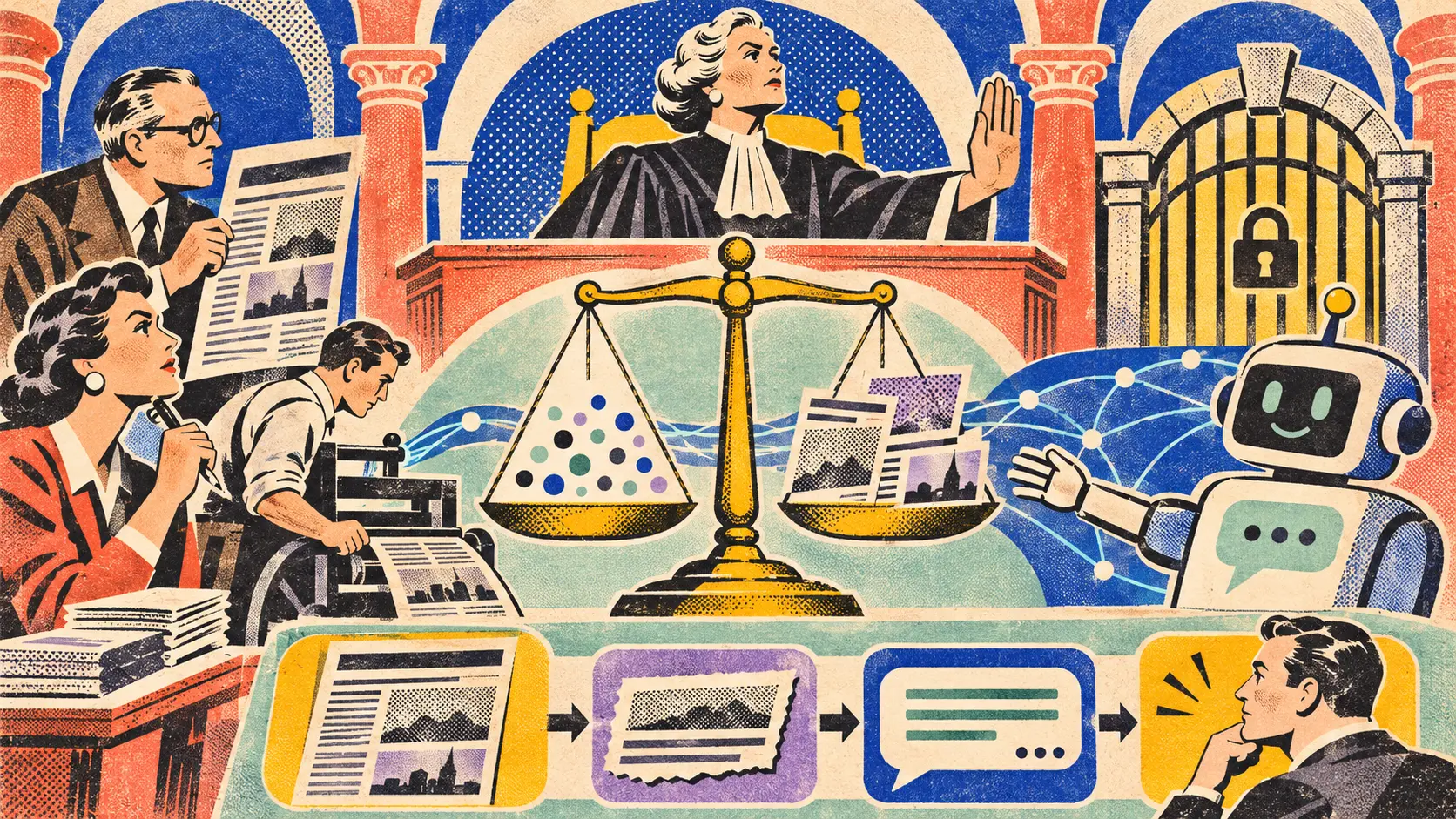
A chatbot answering a news question can look like a clean little window. Behind the glass, the plumbing is less elegant. The system may search the web, open a publisher's page, pull passages into a temporary context, combine them with other material and write an answer that feels complete. The reader gets the information without seeing the reporting, page, subscription request or corrections that made the answer possible. On November 3, Advocate General Maciej Szpunar at the Court of Justice of the European Union issued an opinion about that exact machinery. The case began in Hungary. Like Company, which operates Hungarian web portals, brought proceedings against Google before the Budapest Regional Court. The publisher argued that Google used its articles in connection with Gemini and reproduced or made them available through chatbot answers. The Hungarian court paused the dispute and sent four questions about EU law to the Court of Justice. This is the first generative AI case to reach the Court of Justice, according to the Court's own press release. It is not yet a judgment. An Advocate General independently proposes a legal solution. The judges are now beginning their deliberations and may follow, narrow or reject the opinion. The Court will give judgment later. That distinction should sit at the top of every summary because legal commentary has a terrible habit of turning advice into law before lunch. The opinion separates two problems that are often mashed together. The first is training. Two of the Hungarian court's questions asked whether using press publications to train a language model falls within a publisher's reproduction right or the EU text and data mining exception. Szpunar advised the Court to treat those questions as inadmissible in this case because there was no evidence that Like Company's articles were used to train Gemini, and because model training was not the kind of online use at issue in the publisher's claim. For completeness, he also suggested that using protected works to train a language model is, as a rule, permitted under the text and data mining exception. That is a significant view. It is also not a final ruling, not a universal permission slip and not a factual finding that these articles trained this model. The second problem is live retrieval. Gemini and other grounded chatbots can collect current information from the web while answering a question. The Court's materials call this retrieval-augmented generation, or grounding. A model may not have memorized today's story. It can fetch the story now. Szpunar advised the Court to focus on the answers produced through that process. In his view, a publisher's right may be infringed when a chatbot retrieves a press publication, reuses it to generate an answer and provides that answer to a user under certain circumstances. The boundary is not simply whether the answer contains news. Facts are not the protected thing. The opinion says the press publisher's right protects the publication's specific form of expression and the investment behind it. It does not give a publisher a monopoly over the event itself. If a council approves a bridge, the fact of the approval remains a fact. The reporter's structure, phrasing, selection, sequencing and original presentation are different. The opinion points to two practical questions. First, did the chatbot access the publication unlawfully, especially by circumventing effective technical measures such as a paywall or an anti-scraping barrier? Second, did the answer merely report facts, or did it reuse the publication's recognizable expression so thoroughly that the user no longer needed to visit the original? That second test lands directly on product design. A chatbot can cite a source and still replace it. A tiny footnote beneath a complete substitute does not restore the publisher's reader, context or commercial opportunity. A link is useful only if the answer leaves a reason to open it. The opinion also says systematic recognizable reuse may infringe the publisher's right of making material available to the public. It places potential responsibility on the chatbot provider when that use is inherent to the provider's business model or when the provider failed to put credible and effective countermeasures in place. That is why a simple blocklist is not enough. AI products need a source receipt for every live news answer. Start with access. Record the exact URL, retrieval time, response status, redirect path, robots instruction, publisher preference, paywall state and any authentication used. The system should never pretend that a successful HTTP response means lawful access. A logged-in user's subscription may permit the user to read an article without permitting a separate service to reproduce it for everyone. Technical boundaries should fail closed. If a page is protected, the retriever should not try an alternate mirror, stripped mobile view, cached copy or third-party snippet to reconstruct the same article. If the system cannot establish the permitted access path, it can tell the user that the source exists and send them to it. Then preserve the evidence. Store the passages actually retrieved, their position in the source, the source version or content hash, the retrieval tool version and the model prompt that received them. This does not require keeping an entire publisher's archive forever. It requires enough of a record to explain why a specific answer said what it said. Next, separate facts from expression. That sounds obvious until a model starts writing. A good pipeline should extract discrete claims with dates, places, people and uncertainty before composing prose. It should compare the generated answer with the retrieved passage for long matching sequences, distinctive phrasing and unusual structure. The goal is not to sand every sentence into bureaucratic oatmeal. The goal is to avoid laundering someone else's writing through a model. Compression matters too. An answer can use entirely new wording and still function as a complete market substitute. Product teams should test whether a reasonable reader would still need the source for context, evidence, methodology, local detail or the publisher's own reporting. For an original investigation, the answer may need to be much shorter than for a routine public notice. Attribution should be close to the claim. Do not dump five links at the bottom and make the reader guess which one supports the number in paragraph three. Attach the source to the sentence or cluster of claims it supports. Name the publisher. Show the publication date and whether the source is reporting, analysis, a press release or a public record. Traffic should become an evaluation metric. Most AI answer tests measure correctness, helpfulness and latency. News retrieval needs another question: did the answer preserve a meaningful path to the original? Teams can test source-link visibility, click-through, citation accuracy, answer length relative to source contribution and whether the generated response exposes the reporting's important limitations. Publishers need controls that are more precise than disappear or surrender. A publisher may allow indexing, snippets or factual extraction while refusing long-form answer generation. It may permit retrieval for subscribers, license some sections or require a particular attribution. The web's existing signals were not designed for every one of these distinctions. Providers should support machine-readable preferences, licensing records and rapid corrections while the legal rules develop. Corrections are part of the receipt. If a publisher changes a headline, fixes a number or adds context, a grounded answer should not keep serving the stale version. The system should record source freshness, revisit time-sensitive claims and connect answer corrections to the source change that triggered them. The same design helps readers outside Europe. The eventual judgment will interpret EU law, but the underlying product problem is global. Newsrooms everywhere pay people to gather facts, verify them, make calls, travel, inspect records and correct mistakes. A retrieval system can use that work while hiding the chain that made it credible. The answer is not to make facts proprietary. It is to keep access lawful, expression distinct, attribution useful and the original reporting reachable. The Advocate General has proposed a line between learning the news and replacing the publication. The judges have not drawn the final line yet. Product teams do not need to wait for the judgment to stop flying blind. Keep the source attached. Keep the access record. Keep enough room in the answer for the reader to visit the people who did the reporting.
01
WHAT ACTUALLY CHANGED
Advocate General Maciej Szpunar delivered an opinion on November 3, 2026 in Case C-250/25, Like Company.
The Court describes the case as the first generative AI case to reach the Court of Justice of the European Union.
The Hungarian proceeding concerns claims by Like Company, a publisher operating web portals, against Google over Gemini-related use of press publications.
The Advocate General advised the Court to treat the two model-training questions as inadmissible because the case record did not show that the publisher's articles trained Gemini.
For completeness, the opinion suggests that model training is generally permitted by the EU text and data mining exception.
The opinion says live retrieval and reuse may infringe a publisher's rights when access is unlawful or the answer recognizably reuses the publication's expression so completely that the source is no longer needed.
The opinion distinguishes unprotected facts from the protected form of expression of a press publication.
The opinion is not binding. The Court's judges are deliberating and will issue a judgment later.
02
WHY THIS MATTERS
The opinion addresses the web retrieval step used by grounded chatbots, which is different from the older dispute over training data.
A final judgment could shape how AI providers access publisher websites, quote articles, summarize news and present source links across the European Union.
The proposed test focuses on both the lawfulness of access and whether the generated answer acts as a substitute for the original publication.
The distinction between facts and recognizable expression gives product teams a concrete reason to extract claims before composing new prose.
Publishers may need more precise machine-readable controls for snippets, subscriber access, factual extraction, answer generation and licensing.
Readers benefit when citations identify which source supports each claim and preserve corrections, context and the route back to original reporting.
The nonbinding status means businesses should prepare and preserve evidence without claiming that the legal question is settled.
03
WHERE IT COULD HELP
- Log the exact source URL, retrieval time, response status, paywall state, authentication path and publisher preference for each grounded answer.
- Fail closed when a retriever encounters a paywall, anti-scraping measure or unclear permission instead of reconstructing the article through mirrors or snippets.
- Preserve the passages actually used, source version, retrieval-tool version and prompt that received the material.
- Extract discrete factual claims before drafting and compare generated prose against source phrasing and structure.
- Attach citations to the claims they support and identify the publisher, publication date and source type.
- Test whether the answer leaves a meaningful reason to visit the original for evidence, context, methodology and reporting detail.
- Measure citation accuracy, source-link visibility, click-through, correction latency and answer length relative to each source contribution.
- Support granular publisher preferences for indexing, snippets, factual extraction, subscriber retrieval and answer generation.
- Recheck time-sensitive answers when a publisher corrects or materially updates a source.
- Keep a review path for publishers and readers to challenge access, attribution or recognizable reuse.
KEEP A HAND ON THE WHEEL
This is an Advocate General's independent legal opinion, not a binding judgment of the Court of Justice and not a decision in the Hungarian dispute. The Court may adopt, narrow or reject the proposed analysis. The press release summarizes the opinion and states that the case record did not establish that Like Company's articles trained Gemini. It should not be reported as a finding that Google infringed the publisher's rights. Watch for the final judgment, the exact treatment of technical access controls, the boundary between facts and recognizable expression, the meaning of a substitute answer, provider countermeasures and how the Hungarian court applies the eventual ruling.
04
TERMS WORTH KEEPING
SOURCES AND VERIFICATION STATUS
This article was written from the materials below. Product claims and dates were checked against those sources on November 3, 2026.
THE PUBLICATION ENGINE
WANT A SIGNAL OF YOUR OWN?
We build source-grounded publications, private briefings, and editorial systems for organizations with something useful to say.
WORK WITH US