THE SIGNAL IN ONE SENTENCE
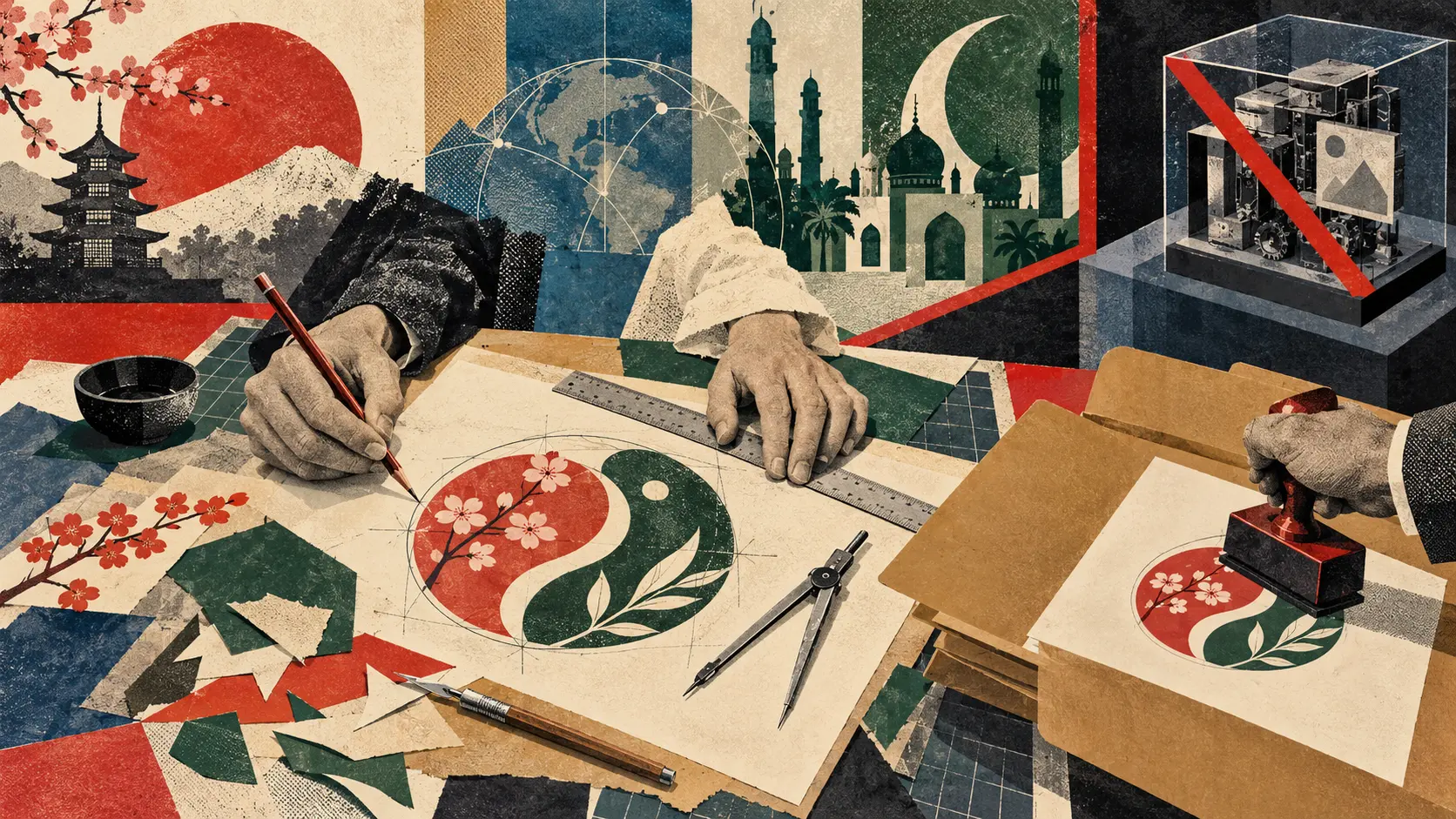
Japan's Ministry of Foreign Affairs is asking people in Japan and Pakistan to design a logo for the 75th anniversary of diplomatic relations between the two countries. The logo must be original. It must work in color and black and white. It must be supplied at high resolution with an explanation of roughly 80 words. It must not use generative AI. The ministry says generated work is prohibited because it may lead to copyright infringement issues. The winning designer will receive public credit if they consent to being named, but no prize, award, prize money or other compensation. The contest terms say rights connected to submitted designs and copyright in the winning logo will belong to the ministry, and entrants agree to relinquish their rights and interests. That is a curious bargain. The government is concerned that an AI system may have borrowed from creators without permission. Its solution asks human creators to contribute labor for free and surrender control over the selected work. The plain signal is that an AI rule can protect human authorship while still undervaluing the human author. This is one public competition, not a Japanese national ban on generative AI. It is not a court ruling that every AI-assisted image infringes copyright. It does not establish a general policy for government design procurement. It is still useful because small rules reveal how institutions are trying to draw a line through ordinary creative work. The competition was published October 2 for the 2027 anniversary. Citizens of Japan or Pakistan may enter regardless of age or current residence. The ministry says entries are due October 23 by email, with results expected around late December. Officials and other concerned parties will evaluate the designs and choose an official logo for anniversary events. The official page gives detailed file specifications and content restrictions. Entries may be JPEG, PDF or EPS files up to three megabytes, at 300 DPI or higher. Designers must submit color and black-and-white versions. Offensive, unlawful, politically or religiously promotional, culturally insensitive, commercially oriented or diplomatically unsuitable work can be disqualified. Then comes the AI sentence: using generative AI in a submitted logo is not permitted because generated work may lead to copyright infringement issues. The concern is understandable. An image generator can produce a polished mark without showing which training examples influenced it. A logo may accidentally resemble an existing trademark, stock illustration or another designer's work. A diplomatic emblem will be copied across websites, events, publications and official materials, so one hidden rights problem can travel widely. The ministry also needs a logo whose ownership it can defend. If a winner cannot explain the source files, fonts, shapes or references, the government may inherit a dispute. A ban is an easy procurement control: do not accept a tool whose provenance the organizer does not know how to verify. Easy is not the same as complete. The rule does not define generative AI. It does not say whether a prohibited use includes generating the entire logo, generating one texture, extending a background, producing early sketches, recoloring a handmade design or asking a language model for wording in the explanation. It does not distinguish generation from other computational assistance. A designer may use vector software that predicts curves, a photo editor with content-aware tools, a font service with automated suggestions or a drawing application that smooths lines. Some ordinary software features now contain machine-learning components. A rule written around the name of a technology can become fuzzy at the exact boundary where a person needs to comply. The ministry does not publish an authorship declaration, source-file requirement, review method, detection standard or appeal process. That matters because there is no reliable tool that can look at any finished image and prove how it was made. An AI detector can estimate whether an image has statistical patterns associated with generated work. It can be wrong. Compression, editing, scanning, illustration style and export settings can change those patterns. A human-made design can be flagged. A generated design can be heavily edited until a detector misses it. If enforcement rests on suspicion, the people most likely to be questioned may be designers whose work looks unusually polished, unfamiliar or stylistically synthetic. That is not an authorship test. It is an aesthetic hunch. A stronger process would ask entrants to keep evidence of how the work developed. That could include dated sketches, editable vector files, a short list of source materials and a declaration describing which tools were used. Organizers could request those materials from finalists instead of forcing every participant through a heavy audit. The point would not be to prove that a designer touched every pixel by hand. It would be to establish provenance: a traceable account of where the work came from, what materials contributed to it and who made the important creative decisions. The rights terms deserve the same precision. The page says all rights relating to submitted designs and the copyright to the winning logo will belong to the ministry. It also says people who submit agree to relinquish all rights and interests regarding their designs. That wording creates an ambiguity. One sentence specifically identifies copyright in the winning design. Another appears to reach rights connected to all submissions. The page does not explain whether non-winning entrants retain copyright, whether the ministry merely keeps their files or whether a broader assignment is intended. The Plain Signal is not making a legal judgment about how those terms would operate under Japanese or Pakistani law. The practical point is simpler: a public competition should state exactly what rights move, from whom, when and for what uses. Copyright assignment is different from permission to use a work. An assignment transfers ownership. A license allows defined uses while the creator keeps ownership. For an anniversary logo, the ministry reasonably needs broad permission to reproduce, resize, translate, distribute and authorize use in both countries. That need does not automatically require ownership of every entrant's idea. A narrower bargain could give the organizer an exclusive, worldwide, royalty-free license to the winning logo for anniversary and diplomatic uses. The designer could retain authorship rights and portfolio use. Non-winning entries could remain entirely with their creators and be deleted after the selection period. The current terms also allow the selected design to be edited, altered or processed as necessary. If agreement cannot be reached on revisions, the selected design may be withdrawn. That is sensible operationally, but it leaves the unpaid winner negotiating changes after the contest has already chosen their work. Payment would make that relationship less strange. The ministry says there is no prize, award, prize money or other compensation. The winner may receive name and affiliation credit, with consent. Exposure is not compensation. For an established designer, the contest may not justify the labor. For a student or early-career creator, official recognition may feel valuable enough to enter. That difference can make unpaid contests draw most heavily from people with less bargaining power, more available time or a stronger need for recognition. Opening the competition to all ages adds another question. The rules do not explain how consent or rights transfer works for a minor, whether a parent or guardian must approve an entry or how personal information from children will be handled beyond the general privacy statement. A contest can welcome young creators, but the legal and ethical process should be designed for them rather than assuming every entrant can sign the same bargain. The bilateral context matters too. Japan and Pakistan have different languages, artistic traditions, professional markets and legal systems. A logo meant to represent their relationship should be judged with cultural knowledge from both countries. The ministry says concerned parties will evaluate the work, but it does not identify the jury, criteria or weighting. Good judging would make those choices visible. Publish the selection panel or at least its institutional composition. Explain how originality, legibility, cultural sensitivity, reproducibility and bilateral meaning will be assessed. Screen obvious trademark conflicts before choosing the winner. Let finalists correct a misunderstanding about authorship or tool use before disqualification. The public page says acknowledgments and rejection notices will not be sent, inquiries about the selection process will not be addressed and the winning design may be withdrawn if submitted information is false. That gives the organizer broad discretion with very little procedural visibility. For a small ceremonial contest, nobody needs a courtroom. They do need a clear path for a good-faith entrant to understand what happened if the organizer questions whether the work is human-made. This is where AI policy often becomes ordinary administration. The dramatic debate asks whether machines can be creative. The actual designer needs to know whether an auto-fill tool is allowed, whether sketches must be saved, whether a detector will be used, who owns a rejected design and whether ten hours of work will be paid. Those details decide whether a rule feels protective or arbitrary. Japan's ministry has identified a real risk: an official logo should not arrive with unclear origins and someone else's rights hidden inside it. Banning generative AI is a defensible narrow choice for this competition. But human authorship deserves more than a prohibition aimed at machines. It deserves a precise tool policy, a credible evidence process, rights terms an ordinary entrant can understand, protection for non-winning work, rules for minors, transparent judging and compensation when a government takes ownership of professional creative work. If the point is to celebrate a relationship between two countries, the contest should model a decent relationship with the person who makes its symbol.
01
WHAT ACTUALLY CHANGED
Japan's Ministry of Foreign Affairs opened a public competition on October 2 for the official logo of the 2027 Japan-Pakistan diplomatic anniversary.
Citizens of Japan and Pakistan may enter regardless of age or current residence, with submissions due October 23.
The rules prohibit generative AI in submitted logo designs because the ministry says it may create copyright infringement issues.
Entrants must provide color and black-and-white versions, a high-resolution digital file and an explanation of roughly 80 words.
The ministry says the winning designer will receive no prize, award, prize money or other compensation.
The rules assign copyright in the winning logo to the ministry and contain broader language requiring submitters to relinquish rights and interests regarding designs.
The ministry may alter the selected design, withdraw it if revisions cannot be agreed or stop using it if submitted information is false.
The public rules do not define generative AI or publish a detection, evidence, appeals or finalist-review process.
02
WHY THIS MATTERS
A diplomatic logo will be reproduced widely, so uncertain copyright or trademark provenance can become an institutional risk.
A tool ban is difficult to enforce fairly when ordinary design software mixes generated, predictive and automated features.
Image detectors provide estimates rather than proof and can create false accusations against human creators.
Process evidence such as sketches and editable files is more useful than judging authorship from appearance alone.
Transferring ownership is not the only way to secure broad official use; a carefully written license can preserve creator rights.
Unpaid public contests tend to shift design cost onto entrants, including students and early-career creators with less bargaining power.
Broad rights language can leave non-winning designers unsure whether they still control work that the government never selects.
Opening a contest to all ages requires explicit consent and rights procedures for minors.
Transparent judging is especially important when one emblem is expected to carry cultural meaning across two countries.
03
WHERE IT COULD HELP
- Require finalists to provide dated sketches, editable files and a short tool-use declaration.
- Define which generated features are prohibited and which ordinary editing or accessibility tools remain allowed.
- Review provenance evidence before using an image detector, and never treat a detector score as proof by itself.
- Publish judging criteria covering originality, cultural sensitivity, legibility, reproducibility and bilateral meaning.
- Use trademark and visual-similarity searches before selecting an official emblem.
- Give a questioned entrant a chance to explain process evidence before disqualification.
- Limit rights transfer or licensing to the winning design and state clearly that rejected entries remain with their creators.
- Specify whether the organizer receives an assignment or a license, including duration, territory, permitted edits and portfolio rights.
- Provide parent or guardian consent rules when minors may enter.
- Pay the selected designer for ownership, revisions and production-ready delivery rather than treating public credit as the whole reward.
KEEP A HAND ON THE WHEEL
This is a narrow rule for one diplomatic anniversary logo competition, not a Japanese national ban on generative AI and not a legal finding that every AI-assisted image infringes copyright. The ministry does not define generative AI, distinguish generation from other automated design tools or publish a detector, audit, declaration, appeal or finalist-review process. Its rights language names copyright in the winning logo but also says submitters relinquish rights and interests regarding designs, leaving the treatment of rejected work unclear on the face of the English page. No payment is offered, all ages may enter and no separate rule for minors is described. Watch for clarified authorship evidence, judging criteria, panel composition, non-winning rights, consent for young entrants, revision terms and the final logo announcement expected around late December.
04
TERMS WORTH KEEPING
OPEN GLOSSARY CARD
Copyright assignment
A transfer of copyright ownership from one person or organization to another under the terms of an agreement.
OPEN GLOSSARY CARD
Provenance
A traceable record of where an object or dataset came from, who held or changed it and how it reached its current form.
OPEN GLOSSARY CARD
AI detector
A statistical system that estimates whether text resembles machine-generated writing. Its output is a probability or classification, not direct observation of who wrote the text.
SOURCES AND VERIFICATION STATUS
This article was written from the materials below. Product claims and dates were checked against those sources on Verified against the Ministry of Foreign Affairs of Japan primary source on October 3, 2026.
PUBLICATION RECEIPT: Original reporting and analysis. The policy is described as a competition-specific rule, and ambiguous rights language is not presented as a legal conclusion.
THE PUBLICATION ENGINE
WANT A SIGNAL OF YOUR OWN?
We build source-grounded publications, private briefings, and editorial systems for organizations with something useful to say.
WORK WITH US