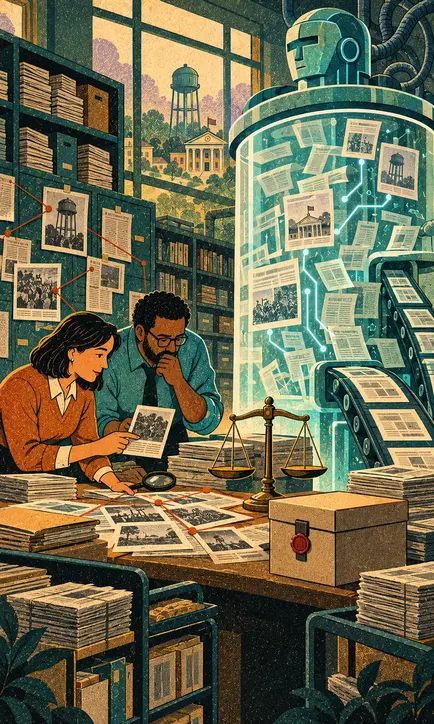
THE SIGNAL IN ONE SENTENCE
Two major regional newspapers allege that AI products copied their work and are asking a court to order destruction of affected copies, datasets, and possibly models, not only financial damages.
01
WHAT ACTUALLY CHANGED
The Seattle Times and Newsday filed a copyright lawsuit against OpenAI and Microsoft in federal court in New York. The publishers allege that their reporting, including work behind paywalls, was copied for the training and operation of products such as ChatGPT, Copilot, and Bing AI.
The complaint says the products can reproduce or closely paraphrase articles, remove or alter copyright-management information, and give readers substitutes for visiting the original publications. The publishers argue that this conduct threatens the subscription and advertising revenue that pays for local reporting.
The requested remedy is the unusual part. Along with damages, the publishers seek destruction of infringing copies and affected datasets or models that incorporate their work. Courts frequently hear arguments about payment. An order aimed at trained systems would force a much harder technical and legal question about whether particular material can be identified and removed after training.
OpenAI says training on publicly available data is grounded in fair use and that its products help people discover publishers. Microsoft said it was surprised by the filing and open to discussion. The allegations have not been proven, and no court has ordered any model or dataset destroyed.
02
WHY THIS MATTERS
This dispute is about both inputs and outputs. Publishers object to how their archives entered the system and to a product that may answer a reader's question without sending that reader back to the reporting that made the answer possible.
Destruction is easy to request and technically awkward to execute. A training corpus can be filtered. A finished model does not contain a neat folder labeled Newsday. If a court eventually requires removal, companies may need stronger data lineage, retraining procedures, or reliable methods for reducing a source's influence.
Local journalism sharpens the stakes. Regional papers produce the court reporting, city-hall coverage, obituaries, sports reporting, and neighborhood records that often exist nowhere else. Treating that work as free industrial feedstock can hollow out the source while preserving a very convincing imitation of access to it.
03
WHERE IT COULD HELP
- Maintain provable data lineage for training and retrieval sources
- License archives with clear compensation and attribution terms
- Link users back to original reporting when answers rely on publisher work
- Design removal procedures before a legal order makes them urgent
KEEP A HAND ON THE WHEEL
This is a complaint, not a judgment. The key questions include fair use, proof of copying, whether outputs substitute for articles, how copyright-management information was handled, and whether destruction of trained systems is legally available or technically feasible.
04
TERMS WORTH KEEPING
OPEN GLOSSARY CARD
Grounding
Connecting an AI answer to specific outside information that can support it.
OPEN GLOSSARY CARD
Evidence trail
The connected sources, calculations, files, and actions that support a result.
OPEN GLOSSARY CARD
Foundation model
A broadly trained model that can be adapted or prompted for many different tasks.
SOURCES AND VERIFICATION STATUS
This article was written from the materials below. Product claims and dates were checked against those sources on September 5, 2026.
PUBLICATION RECEIPT: Revision 1. Approved by Zak and published September 5, 2026.
THE PUBLICATION ENGINE
WANT A SIGNAL OF YOUR OWN?
We build source-grounded publications, private briefings, and editorial systems for organizations with something useful to say.
WORK WITH US