THE SIGNAL IN ONE SENTENCE
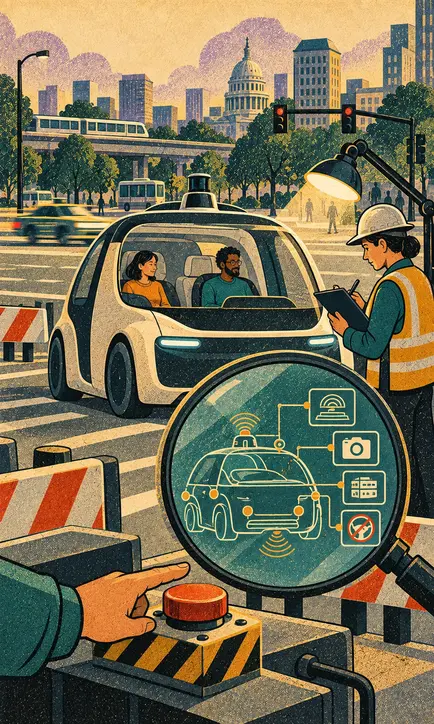
Tesla has launched paid rides in a purpose-built driverless vehicle while federal regulators check whether a car without conventional controls complies with existing safety rules.
01
WHAT ACTUALLY CHANGED
Tesla began carrying paying passengers in Austin with the Cybercab, a two-seat vehicle designed without a steering wheel, pedals, or conventional side mirrors. This is different from placing autonomous software inside an ordinary car because there is no normal driving position for a human to take over from inside the cabin.
The National Highway Traffic Safety Administration opened an audit covering roughly 1,000 vehicles to evaluate how Tesla self-certified the Cybercab under federal safety standards. In the United States, manufacturers generally certify their own compliance and can be audited afterward.
Federal law also provides a limited exemption route for vehicles that do not meet every existing standard, capped at 2,500 vehicles per manufacturer per year. Reuters reported that Tesla had not applied for that exemption before the launch, making the company's compliance theory a central question in the audit.
Tesla says its Full Self-Driving system can be up to ten times safer than a human driver. That figure is company-reported and has not been independently established for this new service. Early operation in one mapped area does not answer how the vehicle behaves across rare weather, road work, emergency scenes, or sensor failures.
02
WHY THIS MATTERS
Removing the steering wheel changes the recovery plan. In a conventional test vehicle, a safety driver can grab control. In a Cybercab, the safety system must depend on remote assistance, automated fallback behavior, stopping safely, or external intervention.
The launch also exposes a timing mismatch in American vehicle regulation. Self-certification lets manufacturers move quickly, while audits and enforcement arrive later. That can work when the product resembles the standards. It becomes more awkward when the entire design removes equipment those standards expected to exist.
The interesting question is not whether robotaxis are good or bad. It is which evidence should be public before strangers become passengers, who can stop the system during an emergency, and whether a regulator is verifying a launch or chasing it down the road.
03
WHERE IT COULD HELP
- Provide mobility for people who cannot drive conventional vehicles
- Operate short, mapped trips where fallback procedures are well tested
- Create auditable remote-assistance and emergency-stop systems
- Publish safety performance using comparable exposure and incident definitions
KEEP A HAND ON THE WHEEL
Watch the NHTSA audit, any exemption request, incident reporting, expansion beyond the initial service area, remote-assistance rules, and independently comparable safety data. A paid ride proves a product can operate. It does not by itself prove the system is safer than the human alternative.
04
TERMS WORTH KEEPING
OPEN GLOSSARY CARD
Human control
The practical ability and authority of people to understand, direct, interrupt or stop an automated process before unacceptable harm occurs.
OPEN GLOSSARY CARD
Regulatory body
A public institution responsible for writing, applying, or enforcing rules in an area.
OPEN GLOSSARY CARD
Audit trail
A durable record of actions, changes, identities, and times that lets someone reconstruct what happened.
SOURCES AND VERIFICATION STATUS
This article was written from the materials below. Product claims and dates were checked against those sources on September 5, 2026.
PUBLICATION RECEIPT: Revision 1. Approved by Zak and published September 5, 2026.
THE PUBLICATION ENGINE
WANT A SIGNAL OF YOUR OWN?
We build source-grounded publications, private briefings, and editorial systems for organizations with something useful to say.
WORK WITH US