THE SIGNAL IN ONE SENTENCE
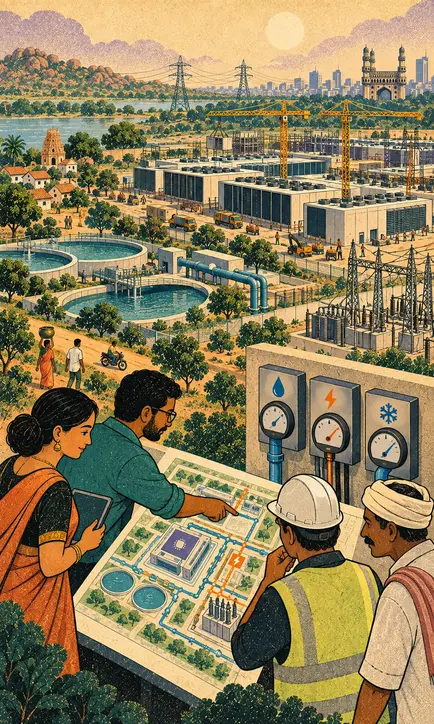
A planned Hyderabad AI campus would consume infrastructure at city scale, making power, cooling, land use, and community benefits as important as the computing hardware inside it.
01
WHAT ACTUALLY CHANGED
TCS' HyperVault unit and partners plan to invest up to 700 billion rupees, about $7.4 billion, in an AI data-center campus in Hyderabad, Telangana. The proposed site covers 264 acres and is intended to reach one gigawatt of capacity through phased construction.
The companies are targeting AI developers and hyperscale cloud providers that need dense GPU infrastructure for model training and inference. TCS says the campus would rank among India's largest data-center developments at full buildout.
One gigawatt is not a decorative specification. It is power-plant territory. High-density accelerators also produce concentrated heat, which turns cooling design, water availability, grid connections, backup generation, and transmission upgrades into central parts of the product.
The project remains a plan. The final investment, schedule, customers, power mix, water design, and construction phases will determine how much of the announced capacity actually arrives. Large infrastructure announcements should be read as proposed systems, not completed server rooms.
02
WHY THIS MATTERS
AI infrastructure is becoming physical enough to reshape regional planning. A data-center campus of this scale competes for electricity, construction capacity, land, network links, and water while promising jobs, tax revenue, and a place in the global computing supply chain.
The location also matters strategically. India has enormous engineering talent and a growing digital economy, but much frontier computing capacity has historically clustered elsewhere. A large domestic campus could reduce latency, support data-residency needs, and make advanced infrastructure more available to regional companies.
The local bargain needs to be visible. Data centers can create valuable construction and technical work, yet the permanent job count may be modest relative to the land and power consumed. Communities deserve clear numbers on water, grid upgrades, emissions, public subsidies, and who pays when the infrastructure must expand.
03
WHERE IT COULD HELP
- Train and serve large models closer to Indian customers
- Support regulated workloads with regional data residency
- Build high-density compute for cloud and research organizations
- Use long-term energy and water planning to make capacity dependable
KEEP A HAND ON THE WHEEL
Track binding investment commitments, construction milestones, power-purchase agreements, renewable-energy claims, water sourcing, customer contracts, local incentives, and community-benefit plans. Capacity announced in gigawatts should not be confused with capacity operating for customers.
04
TERMS WORTH KEEPING
OPEN GLOSSARY CARD
Inference
The moment a trained model uses what it learned to produce an answer.
OPEN GLOSSARY CARD
Evidence trail
The connected sources, calculations, files, and actions that support a result.
OPEN GLOSSARY CARD
Foundation model
A broadly trained model that can be adapted or prompted for many different tasks.
SOURCES AND VERIFICATION STATUS
This article was written from the materials below. Product claims and dates were checked against those sources on September 5, 2026.
PUBLICATION RECEIPT: Revision 1. Approved by Zak and published September 5, 2026.
THE PUBLICATION ENGINE
WANT A SIGNAL OF YOUR OWN?
We build source-grounded publications, private briefings, and editorial systems for organizations with something useful to say.
WORK WITH US