THE SIGNAL IN ONE SENTENCE
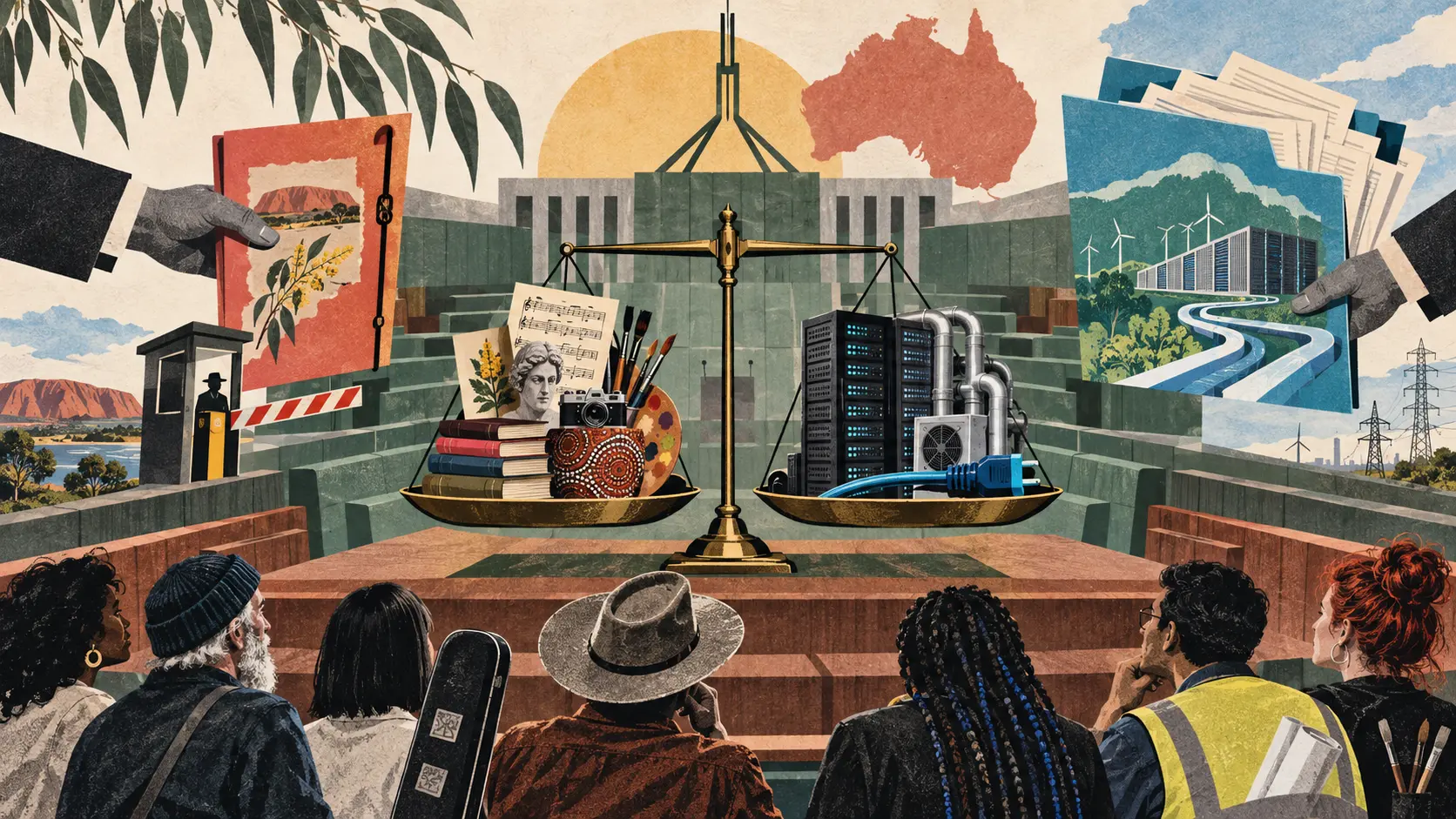
OpenAI and Anthropic have submitted two versions of the same request to Australia: do not treat every use of publicly available copyrighted material for AI training as categorically off limits. Anthropic accepts that a broad exception has little political support and proposes a narrower route. It says the government could condition permission to train models in Australia on investment or other support for Australian creators and cultural work. OpenAI asks for a balanced copyright framework that lets models learn from publicly available information while giving rights holders ways to collaborate. Both companies connect that policy argument to physical investment. Reuters points to OpenAI's offtake agreement with Australian data-center developer NEXTDC for a planned Sydney facility and Anthropic's recently announced role in a Queensland data-center project. The Australian Parliament's Joint Select Committee on Artificial Intelligence has published both company submissions. Its terms of reference explicitly include copyright, Australian creative and media content, sovereign capability, investment, data centers and the wider legal framework. The committee is due to report by November 30. None of this is law. The government has rejected a broad text-and-data-mining exemption, and Prime Minister Anthony Albanese said in July that Australian creators must retain ownership and control of their work, including control over price and value. The proposals therefore arrive as a bargain: allow some training under conditions, and receive investment, local infrastructure or creator support in return. That bargain may be worth debating, but the nouns must stop doing acrobatics. Publicly available does not mean unowned. Investment does not establish permission. Creator support is not the same thing as paying the particular creator whose work entered a dataset. A data center can create jobs while the training record remains opaque. The plain signal is that Australia is being asked to price a copyright exception before anyone has published a complete receipt. A credible framework would identify which works can be used, how lawful access is proved, how rights holders can license or refuse, what compensation follows, what records model developers retain, which outputs are restricted and which promises survive after the concrete is poured.
01
WHAT ACTUALLY CHANGED
Australia's Joint Select Committee on Artificial Intelligence published submissions from OpenAI and Anthropic among 331 submissions to its inquiry. The committee was appointed on August 20, submissions closed September 14 and its final report is due by November 30.
The inquiry's terms of reference explicitly include the interaction between AI and existing intellectual-property and copyright law, including the use of Australian creative, cultural and media content in model training.
Reuters reported on September 22 that Anthropic accepts a broad copyright exception has been ruled out and instead proposes a narrow conditional approval for model training.
Anthropic says it is open to conditions involving investment or support for Australian creators and cultural endeavours. The published proposal does not amount to an enacted license, a negotiated industry agreement or a guaranteed investment program.
OpenAI asks for a balanced copyright framework that permits models to learn from publicly available information while offering rights holders opportunities to collaborate. Public availability and permission are separate questions under copyright law.
Both companies placed the copyright request beside infrastructure plans. Reuters identifies OpenAI's agreement with NEXTDC for a planned Sydney data center and Anthropic's connection to a Queensland project.
The government's stated position remains stricter. In a July 15 speech, Prime Minister Anthony Albanese said Australian writers, musicians, artists and journalists must retain ownership and control of their work, including control of price and value.
The prime minister also announced a planned national AI framework covering large data centers, copyright, investment, energy and water. He said legislation would be brought to Parliament early in 2027 after consultation.
The parliamentary committee can recommend policy, but it cannot turn either company submission into law. The final report, any government response, draft legislation and parliamentary votes remain ahead.
02
WHY THIS MATTERS
The proposal joins two policy questions that should be inspected separately. One asks when copyrighted work may be copied or analyzed for training. The other asks where companies build infrastructure, hire workers, buy power and pay tax. A government can value both without letting a server park answer for a library of unlicensed work.
The phrase publicly available is doing heavy lifting. A book displayed in a shop window is public to view, but the window does not grant permission to reproduce the book. Websites, journalism, photographs, music and video can be easy to access while remaining protected and licensed under specific terms.
A conditional approval can be more precise than a blanket exception, but only if the conditions attach to measurable rights and duties. Local spending, research grants and creator funds are not substitutes for identifying the works used, documenting the legal basis and paying the people whose rights are affected.
Collective support and individual compensation solve different problems. A national arts fund may strengthen culture broadly. It does not tell one photographer whether her image was copied, whether she could refuse, what rate applied or how to challenge an unauthorized use.
Training is not one clean event. Developers gather data, deduplicate it, filter it, convert it, store it, mix it with licensed and synthetic material, train model versions and sometimes use outputs to train later systems. Rules need to say which stages create obligations and how long the evidence must survive.
Rights holders need practical controls, not a website checkbox that disappears into a crawler. Useful options include machine-readable reservations, collective licensing, direct licenses, provenance records, dataset audits, complaint procedures and remedies that do not require an individual artist to fund years of litigation.
Model developers also need a workable standard. A rule that cannot distinguish facts, ideas, public-domain material, licensed work, quotations, incidental copies and protected expression will be hard to administer and easy to game. Precision matters more than slogans on either side.
Infrastructure promises deserve their own ledger. A data-center commitment should state the capital actually contracted, jobs during construction and operation, grid and water obligations, local research access, project deadlines, withdrawal clauses and what happens if the copyright condition changes.
Australia has leverage because model training and inference eventually meet land, energy, networks, skilled workers and courts. The country can set terms before projects are locked in. It can also lose leverage if approval is exchanged for headline investment that can be delayed, downsized or moved.
The strongest bargain would not sell a permanent cultural rule for temporary construction activity. It would use time-limited approvals, independent audits, renewal gates and public reporting so Parliament can revisit the trade after seeing who was paid, what was built and whether the model behavior matched the promises.
The debate matters beyond Australia because other countries face the same bundle. Frontier labs want predictable access to large datasets and places to build compute. Creators want consent, credit, compensation and control. A transparent Australian framework could become a useful template, while a vague trade could become a convenient loophole.
The immediate practical question is not whether Australia is for creators or for AI. It is whether the government can design a permission system where the consideration is explicit, the beneficiary is identifiable, the record is auditable and the refusal remains real.
03
WHERE IT COULD HELP
- Parliament can separate any training permission from infrastructure approval, then publish the tests and evidence required for each.
- Creators and publishers can use direct or collective licenses that identify covered works, uses, models, duration, territories, rates and audit rights.
- Model developers can maintain dataset manifests, lawful-access records, license identifiers, removal procedures and versioned training logs that an independent auditor can inspect.
- Cultural institutions can negotiate access for defined collections while excluding sensitive, Indigenous, unpublished or commercially restricted material.
- Data-center agreements can include milestones for capital spending, local jobs, research access, power, water, emissions and community benefits without pretending those terms resolve copyright.
- Regulators can require a plain-language training notice and a dispute channel that lets a rights holder provide a work, receive a traceable case number and learn what evidence was checked.
- Procurement teams can favor models whose providers disclose provenance controls and license coverage instead of relying only on vendor assurances that the data was public.
- Researchers can test whether opt-outs, removal requests and licensed dataset boundaries remain effective across later fine-tunes, retrieval systems and successor models.
KEEP A HAND ON THE WHEEL
Watch the committee report due November 30, any government response, draft legislation, the exact scope of a proposed approval, treatment of publicly available material, Indigenous cultural and intellectual property, creator consent and payment, dataset records, independent audit powers, enforceable infrastructure commitments and whether the OpenAI or Anthropic submissions are revised. Until those pieces exist, the bargain is a proposal with attractive nouns and missing receipts.
04
TERMS WORTH KEEPING
OPEN GLOSSARY CARD
Text and data mining
Automated analysis of large collections of material to identify patterns, relationships, or information.
OPEN GLOSSARY CARD
Copyright exception
A legal rule that permits a defined use of protected material without individual permission when its conditions are satisfied.
OPEN GLOSSARY CARD
Conditional approval
Permission that applies only while stated requirements such as licensing, audit, reporting, or investment are met.
SOURCES AND VERIFICATION STATUS
This article was written from the materials below. Product claims and dates were checked against those sources on September 22, 2026.
PUBLICATION RECEIPT: Revision 1. Published September 22, 2026.
THE PUBLICATION ENGINE
WANT A SIGNAL OF YOUR OWN?
We build source-grounded publications, private briefings, and editorial systems for organizations with something useful to say.
WORK WITH US