THE SIGNAL IN ONE SENTENCE
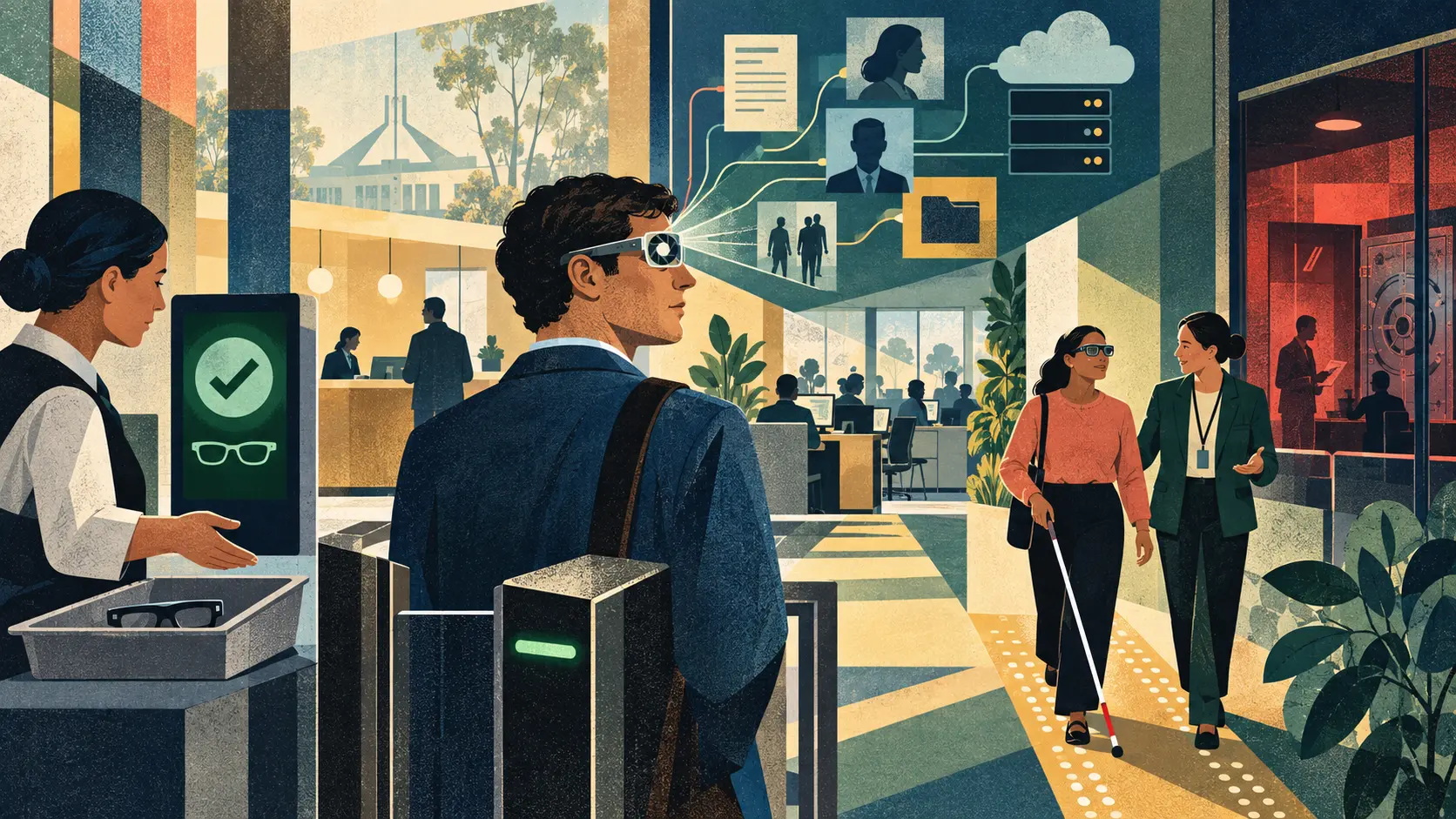
Australia is considering a consistent rule for camera-equipped smart glasses in Commonwealth workplaces. Public Service Minister Katy Gallagher has asked the Australian Public Service Commission for advice, including whether the devices should be prohibited and which exemptions would be appropriate. The government has also asked the Privacy Commissioner to give smart glasses priority consideration. This is a review, not an enacted national ban, import restriction, published workplace policy, or rule for every Australian building. That distinction matters because the device is only the visible end of the problem. A pair of glasses may record sound and video, send information to a cloud service, identify objects, summarize a scene, or assist a blind or low-vision wearer. Each function creates a different benefit, risk, and possible control. The plain signal is that a workable office policy should govern sensors, data paths, rooms, purposes, and people rather than treating every frame as equally dangerous. Sensitive rooms may justify a hard stop. Public counters may need conspicuous notice and consent. Accessibility uses need fast, dignified accommodations. A ban is one control. The real job is drawing a boundary that people can understand, systems can enforce, and workers can challenge.
01
WHAT ACTUALLY CHANGED
Gallagher said she had asked the Australian Public Service Commission for advice on a consistent Commonwealth approach to recording-capable smart glasses in government workplaces. ABC reports that the advice will consider whether the devices should be prohibited and what exemptions may be appropriate. No final rule, covered-building list, start date, legal instrument, penalty, or implementation guide has been published.
The review is narrower than some headlines suggest. Attorney-General Michelle Rowland said the government is not considering an import ban. Prime Minister Anthony Albanese described the need for appropriate protections as technology evolves. The proposal concerns how Commonwealth workplaces handle the devices, not whether Australians may buy or own smart glasses.
The government has separately asked the Australian Privacy Commissioner to give smart glasses priority consideration. That adds a privacy lens to the workplace advice, but it is not yet a published finding, investigation result, regulatory determination, or new power. The respective roles of the Commission, individual agencies, building managers, security teams, employers, and service providers remain to be defined.
The policy question did not arrive from nowhere. Guardian Australia reports that some local councils have already restricted smart glasses in sensitive public facilities such as pools and playgrounds, while providing disability-related exemptions. Those local examples show both the demand for immediate rules and the risk of a patchwork in which a device is treated differently at every doorway.
Australia's eSafety Commissioner published a broader smart-glasses analysis in August. It describes devices that combine cameras, microphones, speakers, connectivity, AI, and sometimes lens displays. It warns that small recording lights can be missed, covered, or disabled, and recommends unmistakable indicators, tamper controls, face blurring without informed consent, limits on identifying members of the public, and safer livestream defaults. Those are design recommendations, not the Commonwealth workplace rule now under review.
02
WHY THIS MATTERS
Glasses weaken the social cue that usually announces a camera. A phone is raised, aimed, and held. A camera built into eyewear can follow the wearer's gaze while leaving both hands free. That does not make every wearer deceptive, but it makes notice harder and changes what coworkers, visitors, claimants, and members of the public can reasonably infer about recording.
The building is not one risk zone. A classified briefing room, public service counter, lunch area, open-plan desk, security checkpoint, laboratory, and public corridor contain different information and expectations. One blanket rule is easy to announce and awkward to operate. A room and function matrix can reserve strict prohibitions for the places where recording, transmission, or identification creates the clearest harm.
The camera is a front end to a data system. Policy needs to ask whether video or audio stays on the device, reaches a phone, crosses a network, enters a cloud account, becomes searchable, is retained, trains a model, identifies a person, or can be exported by the wearer, employer, vendor, or law-enforcement agency. Removing the glasses at one doorway does not answer what happened to yesterday's recording.
Accessibility is part of the safety case. The eSafety Commissioner notes that smart glasses can help blind and low-vision people identify objects and can provide live speech-to-text for Deaf users. An exemption that requires a person to disclose a disability to a security guard each morning, wait for a manager, or accept an inferior substitute is not a meaningful accommodation. Privacy and access can coexist when the policy controls functions and data without treating the user as a problem.
Workplace power complicates consent. An employee may feel unable to refuse a manager's recording, while a member of the public may not know which agency is collecting data. At the same time, recordings can preserve evidence of misconduct, discrimination, or unsafe conditions. A credible rule needs complaint channels, evidence-preservation exceptions, union and worker consultation, investigation protocols, and an appeal when enforcement gets the context wrong.
03
WHERE IT COULD HELP
- Classify spaces and activities before classifying devices, mapping public areas, routine offices, service counters, secure rooms, personal-care spaces, meetings, inspections, field work, and emergency response to the exact recording, streaming, recognition, storage, and assistance functions allowed in each
- Require clear recording notice that works for people who cannot see a tiny light, with a non-disableable visual signal, an audible or haptic cue where appropriate, tamper detection, and a documented response when the indicator fails rather than assuming one green dot creates informed consent
- Approve specific devices, accounts, applications, networks, storage locations, retention periods, export routes, and model-training settings, then provide a data-flow receipt showing what leaves the glasses, who can retrieve it, when it disappears, and how a person can request access or correction
- Create a confidential accessibility path with quick decisions, equivalent alternatives, function-specific settings, trained security staff, portable approval across buildings, minimal disclosure, an urgent-review route, and direct participation by disabled workers and visitors in the policy design
- Design enforcement before launch with consistent signage, secure temporary storage, incident logs, proportional consequences, evidence preservation, worker representation, privacy complaints, independent review, appeal, and scheduled publication of exemptions, incidents, false alarms, and policy changes
KEEP A HAND ON THE WHEEL
The verified event is a request for advice about Commonwealth workplaces, not an enacted Australian ban on smart glasses. No public document yet defines the legal authority, agencies, buildings, rooms, employees, contractors, visitors, device types, functions, approved products, accessibility accommodations, evidence exceptions, commencement date, procurement rules, technical controls, storage arrangements, penalties, complaint routes, appeal process, training, audit, or review schedule. The government says it is not considering an import ban. The Privacy Commissioner has been asked to give the issue priority consideration, but no finding has been published. The eSafety Commissioner's August analysis is an online-safety and design resource, not the pending workplace policy. Its reference to a 2024 study in which 17 percent of Australian smart-glasses owners reported prohibited uses is a cited self-report finding, not a government measurement of all owners or evidence that every device is misused. Claims that an Australian rule would be the world's first require a complete jurisdictional comparison. Watch for the Commission's written advice, agency consultation, worker and disability participation, a function-by-function policy, privacy impact assessment, data-flow requirements, genuine accommodation process, enforcement evidence, and publication of what happens after the first contested incident.
04
TERMS WORTH KEEPING
OPEN GLOSSARY CARD
Sensor boundary
A rule defining where a device may collect, process, transmit, or retain information through cameras, microphones, location, or other sensors.
OPEN GLOSSARY CARD
Recording indicator
A visible, audible, or tactile signal intended to tell nearby people that a device is capturing sound, images, or video.
OPEN GLOSSARY CARD
Function-based restriction
A policy that controls a capability such as recording, streaming, identification, or storage instead of banning every use of a device category.
SOURCES AND VERIFICATION STATUS
This article was written from the materials below. Product claims and dates were checked against those sources on September 17, 2026.
PUBLICATION RECEIPT: Revision 1. Published September 17, 2026.
THE PUBLICATION ENGINE
WANT A SIGNAL OF YOUR OWN?
We build source-grounded publications, private briefings, and editorial systems for organizations with something useful to say.
WORK WITH US