THE SIGNAL IN ONE SENTENCE
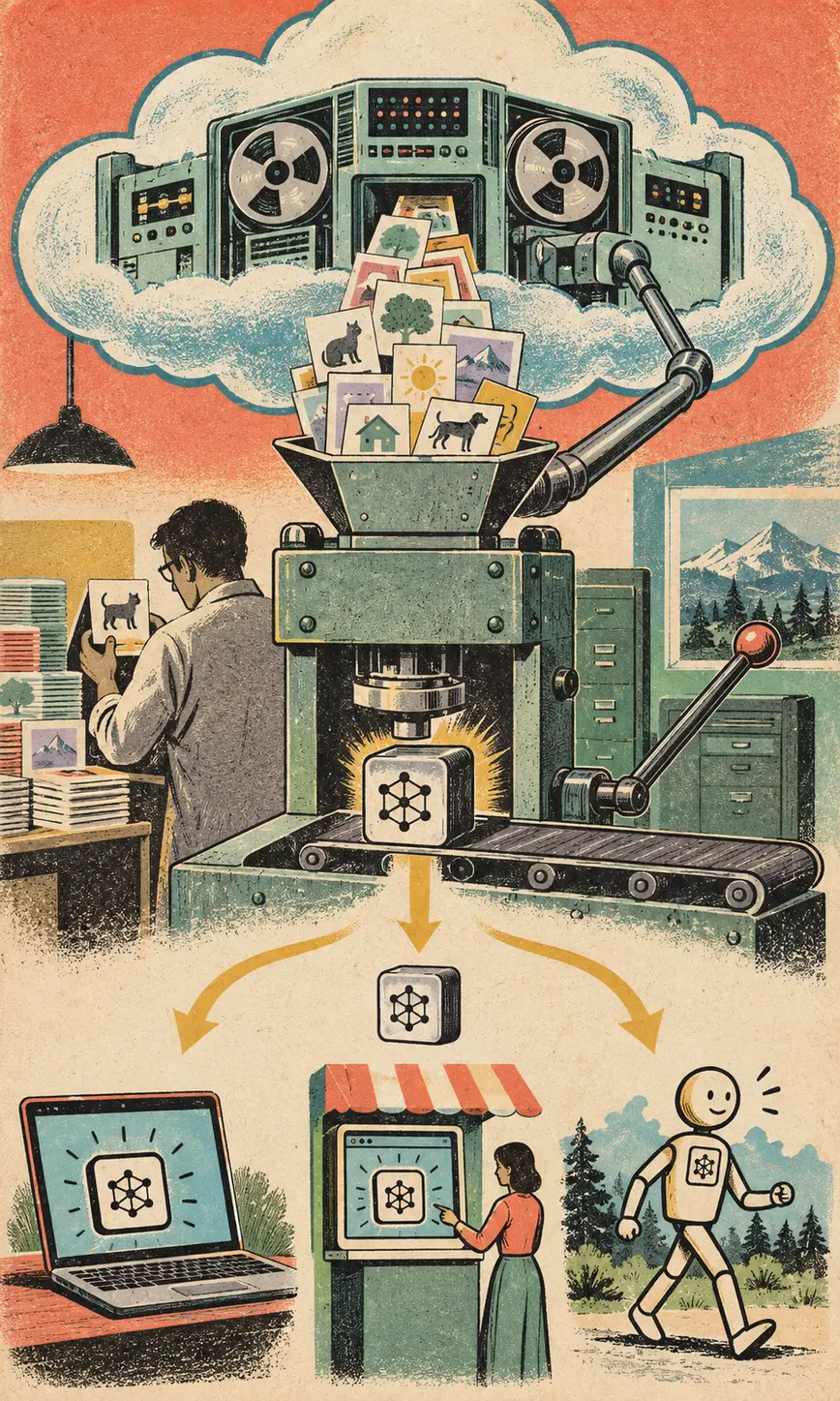
Researchers created a compiler that turns a plain-language description of a recurring text job into a small neural function that runs without the large teacher models.
01
WHAT ACTUALLY CHANGED
Researchers from Harvard introduced compile by training, a system for turning a natural-language specification into a reusable neural function. It targets recurring text operations that are easy to describe but awkward to implement with exact rules.
During compilation, large teacher models generate examples tailored to the requested task. Those examples train a small adapter attached to a compact interpreter. After that process, the finished function runs without contacting the teacher models.
The module can be stored, versioned, shared, and combined with ordinary software. The researchers demonstrate the approach with a helper working across several websites, a 3D avatar controlled through language, and a translator between English and a fictional language called Claudish.
On a difficult FuzzyBench subset where an earlier fast Program-as-Weights compiler found no exact matches, compile by training reached 83.6 percent semantic accuracy. The improvement comes with additional preparation: compilation takes roughly one minute instead of seconds.
02
WHY THIS MATTERS
Generative AI usually behaves like a remote specialist who must be contacted and paid every time the task appears. Compile by training asks whether the specialist can teach a tiny local worker once, then leave behind a reusable piece of software.
That could be valuable for narrow jobs with high repetition, private inputs, or unreliable connectivity. A local function may offer predictable latency and fewer continuing dependencies than sending every small transformation back to a frontier model provider.
The larger idea is delightfully strange. Traditional compilers translate precise code into executable instructions. This system begins with fuzzy human language and produces weights. The function is not handwritten logic, but it can still be named, versioned, tested, and composed like a software dependency.
03
WHERE IT COULD HELP
- Run private text classification on local devices
- Replace repeated large-model calls for narrow workflows
- Create reusable functions from plain-language specifications
- Version task-specific AI behavior alongside application code
KEEP A HAND ON THE WHEEL
The compilation step still depends on large teacher models, and the reported accuracy comes from the authors' evaluation. A neural function can also fail less visibly than conventional rules. Production use would need held-out tests, known boundaries, and a fallback for inputs outside the examples it learned from.
04
TERMS WORTH KEEPING
OPEN GLOSSARY CARD
Inference
The moment a trained model uses what it learned to produce an answer.
OPEN GLOSSARY CARD
Fine-tuning
Extra training that shapes a model for a narrower job or behavior.
OPEN GLOSSARY CARD
Model snapshot
A fixed, dated version of a model whose behavior can be tested and referenced consistently.
SOURCES AND VERIFICATION STATUS
This article was written from the materials below. Product claims and dates were checked against those sources on September 5, 2026.
PUBLICATION RECEIPT: Revision 1. Approved by Zak and published September 5, 2026.
THE PUBLICATION ENGINE
WANT A SIGNAL OF YOUR OWN?
We build source-grounded publications, private briefings, and editorial systems for organizations with something useful to say.
WORK WITH US