THE SIGNAL IN ONE SENTENCE
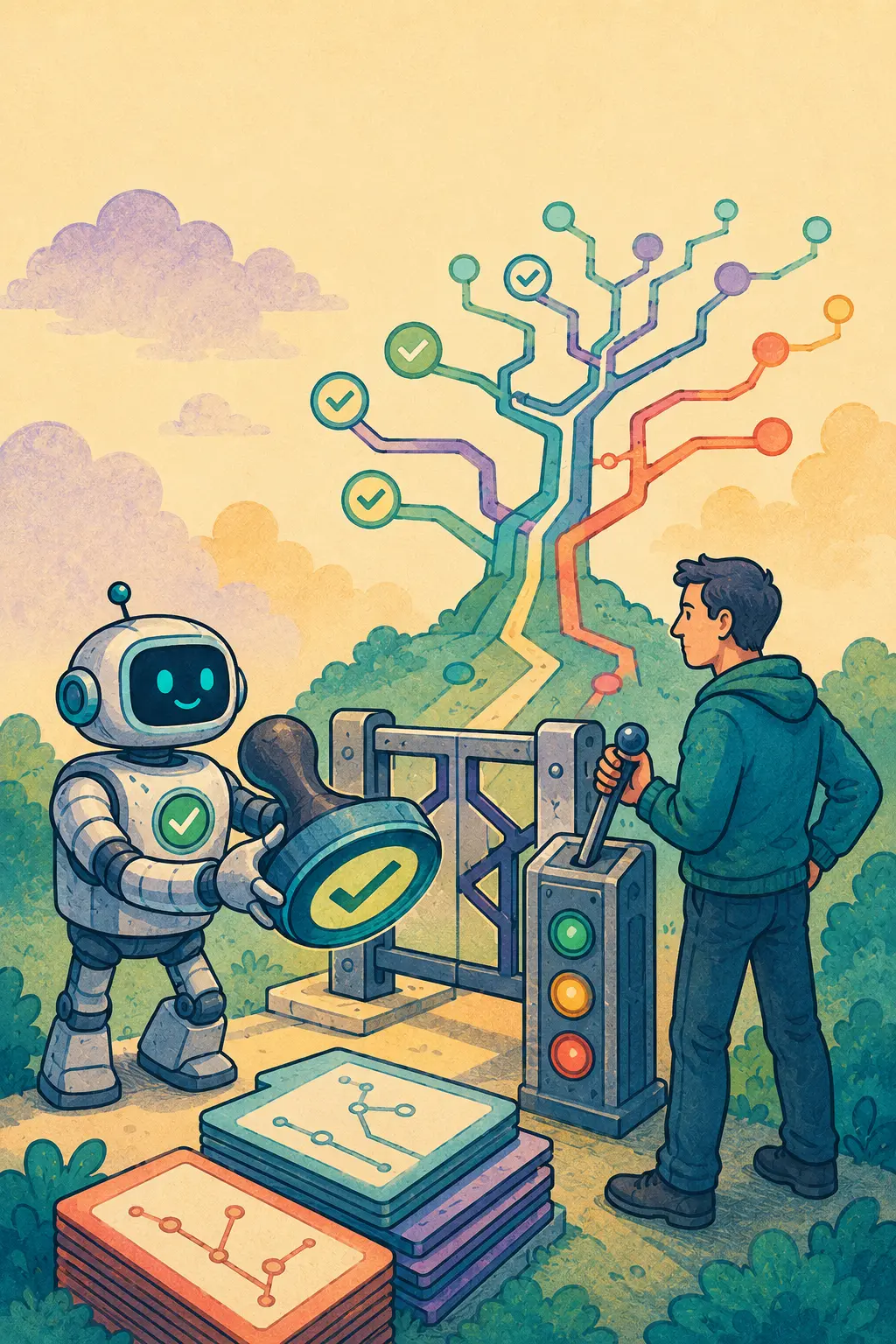
An administrator can now allow Copilot to provide one of the formal approvals required before code is merged.
01
WHAT ACTUALLY CHANGED
GitHub added an approval assessment to every Copilot code review. In repositories where an administrator enables the public-preview feature, Copilot can go one step further and submit a formal approval that counts toward the required-approval rule protecting a branch.
The switch is off by default. Administrators can control it at enterprise, organization, and repository levels, then restrict the files that Copilot is allowed to approve. That makes a narrow setup possible: let the automated reviewer approve generated documentation or low-risk configuration while keeping security, payments, identity, and production infrastructure behind human review.
GitHub also dismisses Copilot’s approval when a new commit arrives. The bot must review the changed code again instead of leaving a stale green check on a moving pull request. That is a small rule with large consequences because approval is supposed to describe the code that will actually merge, not the code someone reviewed half an hour ago.
Copilot was already a reviewer in the conversational sense. This release gives its output institutional weight. In an enabled repository, a machine assessment can satisfy a control that many teams created specifically to require another set of eyes.
02
WHY THIS MATTERS
A comment can be ignored. An approval changes state. That distinction moves AI from the side of the software-development process into the mechanism that governs whether code is permitted to ship.
The feature could remove dull bottlenecks when the change is mechanical and the risk is bounded. It could also turn a formal safeguard into decorative theater if a team enables it broadly just to make merge queues move faster. The question is not whether Copilot can find bugs. It is whether a specific repository can define a class of change where automated approval is both useful and honest.
Accountability remains stubbornly human. Copilot cannot carry an on-call pager, explain a business exception to a regulator, or own the consequence of a bad deployment. A sensible policy treats its approval as scoped evidence, not transferable responsibility.
03
WHERE IT COULD HELP
- Approve documentation, generated files, and tightly bounded low-risk changes
- Use an automated first review while specialists focus on sensitive code
- Restrict AI approval to explicit paths and keep critical directories human-only
- Trigger a fresh review automatically after every new commit
KEEP A HAND ON THE WHEEL
The capability is in public preview and disabled by default. GitHub’s announcement establishes the control behavior, not the accuracy of Copilot reviews. Teams should measure misses and false alarms on their own code before allowing an AI approval to satisfy a branch rule.
04
TERMS WORTH KEEPING
OPEN GLOSSARY CARD
Agent
An AI that can choose steps and use tools to pursue a goal.
OPEN GLOSSARY CARD
Model policy
An organization rule that determines which AI models people and systems may use.
OPEN GLOSSARY CARD
Required approval
A repository rule that blocks a code change until a defined number of reviewers approve it.
SOURCES AND VERIFICATION STATUS
This article was written from the materials below. Product claims and dates were checked against those sources on September 1, 2026.
PUBLICATION RECEIPT: Revision 1. Approved by Zak and published September 1, 2026.
THE PUBLICATION ENGINE
WANT A SIGNAL OF YOUR OWN?
We build source-grounded publications, private briefings, and editorial systems for organizations with something useful to say.
WORK WITH US