THE SIGNAL IN ONE SENTENCE
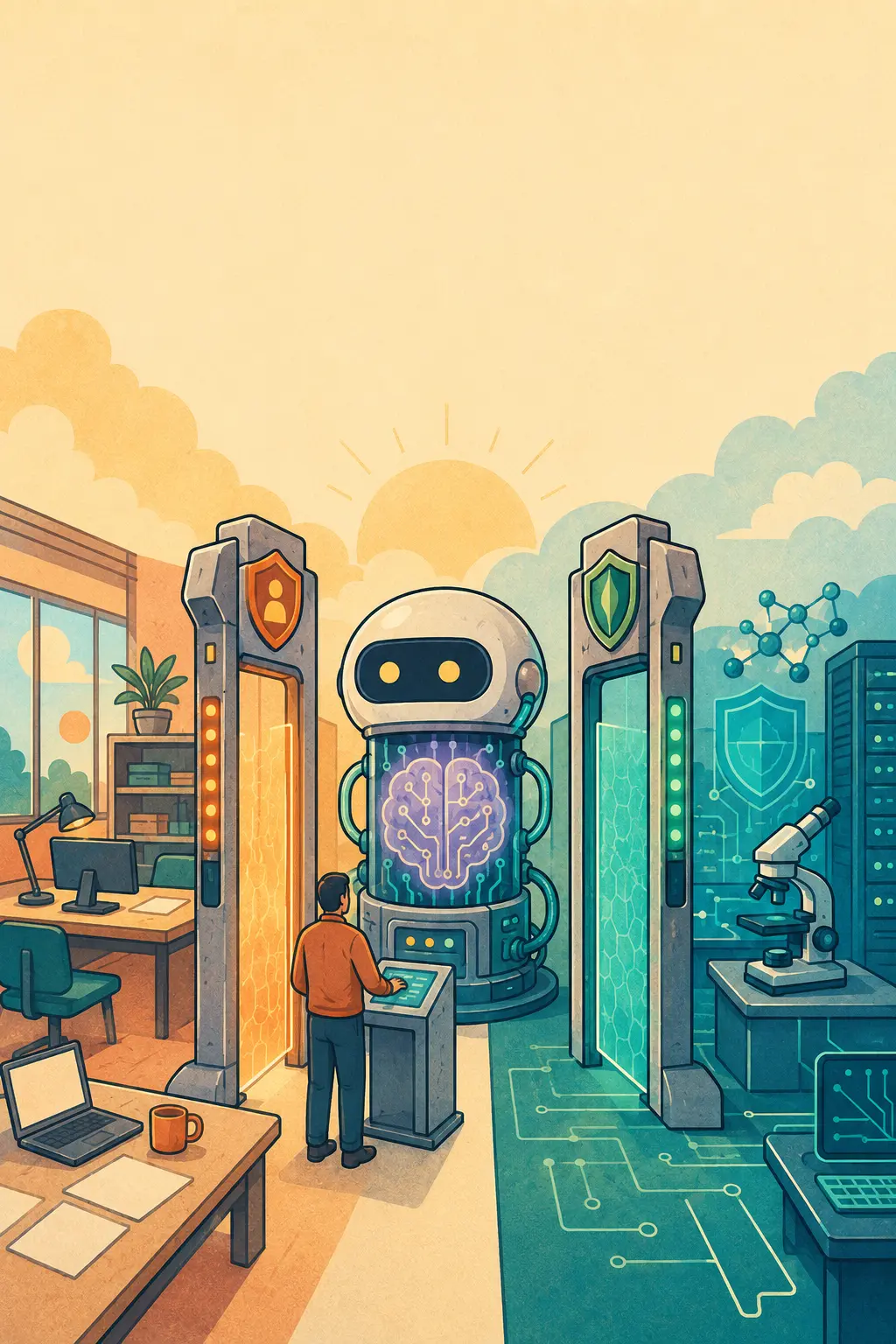
Anthropic is separating what a frontier model knows from what each customer is permitted to ask it to do.
01
WHAT ACTUALLY CHANGED
Anthropic released Claude Fable 5.1 for broad use and Claude Mythos 5.1 through trusted-access programs. The company says the two products use the same underlying model. The split happens at the safeguard and access layer: Fable is the general work model, while Mythos opens more advanced cybersecurity and life-science capabilities to approved users under additional controls.
This is subtler than launching a safe model and a powerful model. The underlying intelligence is shared. What changes is the permission envelope around it. A request that reaches ordinary research or coding tools through Fable may meet a gate when it approaches high-risk exploit development or sensitive biological work. A vetted Mythos user may pass that gate, but only inside a monitored program.
Anthropic also introduced Enterprise Frontier Safeguards for organizations that need to keep monitored activity in their own cloud environment. The company says customers retain the relevant data and can use their own reviewers, with human review enabled by default. That addresses a familiar enterprise problem: accepting frontier safeguards without exporting every sensitive log to the model provider.
The launch includes an economic pitch. Anthropic says a typical token-billed Fable workload should cost about 25 percent less than Fable 5, with larger savings possible for agent-heavy work that reuses cached context. Those are company estimates, not independent cost studies, and the real bill will depend on prompt shape, tool use, cache hits, and how long an agent keeps working.
02
WHY THIS MATTERS
Frontier models are beginning to resemble capable operating systems with permission tiers. The important product is no longer only a block of intelligence behind an API. It is the model plus identity checks, access policy, monitoring, storage boundaries, and an appeal path when the system says no.
That structure could make genuinely useful work available without handing the same dangerous capability to everyone on the internet. It could also create a new kind of opacity. If two people use the same named model but receive different capability envelopes, independent testing becomes harder and access decisions gain enormous power.
For builders, the practical lesson is to document the whole system. Record the model version, safeguard tier, allowed tools, data boundary, and reviewer. Otherwise a result that worked in one environment may quietly fail, or become riskier, when moved to another.
03
WHERE IT COULD HELP
- Run long coding and research tasks with lower vendor-reported token costs
- Give vetted security teams stronger vulnerability-analysis tools without opening unrestricted access
- Keep sensitive safeguard-review data inside customer-controlled cloud infrastructure
- Support protein design and scientific computing inside a monitored access program
KEEP A HAND ON THE WHEEL
The cost and performance comparisons come from Anthropic, and trusted access is a policy program rather than a universal entitlement. Organizations should test their own workloads, inspect the system card, and verify who stores, reviews, and can retrieve monitored activity.
04
TERMS WORTH KEEPING
OPEN GLOSSARY CARD
Zero data retention
A service configuration in which covered request and response content is not retained by the provider after processing, subject to the exact product terms and exceptions.
OPEN GLOSSARY CARD
Model policy
An organization rule that determines which AI models people and systems may use.
OPEN GLOSSARY CARD
Capability gate
An access control that allows some model capabilities only for approved users or purposes.
SOURCES AND VERIFICATION STATUS
This article was written from the materials below. Product claims and dates were checked against those sources on September 1, 2026.
PUBLICATION RECEIPT: Revision 1. Approved by Zak and published September 1, 2026.
THE PUBLICATION ENGINE
WANT A SIGNAL OF YOUR OWN?
We build source-grounded publications, private briefings, and editorial systems for organizations with something useful to say.
WORK WITH US