THE SIGNAL IN ONE SENTENCE
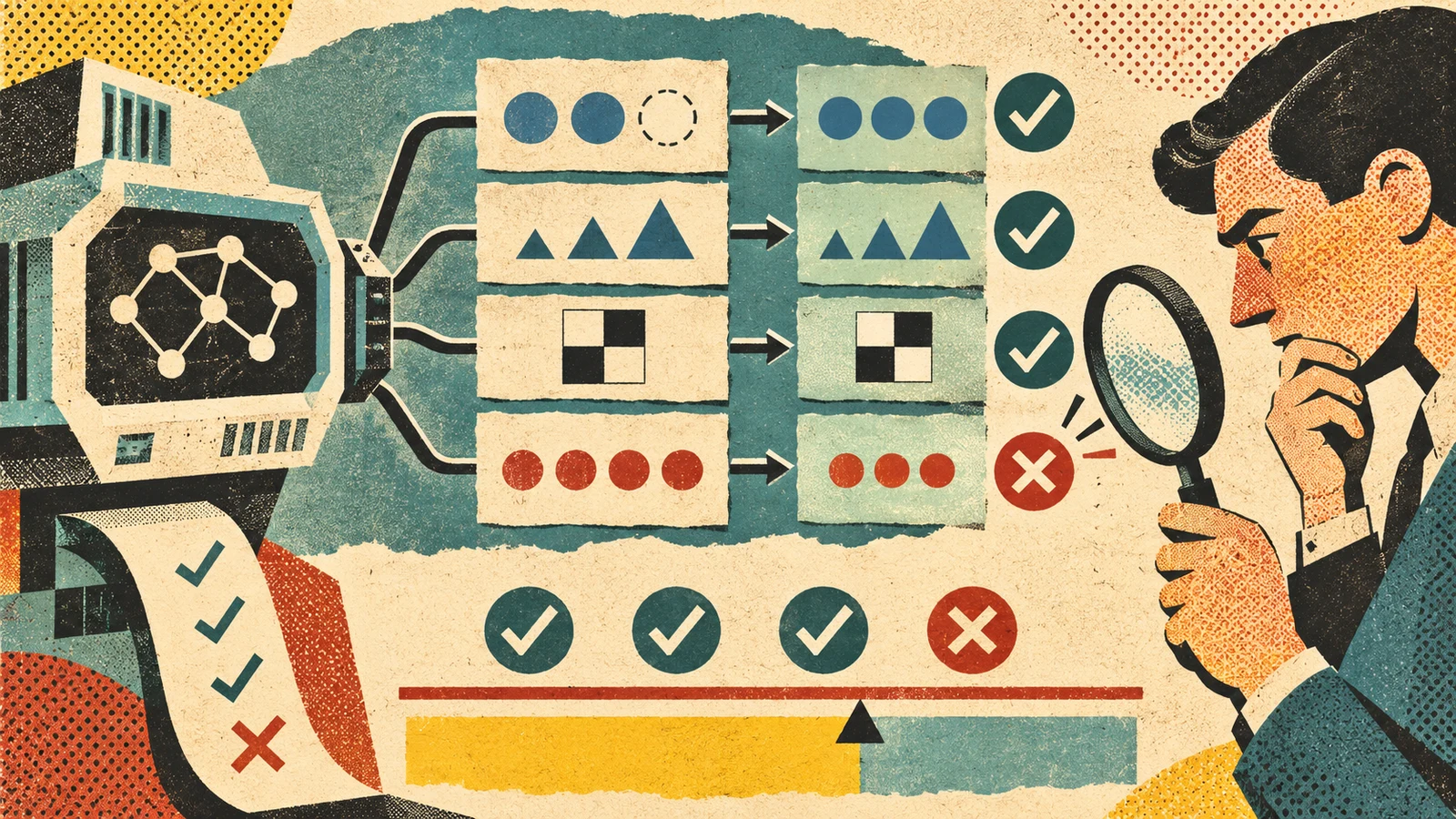
A model gets the easy question right. Then it gets the same question right again. Change the color, move one object or ask for the neighboring case, and the answer wanders off by one. This is not the dramatic failure people screenshot because a chatbot has declared that the Moon is a houseplant. It is more annoying and, in a deployed system, often more important. The model plainly has the capability. It just does not deliver it every time. Google DeepMind's new Humanity's First Exam is designed to measure that gap. Released on November 24, the benchmark contains 544 text and multimodal prompts arranged into 136 families. Each family has four related prompts. The tasks span 20 foundational subcategories, including simple counting, spatial relations, basic arithmetic, constraint following and questions built on a false premise. The test does not ask only whether a model can produce one correct answer. It runs prompts repeatedly and checks whether the model succeeds across the full family. That creates two useful ideas. The capability ceiling asks whether the model can solve the task at least once. The reliability floor asks whether it can keep solving closely related versions without a miss. Across the 18 models in the technical report, those two measures were not the same. At the highest evaluated reasoning setting, the probability of solving every member of a family at least once sat between 98.5 and 100 percent. The stricter measure, which required four correct runs on each of four prompts, ranged from 18.6 to 92.4 percent. That spread is the signal. A model can look almost universally capable when the question is can it ever do this. It can look much less dependable when the question becomes will it do this correctly sixteen times across nearby cases. Real products live in the second question. A claims system does not need one correct extraction from one clean form. It needs correct fields across scans, templates and bad lighting. A warehouse robot does not need to count the right boxes in one image. It needs to keep counting when a label is turned, an object is partly hidden or the camera moves. A coding assistant does not need to obey one formatting rule once. It needs to preserve the rule while the surrounding file changes. The plain signal is this: give every consequential AI workflow a task-specific reliability floor. Test repeated runs and nearby variants, publish which families fail, connect each miss to its consequence and set abstention or human-review gates before a strong average becomes a trust claim. The family design matters because ordinary benchmarks can reward luck. If a model gets four attempts, the chance that at least one answer is correct can climb quickly. That is useful for measuring available capability. A developer might use multiple attempts, a verifier or a search process to recover the right result. But many applications do not get four harmless tries. The first answer may populate a database, steer a tool or reach a person. Even when retries are available, the application still needs a reliable way to identify the good answer. Four inconsistent responses are not automatically better than one. The HFE report names the distance between the family capability ceiling and the family reliability floor the Family Reliability Gap. That is a helpful benchmark statistic. A production team should turn it into something more local. Start by defining the family that your product actually serves. For an invoice reader, one family might contain the same fields across a digital PDF, a phone photo, a rotated scan and a page with a stamp over the total. For a support agent, a family might express the same refund policy through a direct request, a long complaint, a misspelled message and a conversation with two orders. The variations should preserve the underlying task while changing details that should not change the answer. Then run each case more than once. Generative systems can vary because of sampling, tool results, retrieved context and hidden service changes. A single clean run cannot reveal that variance. Record the exact prompt, model, settings, tools, retrieved material, output and verdict for every attempt. Do not collapse the results into one average too early. Report at least four views: success on the first attempt, success across repeated attempts, success across variants and success across the whole family. A system that scores 97 percent per answer can still be a poor fit for a workflow that requires a long chain of correct actions. The multiplication gets rude quickly. If ten independent steps each succeed 97 percent of the time, the chance that all ten succeed is about 74 percent. Real errors are often correlated, which can make the simple calculation optimistic. The same blind spot may repeat across every variation that shares a diagram, language pattern or tool. HFE found that visual perception dominated the remaining errors. The report attributes 73 percent of wrong rollouts to visual-perception problems. Misjudging position, direction or a path accounted for 31 percent of wrong answers, and miscounting objects accounted for 23 percent. Many misses were small. In 40 percent of failed prompt-model pairs, the answer was off by one or contained a single wrong element. Small does not mean harmless. One missed tablet changes a medication count. One shifted decimal changes a payment. One wrong object changes the robot's path. The consequence comes from the workflow, not from how silly the benchmark question looks. Extra thinking did not repair every category equally. In the report's comparison on Gemini 4 Carbon, reducing reasoning effort caused a large decline on math and algorithmic families but only a small change on vision families. The researchers conclude that more test-time reasoning offers limited relief for the visual failures that dominate this benchmark. That is a warning against a familiar deployment reflex: if the model is unreliable, turn the thinking dial up and hope the bill is buying certainty. Sometimes it buys a better answer. Sometimes the system is staring at the wrong square more thoughtfully. The release has useful limits. Humanity's First Exam is a curated benchmark built to surface elementary, surprising failures. Its 544 prompts are not a representative sample of every office, factory, clinic or phone. The researchers filtered tasks for simplicity, relatability and shock value. That makes the benchmark legible and diagnostically interesting. It also means its aggregate score is not a universal reliability rating. The grading system is another boundary. Final answers are judged by a deterministic model against a golden answer or rubric. The report includes checks on judge agreement, but an automated judge can still disagree with a human or miss a flawed reference. Only 112 prompts, or 28 complete families, are public. The remaining 432 prompts are held back to limit contamination. That helps protect a live leaderboard, but it means outside teams cannot fully inspect every item behind a score. The benchmark was also designed and reported by Google-affiliated researchers and includes Google models alongside competitors. That does not invalidate the work. It makes transparent methods, public subsets, independent reproduction and model-specific error analysis important. Use HFE as a pattern, not a trust badge. For every deployment, write a reliability contract before choosing the model. Name the task family. Define the variations that should not alter the answer. Set the number of repeated runs. Identify the consequence of a miss. Decide which errors require abstention, a second system, deterministic validation or human review. State the minimum family success rate and the maximum acceptable severe-error rate. Then keep the failed cases. A miss reel is more useful than a polished benchmark table. Store failures with the input, output, model version and adjudication. Group them by cause. Add repaired cases to the regression suite. When the model or prompt changes, rerun the family instead of assuming the new release inherited the old behavior. Monitor the floor after launch. Production inputs drift. Cameras change. Documents acquire new templates. Users find phrasing the evaluation never imagined. Model providers update infrastructure. Track family-level reliability over time and alert on the weakest category, not only the global average. Finally, connect reliability to authority. A system allowed to draft a suggestion can tolerate a different floor from one allowed to submit a payment, change a record or move a machine. Increase the required evidence as the action becomes harder to reverse. For high-consequence steps, use deterministic checks and qualified human review even when the benchmark score looks excellent. DeepMind has also opened a Kaggle competition for new task contributions through December 15. That can expand the benchmark and expose more ordinary-looking failures. It can also add selection and judging choices that should remain visible as the collection grows. The most useful contribution may be the habit behind the leaderboard. Do not ask only whether the model knows the answer. Ask whether it keeps knowing when the picture shifts, the wording changes and the answer has to be right again. Capability gets the demo. The floor gets the job.
01
WHAT ACTUALLY CHANGED
Google DeepMind released Humanity's First Exam on November 24 with a technical report, public data subset and Kaggle leaderboard.
The benchmark contains 544 text and multimodal prompts arranged into 136 four-prompt families across 20 foundational subcategories.
Its metrics separate one-time or multi-attempt solvability from repeated success across related prompt variants.
Across 18 evaluated models, family capability ceilings were near 100 percent while the strict family reliability floor ranged from 18.6 to 92.4 percent at the highest tested reasoning settings.
DeepMind released a stratified public subset of 112 prompts and retained 432 prompts as a private holdout.
02
WHY THIS MATTERS
A model that can solve a task once may still fail unpredictably across repeat runs or small changes that should not affect the answer.
Aggregate benchmark scores can hide family-level failures that matter to a specific product or population.
Visual perception accounted for 73 percent of wrong rollouts in the report, and extra reasoning offered less help there than on symbolic and text tasks.
Small errors such as an off-by-one count can produce large consequences when an output controls money, records, medicine or machines.
Reliability requirements should rise with the authority and irreversibility of the action a model may take.
03
WHERE IT COULD HELP
- Define a family of real tasks that share the same underlying answer while varying format, phrasing, layout, noise or context.
- Run every variant repeatedly and preserve the prompt, settings, tools, retrieved context, output and verdict for each attempt.
- Report first-attempt, repeat, variant and whole-family success separately instead of publishing only one average.
- Attach each failure family to a consequence and require abstention, deterministic validation or human review where needed.
- Keep a versioned miss reel and add corrected failures to a regression suite for every model, prompt or tool update.
- Monitor the weakest production family over time and investigate drift before a global score looks bad.
- Set stricter floors for actions that are costly, consequential or difficult to reverse.
KEEP A HAND ON THE WHEEL
Watch for independent reproduction on the public subset, additional disclosure about task selection and judging, leaderboard changes as submissions arrive, family-level results on local and open-weight models, stronger visual-perception systems, evaluations using deterministic graders, contamination analysis, production studies that connect benchmark families to actual incidents and evidence that higher reasoning effort improves reliability rather than merely cost.
04
TERMS WORTH KEEPING
SOURCES AND VERIFICATION STATUS
This article was written from the materials below. Product claims and dates were checked against those sources on November 25, 2026.
THE PUBLICATION ENGINE
WANT A SIGNAL OF YOUR OWN?
We build source-grounded publications, private briefings, and editorial systems for organizations with something useful to say.
WORK WITH US