THE SIGNAL IN ONE SENTENCE
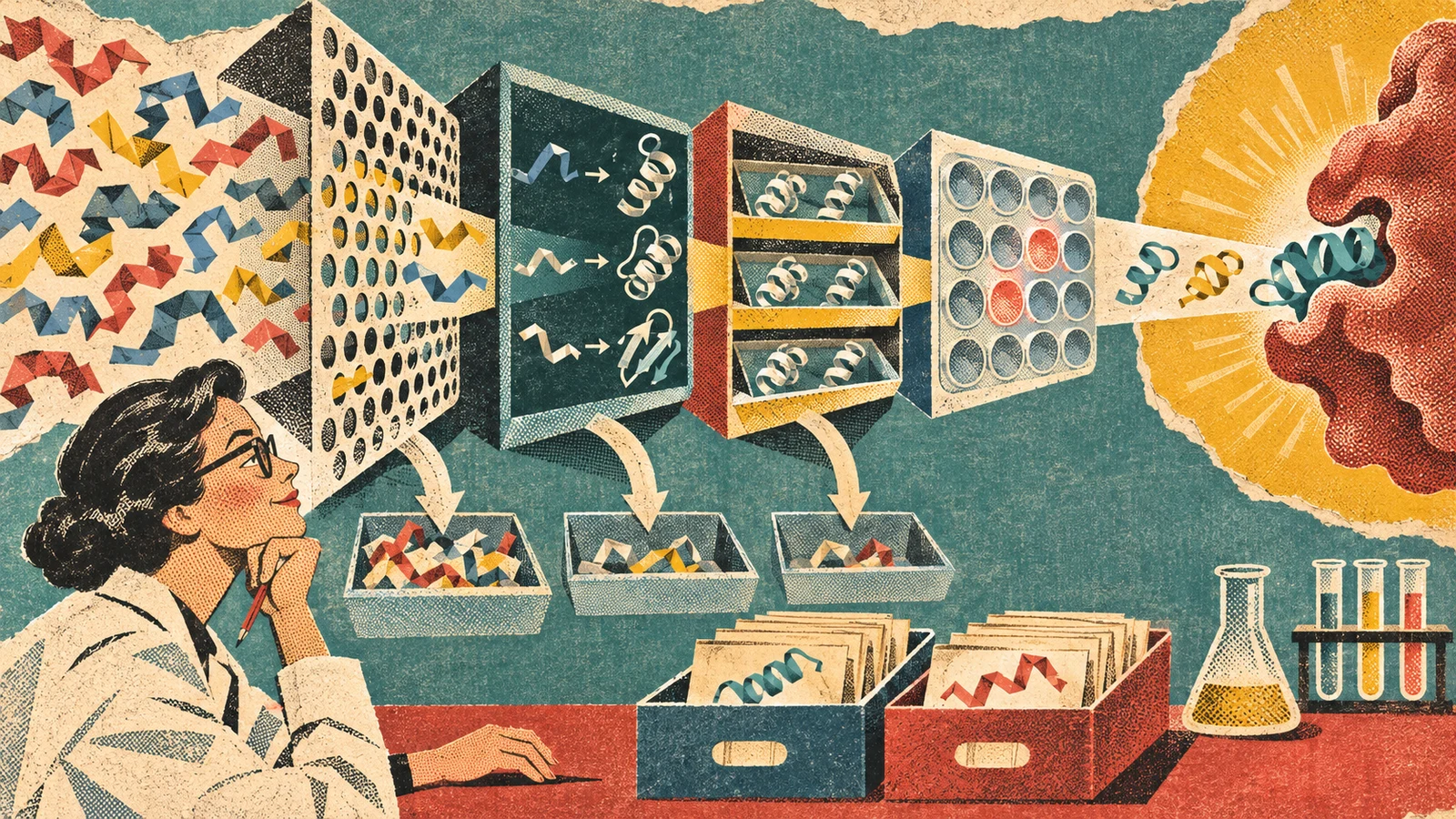
A protein that sticks to its intended target is an exciting little object. It is also the last visible survivor of a long line of less photogenic decisions. Before the successful binder reached a laboratory well, a model generated a shape. Another model proposed a sequence. More software predicted whether the sequence would fold. Researchers ranked candidates, ordered a subset, expressed or synthesized them, ran assays and decided what counted as binding. Every one of those steps changes the result. OpenAI reported on November 24 that GPT-6 models can perform several protein-design tasks using reasoning and general-purpose coding tools. In work with research partner Onava, proteins based on GPT-6.2 designs showed evidence of binding to five target proteins. Separate experiments found that many model-redesigned minibinders and antibody fragments retained binding to their original targets. This is meaningful laboratory evidence. It is not a drug, an end-to-end autonomous design system or proof that a general model has made specialized biology tools obsolete. The plain signal is this: publish the whole design funnel. Count every generated candidate, filter, specialized-model contribution, selection decision, synthesis or expression failure, negative assay, replicate, concentration, human intervention and compute cost. A hit rate without the funnel is a fraction whose denominator has wandered off. The first laboratory experiment makes the point neatly. Researchers gave GPT-6.2 three-dimensional structures for five target proteins and marked where a small protein, called a minibinder, should attach. GPT-6.2 wrote code to propose three-dimensional minibinder shapes. OpenAI says it did this design step without calling a specialized protein-generation model. But a shape is not a protein someone can put into a test tube. A protein also needs an amino acid sequence that folds into that shape. The team used a specialized model called SolubleMPNN to propose sequences. Other specialized protein models helped filter candidates predicted to fold correctly and contact the intended site. Onava then made and tested selected proteins. The laboratory tested 322 minibinders. Thirty-five, or 10.9 percent, showed evidence of binding to their intended targets. The hits included five for PD-L1, three for IL-7Rα, one for TrkA, eight for VEGF-A and eighteen for IL-17A. At least one candidate bound for every target. That result says something real: shapes proposed through GPT-6.2's reasoning and code could be turned into physical proteins that produced a positive binding signal. It does not say GPT-6.2 independently produced 322 finished designs from target to assay. The sequences and candidate selection depended on specialized systems. Human researchers chose the targets, prompts, computational gates and laboratory protocol. The published number is the last stage of a mixed human and machine pipeline. That is not a flaw. Modern protein design is usually a pipeline. The problem begins when the pipeline disappears from the headline and the last model gets sole possession of the result. The second laboratory experiment moved the general model into sequence design. Researchers gave GPT-6.2 three-dimensional models of existing minibinders, withheld their original amino acid sequences and asked it to propose new sequences. Specialized models still helped choose which candidates to make. For three targets built from known minibinder structures, the initial screens found binding in 75 of 88 designs for MDM2, 26 of 42 for VEGF-A and 8 of 59 for PD-1. The new sequences often differed substantially from the originals. The team also tested GPT-6.2 sequences for three previously unpublished minibinder shapes. Fourteen of 107 proteins, or 13.1 percent, showed binding. Because those shapes had not been public and some successful sequences differed sharply from the earlier sequence, the experiment provides better evidence against simple memorization than a benchmark made entirely from published structures. Then came antibody loops. GPT-6.2 redesigned the three binding loops in six small antibodies aimed at IL-4Rα. Of 182 designs tested, 128 showed evidence of binding. In another experiment, researchers asked the model to change about half the amino acids in each of three binding loops from five therapeutic antibodies. Of 272 tested fragments, 179 retained binding to PD-1 or PD-L1. Retained binding is useful. It is also a first checkpoint. An antibody redesign can bind the original target and still fail on selectivity, stability, aggregation, manufacturability or biological effect. A signal in an assay does not establish whether the molecule works inside a cell, survives in an animal, reaches the right tissue or is safe in a person. OpenAI makes this limitation explicit. Binding is one step toward a useful research tool or medicine. Specificity, stability, biological activity, safety and efficacy remain to be established. The phrase showed evidence of binding deserves similar care. Binding depends on the assay, threshold, concentration, controls and replication. A campaign should publish those conditions beside every hit rate. Report which assay produced the signal, how a positive was defined, whether measurements were repeated, which controls were included and how borderline cases were handled. Without that information, 10.9 percent is precise-looking but difficult to compare. OpenAI notes that an earlier RFdiffusion study reported higher hit rates, while also warning that rates depend heavily on filtering strictness and the definition of binding. That is exactly why the funnel matters. Two systems can begin with the same number of computational designs and report different laboratory success because one discards more candidates, uses a different threshold or tests a different set of targets. The first denominator should be every candidate the design process generated. Then publish the number that survived each gate. How many structures were proposed? How many failed geometry checks? How many received a sequence? How many sequences were rejected by folding prediction? How many candidates were ranked? How many were ordered? How many could be synthesized or expressed? How many entered the assay? How many produced a signal? How many repeated? How many remained specific when tested against close alternatives? A funnel like that lets readers distinguish model productivity from filter quality and laboratory recovery. It also prevents a common scientific magic trick: counting inexpensive digital candidates before a harsh filter, then discussing only the few expensive physical successes after it. Negative results belong in the record. For every failed design, preserve the originating prompt, model and settings, generated code, structure, sequence source, specialized-model scores, selection status, assay conditions and observed result. Group failures by target and stage. A candidate that never folded is different from one that folded but did not bind. A protein that bound weakly is different from one that bound the wrong molecule. Those bins become a better training and evaluation set than a folder containing only attractive successes. The report also shows a jagged capability frontier. OpenAI tested model families across fourteen protein tasks, including minibinder design, motif scaffolding, docking, mutation ranking and full structure prediction. The models performed competitively on several component tasks. Yet predicting a complete protein structure from its amino acid sequence remained much weaker. OpenAI reports an average TM-score of 0.26 for GPT-6.2 and 0.38 for its latest internal model on the full structure-prediction test, compared with 0.93 for the specialized ESMFold2 model. A TM-score above 0.5 generally indicates that the overall fold is captured. The general model can be good at parts of a workflow without replacing the specialist that checks the next part. That makes orchestration evidence important. Record which system performed every operation. If GPT generated the backbone, SolubleMPNN produced the sequence and Boltz-2 helped filter it, say so at the result level. If a human altered the prompt, repaired code, rejected a structure or chose a promising target, record that intervention too. The useful scientific unit is the pipeline run, not the name on the most famous model. Cost belongs beside yield. Protein campaigns spend computation on generation, scoring, folding prediction and ranking before spending laboratory money on synthesis and assays. Report model tokens, tool runtime, accelerator hours, generated designs, purchased proteins, staff time and assay cost. Then calculate cost per confirmed binder, not merely cost per generated structure. Time matters in the same way. A system that generates a thousand candidates overnight may not accelerate discovery if human triage, synthesis or laboratory validation becomes the new bottleneck. Track design-to-test cycle time and the number of rounds required to meet a predeclared target profile. Predeclare the target profile. Before generation begins, write down the intended binding site, affinity range, selectivity requirements, stability threshold, manufacturability constraints, assay plan and stopping rule. Otherwise researchers can discover what counts as success after seeing what the model happened to make. Keep holdouts truly held out. Several computational evaluations use public protein structures that models may have encountered during training. OpenAI acknowledges that some strong results could reflect memorization or artifacts left by the structure-generation process. Unpublished structures and prospective laboratory tests are stronger, but they should still be separated from exploratory work and reported with a locked protocol. Independent replication would strengthen the evidence further. The current findings come from OpenAI and its collaborator, and the paper is a preprint rather than peer-reviewed work. Outside laboratories should be able to reproduce the pipeline, rerun assays and test whether the reported performance survives different targets, filters and definitions of binding. Biosecurity is part of the funnel too. The same flexible molecular-design capabilities that could help researchers search for useful proteins could be misused. OpenAI says it evaluates these risks through its Preparedness Framework. A practical release should describe access controls, monitoring, restricted target classes, escalation paths and how risky outputs are identified without blocking ordinary research by default. Safety claims need measured evidence just as binding claims do. The work points toward an interesting future. A scientist may be able to describe a desired molecular interaction in plain language, have a general model write and run design code, coordinate specialized predictors and propose a compact set of candidates for the lab. That could make protein research more programmable and reduce design cycles. But the laboratory is not a decorative final slide. It is where computational confidence meets matter and learns manners. Publish every stage that led there. The binder is the headline. The funnel is the finding.
01
WHAT ACTUALLY CHANGED
OpenAI published a November 24 report and linked preprint describing protein-design capabilities across GPT-6 models.
GPT-6.2 used reasoning and general-purpose coding tools to propose three-dimensional minibinder structures for five targets.
Onava tested 322 minibinders based on those structures, and 35 showed evidence of binding to their intended targets.
In separate experiments, GPT-6.2 proposed amino acid sequences for known and unpublished minibinder structures and redesigned antibody binding loops.
Specialized models supplied sequences in the first experiment and helped filter or select candidates across the laboratory campaigns.
02
WHY THIS MATTERS
Physical binding evidence is stronger than a computational score, but it remains one stage in a longer path toward a useful biological tool or medicine.
Specialized models and human decisions materially contributed to the reported results, so the complete pipeline is the proper unit of evaluation.
Hit rates change with filtering, target choice, assay conditions and the definition of a positive result.
General models showed competitive performance on several component tasks while remaining far behind a specialist on complete structure prediction.
Transparent failure bins can turn expensive negative results into better evaluation and future design data.
03
WHERE IT COULD HELP
- Predeclare the target profile, assay, positive threshold, controls and stopping rule before generating candidates.
- Count every candidate through generation, computational filtering, sequence design, synthesis or expression, assay and replication.
- Attribute every operation to the general model, specialized model, tool or human that performed it.
- Preserve negative results by failure stage, including folding, expression, binding, specificity and reproducibility.
- Report assay concentration, controls, replicates and borderline cases beside every hit rate.
- Calculate compute, laboratory cost, staff time and cycle time per confirmed result rather than per digital design.
- Use unpublished and prospective holdouts, then seek independent laboratory replication across new targets.
- Document biosecurity controls and measured safeguard performance as molecular capabilities expand.
KEEP A HAND ON THE WHEEL
Watch for the complete preprint methods and supplementary data, exact assay thresholds and replicates, full candidate counts before each filter, independent laboratory replication, specificity and stability measurements, results on harder targets, biological activity beyond binding, manufacturability tests, prospective comparisons with specialized design systems, cost per confirmed binder and access controls for higher-risk molecular work.
04
TERMS WORTH KEEPING
SOURCES AND VERIFICATION STATUS
This article was written from the materials below. Product claims and dates were checked against those sources on November 25, 2026.
THE PUBLICATION ENGINE
WANT A SIGNAL OF YOUR OWN?
We build source-grounded publications, private briefings, and editorial systems for organizations with something useful to say.
WORK WITH US