THE SIGNAL IN ONE SENTENCE
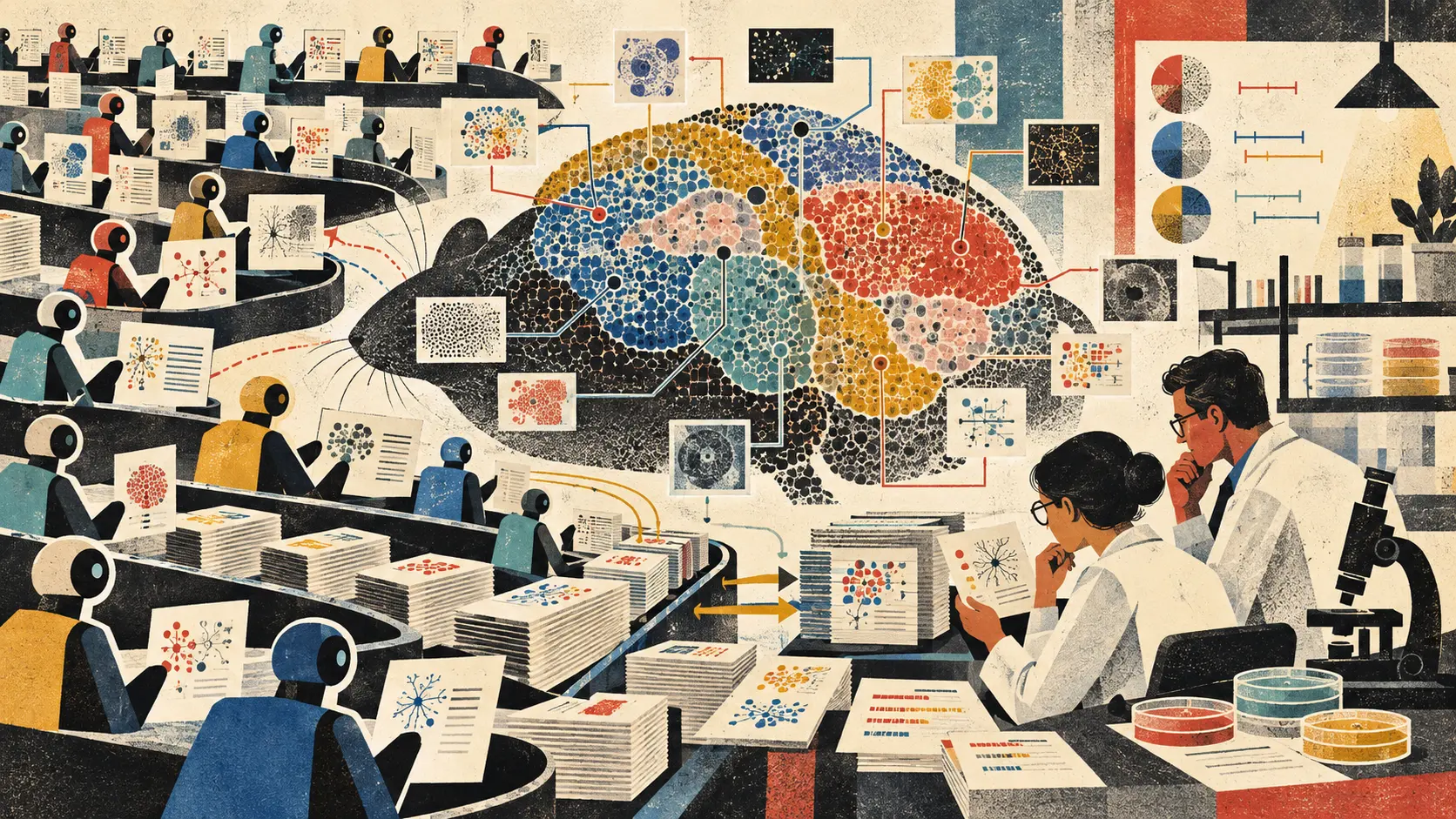
A research team gave thousands of AI agents the same enormous biological puzzle, one small piece at a time. They finished the first pass in 32 minutes. That sentence is designed to make a laboratory manager reach for a calculator. On October 21, OpenAI, PerturbAI and Scripps Research described a system they call distributed biological reasoning. The team applied it to an existing whole-brain CRISPR atlas built from millions of mouse brain cells. The underlying dataset measures what happens across many cell types when researchers disrupt disease-linked genes. Instead of asking one model to read the whole experiment, the researchers assigned separate agents to individual gene disruptions. Each agent examined cellular responses, searched scientific literature and proposed explanations. The system then combined those reports into a reasoning atlas linking genes, observed effects, papers and possible mechanisms. The public announcement says the parallel run took 32 minutes. The researchers estimate that a comparable one-by-one human review could take months to a year. That is the impressive part. Here is the part worth slowing down for: the agents did not discover a treatment in 32 minutes. They generated and ranked research leads from data that already existed. Those leads include possible differences in how two disease-linked genes affect brain cells and a possible connection between cholesterol regulation and neurodegeneration. Interesting? Absolutely. Established? Not yet. The paper is a bioRxiv preprint, so it has not completed peer review. The cells came from mice, not people. A transcriptional pattern is not a clinical outcome. A literature-supported explanation is not a causal mechanism. And an agent's confidence is not a substitute for an experiment designed to prove it wrong. This is not a reason to dismiss the work. It is the reason to use it properly. Large biological experiments routinely produce more observations than a research team can investigate. The bottleneck has moved. Scientists can perturb thousands of genes and profile millions of cells, then spend months deciding which odd result deserves the next expensive assay. Distributed agents could make that triage much better. They can give every perturbation a first reading, collect relevant literature, expose patterns across reports and keep obscure observations from disappearing beneath the obvious ones. The public repository matters here. It contains the agent framework, corpus tooling, saved predictions, reports, prompts, run measurements and notebooks used for the manuscript. The underlying whole-brain dataset is also public. That gives outside researchers something more useful than a launch video: a path to inspect and reproduce parts of the work. Still, a public pipeline does not automatically make every conclusion reliable. The useful operating unit is not the final reasoning atlas. It is an experiment queue. Every lead should enter that queue with a compact evidence packet. Record the perturbation, cell type, measured effect, statistical support, papers retrieved, claim produced, model and prompt version, confidence or ranking signal, known alternative explanations and the cheapest decisive follow-up test. Then put a human name next to the decision. Someone should decide whether the lead is biologically plausible, novel enough to matter, testable with available methods and important enough to consume scarce laboratory time. That reviewer should be able to reject it, merge it with another lead, request a narrower analysis or send it forward. The next stage should be adversarial, not ceremonial. Ask what result would falsify the proposed mechanism. Check whether the effect survives a different guide RNA, analysis method, cell subset and dataset. Look for batch effects, cell-state confounding, off-target edits and literature that points the other way. If a hypothesis survives those checks, move it into wet-lab validation with a preregistered protocol and explicit stopping rule. If it fails, keep the failure in the record. A dead end is useful training data for the scientific team and a warning against similar agent-generated stories later. This is where parallel agents create a new management problem. A system that can generate thousands of plausible leads can bury a laboratory faster than it can enlighten one. Ranking becomes power. The criteria used to select the top ten ideas may determine which genes receive funding, which assays are ordered and which disease mechanisms stay invisible. That ranking needs its own evaluation. Measure how many top-ranked leads reproduce. Compare them with leads chosen by unaided experts and with a simple statistical baseline. Track novelty separately from correctness. Report whether the system favors well-studied genes because those genes have richer literature. Check whether lesser-known pathways are penalized for having fewer citations rather than weaker evidence. The blinded expert review described by the team is encouraging. OpenAI says human experts' assessments of novelty and scientific value aligned with the agents' rankings, and the agents recovered findings from the original human analysis while adding leads. But agreement is not the finish line. Experts can share the literature's blind spots. A convincing narrative can make a weak association feel mature. And ranking a lead as interesting is easier than showing that the proposed mechanism survives a new experiment. The distinction becomes especially important when the language shifts from mouse-brain data to Alzheimer's or Parkinson's disease. Those diseases make every headline feel urgent. The responsible translation is modest: this system may help scientists choose which questions to test next. It does not show that the agents found a therapy, a diagnostic marker or a result that applies to patients. There is a practical opportunity hiding inside that restraint. Research groups could use distributed analysis to revisit old datasets that were published once and rarely mined deeply. Public cell atlases, perturbation screens and imaging repositories contain observations that no small team can read exhaustively. A reproducible agent run could create a searchable layer of candidate connections, each tied back to the underlying measurement and literature. Funding agencies could support independent reruns across models and laboratories. Journals could ask authors to release the complete hypothesis queue, not only the successful anecdotes. Dataset stewards could publish standard splits that prevent a model from seeing the paper it is supposed to recover. Labs could reserve part of their validation budget for agent-selected leads and part for human-selected controls. And teams should publish the funnel. How many perturbations were analyzed? How many claims were generated? How many survived data-quality review? How many were judged novel? How many reached an experiment? How many reproduced? How many changed the team's understanding? Without that funnel, 32 minutes becomes a magic trick. With it, the number becomes useful. It tells us how quickly a machine can assemble a field's clues. The harder question is how efficiently a laboratory can turn those clues into reliable knowledge. The agents have filled the suggestion box. Now science has to empty it carefully.
01
WHAT ACTUALLY CHANGED
OpenAI, PerturbAI and Scripps Research published a distributed biological reasoning study on October 21, 2026
The system assigned separate GPT-Rosalind agents to individual gene disruptions in a whole-brain mouse CRISPR atlas
Each agent examined cell responses, searched literature and proposed an explanation before reports were combined into a reasoning atlas
OpenAI reports that the parallel analysis of data from millions of mouse brain cells took 32 minutes
The agents recovered findings from the original human analysis and produced additional leads for follow-up
Blinded experts reviewed the novelty and scientific value of agent-generated leads
The paper is a bioRxiv preprint and has not completed peer review
The framework, saved analyses and notebooks are available in a public MIT-licensed repository
The underlying whole-brain CRISPR atlas is available as a public dataset
02
WHY THIS MATTERS
Modern perturbation screens can produce more observations than a research team can examine closely
Parallel agents can give every perturbation a first pass without forcing one context window to carry the entire experiment
A reasoning atlas can connect measurements, literature and proposed mechanisms in a searchable structure
Fast interpretation may help laboratories choose scarce follow-up experiments more deliberately
Public code and data create a path for independent inspection that a closed demonstration would not provide
The same system can manufacture far more plausible hypotheses than a laboratory can test
Ranking rules may favor well-studied genes and literature-rich mechanisms over genuinely novel biology
Agreement with expert judgments measures prioritization, not whether a mechanism is biologically true
Mouse-cell findings cannot be translated directly into claims about human disease or treatment
A visible experiment queue can preserve the boundary between generated explanation and verified knowledge
03
WHERE IT COULD HELP
- Create a first-pass interpretation for every perturbation in a large screen
- Link gene effects to supporting and contradicting literature
- Build searchable reasoning atlases for public biological datasets
- Surface neglected observations that did not fit the original paper narrative
- Rank candidate follow-up experiments by novelty, evidence and cost
- Compare agent-selected leads with expert-selected and statistical baselines
- Reanalyze older cell atlases with a documented modern pipeline
- Generate falsification questions and alternative mechanisms for every lead
- Track each hypothesis from model output through review, assay and replication
- Measure literature bias by gene, disease area and publication density
- Share complete hypothesis funnels with reviewers and funders
- Reserve validation capacity for both agent-ranked ideas and independent controls
KEEP A HAND ON THE WHEEL
Watch for peer review of the preprint; independent reproduction of the reported analysis; complete disclosure of prompts, model versions and ranking criteria; tests on different biological datasets; measurements of citation quality and literature bias; comparisons with simpler baselines and unaided experts; the share of top-ranked hypotheses that survive new experiments; corrections to the public reasoning atlas; evidence that findings transfer beyond mouse cells; and whether future reports publish the full funnel from generated lead to replicated result.
04
TERMS WORTH KEEPING
SOURCES AND VERIFICATION STATUS
This article was written from the materials below. Product claims and dates were checked against those sources on October 22, 2026.
THE PUBLICATION ENGINE
WANT A SIGNAL OF YOUR OWN?
We build source-grounded publications, private briefings, and editorial systems for organizations with something useful to say.
WORK WITH US