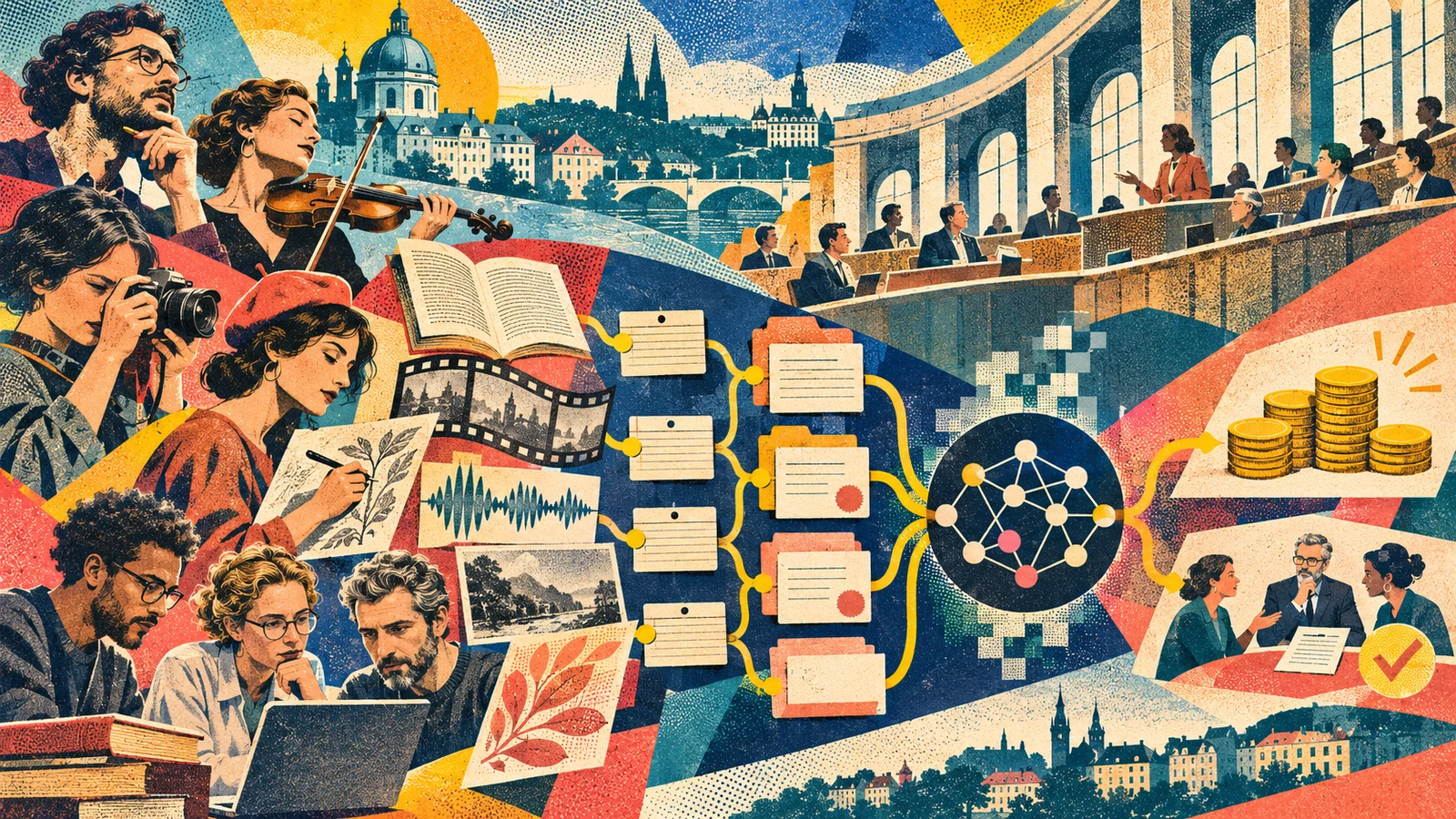
THE SIGNAL IN ONE SENTENCE
Copyright arguments about AI often begin at the wrong end. One side asks whether every training item must be published. The other says a model cannot reveal its entire recipe. Everybody then spends a pleasant afternoon throwing the word transparency across a room. Germany and 14 other European Union member states have now asked the European Commission to move the argument into legislation. On November 20, Germany's federal government said the group, including France, Poland and Spain, had called for a proposal to strengthen copyright in the AI era. The German initiative emphasizes greater transparency around AI training data, effective enforcement of copyright and related rights, fair compensation for creators and lawful access to protected works for AI companies. This is a political request, not a new law. The release does not include the joint letter, a complete signatory list, draft legal text, an enforcement design or a timetable. It also does not settle what level of training-data disclosure would be useful, proportionate or technically possible. Europe is not starting from zero. Article 53 of the European Union AI Act already requires providers of general-purpose AI models to maintain a copyright-compliance policy, identify and respect qualifying rights reservations and publish a sufficiently detailed summary of the content used for training according to an AI Office template. The European Commission says those obligations are now enforceable. Its guidance also describes documentation about the type, provenance and curation of training, testing and validation data. The new German-led request is therefore not simply a request to discover copyright for the first time. It is a demand for a stronger legal environment around access, enforcement, payment and creative work. The plain signal is this: a workable rule needs an evidence chain. Not a 40-page PDF that says the model learned from public web data, licensed collections and user material. Not a demand to publish every engineering choice and private contract. A durable chain of records that lets the right people answer the right question. Where did the material come from? What rule or licence allowed its use? Was a rights reservation present? Which model or dataset version received it? Can a creator make a claim? Can an auditor test the record? What happens when the answer is wrong? Start at acquisition. An AI provider should record the source collection, acquisition date, collector or supplier, access method, relevant territory, content category and the technical identity of the captured material. The record does not need to put every work into a public downloadable database. That could expose personal information, confidential material, security details and the works themselves. But the provider needs an internal inventory precise enough to reproduce the decision. A newspaper article collected by a crawler, a photograph bought through a dataset vendor, a book supplied under licence, a public-domain score and a user-uploaded document do not arrive with the same rights. Treating them as one bucket named internet data is not documentation. It is weather. Preserve the acquisition logs. Record crawler identity, time, response, robots instructions, machine-readable rights signals, account terms, access controls and any reservation of rights. If the provider receives a bulk archive, preserve the supplier manifest, warranties and audit rights. Do not assume a vendor contract proves every file inside the package was lawfully supplied. Next, attach the rights basis. For each source or coherent collection, record whether the provider relies on a licence, public-domain status, statutory exception, authorization from a rightsholder, an employment agreement or another legal basis. Name the territory, duration, permitted uses, model families, redistribution limits, payment terms and withdrawal conditions. Legal conclusions can be contested. The ledger should show the conclusion and the evidence behind it, not pretend the conclusion fell from the sky. Machine-readable reservations need a receipt too. If a rightsholder uses an accepted method to reserve a work from text and data mining, the collection system should log that signal and the action taken. If the signal was absent, malformed, contradicted or added later, preserve the date and the handling rule. This matters because the web changes. A crawler that visits on Tuesday cannot reconstruct Saturday's instructions from a current page and call the result an audit. Then create a transformation record. Raw material may be deduplicated, filtered, transcribed, translated, captioned, chunked, scored, combined with metadata or converted into another representation. Those steps can remove identifiers that a creator would later need. Assign stable internal references before transformation. Preserve the mapping from source item to processed item, dataset release and model run wherever technically and legally appropriate. If exact item-level mapping cannot survive a process, state the boundary and retain the best available collection-level evidence. Do not promise forensic precision the system was never designed to provide. Version everything. Training data are not one eternal lake. They are releases. Record which dataset version entered which pretraining, fine-tuning, reinforcement, retrieval or evaluation stage. Record additions, exclusions, corrections and known gaps. Link the model card to the underlying data and rights records without publishing sensitive implementation details. A creator's claim must point to a version. So must a provider's defense. Now separate public transparency from confidential audit access. The public summary should be useful enough for creators, researchers and regulators to understand major sources, content categories, languages, periods, collection methods, licensed collections, synthetic material and exclusion practices. It should not be a scavenger hunt through terms such as broadly available sources. At the same time, public disclosure is not the only disclosure. Regulators and qualified independent auditors can receive more detailed inventories, sample records, contracts, acquisition logs and transformation evidence under appropriate confidentiality and security rules. Creators pursuing a specific claim can receive information relevant to that claim without gaining a map of the entire model pipeline. That is proportional transparency. Different audiences see different layers, while the underlying record remains connected. Give creators a claim route that does not require a lawsuit as the first user interface. A rightsholder should be able to identify a work, provide evidence of ownership or representation, state the suspected use and receive a case number. The provider should explain what information is needed, how it will search, what response time applies and how a decision can be challenged. The route must work for an independent illustrator with three works, not only a collecting society with a legal department. It also needs protection against fraudulent claims. Verify identity and authority. Handle joint authorship, publishers, labels, estates, agencies, licences and conflicting registrations. Preserve who submitted what and when. Do not let a false claimant remove another person's work or collect their payment. Correction is more complicated than deletion. Removing a source file from the next dataset release is possible. Removing its influence from an already trained model may require retraining, targeted unlearning, output controls, compensation or another remedy. The correct response will depend on the use, evidence, harm, model architecture and law. Publish the remedy menu and its limits. State when a work can be blocked from future collection, removed from a dataset, excluded from a model update, addressed through unlearning, restricted at output, licensed retroactively or compensated. State how the result is tested and which model versions remain affected. A button labeled opt out is not enough if nobody can explain what it changes. Compensation needs its own ledger. If a scheme pays creators, publish the eligible uses, calculation method, revenue or usage basis, deductions, administrative cost, distribution schedule, unmatched funds and dispute process. Avoid the magical pool of money problem. A large fund can still produce tiny or arbitrary payments if nobody can see how works, uses and recipients connect. Collective licensing may be practical for some sectors. Direct licences may work for others. Public-interest exceptions and open licences remain important. One payment model will not fit novels, news, music, photographs, software, film and scientific literature. The evidence chain should support several lawful paths rather than quietly picking a winner. Small AI companies need a usable compliance route too. A rule that only the largest providers can implement can harden their advantage. Publish standard rights signals, licence terms, inventory fields, audit formats and claim interfaces. Create shared tools for checking reservations, recording provenance and purchasing legitimate access. Scale obligations by risk and volume without making smallness a free pass. A startup training on a narrow licensed collection should not need the same public apparatus as a frontier model trained across the web. It should still be able to show where the material came from and why it was used. Independent oversight closes the loop. Audit a representative sample from source to model release. Test whether rights reservations were detected. Reconcile licences against collected material. Submit controlled creator claims. Check response times, correction decisions and payment records. Publish findings, error rates and repairs without exposing protected works or confidential system details. The most useful metric may be boring: what percentage of sampled items had a complete, consistent rights record? That number would tell Europe more than a hundred speeches about balance. Germany and its partners have identified a real problem. Creative work is entering powerful systems, and creators often cannot tell whether it was collected, licensed, excluded or paid for. AI companies also need a lawful, predictable way to obtain material without solving copyright again for every dataset. The political announcement has not supplied that mechanism. The Commission has not yet produced the requested proposal. The participating countries have not agreed on a detailed transparency standard, claim system, remedy or compensation model. Those blanks matter. Fill them with an evidence chain. Source. Rights basis. Reservation. Transformation. Dataset version. Model run. Public summary. Confidential audit. Creator claim. Remedy. Compensation. That chain will not settle every copyright dispute. It will at least ensure the dispute arrives with receipts.
01
WHAT ACTUALLY CHANGED
Germany says 14 other European Union member states, including France, Poland and Spain, asked the European Commission for an AI-era copyright proposal.
The German initiative calls for stronger transparency around AI training data and more effective enforcement of copyright and related rights.
The stated goal includes fair compensation for creators alongside lawful access to protected works for AI companies.
The request follows existing European Union AI Act duties for general-purpose AI providers, including a copyright policy and a public training-content summary.
The announcement does not publish draft legislation, the joint letter, a complete signatory list, an enforcement design or a timetable.
No new copyright rule or compensation scheme was enacted by the November 20 announcement.
02
WHY THIS MATTERS
Creators often lack a practical way to determine whether a work entered a training collection, under which rights basis or in which model version.
AI providers need predictable, auditable access rules rather than uncertainty that appears only after a model is trained.
A public training summary can remain too broad unless it connects to detailed records available for regulators, auditors and specific claims.
Machine-readable rights reservations are useful only when collection systems preserve the signal and the response at the time of acquisition.
Compensation cannot be evaluated unless eligibility, calculation, deductions, unmatched funds and dispute handling are visible.
Standard records and claim interfaces can improve compliance without reserving lawful AI development for the largest companies.
03
WHERE IT COULD HELP
- Record source, acquisition date, collector, access method, content category, territory and stable item or collection identifiers.
- Attach the licence, legal basis, permitted use, duration, territory, payment terms and withdrawal conditions to each collection.
- Log robots instructions, accepted rights reservations and the action taken at collection time.
- Preserve mappings through filtering, deduplication, transcription, translation and other transformations.
- Version datasets and connect every training, fine-tuning, retrieval and evaluation stage to the relevant release.
- Publish useful collection-level summaries while giving regulators and qualified auditors controlled access to detailed evidence.
- Create an accessible creator claim route with identity checks, response deadlines, evidence standards and an appeal process.
- Define remedies for future collection, dataset removal, model updates, unlearning, output controls, licensing and compensation.
- Publish payment calculations, deductions, distribution schedules, unmatched funds and disputes for any compensation scheme.
- Audit representative records from source to model and publish completeness rates, failures and repairs.
KEEP A HAND ON THE WHEEL
The November 20 German announcement is a political request for a European Commission proposal. It is not enacted legislation, a settled transparency definition, an agreed compensation system or a new enforcement mechanism. The release does not include the joint letter, complete signatory list, legislative text or timetable. Existing European Union AI Act obligations already require general-purpose AI providers to maintain a copyright policy and publish a sufficiently detailed summary of training content. A future proposal would need to explain what it adds or changes. Watch for a Commission consultation or draft, precise disclosure layers, accepted machine-readable rights reservations, audit access, creator claim procedures, remedies for already trained models, treatment of trade secrets and personal data, small-provider obligations, compensation design and coordination with existing AI Act enforcement.
04
TERMS WORTH KEEPING
OPEN GLOSSARY CARD
Provenance
The documented origin and history of material, including who created, edited, translated, funded or transmitted it.
OPEN GLOSSARY CARD
Provenance
A traceable record of where an object or dataset came from, who held or changed it and how it reached its current form.
OPEN GLOSSARY CARD
Text and data mining
Automated analysis of large collections of material to identify patterns, relationships, or information.
SOURCES AND VERIFICATION STATUS
This article was written from the materials below. Product claims and dates were checked against those sources on November 21, 2026.
THE PUBLICATION ENGINE
WANT A SIGNAL OF YOUR OWN?
We build source-grounded publications, private briefings, and editorial systems for organizations with something useful to say.
WORK WITH US