THE SIGNAL IN ONE SENTENCE
European Central Bank President Christine Lagarde used a September 14 speech in Vienna to make an unusually practical case for European AI infrastructure. Her argument is not that every useful model must be invented in Europe or that foreign technology is automatically dangerous. It is that a service woven into customs, tax systems, hospitals, trains, banks, factories, and offices creates a different kind of dependency. A supplier can change the price, licence, model, safety policy, data route, or availability after an organization has designed its work around the service. Lagarde says Europe needs more local computing capacity, European models that are good enough for ordinary work, and continued access to the global frontier. That is a policy proposal, not evidence that anyone plans to switch Europe off. The useful signal is simpler: before an institution calls an AI service essential, it should know whether the service can disappear and what still works the next morning.
01
WHAT ACTUALLY CHANGED
Lagarde published the full speech, titled A new age of capital: growth, sovereignty and AI, on September 14. She said Europe should adopt AI quickly for productivity while building enough domestic capacity to protect data, maintain access, and retain economic choice. Reuters independently reported the remarks from Vienna the same day.
The speech presents adoption as both an opportunity and a financing problem. Lagarde said euro area firms expect to devote roughly 10 percent of total investment to AI in 2026, that AI-related borrowing accounted for about one quarter of the first-quarter growth in credit to firms, and that more than half of euro area workers now use AI at work. She cited ECB scenarios in which rapid adoption could lift total factor productivity by as much as 4 percent over a decade. That is an upper scenario, not a guaranteed gain.
Lagarde also set out the infrastructure imbalance. Citing the Stanford AI Index and Epoch AI, she said the United States produced 59 notable models in 2025, China produced 35, and France and the United Kingdom produced one each. She said the United States hosts about three quarters of global AI computing capacity while Europe hosts about 5 percent. These measures describe selected notable models and estimated cluster performance, not every model or computer in either region.
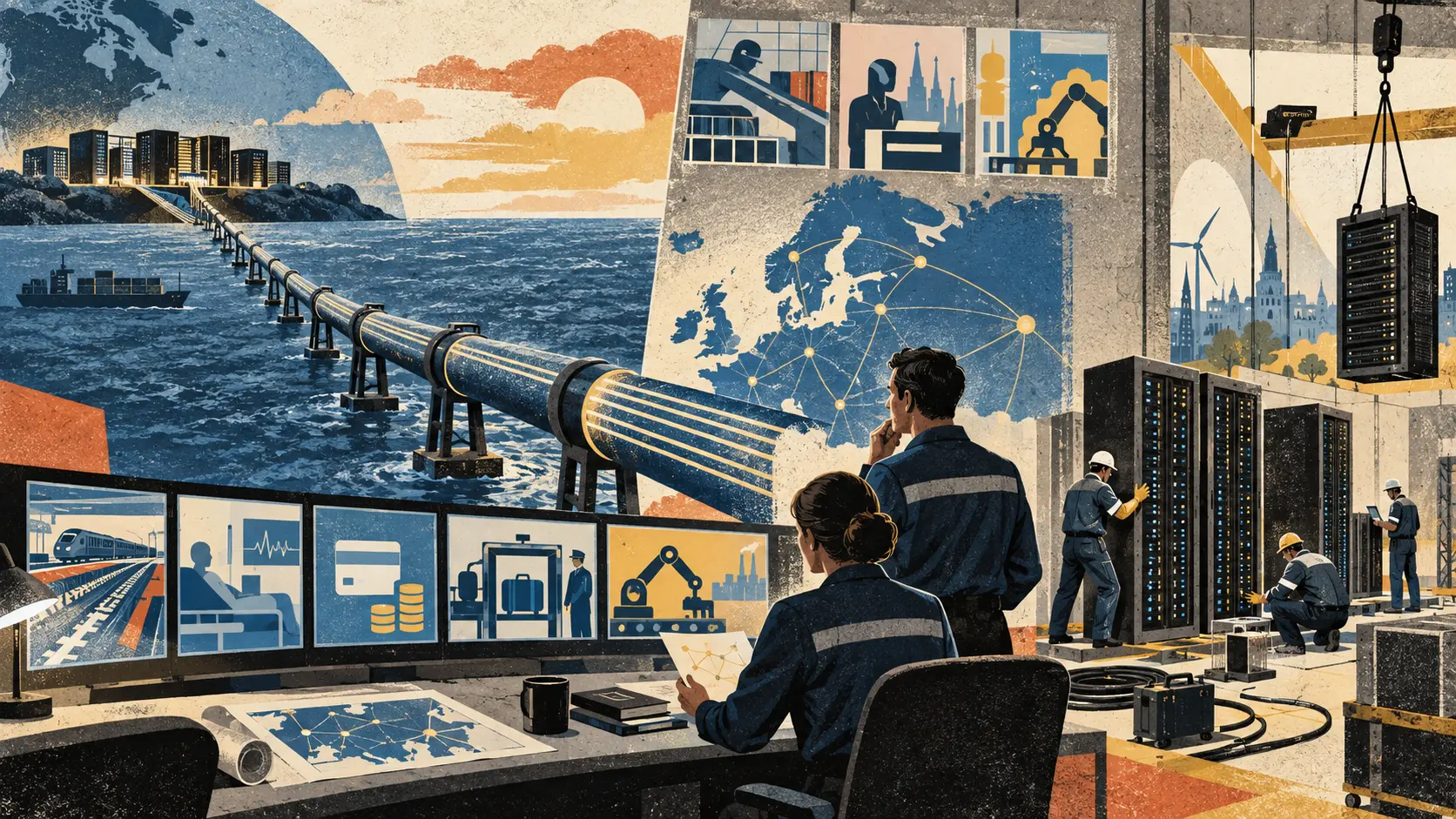
The new security claim concerns simultaneous exposure. Lagarde said a withdrawal of access, or a change in terms, could eventually reach border screening, tax audits, train dispatch, patient monitoring, and bank payments at the same time. She argued that models running on European infrastructure would reduce that leverage for common workloads, even if they were not the best models in the world.
The speech gives the capacity problem a scale and a price. An underlying European Commission study projects Europe's data-centre capacity gap rising from about 3 gigawatts in 2025 to roughly 20 gigawatts by 2036. Lagarde said closing the gap could cost as much as 600 billion euros including chips. Her footnote explicitly calls that figure an upper bound because it applies the cost of GPU-dense AI facilities to a gap that includes other kinds of data centres.
02
WHY THIS MATTERS
AI dependency is not one cable with one plug. It is a stack of models, model weights, application interfaces, cloud accounts, chips, electricity, networks, identity systems, safety filters, software updates, licences, payment rails, and specialist labour. A European data centre can still depend on a foreign model and foreign accelerators. A downloadable model can still depend on a licence, an unsupported software library, or scarce hardware. Sovereignty is a map of dependencies, not a sticker on the server-room door.
Continuity matters most when the AI system becomes boring. A pilot chatbot can be turned off with limited damage. A service that routes trains or prioritizes hospital work creates queues, deadlines, and human habits around its output. If it disappears, the organization needs current data, trained people, conventional procedures, and enough capacity to take back control. A fallback that has not been exercised is closer to a wish than a plan.
Lagarde's good-enough argument is economically interesting. Most organizations do not need the frontier model for every email, document search, translation, classification, or internal workflow. A smaller or slightly older system may be sufficient if it can run predictably under local rules. The trade is not simply more intelligence against less intelligence. It can be capability against continuity, price stability, auditability, latency, data location, and the freedom to change vendors.
Open weights can reduce cut-off risk because an organization can keep a copy of a model and run it on infrastructure it controls. They do not freeze the ecosystem. Future versions may use different licences, require different hardware, or never be released openly. A downloaded model also needs evaluation, security maintenance, deployment software, and people who can operate it. Possession helps. Maintenance keeps possession useful.
The capital argument reaches ordinary savers and borrowers. Lagarde said euro area households hold about 440 billion euros in United States technology companies and that large American technology firms are increasingly borrowing in euro markets to finance AI infrastructure. Europe can share in those returns, but it can also absorb market losses and higher borrowing costs while much of the physical capacity and resulting growth stays elsewhere. Her proposed answer is deeper European equity markets, not a ban on foreign investment.
03
WHERE IT COULD HELP
- For every essential AI workflow, list the model, cloud, application interface, hardware, identity provider, network, licence, update channel, payment method, and jurisdiction that can interrupt it
- Define a maximum tolerable outage, keep a conventional process and current data ready, train the people who would take over, and run a timed recovery exercise
- Split workloads by required capability so routine jobs can move to a local or open-weight model while genuinely frontier-dependent work has a separate access and contingency plan
- Test portability before procurement by moving representative prompts, tools, retrieval indexes, logs, and evaluations between two providers or into a self-hosted environment
- For public investment, publish expected workloads, capacity, energy and water needs, financing terms, utilization targets, security requirements, environmental effects, and a method for measuring public value rather than counting announced gigawatts
KEEP A HAND ON THE WHEEL
Lagarde's speech is an official policy argument, not a forecast that the United States, China, or a private supplier will cut Europe off. Her productivity estimate is an ECB scenario about total factor productivity and uses the phrase up to. The model counts rely on the Stanford AI Index definition of notable models, and the computing shares rely on estimates of large AI clusters. They do not count all software or all data-centre capacity. The projected gap of roughly 3 gigawatts in 2025 and 20 gigawatts in 2036 is a baseline from a Commission-commissioned study, not measured future demand. The 600 billion euro figure is an explicit upper bound produced by applying an estimated GPU-dense facility cost across a broader data-centre gap. Local infrastructure does not automatically provide competitive models, lower prices, privacy, security, skilled operators, reliable power, or public benefit. Open weights do not guarantee future releases or permanent licence terms. Watch for the underlying Commission study, project-level costs, energy and water plans, procurement rules, interoperability tests, public-service fallback exercises, independently measured utilization, and proof that European users can change suppliers without rebuilding their entire workflow.
04
TERMS WORTH KEEPING
OPEN GLOSSARY CARD
Digital sovereignty
The practical ability to control important digital systems, data, rules, suppliers, and continuity rather than depending on one outside service.
OPEN GLOSSARY CARD
Compute capacity
The amount of processing work that computers and data centres can perform within limits such as time, power, memory, cooling, and network access.
OPEN GLOSSARY CARD
Chokepoint
A scarce part of a supply chain or system whose loss can restrict many downstream users at once.
SOURCES AND VERIFICATION STATUS
This article was written from the materials below. Product claims and dates were checked against those sources on September 14, 2026.
PUBLICATION RECEIPT: Revision 1. Published September 14, 2026.
THE PUBLICATION ENGINE
WANT A SIGNAL OF YOUR OWN?
We build source-grounded publications, private briefings, and editorial systems for organizations with something useful to say.
WORK WITH US