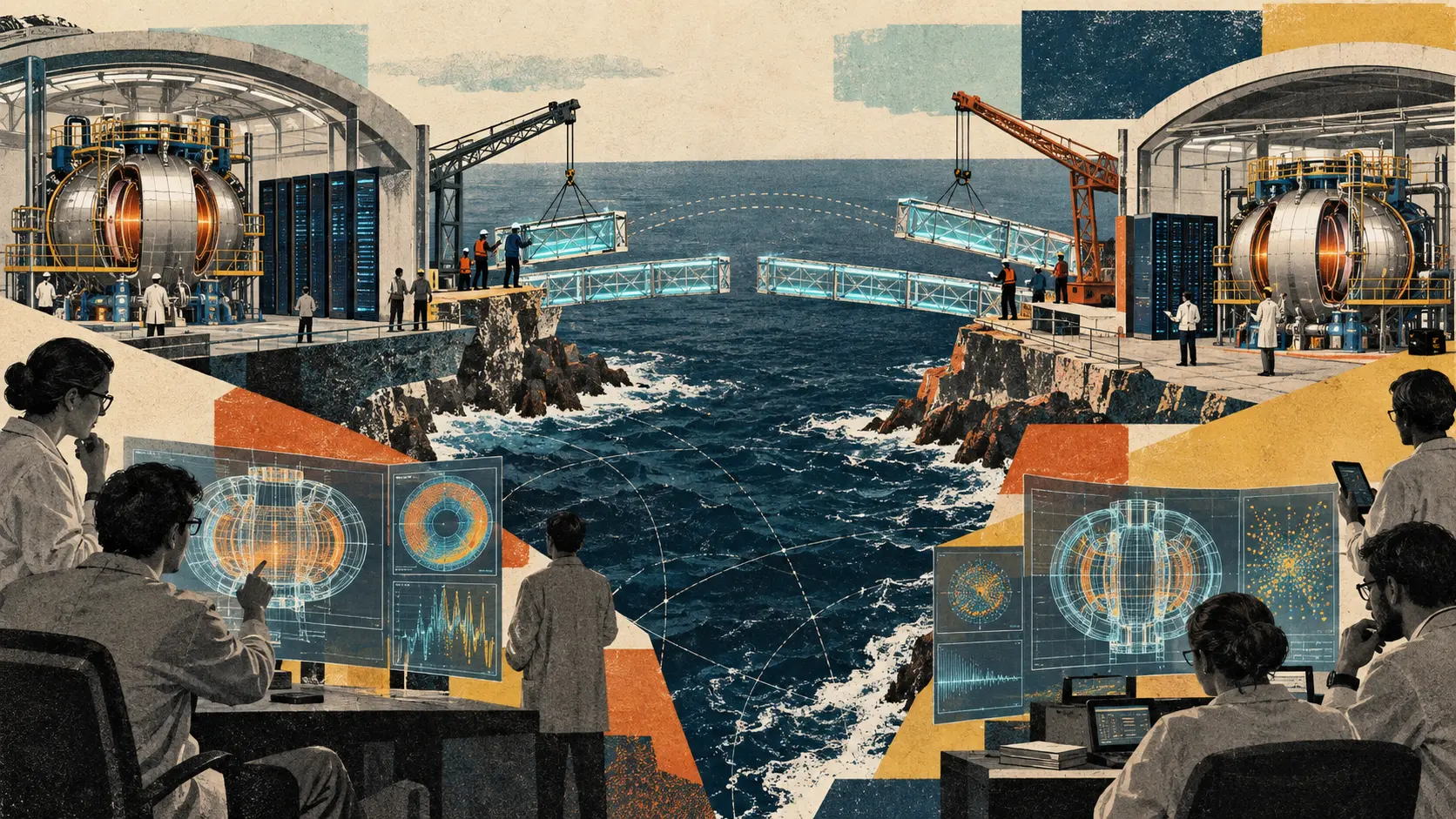
THE SIGNAL IN ONE SENTENCE
The United Kingdom Atomic Energy Authority and the Princeton Plasma Physics Laboratory signed a declaration on September 14 to explore connecting two AI and supercomputing platforms for fusion research. The proposed SUNRISE and STELLAR-AI federation would let researchers train models with results from two related experimental machines, move computing jobs to the hardware best suited to them, and test whether a prediction learned in one laboratory survives contact with another. That last part is the real signal. An AI model can look clever when it memorizes the habits of one machine. Fusion engineers need tools that still work when the sensors, operating conditions, geometry, and plasma behavior change. The partners have a sensible research plan and serious computers. They do not yet have a live federation, a published shared dataset, a benchmark result, or evidence that AI has shortened the path to commercial fusion power. The bridge is on the drawing board, and that is still worth examining.
01
WHAT ACTUALLY CHANGED
UKAEA and PPPL signed a Joint Declaration of Intent at the Global Fusion Policy Summit in London on September 14. The document creates a plan to explore a SUNRISE and STELLAR-AI federation. The partners say they want models, experimental results, and computing jobs to move between the British and American platforms. A declaration of intent is a formal research commitment, not confirmation that the systems are already connected.
The scientific case rests on two experimental spherical tokamaks. UKAEA operates MAST Upgrade, and PPPL operates NSTX-U. Both use a compact configuration often described as resembling a cored apple. Their similar designs make cross-machine learning plausible, while their differences create a harder and more useful test than training and evaluating on one facility alone.
Researchers plan to combine experimental results with simulation to fill gaps and extend the training material into conditions the machines have not yet explored. They are also considering digital twins, software representations updated with experiment data so engineers can test proposed changes and predict behavior before applying them to hardware. These are planned uses. No digital twin, shared foundation model, or validated cross-machine predictor was released with the announcement.
The computing platforms have public investment behind them. The United Kingdom says SUNRISE is its first AI supercomputer dedicated to fusion and is backed by 45 million pounds. It is the first computing phase of the AI Growth Zone at UKAEA's Culham Campus. PPPL says STELLAR-AI is a 13 million dollar AI and high-performance computing platform supported by Princeton University and intended to host fusion workflows as they mature.
The September declaration builds on a memorandum of understanding signed in June and a planning workshop held online on September 9 and 10. The longer-term ambition includes a shared foundation model for spherical tokamaks and later support for more tokamak designs. The releases do not publish a network architecture, operating date, data-governance agreement, model specification, security assessment, performance target, or procedure for allocating scarce computing time.
02
WHY THIS MATTERS
Fusion research produces expensive, uneven evidence. Each experiment is constrained by machine time, sensors, operating limits, maintenance, and safety. Simulation can add controlled examples, and machine learning can build faster approximations of slow physics calculations. The combination may help researchers screen designs, choose experiments, estimate hidden plasma states, detect instability, and interpret results. It does not repeal the physics or turn simulated success into electricity.
Cross-machine testing attacks a common AI weakness. A model trained on one instrument can learn details that do not generalize, including sensor placement, calibration, control software, or a narrow operating range. Testing on a related but distinct tokamak can reveal whether the model learned a transferable physical relationship or merely a local accent. A worse result on the second machine can be valuable because it tells scientists where confidence ends.
Moving work between two computing systems is also an engineering test. Hardware differs. Software libraries, numerical precision, data formats, scheduling rules, identity systems, and security controls differ too. Reproducing the same result across platforms requires versioned code, traceable data, documented environments, and agreed evaluation methods. Federation is useful only when the result can travel with its evidence intact.
Digital twins sound more complete than they usually are. A fusion twin may represent particular components or behaviors at a useful level of detail. It will still contain approximations, uncertain parameters, missing measurements, and regions where no experiment has validated it. Engineers need to know what the twin includes, when it was updated, how uncertainty is shown, and which decisions still require physical testing.
The international angle matters because no single laboratory owns every machine, dataset, material test, computing architecture, and engineering skill required for fusion. Shared tools could reduce duplicated work and expose models to broader evidence. They also create questions about access, export controls, intellectual property, cybersecurity, research publication, and who benefits when public data helps produce a commercial system. Those rules belong in the federation design, not in a footnote after the cables are connected.
03
WHERE IT COULD HELP
- For cross-machine learning, reserve one facility or operating campaign as a genuine external test and publish performance by condition rather than one blended score
- Attach every model result to its training-data versions, simulation assumptions, code commit, hardware environment, uncertainty range, and failed cases so another laboratory can reproduce it
- Use fast surrogate models to propose experiments or screen designs, then require higher-fidelity simulation, expert review, and physical measurement before consequential engineering decisions
- Define which datasets, models, jobs, logs, and results may cross the federation, who can access them, how export controls and intellectual property apply, and how credentials are revoked
- Measure the partnership by completed cross-platform runs, reproducible findings, prediction error on the second machine, researcher access, compute utilization, and documented design decisions, not by the number of systems named in a press release
KEEP A HAND ON THE WHEEL
The September 14 announcements describe a Joint Declaration of Intent and proposed federation. They do not establish that SUNRISE and STELLAR-AI are already linked or that researchers are currently pooling all MAST Upgrade and NSTX-U data. The 45 million pound and 13 million dollar figures describe announced platform investments, not the cost of the federation itself. Similar spherical tokamak designs do not make measurements interchangeable. Simulation can extend a dataset but can also carry assumptions and modelling errors into training. A digital twin is not a complete duplicate of a physical machine, and a foundation model is a long-term ambition rather than a released artifact. Neither laboratory published a model, dataset, benchmark, external validation result, network plan, cybersecurity review, energy-use figure, compute-allocation process, or estimate of time saved. The broader United Kingdom announcement connects the work to a 2040 STEP prototype goal and future commercial fusion, but this partnership is not evidence of net-electricity production, an economic power plant, or a new delivery date. Watch for an operating federation, named research projects, data and access rules, cross-machine baselines, negative results, reproducibility reports, peer-reviewed findings, and evidence that any AI recommendation improves a real experiment or engineering decision.
04
TERMS WORTH KEEPING
OPEN GLOSSARY CARD
Digital twin
A software representation of a physical system that uses measurements and models to estimate current state or simulate possible future behavior.
OPEN GLOSSARY CARD
Spherical tokamak
A compact magnetic fusion device whose plasma chamber has proportions often compared with a cored apple.
OPEN GLOSSARY CARD
Digital twin
A software representation of a physical system that is updated with measurements and used to test or predict selected behavior.
SOURCES AND VERIFICATION STATUS
This article was written from the materials below. Product claims and dates were checked against those sources on September 14, 2026.
PUBLICATION RECEIPT: Revision 1. Published September 14, 2026.
THE PUBLICATION ENGINE
WANT A SIGNAL OF YOUR OWN?
We build source-grounded publications, private briefings, and editorial systems for organizations with something useful to say.
WORK WITH US