THE SIGNAL IN ONE SENTENCE
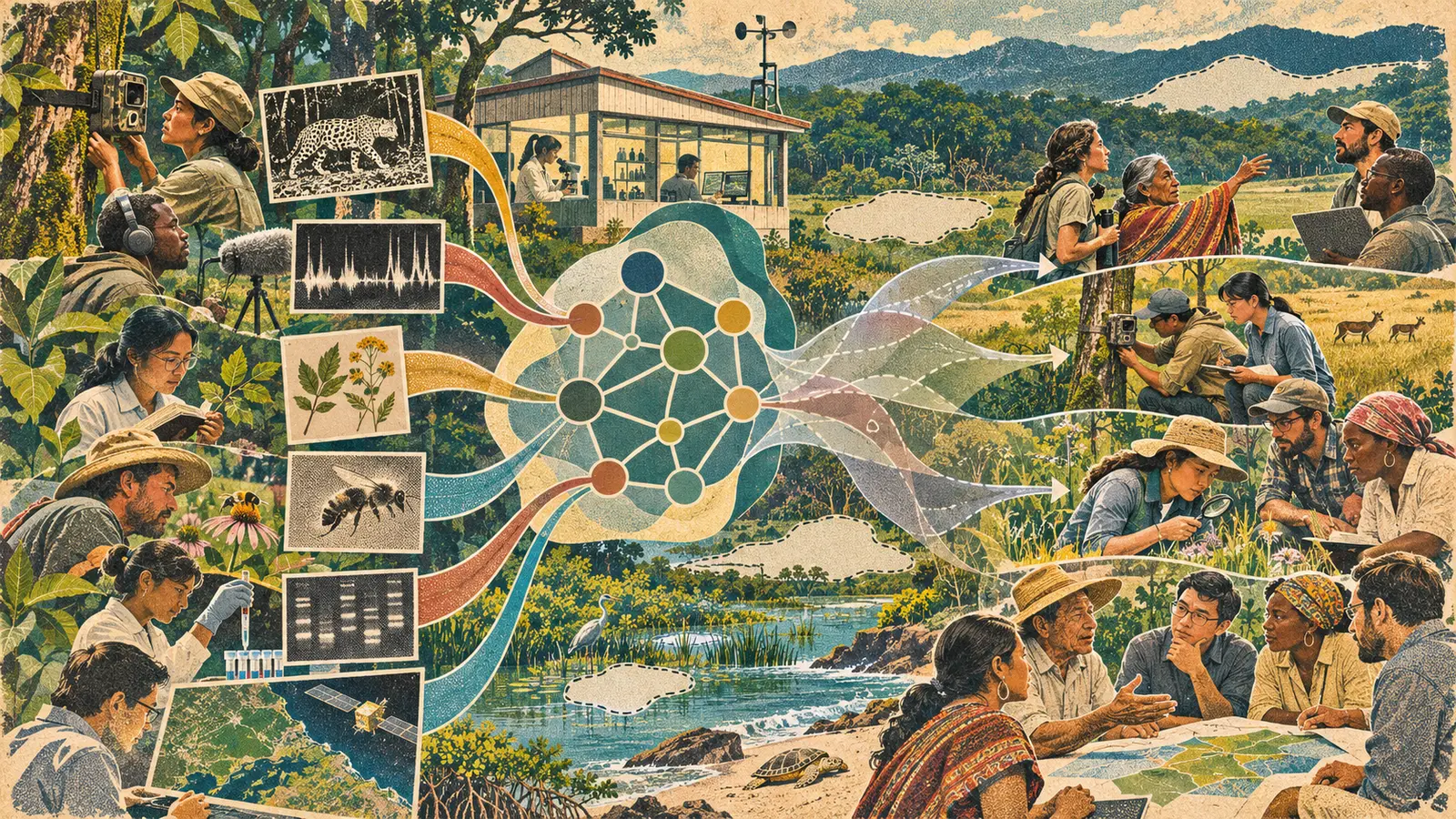
Nature does not arrive as one tidy dataset. It arrives as a moth in a light trap, a frog on an audio recorder, a pollen grain on a microscope slide, a patch of warm ocean in a satellite image, a local name for a medicinal plant, a century of handwritten field notes and a camera trap full of grass moving for reasons that are definitely not a leopard. An international group of ecologists, conservation practitioners and AI researchers wants to connect more of that evidence. In a Perspective published November 6 in Nature Machine Intelligence, the team proposes a roadmap for ecological foundation models, or ecoFMs. These would be large models trained across many kinds of ecological data and informed by ecological theory. The goal is not merely to identify an animal in a photograph. It is to learn representations of organisms, environments and interactions that could transfer across research questions. The proposed inputs span images, acoustic recordings, genetic sequences, traits, weather, climate, satellite imagery, soil, species occurrences, community records and scientific literature. The authors imagine models that could help scientists identify species, connect plants with pollinators, examine food webs, infer missing interactions and forecast how ecosystems respond to climate change or habitat loss. That is the vision. Here is the awkward but important bit: no complete ecological foundation model exists. This paper is a blueprint, not a launch. It does not release a trained general-purpose model, a production forecasting service or a benchmark proving that one system can understand nature. The authors are explicit about what is missing: data infrastructure, ecological architectures, uncertainty methods, evaluation strategies and governance. They are also unusually direct about the traps. Ecological records are lopsided. The Global North is observed more heavily than many biodiversity-rich regions. Birds and familiar vertebrates appear more often than insects, fungi and microbes. Rare species are misidentified. Satellite systems miss life beneath dense canopies and can struggle in aquatic environments. Political instability and historic racist policies have shaped where biodiversity data exist. Indigenous and local knowledge is often absent from datasets, and collecting it without consent, authority or benefit-sharing can turn collaboration into extraction with better graphics. The proposed models could find patterns across those gaps. They could also polish the gaps until they look like facts. So the practical signal is simple: keep the field observation attached. Every ecological prediction should retain a path back to the observations that supported it: where they were made, when, by whom, under what sampling method, with which taxonomy, what was not observed, which communities govern the knowledge and how uncertain the model is outside its familiar range. If a system predicts that an understudied pollinator visits a certain flower, that is a useful lead for a field team. It is not a newly discovered interaction until someone checks the flower, the pollinator, the season and the place. Foundation models are good at compressing a great deal of evidence into a reusable representation. Ecology will need the reverse move too. When the model points somewhere interesting, researchers must be able to unfold the answer back into inspectable evidence, missing evidence and a sensible next observation. The model can suggest where to look. Nature still gets the final review.
01
WHAT ACTUALLY CHANGED
A peer-reviewed Perspective lays out a roadmap for a complete ecological foundation model. The proposal comes from an international team spanning ecology, conservation and machine learning. It argues that current ecological data and theory remain fragmented across tasks, scales and disciplines, which limits how well specialized models generalize beyond the systems that produced them. The authors propose a shared framework that could connect genes, organisms, communities, environments, space and time. This is a research agenda. The paper describes required data, architecture, evaluation and governance, but it does not release the complete model it envisions.
The proposed system would learn from ecological evidence in its native forms. The roadmap includes images, audio, genetic sequences, traits, environmental time series, satellite imagery, species records and other field observations. Modality-specific encoders would turn each source into representations that can be compared and combined. That matters because a language model trained mostly on papers sees ecology after people have already interpreted it. An ecoFM is supposed to connect closer to the original photograph, recording, sequence, location and measurement. The hard part is preserving the context that makes each observation scientifically meaningful.
The architecture combines shared representations with ecological structure. The authors propose multimodal masked learning, tools for inspecting learned representations, uncertainty modelling and graph-based structures for relationships such as food webs, co-occurrence networks and phylogeny. They argue that uncertainty must live inside the representation, not be pasted onto the final answer as a confidence badge. Missing inputs, conflicting modalities and unfamiliar conditions should increase uncertainty and affect downstream predictions.
The paper puts governance and environmental cost inside the technical roadmap. It warns that models trained on today's records may reproduce geographic, taxonomic and historical blind spots. It identifies data colonialism as a risk when knowledge from Indigenous communities or the Global South is used without recognition, authority, local governance or benefit-sharing. The authors also name the energy, water, land and biodiversity costs of model infrastructure. The possible efficiency of pre-training once and adapting many times does not erase the upfront bill, especially if training must be repeated.
02
WHY THIS MATTERS
For field ecologists, a cross-modal model could turn one observation into a better question. A photograph might connect with an acoustic pattern, a weather history, a genetic record and known species interactions. That could help researchers find records they would otherwise miss or prioritize the next survey. The useful output is not a declaration from the machine. It is a testable lead with a location, season, evidence trail and uncertainty range.
For conservation teams, apparent coverage can hide missing life. A global map may look complete while representing birds near roads far better than insects inside tropical forests. A model can interpolate smoothly across a blank region and still be wrong in the exact place where a decision matters. Funding, protected-area planning and restoration should distinguish observed evidence from modelled estimates.
For Indigenous peoples and local communities, ecological data can carry rights, responsibilities and cultural limits. Open science is not a universal permission slip. Knowledge about a plant, habitat or species may be collectively governed, sensitive or tied to a place and purpose. The CARE Principles emphasize collective benefit, authority to control, responsibility and ethics. Model builders need consent and governance that survive after data enter a training pipeline.
For machine-learning researchers, ecology is a hostile test of confident generalization. The same species behaves differently across habitats, seasons and life stages. Rare events can restructure a system. Measurements are uneven, noisy and collected for different questions. A model that succeeds on a random benchmark split may fail when moved to a new region or time period. Evaluation must follow geography, time and taxonomy, not just average accuracy.
For the planet, the infrastructure must earn its ecological cost. Training large models consumes energy and water, while data centers can compete with local ecosystems for resources. An ecology model should publish its compute, emissions, water and hardware footprint, then compare that cost with smaller models, shared representations and the conservation decisions it actually improves. Saving nature by quietly increasing pressure on it would be a fairly on-brand human mistake.
03
WHERE IT COULD HELP
- Attach a field receipt to every prediction. Include source observations, coordinates at an appropriate privacy level, collection date, sampling method, observer, instrument, taxonomy version and data license.
- Separate observed, inferred and unknown. A map should make clear which points came from direct evidence, which areas were estimated by the model and where evidence is too thin for a responsible output.
- Use geographic and temporal holdouts. Test on regions, seasons and years that were not represented in training, rather than relying only on random examples from the same underlying surveys.
- Evaluate by taxonomic group. Publish performance for common and rare species, vertebrates and invertebrates, plants, fungi and microbes instead of hiding uneven results inside one average.
- Preserve modality contributions. Show whether a prediction relied on sound, imagery, satellite conditions, genetics, literature or a proxy, and how the result changes when one source is missing.
- Build an abstain path. When observations conflict, conditions are unfamiliar or uncertainty crosses a threshold, return a request for more field evidence rather than a smooth guess.
- Create a field-verification queue. Rank model suggestions by scientific value, uncertainty, cost and harm, then let ecologists decide which relationships deserve observation.
- Record community authority. For Indigenous and local knowledge, store consent, permitted uses, access limits, benefit-sharing terms, contact points and the community's right to withdraw or correct material.
- Protect sensitive species. Blur or withhold precise locations for vulnerable organisms, nesting sites and culturally restricted knowledge. Access control belongs in the model workflow, not only in a download form.
- Publish an environmental ledger. Report training runs, hardware, energy, water, estimated emissions, data-center region and whether reusing a shared model saved resources relative to separate systems.
KEEP A HAND ON THE WHEEL
This is a Perspective and roadmap, not a released complete ecoFM. Do not describe the proposed capabilities as demonstrated model performance. Watch for an actual training dataset, architecture, checkpoints, licensing terms, evaluation suite and independent results. Ecological evidence is not independent and identically distributed. Nearby observations may share the same survey team, road access, weather or citizen-science community. Random train-test splits can leak those patterns. Watch for evaluation across genuinely new places, time periods, taxa and environmental conditions. The source paper warns that contemporary datasets overrepresent the Global North and familiar vertebrates while undersampling many biodiversity-rich regions, insects, fungi and microbes. Watch for targeted investment in missing regions and taxa, not just clever techniques for filling blanks from existing bias. Model uncertainty is not the same as ecological uncertainty. A system may be confident because its inputs resemble training data while the underlying ecological process remains variable or poorly understood. Watch for methods that distinguish missing data, measurement error, model uncertainty and natural variability. Interpretability can reveal which inputs influenced a representation. It cannot prove that a learned relationship is causal, stable or biologically sensible. Watch for field experiments, mechanistic models and expert review before inferred relationships guide conservation action. Data governance must survive model training. Consent attached to a database row can disappear when information becomes a model weight or embedding. Watch for enforceable community authority, traceable use, benefit-sharing, access controls, correction and withdrawal procedures. Sensitive ecological data create a dual-use problem. Better prediction can support conservation, but it can also expose rare species, valuable genetic resources or culturally restricted knowledge. Watch for threat modelling, tiered access and deliberate limits on what the model will reveal. Finally, follow the environmental bill. The paper argues that one shared model might reduce repeated training for downstream tasks, but that benefit depends on reuse, model size and retraining frequency. Watch for measured energy, water, emissions and habitat effects rather than efficiency claims based on a hypothetical future.
04
TERMS WORTH KEEPING
SOURCES AND VERIFICATION STATUS
This article was written from the materials below. Product claims and dates were checked against those sources on November 7, 2026.
THE PUBLICATION ENGINE
WANT A SIGNAL OF YOUR OWN?
We build source-grounded publications, private briefings, and editorial systems for organizations with something useful to say.
WORK WITH US