THE SIGNAL IN ONE SENTENCE
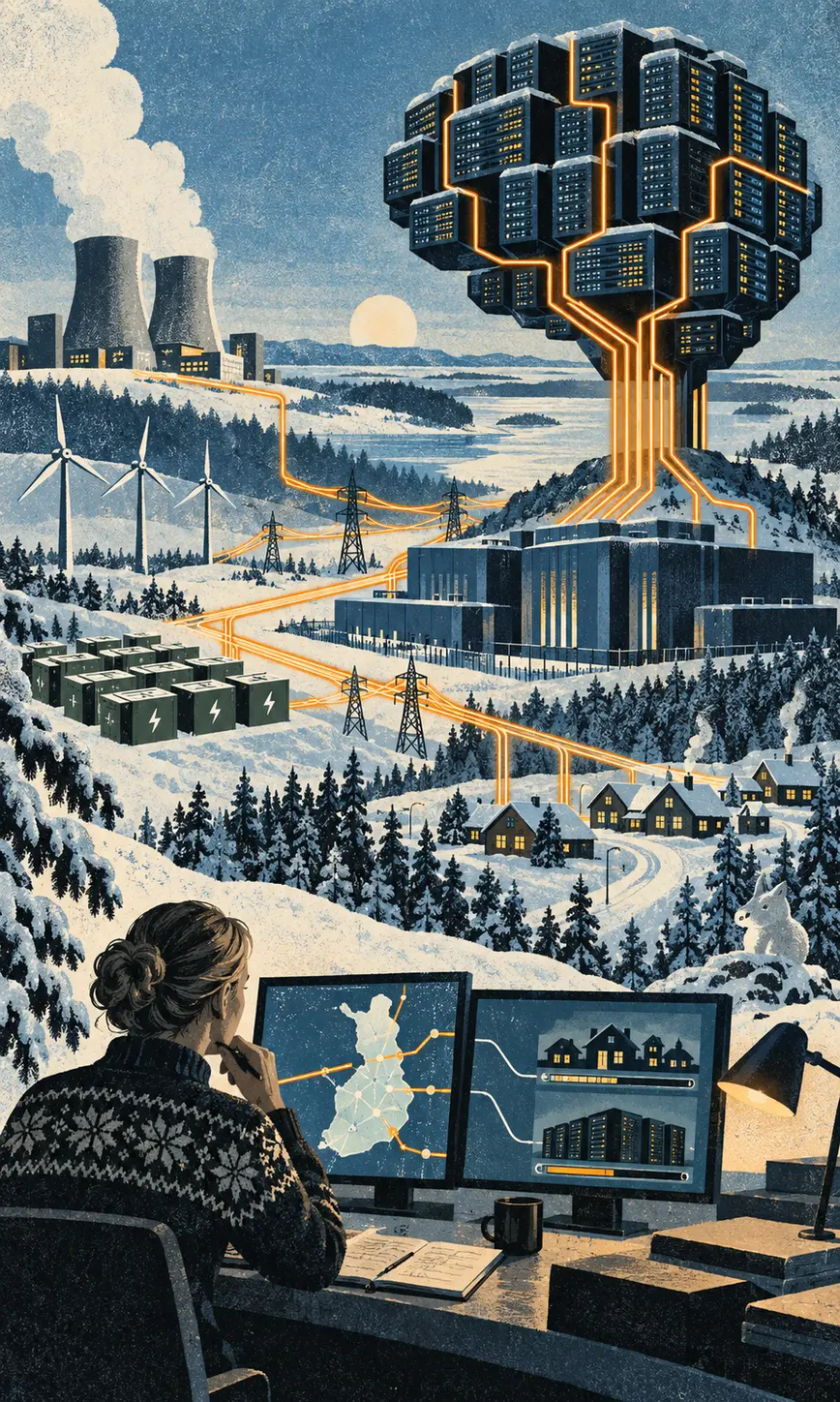
Finland is welcoming a giant expansion of AI data centers only after Google agreed to bring a long-term power plan, including buying as much as half the output of the Loviisa nuclear plant for 22 years.
01
WHAT ACTUALLY CHANGED
Google announced on September 9 that it plans to invest at least €13 billion in Finnish AI and digital infrastructure during 2027 and 2028. Reuters describes it as the company's largest single investment in Europe. The expansion includes three new data centers in northern Finland alongside further work around Google's existing Hamina facility.
The computers arrive with an unusually concrete answer to the obvious question: where does the electricity come from? Google signed a 22-year power purchase agreement with Finnish utility Fortum covering as much as 50 percent of the Loviisa nuclear plant's capacity from 2030 through 2049.
Fortum says that long commitment provides enough certainty to invest nearly €1 billion in extending Loviisa's operating life and improving its performance. The plant currently produces roughly one-tenth of Finland's electricity. The companies will also explore new nuclear generation, renewable power, batteries, and other flexibility services as Google's demand grows.
Finland offers more than cold air, although cold air is a lovely thing when your servers run hot. The country has a stable grid, abundant low-carbon electricity, and political leaders willing to treat large data centers as industrial projects. Google says the construction phase will add about €3.6 billion to Finnish gross domestic product and that the finished investment will support roughly 7,000 jobs annually.
Those economic figures are projections from Google, not audited outcomes. Prime Minister Petteri Orpo said the country has enough electricity and expects production and prices to remain under control. That confidence is now part of the experiment. Finland is not merely hosting computers. It is testing whether a national grid can absorb the AI build-out without quietly sending the bill to everyone else.
02
WHY THIS MATTERS
AI infrastructure announcements usually arrive as a parade of large numbers with the power question politely hiding behind the curtain. This agreement drags it onto the stage. Half of a nuclear plant, plus wind, batteries, grid work, and future generation, makes the physical size of the computing appetite difficult to ignore.
The arrangement changes how a data-center project is financed. A long-term corporate buyer gives Fortum predictable revenue. That certainty can support plant upgrades that would otherwise be harder to justify. In return, Google gets firm low-carbon electricity for machines expected to run every hour, including cold and windless nights when renewable output may be limited.
Finland also gains leverage from geography. Cold weather can reduce cooling demand, and an existing energy system gives it something warmer countries cannot manufacture quickly. The lesson for other regions is not simply to build farther north. It is to match new computing demand with a credible local plan for generation, transmission, storage, workforce, and public benefit.
The public-interest test is tougher than the ribbon-cutting test. A project can create jobs and investment while still tightening the grid, raising local prices, consuming land and water, or concentrating infrastructure gains in a few communities. The useful metric is not the announced euro total. It is whether ordinary Finnish households and businesses still receive reliable, affordable power after the server halls switch on.
This is the emerging bargain behind sovereign AI infrastructure. Countries want investment, technical capacity, and a place in the model economy. Companies want power, land, cooling, and predictable regulation. The smart contract makes both sides carry part of the infrastructure burden instead of treating electricity as somebody else's problem.
03
WHERE IT COULD HELP
- Pair new data-center permits with a disclosed power plan
- Use long-term electricity contracts to finance generation upgrades
- Combine firm power with wind, storage, and grid-balancing systems
- Site compute where climate and existing infrastructure reduce cooling costs
- Measure local jobs, electricity prices, and grid reliability after construction
KEEP A HAND ON THE WHEEL
The investment, job, and GDP figures are company projections, and most construction has not begun. Neither the exact future load of the new data centers nor the complete allocation of grid-upgrade costs is public in the cited material. Nuclear lifetime extensions require regulatory approval and successful engineering work. Policymakers and residents should watch electricity prices, transmission constraints, water and land use, community benefits, and whether promised new generation arrives before demand. A signed power contract is a serious plan, but it is not yet a functioning data center or an extra electron on the grid.
04
TERMS WORTH KEEPING
OPEN GLOSSARY CARD
Power purchase agreement
A contract setting the price and conditions under which electricity is bought from a generator, sometimes over many years.
OPEN GLOSSARY CARD
Power purchase agreement
A long-term contract in which a buyer agrees to purchase electricity from a specific generator or portfolio.
OPEN GLOSSARY CARD
Firm low-carbon power
Electricity expected to be reliably available while producing relatively little carbon pollution.
SOURCES AND VERIFICATION STATUS
This article was written from the materials below. Product claims and dates were checked against those sources on September 9, 2026.
PUBLICATION RECEIPT: Revision 1. Published September 9, 2026.
THE PUBLICATION ENGINE
WANT A SIGNAL OF YOUR OWN?
We build source-grounded publications, private briefings, and editorial systems for organizations with something useful to say.
WORK WITH US