THE SIGNAL IN ONE SENTENCE
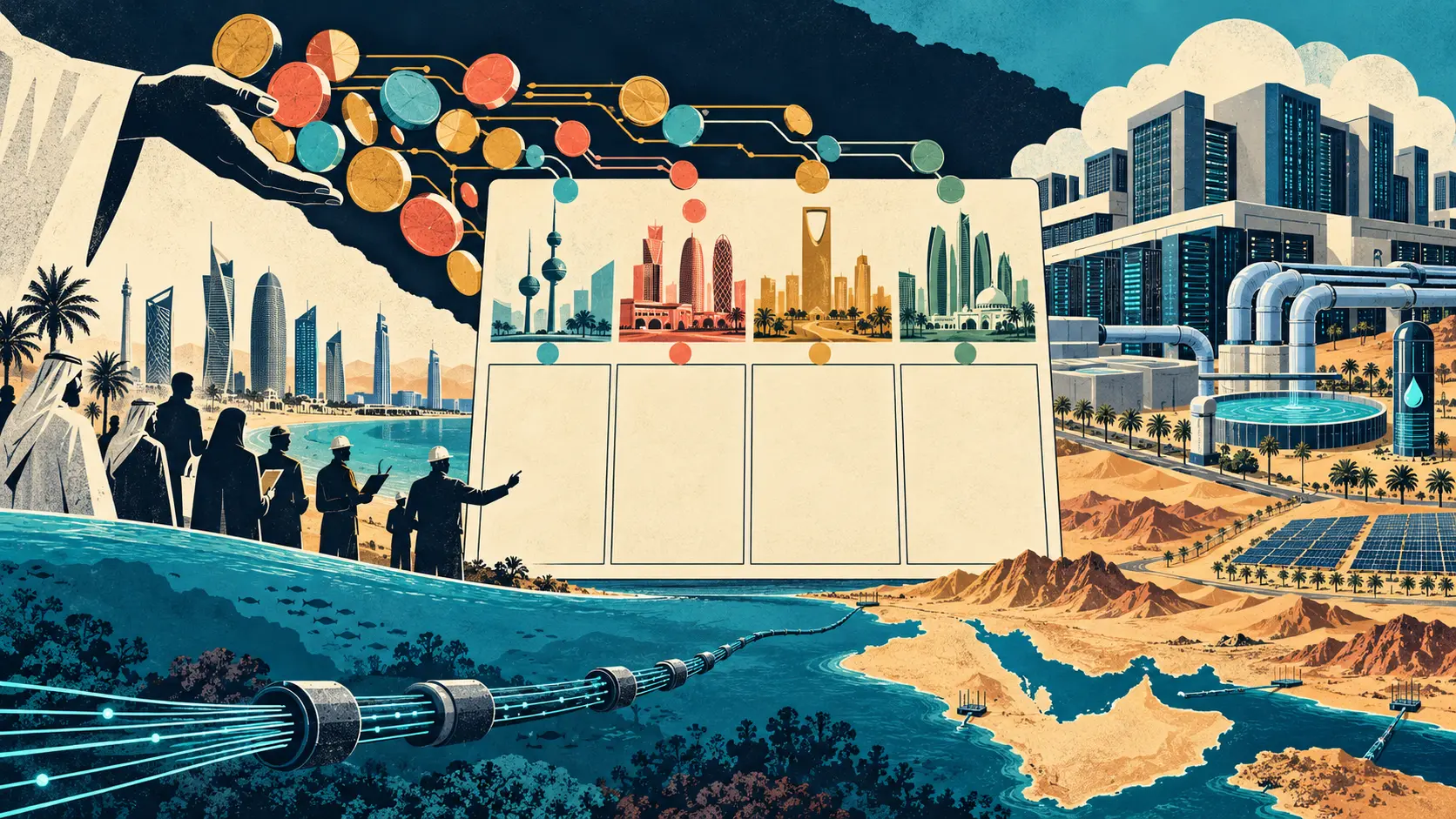
Microsoft has announced a Middle East framework with the sort of number that arrives wearing its own spotlight: more than $10 billion in capital and operating expenses between now and 2030. The plan covers cloud and AI infrastructure in Kuwait, Qatar, Saudi Arabia and the United Arab Emirates. It also includes more than $400 million for subsea and terrestrial connectivity, expanded sovereign-cloud offerings, cybersecurity cooperation, responsible-AI work and skills programs. Those are real categories of activity. They are not a country-by-country bill. Microsoft does not say how much of the $10 billion goes to each country, how much buys long-lived equipment, how much pays ordinary operating costs, which facilities will be built or leased, how much computing capacity will arrive, or what delivery date belongs to any one item. The company also says it is building on commitments to help skill more than 4.2 million people across the four countries by 2030. Again, there is no public country allocation, completion standard or job-outcome measure attached to the regional figure. Brad Smith's fuller September 23 account adds useful physical context. Microsoft says it will prioritize zero-water cooling where feasible, work with utilities and regulators on carbon-free electricity, and expand network redundancy. The careful phrases matter. Where feasible is not a water budget. Work with is not a power contract. More than $10 billion is not evidence that the money has already been spent. Gulf governments may reasonably want domestic cloud capacity, Arabic and multilingual tools, stronger recovery systems and more routes around cable failures. The public should be able to inspect the bargain with the same precision used to advertise its size. The plain signal is simple: one regional promise cannot answer four national questions. Each country needs a ledger that names the facility, capacity, owner, energy, water, public concession, security boundary, workforce result, deadline and evidence of delivery.
01
WHAT ACTUALLY CHANGED
Microsoft published the regional framework on September 24 after Brad Smith released a fuller company account on September 23.
The framework initially covers Kuwait, Qatar, Saudi Arabia and the United Arab Emirates.
Microsoft says it plans to invest more than $10 billion in capital and operating expenses across the Middle East between now and 2030.
The company says the investment will expand cloud and AI capacity and support long-term infrastructure commitments across the four countries.
The announcement does not allocate the $10 billion by country, year, facility, asset class or partner.
It does not separate capital expenditure on long-lived infrastructure from operating expense for services, staffing, leases or other recurring costs.
Microsoft separately plans to invest more than $400 million in subsea and terrestrial connectivity across the Middle East by 2030.
That network plan builds on Microsoft's involvement with the SeaMeWe-6 cable system, which the company says has landings in Qatar, Saudi Arabia and the UAE.
Named national and regional partners include HUMAIN, G42, QAI and the Government of Kuwait.
Named public-service initiatives include TAMM in the UAE, SDAIA's ALLaM in Saudi Arabia, TASMU in Qatar and Microsoft 365 Copilot adoption across the Government of Kuwait.
Microsoft says eligible governments and customers will receive expanded data-protection, sovereignty and business-continuity commitments through its sovereign-cloud portfolio and Project Digital Shield.
The company says dedicated Microsoft cybersecurity champions will work with authorities in each of the four countries.
Microsoft plans to expand work with the Responsible AI Future Foundation, which it co-founded with G42 and the Mohamed bin Zayed University of Artificial Intelligence.
The company says the infrastructure will prioritize zero-water cooling where feasible and that it will work with governments, utilities and lessor partners on water stewardship and carbon-free electricity procurement.
Microsoft says the framework builds on existing commitments to help skill more than 4.2 million people across the four countries by 2030.
The public announcement does not provide capacity in megawatts or accelerators, facility locations, construction schedules, energy and water budgets, country-level skills targets, public incentives or independent outcome measures.
02
WHY THIS MATTERS
A regional total is useful for scale and poor for accountability. Four governments and four publics cannot tell which country receives which asset or obligation.
Capital and operating expenses are not interchangeable. A data center that remains for years is different from a cloud lease, staffing cost or service contract that may end when spending stops.
AI infrastructure is physical infrastructure. It requires sites, chips, substations, cooling, network routes, maintenance staff and contracts that survive beyond a launch event.
The Gulf has capital and ambitious national technology programs, but heat and water scarcity make cooling design a public question rather than a footnote.
Zero-water cooling where feasible is a direction, not a measurable commitment. A facility-level water budget would show which designs actually avoid consumption and under which operating conditions.
Carbon-free electricity procurement can support new generation or merely reassign existing clean power on paper. Each project needs an hourly energy source, grid-impact study and additional-capacity plan.
Cloud regions can improve latency, availability and legal options for local customers. They can also deepen dependence on one foreign supplier if contracts, keys, administration and exit rights remain concentrated.
A sovereign product name does not itself establish sovereignty. Customers need to know where data and logs travel, who controls encryption keys, who can administer the service and how workloads can leave.
Subsea cables create capacity but also concentrate risk at landing stations and narrow routes. Resilience comes from genuinely independent paths, rehearsed failover and transparent recovery targets.
The region has recently experienced network and service disruption. A resilience initiative matters only if assessments lead to tested recovery plans and published service evidence.
Government adoption makes the framework a public-administration story. Procurement terms, records rules, security reviews and vendor exit plans affect citizens even when Microsoft funds the underlying infrastructure.
Partnerships with national AI champions can build local capability. They can also blur ownership and responsibility unless equity, control, procurement and data rights are visible.
Training 4.2 million people is an activity target. It says little about course completion, skill gain, job placement, wages, employer demand or who was excluded.
A single learner may take several courses, so registrations should not be reported as unique people without a clear counting method.
The $10 billion figure is a company plan, not a government appropriation, completed expenditure, signed country allocation or independent audit.
A public ledger would let the four countries compare delivery rather than compete over the largest announcement.
03
WHERE IT COULD HELP
- Publish a country table with Microsoft capital expense, Microsoft operating expense, partner funding, public incentives and financing source for every year through 2030.
- Name every planned facility or leased capacity block, its owner, operator, location, construction status and expected service date.
- Report computing capacity using physical measures such as megawatts, rack capacity and accelerator availability rather than the word expansion alone.
- Separate capacity reserved for governments, national AI champions, commercial customers, research institutions and smaller local developers.
- Publish each project's electricity demand, grid connection, backup generation, procurement method and expected share of hourly carbon-free power.
- Provide a facility water budget covering source, consumption, withdrawal, cooling design, seasonal stress and the conditions under which zero-water operation is feasible.
- Disclose land grants, tax treatment, discounted power, public guarantees, anchor contracts and other concessions supplied by national or local governments.
- List the subsea and terrestrial routes funded by the $400 million, including landing points, ownership, maintenance responsibility and in-service dates.
- Demonstrate network independence by testing failover across physically separate routes and publishing recovery time and capacity during the exercise.
- Give government customers a sovereign-control matrix for data location, key ownership, privileged access, logs, incident response, legal orders and workload portability.
- Require a tested exit plan that exports data, configurations, audit records and applications in usable formats before a public agency becomes dependent on one cloud.
- Publish procurement documents and security assessments for government deployments except for narrowly defined details whose disclosure would create a real security risk.
- Give each skills program a country, curriculum, delivery partner, unique-person count, completion rate, assessment method and six-month employment or job-quality result.
- Distinguish a short AI-literacy session from an accredited technical course and from employment in a data center or software team.
- Report local hiring, seniority, pay bands, supplier spending and technology transfer instead of treating any job near a data center as a high-skill AI job.
- Publish Arabic and multilingual model evaluations by dialect and task, with local researchers able to inspect failures and challenge the benchmark.
- Record every major milestone in one public ledger with the promised date, actual date, evidence link, responsible party and reason for delay.
- Commission independent annual assurance of money spent, capacity delivered, resilience tested, environmental performance and workforce outcomes.
KEEP A HAND ON THE WHEEL
Both cited documents are Microsoft publications. They support what the company announced, not whether the investment will be completed or produce the claimed regional benefits. More than $10 billion is a plan covering capital and operating expenses through 2030. Microsoft does not publish country allocations, annual spending, facility locations, signed contracts, compute capacity, delivery milestones or the portion that represents new money rather than existing commitments. The more than $400 million connectivity plan is separately described, but the announcement does not state whether it sits inside or outside the larger $10 billion total. Do not add the figures together without clarification. The 4.2 million skills commitment is also a company target and lacks a public country breakdown, unique-person counting rule, completion standard or employment outcome. Named partnerships and public-service programs establish relationships, not ownership, effectiveness or completed deployment. Sovereign cloud is a product category, not proof that a government controls every data, key, administrator, model, log and exit path. Zero-water cooling where feasible is not a guarantee that every facility uses no water. Collaboration on carbon-free power is not a disclosed energy contract. Watch for country annexes, project agreements, site permits, capacity figures, grid and water disclosures, public subsidies, procurement records, cable-route details, resilience exercises, independent spending assurance, workforce outcomes and evidence that customers can move away without losing service or data.
04
TERMS WORTH KEEPING
OPEN GLOSSARY CARD
Capital expenditure
Money spent to acquire, build, or improve long-lived assets such as factories, machinery, infrastructure, data centers, and equipment.
OPEN GLOSSARY CARD
Critical infrastructure
A system or facility whose failure would seriously disrupt public safety, essential services, government, or the economy.
OPEN GLOSSARY CARD
Redundancy
Deliberately keeping an independent backup path or component so one failure does not stop the whole system.
SOURCES AND VERIFICATION STATUS
This article was written from the materials below. Product claims and dates were checked against those sources on September 24, 2026.
PUBLICATION RECEIPT: Revision 1. Published September 24, 2026.
THE PUBLICATION ENGINE
WANT A SIGNAL OF YOUR OWN?
We build source-grounded publications, private briefings, and editorial systems for organizations with something useful to say.
WORK WITH US