THE SIGNAL IN ONE SENTENCE
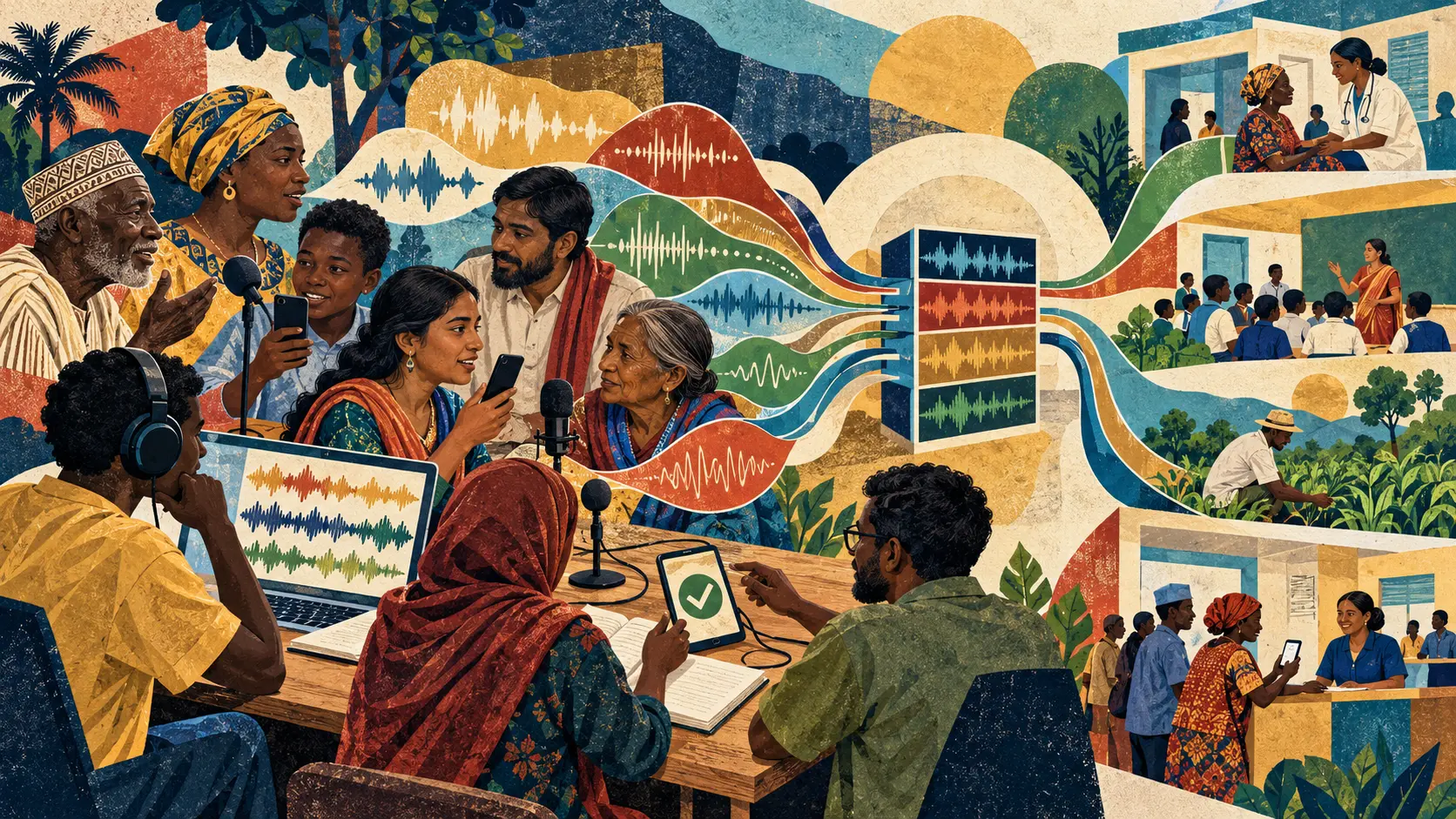
The world has roughly 7,000 languages, but the most capable AI systems work well in only a small slice of them. A model can produce polished English while stumbling over a health worker speaking Luganda, a farmer switching between a local language and a national one, or a child whose home language barely appears in the training data. That is not a decorative translation problem. It decides who can ask a question naturally, who gets understood and who has to borrow somebody else's language before technology will listen. On September 21, sixty organizations announced a five-year commitment aimed at changing that. The coalition includes Amazon, Anthropic, Google, Microsoft, Mistral, NVIDIA, the OpenAI Foundation, UNICEF and the World Bank Group, alongside language researchers, African and South Asian AI groups, public institutions, funders and community organizations. Its shared goal is for an estimated 3.4 billion people who speak languages underrepresented in today's models to use AI tools in their own language and voice. The commitment organizes the work into four buckets: open language data, honest benchmarks, usable models and applications, and deployment that protects privacy, consent and data sovereignty. That is a solid list. It is not yet a delivery plan. The Gates Foundation says the coalition's detailed governance, structure and workstreams will be developed over the coming year. No language-by-language baseline, common budget, milestone table, data-rights contract or shared definition of usable access was published with the announcement. The coalition is also joining work that already exists. AI4Bharat, BHASHINI, Masakhane, Karya, Digital Umuganda and others did not suddenly discover local languages because a global press release arrived. They have been collecting speech, building models, creating benchmarks and negotiating community relationships for years. The useful test is whether the larger companies and funders bring money, compute and distribution without swallowing ownership, credit or control. The plain signal is that 3.4 billion is not a user count. It is the estimated population attached to a promise. The number becomes meaningful only when each language has a baseline, native-speaker tests, consent records, practical services, published failure rates and a community with the authority to correct or withdraw its data.
01
WHAT ACTUALLY CHANGED
On September 21, the Gates Foundation announced a coalition of sixty initial signatories around a five-year AI language-access goal.
The target is for an estimated 3.4 billion people who speak languages underrepresented in current AI models to be able to use AI tools in their own language and voice.
The 3.4 billion figure describes the estimated population speaking underrepresented languages. It is not a count of current users, funded beneficiaries or people already reached.
The coalition includes frontier AI developers, technology companies, government bodies, multilateral organizations, philanthropies, researchers and community-led implementation groups.
Named signatories include Amazon, Anthropic, Google, Microsoft, Mistral, NVIDIA, the OpenAI Foundation and Zoom, together with UNICEF, the World Bank Group and the United Kingdom's Foreign, Commonwealth and Development Office.
Local and regional participants include AI4Bharat, BHASHINI, BharatGen, Karya, Masakhane, Lelapa AI, Digital Umuganda, Sunbird, Qhala, Data Science Nigeria, Deep Learning Indaba, the Ethiopia AI Institute and Senegal's digital ministry.
The commitment describes an open language layer made from shared and safe data infrastructure that builders can use under open licenses.
A second workstream is meant to create assessments and benchmarks that measure actual gains against the coalition's goal.
A third workstream aims to turn language data into models and applications usable by smaller builders, not only organizations with the largest computing budgets.
A fourth workstream promises responsible deployment that protects privacy, consent and data sovereignty.
The joint statement says local ecosystems should lead, and that value should return to participating communities through ownership, capacity building and support for local research.
The statement also acknowledges that better language models do not solve connectivity, electricity or affordable-device gaps.
The Gates Foundation says the coalition's detailed governance, structure and workstreams will be developed collaboratively over the next year.
Associated Press reporting says a secretariat is expected to track commitments, but the announcement does not yet identify the secretariat, publish its authority or define consequences for missed promises.
A compiled document publishes statements from forty-eight participating organizations. The foundation's press release separately lists all sixty initial signatories.
Existing projects supply early building blocks. Google says Project Vaani is collecting more than 150,000 hours of speech across India, Digital Green reports that FarmerChat supports sixteen languages, and Sunbird says it is building open text and speech technology for sixty-seven low-resource African languages. These are organization claims, not a common coalition baseline.
02
WHY THIS MATTERS
Language determines whether a person can describe a symptom, a crop problem or a public-service request precisely. Forcing someone into a second language can remove the one word that carries the decision.
Translation is only one layer. A system also has to recognize speech, dialect, code-switching, idioms, names, local units and the cultural context that tells a listener what a phrase actually means.
Voice access matters where typing is difficult, literacy varies, scripts are poorly supported or inexpensive phones are more common than computers. A product that adds a language only to a text menu may still miss the people named in the headline.
Health and agriculture make failure concrete. A mistranslated symptom or pesticide instruction can cause harm even when the sentence sounds fluent.
Counting supported languages is a weak measure. One model may handle weather questions in a language while failing on medical speech, regional accents or noisy phone audio.
A benchmark can reveal that difference only if native speakers help design it and the tasks represent real use. Translating an English test into another language can carry the same blind spots across the border.
Speech data is not raw material waiting for a company to discover it. Voices can identify people, reveal sensitive traits and preserve cultural knowledge. Collection requires meaningful consent, limited uses and a practical way to withdraw.
Open licensing can let smaller labs build on shared resources. It can also become a one-way pipe if communities donate data while commercial systems capture the revenue, patents, cloud spending and product control.
The coalition mixes organizations with very different power. A local language group and a frontier model company may share a signature while controlling vastly different budgets, infrastructure and routes to market.
The commitment's local-ownership language is important because the best technical decisions may be social ones: which dialect names to use, which recordings should remain restricted and which errors are too dangerous for release.
A shared coalition can reduce duplicated collection and incompatible evaluation. It can also create a central agenda that overlooks smaller languages unless allocation rules are visible.
The five-year deadline creates a useful horizon, but the goal has no published annual milestones. Without them, the coalition could count nearly any language project as progress near the end.
The 3.4 billion estimate can focus attention. It can also hide distribution. Large languages could absorb most investment while hundreds of smaller communities remain absent and the headline number still appears to move.
Existing local builders should not become supporting characters in a story told by larger funders. Their data, research, relationships and implementation knowledge are the infrastructure the coalition says it wants.
Language access does not guarantee useful access. A system also needs a relevant service, reliable connectivity, affordable devices, trusted institutions, redress and people who can act on the answer.
The coalition will matter beyond language technology if it proves that global AI infrastructure can be built with communities as owners and governors rather than as unpaid suppliers of examples.
03
WHERE IT COULD HELP
- Publish a language-by-language baseline covering text generation, speech recognition, speech synthesis, retrieval, safety and task-specific accuracy before claiming improvement.
- Define what able to use means. Separate a laboratory demonstration, a model endpoint, a consumer feature, an affordable service and sustained use by the intended community.
- Create annual milestones for people reached, languages tested, datasets released, local organizations funded, models improved, applications deployed and high-risk failures corrected.
- Give every signatory a public commitment record with a named owner, resources, deadline, status, evidence and reason for any delay.
- Publish the coalition's governance, voting rules, secretariat, conflict policy, funding flows, complaint process and authority to remove or correct a misleading claim.
- Fund local language groups directly for recording, annotation, evaluation, maintenance and governance instead of paying them only as temporary data vendors.
- Use consent forms and explanations in the language being collected, with separate choices for research, open release, commercial training, biometric processing and future reuse.
- Record provenance for each dataset, including who collected it, where, from whom, under which permission, for which uses and with which withdrawal route.
- Let communities restrict sacred, private, endangered or easily identifying material rather than treating open release as the only public-interest outcome.
- Pay contributors fairly and publish compensation methods, especially where speech data may create long-lived commercial value.
- Test dialects, accents, age groups, genders, code-switching, background noise, phone compression and regional vocabulary separately.
- Build dangerous-error tests for health, education, agriculture, finance and government services rather than relying on general conversation scores.
- Require native-speaker review of the benchmark itself, including whether prompts sound natural and whether the accepted answer reflects local practice.
- Measure the cost of using each language. Tokenization, longer audio, connectivity and device constraints can make a technically supported language materially more expensive.
- Publish model cards by language and task, including known gaps, refusal behavior, unsafe outputs, unavailable features and the date of the last evaluation.
- Support low-bandwidth channels such as basic voice calls and offline tools where an app or modern smartphone would exclude the intended user.
- Create a public incident channel where speakers can report a dangerous mistranslation, hear back in their language and see whether the error was repaired.
- Track who captures downstream value through cloud contracts, model access, licensing and applications, then return funding and control to the communities that made the system possible.
KEEP A HAND ON THE WHEEL
The coalition and its goal are real, but the announcement is a voluntary commitment rather than a funding award, contract, treaty or delivered service. The 3.4 billion figure is an estimate of people who speak languages currently underrepresented in AI. It should not be reported as people already reached. The joint statement does not publish a language list, country list, starting performance baseline, shared budget, annual target, measurement protocol, named secretariat, voting rules, enforcement process or allocation formula. It says the detailed structure, governance and workstreams will be developed over the coming year. The four work areas are directions, not completed infrastructure. Open data is not automatically safe or equitable; licenses must match consent, provenance and community rules. Company language counts often combine very different levels of quality and functionality. A system can support written translation while failing at spontaneous speech, dialect, code-switching or a high-stakes task. Existing project figures in the signatory document are self-reported and use different definitions, so they should not be added into one reach total. Associated Press reporting provides independent context but also notes that governance remains unfinished. Watch for a complete baseline, the secretariat, governance charter, money committed, grants to local groups, dataset licenses, consent and withdrawal mechanisms, per-language benchmarks, application-level safety tests, annual public results and evidence of sustained use rather than a larger language dropdown.
04
TERMS WORTH KEEPING
OPEN GLOSSARY CARD
Low-resource language
A language with relatively limited digital text, recorded speech, tools, funding, or evaluation data available for building and testing language technology.
OPEN GLOSSARY CARD
Speech corpus
An organized collection of recorded speech and related information used to build or evaluate systems that recognize, generate, or analyze spoken language.
OPEN GLOSSARY CARD
Code-switching
Moving between languages, dialects, or language varieties within a conversation or sentence.
SOURCES AND VERIFICATION STATUS
This article was written from the materials below. Product claims and dates were checked against those sources on September 24, 2026.
PUBLICATION RECEIPT: Revision 1. Published September 24, 2026.
THE PUBLICATION ENGINE
WANT A SIGNAL OF YOUR OWN?
We build source-grounded publications, private briefings, and editorial systems for organizations with something useful to say.
WORK WITH US