THE SIGNAL IN ONE SENTENCE
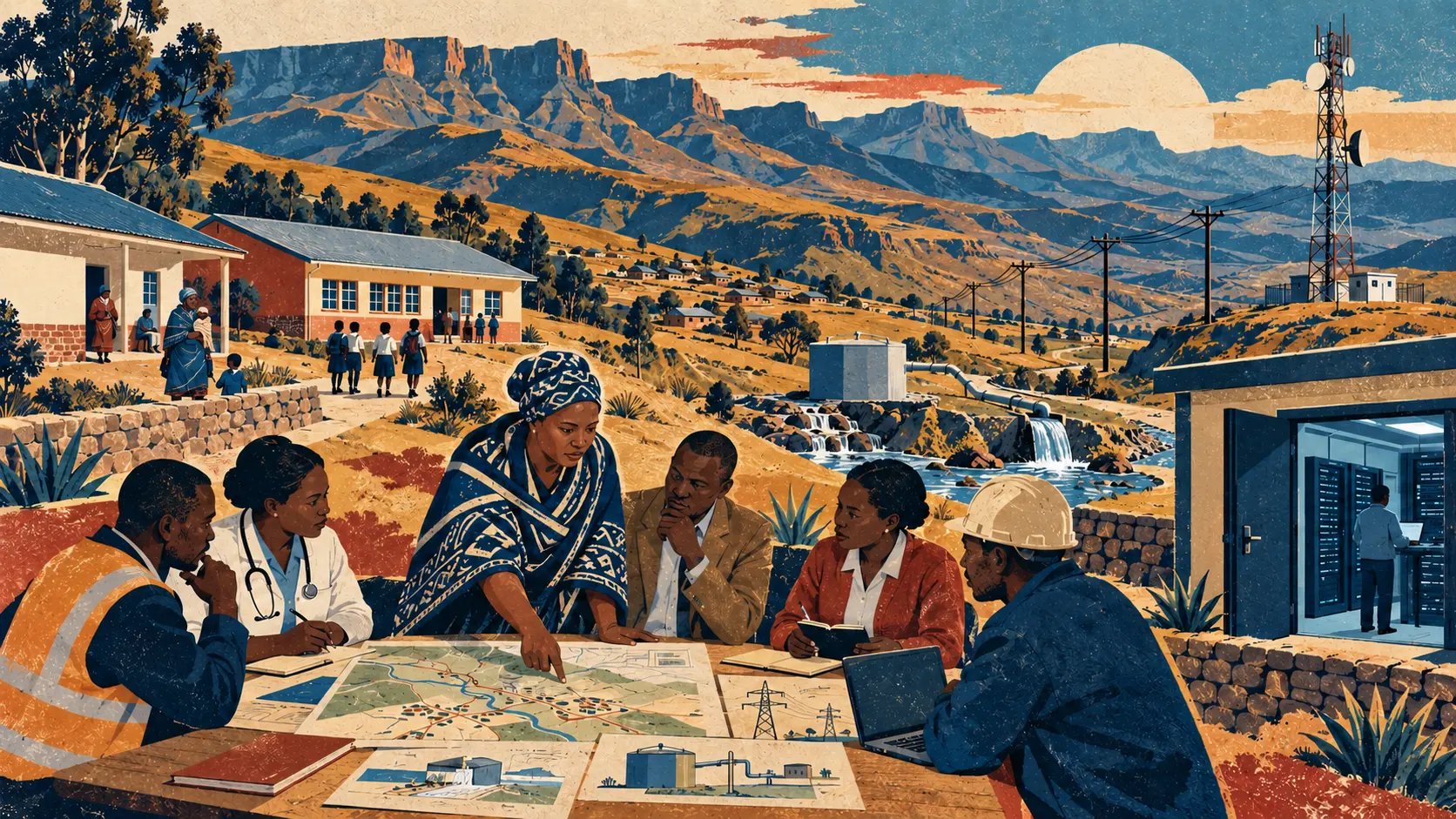
A data centre is wonderfully easy to photograph. A functioning national technology plan is harder. It needs electricity that stays on, water and cooling that can be afforded, network links that reach the intended users, trained people who can run the equipment, rules for the data and a budget that survives past the launch speech. Lesotho has now put that less glamorous list at the center of its AI planning. At the United Nations Digital Cooperation Day in New York on September 21, Prime Minister Samuel Ntsokoane Matekane said Lesotho had become the first country to apply the UN Blueprint for National AI Strategies. He described more than a year of readiness work, a five-day planning session in Maseru and the start of Phase One of a National Compute Roadmap for 2026 to 2029. The country already has three validated digital policies, an operating government data centre and a designated Chief Digital Office, according to his published remarks. But Matekane also supplied the sentence that keeps the story honest: possessing a data centre is not the same as being prepared for AI. The government says the Blueprint begins with services people need in agriculture, health, education, water management and public administration, then works backward to the infrastructure required to deliver them. That ordering matters in a country where the World Bank reports that 60.6 percent of the population had access to electricity in 2024. It does not mean every person with electricity has reliable, affordable power, and it certainly does not mean the remaining infrastructure problem is solved. It means a national compute plan has to fit inside a real grid, a real public budget and real service priorities. The published speech says the Maseru workshop produced five concrete actions with responsible institutions and timelines, but it does not list those actions, publish their costs or show the financing. The UN Blueprint is a planning method and coordination framework. It is not a grant, a new power station, a trained civil service or a completed national AI strategy. The plain signal is that Lesotho has chosen a sensible test for AI sovereignty: start with what people need, price the physical and institutional work, and build only what the country can govern. Now the useful evidence has to move from the podium into the budget, procurement record, service target and public scorecard.
01
WHAT ACTUALLY CHANGED
The United Nations held its second Digital Cooperation Day in New York on September 21 under the theme Shaping a Global AI Future Through Science, Policy, and Capacity.
Prime Minister Samuel Ntsokoane Matekane announced that Lesotho was the first country to apply the UN Blueprint for National AI Strategies.
The Government of Lesotho published Matekane's remarks on September 22. The page title says 2025, but its publication date, event description and speech text concern the 2026 Digital Cooperation Day.
Matekane said the government had spent more than a year assessing its readiness for AI under the Ministry of Information, Communications, Science, Technology and Innovation.
The assessment identified needs across digital infrastructure, compute capacity, data governance, institutional arrangements, skills and sustainable financing.
Lesotho entered the process with three validated digital policies, an operational government data centre and a designated Chief Digital Office, according to the prime minister's account.
The government also used an AI Strategy Blueprint and a Data Centre Blueprint. Public material describes these as planning frameworks, not as funded construction commitments.
Matekane said the process starts with existing policy and the services that matter to people. Infrastructure choices follow after the government identifies needs in agriculture, health, education, water management and public administration.
A five-day working session in Maseru brought together Lesotho and support from the UN Resident Coordinator's Office, the UN Office for Digital and Emerging Technologies, the Global AI Capacity Development Network, UNDP, UNICEF, UNESCO and ITU.
The prime minister said the session produced a roadmap with five concrete actions, responsible institutions and timelines. The published speech does not name the five actions or provide the associated dates, budgets or performance measures.
Lesotho says it is implementing Phase One of its National Compute Roadmap for 2026 to 2029. The government has not yet published the complete roadmap through the cited materials.
Matekane framed the Blueprint as a coordination tool that can align international partners around priorities chosen by Lesotho, rather than letting separate projects arrive with unrelated schedules and demands.
The World Bank's current data release records electricity access for 60.6 percent of Lesotho's population in 2024, up from 57.3 percent in 2023. The indicator measures whether people have access, not service reliability, price, capacity or suitability for data-centre loads.
Lesotho's Ministry of Finance maintains a public budget portal with the 2026 to 2027 Appropriation Act, budget estimates and execution material. The cited AI announcements do not connect each compute-roadmap action to a published appropriation line.
Localized reporting published September 24 describes the Blueprint as a guided method intended to move governments from a mandate toward a costed and achievable strategy. It also notes that no total cost for Lesotho's plan has been published.
02
WHY THIS MATTERS
Many national AI plans begin with a model, a cloud partnership or a large machine count. Lesotho's stated sequence begins with public services. That makes it possible to ask whether the technology solves a named problem before paying for it.
A country can own a data centre and still lack the power quality, cooling, connectivity, security, staffing and workload needed to operate useful AI services. Capacity is a system, not a room full of equipment.
The 60.6 percent electricity-access figure makes the tradeoff visible. Compute investment sits beside electrification, clinics, schools, water systems and other public needs. A strategy must show why its load deserves scarce capital and power.
Electricity access is not the same as electricity reliability. A household indicator cannot tell planners whether a facility has sufficient continuous power, backup capacity, affordable tariffs or the grid connection needed for dense computing equipment.
Water belongs in the AI discussion because some computing facilities use it directly for cooling and all energy systems have resource consequences. Lesotho's government explicitly lists water among the constraints the plan must respect.
The prime minister's rule that infrastructure should follow demand is a useful defense against prestige projects. A server that serves no defined public workload can become an expensive monument with a very tidy ribbon cutting.
A costed roadmap can help Lesotho choose between buying equipment, using regional or commercial cloud capacity, improving the existing government data centre or combining those options. Sovereignty is partly the ability to make and revisit that choice.
International coordination can reduce duplicate assessments and incompatible pilot projects. It can also concentrate influence. Public priorities, contracts and evaluation rules still need to remain under accountable Lesotho institutions.
Five assigned actions sound more operational than a general declaration. Without the action list, owners, deadlines, budgets and status reports, the public cannot yet tell whether the plan is moving or merely becoming more specific in private.
Agriculture, health, education and water management carry different error costs. A crop advisory, a clinical triage tool and an exam system should not share one vague standard for accuracy, privacy or human review.
Local compute can keep some data and operational knowledge closer to public institutions. It does not automatically create good data governance. Access controls, procurement terms, logs, retention, security testing and incident response still decide who is actually in control.
The 2026 to 2029 window creates a useful accountability period. It is long enough to build capability, but short enough for the government and partners to publish annual milestones, spending and service results.
Lesotho's test matters outside Lesotho. Smaller states do not need miniature copies of the infrastructure built by the largest economies. A credible method for sizing compute to services, resources and budgets could be more valuable than another universal shopping list.
The strongest outcome would not be the largest data centre. It would be a transparent decision to build, rent, share or decline each piece of capacity based on public value and total operating cost.
03
WHERE IT COULD HELP
- Publish the five roadmap actions in full, with the responsible institution, deadline, dependency, budget, funding source and public-service outcome attached to each one.
- Connect every technology purchase to a named workload, such as a specific agriculture, health, education, water or administrative service, and state who uses it and what improvement is expected.
- Model the total cost of ownership for local compute, including grid connection, power, backup, cooling, bandwidth, security, staffing, repairs, software, replacement cycles and decommissioning.
- Compare that local cost with commercial cloud, regional shared infrastructure and hybrid options using the same workloads, security requirements and service levels.
- Publish an energy profile for each proposed facility, including peak demand, expected annual use, backup design, renewable supply claims and the effect on other users of the grid.
- Publish a water and cooling plan before approving equipment whose operating conditions could strain local resources or fail in the highland climate.
- Treat the existing government data centre as a measured starting point. Report its usable capacity, uptime, utilization, security posture, staffing, power limits and remaining life before proposing expansion.
- Use the Ministry of Finance budget portal to show appropriations, contracts, quarterly execution and future operating liabilities in a form that citizens and legislators can follow.
- Create separate evaluation sets for each public service. A health system should be tested for clinically consequential errors, while an agriculture service should be tested across crops, districts, seasons and local languages.
- Name the datasets required for each service, the legal basis for using them, the institution responsible for quality and the rule for deletion or reuse.
- Require meaningful Sesotho support and test it with speakers from different communities, not only through translated benchmark prompts.
- Give frontline workers and affected communities a formal role in choosing problems, testing prototypes and rejecting systems that add risk or paperwork without improving service.
- Publish procurement contracts and disclose vendor lock-in, data transfer, model-update, audit, exit and continuity terms.
- Train public-sector technicians, data stewards, procurement teams and service managers alongside any hardware investment so the operating knowledge is not held only by a contractor.
- Set an annual stop-or-change review. If a workload does not improve its named public outcome at a defensible cost, redirect the money instead of preserving the project for appearances.
- Maintain a public scoreboard for service availability, cost, energy use, incidents, complaints, audit findings and measured outcomes throughout the 2026 to 2029 roadmap.
KEEP A HAND ON THE WHEEL
The government speech is strong primary evidence for Lesotho's own description of its planning process. It is not an independent evaluation of readiness or implementation. The official web page has a confusing 2025 reference in its title even though its metadata says it was published September 22, 2026 and the speech describes the September 21, 2026 event. The prime minister says Lesotho is the first country to apply the UN Blueprint and that Phase One of the National Compute Roadmap is under implementation. The cited public material does not provide the complete roadmap, the five actions, a total cost, named appropriations, procurement contracts, facility specifications, energy demand, water demand, cloud commitments or performance baseline. An operational government data centre does not establish available AI capacity or safe operation. The World Bank's 60.6 percent figure is an electricity-access estimate for 2024, not a measure of uptime, affordability, grid headroom or data-centre readiness. The Blueprint can help sequence choices and coordinate partners, but it supplies no infrastructure or financing by itself. Published plans should distinguish grants, loans, government appropriations, vendor support and unfunded proposals. Watch for the five-action roadmap, line-item budget, workload inventory, energy and water assessment, public procurement, data-governance rules, Sesotho evaluation, staffing plan, independent security review, annual milestones and evidence that a service actually improves life outside the data centre.
04
TERMS WORTH KEEPING
OPEN GLOSSARY CARD
Data governance
The rules, roles and records that determine how data is collected, accessed, used, shared, retained and deleted.
OPEN GLOSSARY CARD
Sovereign compute
Computing capacity whose ownership, location, access, supply, security, continuity, and governing rules remain under the authority claimed by a country or institution.
OPEN GLOSSARY CARD
Readiness assessment
A structured country-level diagnosis of the institutions, laws, skills, infrastructure, evidence, and participation needed to govern or use a technology responsibly.
SOURCES AND VERIFICATION STATUS
This article was written from the materials below. Product claims and dates were checked against those sources on September 24, 2026.
PUBLICATION RECEIPT: Revision 1. Published September 24, 2026.
THE PUBLICATION ENGINE
WANT A SIGNAL OF YOUR OWN?
We build source-grounded publications, private briefings, and editorial systems for organizations with something useful to say.
WORK WITH US