THE SIGNAL IN ONE SENTENCE
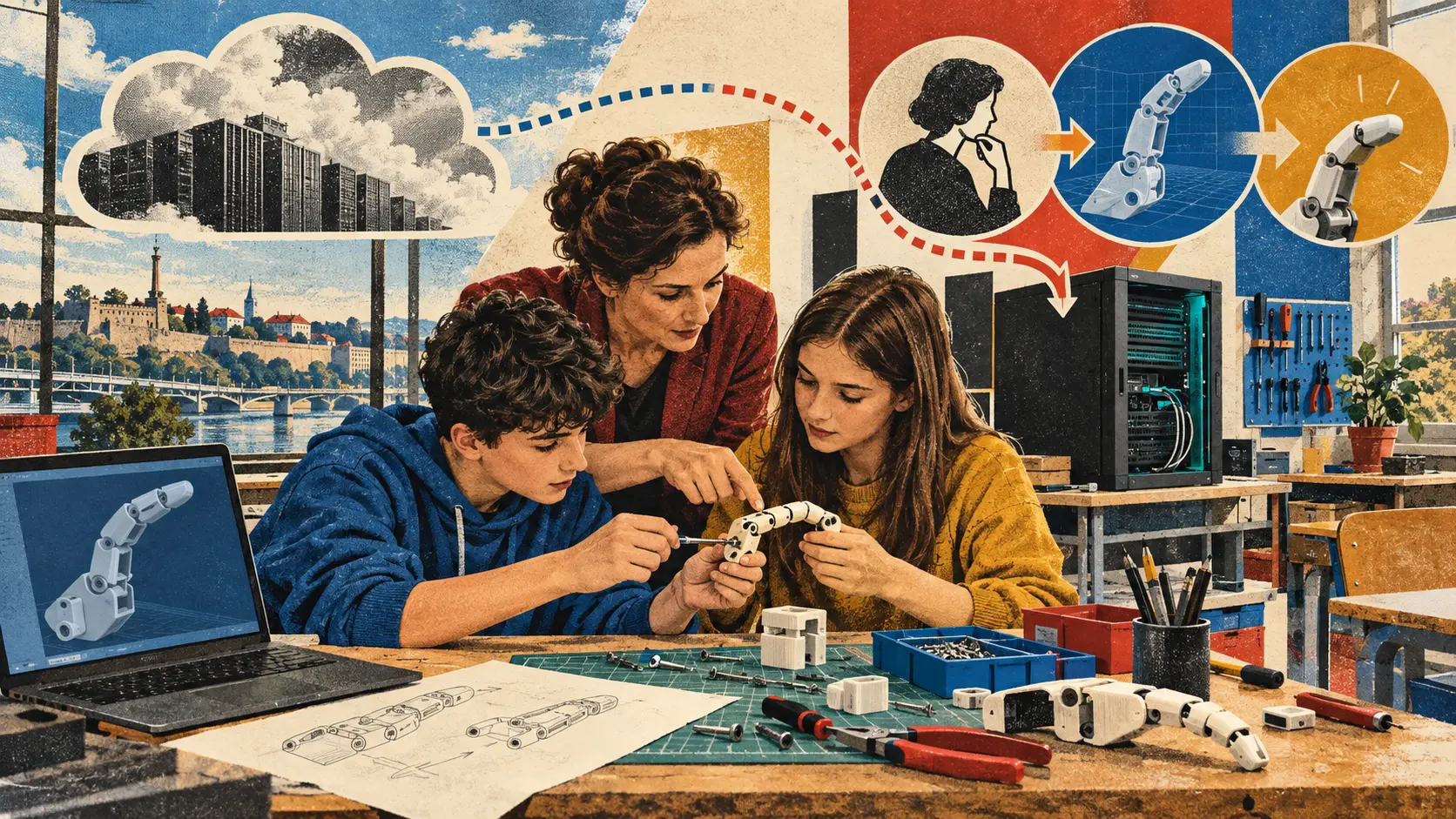
A Serbian mathematics and programming teacher needed a three-millimeter screw for a student robotics project. Local hardware shops did not have it, so Sanja Rajić and her students asked the Petlja AI Assistant what the M3 label meant and how to print a replacement. The first attempts failed. One print came out at five millimeters. Students changed the scale several times, tested each version and eventually produced a part that fit the mechanical finger. That small scene is a better description of classroom AI than the usual magic-wand demo. The assistant suggested a path. The teacher and students still had to measure, correct and touch the result. Petlja Foundation, a Serbian education nonprofit founded in 2017, built the assistant on Microsoft Azure and Azure OpenAI Service. It helps teachers prepare lessons, create exercises and adapt material, while teachers remain responsible for reviewing what it produces. Microsoft says about 250 teachers currently have access and roughly 50 to 60 use it actively. The awkward part is that every request to a commercial model costs money. Petlja now says it is fine-tuning an open model for Serbian education through a UNICEF project, with plans to run it locally on donated hardware. The stated goals are lower operating costs, more local control over data and access for more teachers. That move is not complete, and Petlja has not named a fixed expansion target or confirmed the funding needed for a wider rollout. The supporting evidence also needs proportion. Microsoft published the new account and has provided Petlja with technology, experts and financial support. A Petlja-supported study asked participating Belgrade-area primary-school computing teachers to use the assistant for several weeks, complete before-and-after questionnaires and, for a smaller group, join a focus group. That can reveal how teachers experienced the tool. It cannot by itself prove better student learning, nationwide effectiveness or lower total cost. The plain signal is that local-language classroom AI will not be won by the flashiest answer. It will be won by systems schools can afford, teachers can correct, communities can govern and researchers can evaluate without confusing enthusiasm with learning.
01
WHAT ACTUALLY CHANGED
Microsoft published a September 24 field report on Petlja Foundation's AI Assistant and its use by teachers and students in Serbia.
Petlja built the assistant inside its existing education platform using Microsoft Azure hosting, Azure SQL and Azure OpenAI Service. Microsoft also says it has supplied technical expertise and direct financial support.
The assistant is designed primarily for teachers. It can help structure formal lesson preparations, generate exercises, adjust material for different knowledge levels and assist with classroom projects.
Sanja Rajić, a mathematics and programming teacher at Palanka Gymnasium in Bačka Palanka, began testing the tool after volunteering during a 2023 conference presentation.
Rajić told Microsoft that a formal lesson preparation can take a couple of hours. She says the assistant supplies a structure that she edits using her own experience.
In the robotics example, students needed an M3 screw for a mechanical finger. The assistant helped them interpret the specification and configure a 3D printer, but several prints failed before a scaled version fit.
Students at the same school also used the assistant while developing BrAInUp, an educational well-being application for a 2026 student-company competition, and while debugging a motion-controlled game.
Microsoft says about 250 teachers have access to the assistant and roughly 50 to 60 are active users. Those figures describe access and activity, not student reach or learning improvement.
Petlja provides the assistant without charge to teachers, while each request to the commercial AI service creates an operating cost for the nonprofit.
Through UNICEF's TLM4EL project, Petlja is fine-tuning an open model for Serbian education using Azure GPU infrastructure. It plans to deploy the model locally on donated hardware supplied through a partnership that includes Tenstorrent.
Petlja says the local model could reduce recurring service costs and keep more data under local control. The exact model, license, hardware configuration, security design, evaluation results and deployment date are not public in the two source accounts.
The project names UNDP Serbia as coordinator, Serbia's Ministry of Education as a funder, UNICEF in the open-model phase, Microsoft as a technology and financial supporter and Tenstorrent as a hardware partner.
Petlja has no fixed target for expanding the user base and no confirmed funding for a wider rollout, according to the Microsoft report.
Petlja's November 2025 research call sought at least 80 primary-school computing teachers from the Belgrade school administration area. Participants were to use the assistant for several weeks, complete questionnaires before and after use and, for ten volunteers, join a focus group.
Microsoft says the resulting Petlja-supported study found that teachers reported saved time, new lesson ideas and support for differentiated teaching. A complete public report with the final sample, response rates, instruments and numerical results was not linked from the announcement.
02
WHY THIS MATTERS
Serbian education has its own curriculum, administrative requirements, terminology and language patterns. A general model can speak Serbian without understanding what a fourth-year IT-track lesson must contain or how a formal preparation is reviewed.
Fine-tuning can make a model more familiar with local material, but familiarity is not accuracy. The system still needs tests written by Serbian teachers across subjects, regions, scripts and student age groups.
Moving inference from a commercial endpoint to local hardware can change the cost curve. It replaces a fee attached to every request with equipment, electricity, maintenance, security and staffing that Petlja must manage itself.
Local hosting can create a clearer data boundary, especially for draft lessons or student work. It does not automatically make the system private. Logs, administrator access, backups, training reuse, connected services and compromised accounts still matter.
The 250-access and 50-to-60-active figures show a real but small deployment. They do not establish how often teachers use the tool, how many students encounter its material or whether usage continues after initial curiosity.
A teacher reporting two hours saved is useful operational evidence. It is not the same as a timed study, an independently measured workload reduction or proof that the resulting lesson helped students learn more.
The screw story makes the division of labor visible. The model did not discover that the print was wrong by touching the part. Students measured the mismatch and kept revising. Physical and pedagogical reality remained outside the chat window.
Teacher review is not a ceremonial final click. A teacher knows the students, the available time, the curriculum, the prior lesson and which explanation is likely to confuse the room. That context is part of the product.
A nonprofit can adapt faster than a national procurement system, but project funding can arrive six to twelve months after an application. Petlja says that delay can leave a proposed AI project chasing technology that has already changed.
Donated hardware solves an acquisition problem once. A durable service needs replacement parts, updates, electricity, secure administration, incident response and people who can maintain the system after a grant ends.
An open model can reduce dependence on one provider and allow local adaptation. Open weights do not guarantee a permissive license, transparent training data, strong Serbian performance or affordable operation.
The research design described by Petlja focuses on teacher experience and perceived usefulness. That is appropriate for an early implementation study, but policymakers also need measures of student learning, error types, equity, teacher workload and total cost.
03
WHERE IT COULD HELP
- Publish the exact model, license, training recipe, source-material categories, hardware requirements and update policy before calling the local deployment open or sustainable.
- Build a Serbian evaluation set with teachers from primary schools, general secondary schools, vocational programs and specialized IT tracks, covering both Latin and Cyrillic scripts where relevant.
- Measure curriculum alignment separately from language fluency. A grammatically clean answer can still target the wrong grade, omit a required outcome or invent a rule.
- Require every generated lesson plan to show the teacher which curriculum sources, course materials and assumptions informed it.
- Keep teacher editing visible in the workflow, with a clear draft state and no automatic delivery to students before review.
- Record why teachers reject or rewrite suggestions so model updates target recurring failures instead of treating every edit as invisible labor.
- Compare commercial-cloud and local-model operation using the same task set, including answer quality, response time, uptime, electricity, staffing, maintenance and cost per reviewed lesson.
- Define which prompts, student artifacts and lesson files may be stored, who can access them, how long they remain and whether any may enter future training.
- Separate anonymous classroom examples from identifiable student information and avoid sending sensitive records to a model when the teaching task does not require them.
- Give teachers a simple way to report a dangerous, biased, fabricated or curriculum-inappropriate answer and see whether the issue was corrected.
- Test failures deliberately, including wrong formulas, invented historical claims, unsafe lab directions, biased student grouping and answers that switch scripts or regional usage unexpectedly.
- Publish the final teacher-study report with recruitment, sample size, attrition, survey instruments, focus-group method, numerical results, limitations and conflicts of interest.
- Add student-learning measures only where consent, fairness and classroom disruption can be handled properly. Do not turn every lesson into a product experiment.
- Budget for the person who patches the server, monitors access, replaces hardware, restores backups and answers teachers after the donated machine is no longer new.
- Let Serbian public institutions and educators govern the local model's priorities, evaluation thresholds and retirement decision rather than treating local hosting as a branding label.
KEEP A HAND ON THE WHEEL
The September 24 account is a detailed company feature, not an independent investigation. Microsoft provides Petlja with infrastructure, expertise and financial support, so its article should be read as primary evidence about the project and the participants' statements, not neutral proof of impact. The classroom examples are attributed to one teacher and two students at Palanka Gymnasium. They show plausible uses and real human correction, but they do not establish average outcomes across Serbia. The reported access figure is about 250 teachers, with 50 to 60 active users. Neither source defines the activity window, frequency, retention or number of students affected. Petlja's 2025 research call sought a minimum of 80 computing teachers from primary schools in the Belgrade school-administration area, using pre-and-post questionnaires and a voluntary focus group for ten participants. The complete final report was not linked, so the eventual sample, attrition, instruments, effect sizes and raw results remain unavailable here. Reported time savings and usefulness are teacher perceptions, not independently timed workload measures or student-learning outcomes. The planned open model has not been named. Its license, parameter count, training data, Serbian benchmarks, hardware, energy use, privacy architecture, security controls, maintenance budget and launch date are not public. Local inference can reduce dependence on a commercial endpoint, but it can introduce operational cost and security responsibility. Donated hardware does not guarantee long-term service. Watch for the complete study, model card, license, evaluation set, cost comparison, data-governance policy, security review, incident process, funding commitment, deployment date, usage retention and evidence that students learn better rather than merely receiving material faster.
04
TERMS WORTH KEEPING
OPEN GLOSSARY CARD
Data governance
The rules, roles and records that determine how data is collected, accessed, used, shared, retained and deleted.
OPEN GLOSSARY CARD
Pilot study
A limited trial used to test feasibility, procedures and measurement before a larger rollout.
OPEN GLOSSARY CARD
Open-weight model
An AI model whose learned weights are available for download and local use, sometimes under license terms that still restrict use or redistribution.
SOURCES AND VERIFICATION STATUS
This article was written from the materials below. Product claims and dates were checked against those sources on September 24, 2026.
PUBLICATION RECEIPT: Revision 1. Published September 24, 2026.
THE PUBLICATION ENGINE
WANT A SIGNAL OF YOUR OWN?
We build source-grounded publications, private briefings, and editorial systems for organizations with something useful to say.
WORK WITH US