THE SIGNAL IN ONE SENTENCE
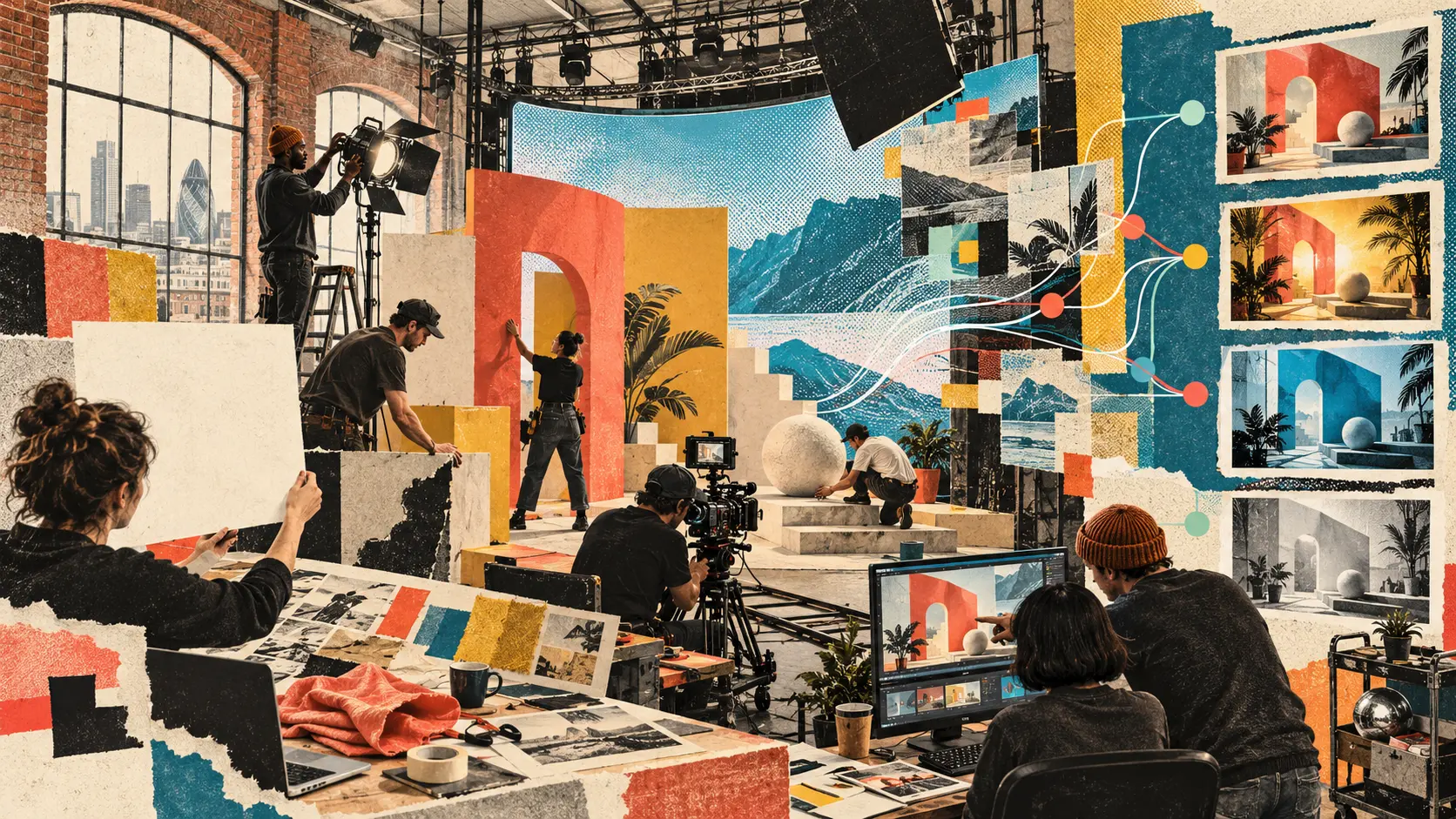
WPP has opened Devon's Point, a 34,000-square-foot production hub in East London built to move an advertisement from idea to finished variants without sending every stage to a different address. The facility combines a large virtual-production stage, modular studios, creator and live-stream rooms, edit and color suites, motion capture, set building, prop storage and even a working kitchen for food shoots. WPP says teams can also use generative and agentic tools through WPP Open, its company platform, and that specialist groups inside the building will mix those tools with robotics and immersive production. This is less a single AI product than a new factory floor for commercial images. A real car can sit in front of a synthetic Paris street. A physical package can be lit once, then placed into several approved backdrops. Editors can prepare versions for different markets and channels without rebuilding the entire shoot. That can reduce travel, shorten handoffs and let a small team test more ideas. It also creates a provenance problem at industrial scale. When a campaign contains a photographed product, a licensed performer, a generated room, an altered label, localized copy and several model-assisted edits, someone needs to know which piece came from where, what permission covered it, which version a client approved and what changed after approval. WPP's announcement supplies a detailed inventory of rooms and equipment. It does not supply measured productivity, error rates, provenance performance, job-quality results, emissions savings or evidence that more content produces better advertising. WPP itself provides the useful tension. It says content capacity is becoming effectively unlimited while human creativity and big ideas remain scarce. The plain signal is that the new production line should be judged by the quality of its receipts as much as the speed of its output. A faster studio is valuable. A studio that can prove who made, licensed, checked and approved every consequential element is much more valuable.
01
WHAT ACTUALLY CHANGED
WPP announced the opening of Devon's Point in East London on September 23. The company describes it as a 34,000-square-foot, multi-floor production hub operated by WPP Production.
The facility combines virtual production, modular stages, post-production, creator spaces, live-stream rooms, set building, styling, prop storage and client storage. The design is meant to reduce the physical and organizational handoffs between planning, shooting, editing and delivery.
Its largest stage covers about 7,000 square feet and includes a curved LED environment measuring roughly 16 by 14 meters. The screen can place a physical subject in a digitally controlled background while cameras and lighting remain in the studio.
WPP says the main stage has moveable walls, sound treatment and a large lighting grid. Those details make it a production facility, not simply a demonstration screen.
The building includes modular stages with isolated lighting, power and cooling. Teams can reconfigure them for product photography, small sets and other work without rebuilding the entire floor.
A motion-capture area called Infinity Cove can record movement for digital production. Four edit and color suites, a climate-cooled server room and creator studios keep more of the finishing work on site.
A commercial kitchen supports food and beverage shoots, while secure storage includes refrigerators and freezers. Those ordinary details matter because generated backgrounds do not remove the need to handle real products correctly.
WPP says its HEX Studio teams at Devon's Point will use generative and agentic AI, immersive technology and robotics alongside conventional production craft. The announcement does not identify the complete model list, training-data terms or task-by-task approval rules.
The hub connects with WPP Open, the company's wider marketing platform. WPP says that connection can help teams move from a brief through production and into media delivery, but it has not published an independent end-to-end accuracy or productivity study for the new facility.
Reuters reported from the opening that WPP demonstrated a real Ford Capri placed in front of a virtual Paris street. The example shows how a physical subject and a synthetic environment can share one frame. It does not establish that every market can reuse the frame without fresh legal, cultural and factual review.
WPP presents Devon's Point as the first hub in a planned network on every continent where WPP Production operates. No complete schedule, location list, capital budget or common measurement framework accompanied the announcement.
The company also positions the building as a training site, including its paid nine-month Creative Technology Apprenticeship. The announcement describes the opportunity but does not publish completion, placement, wage, retention or demographic results for the program.
02
WHY THIS MATTERS
Virtual production can replace a travel day with a controlled digital environment. That may lower cost, reduce weather risk and make a location repeatable. It can also turn a place into a licensed asset whose ownership, accuracy and permitted uses need to be recorded.
The car in front of the synthetic Paris street is a clean example of compositing. The difficult campaigns are messier. A model, package, product claim, voice, location, trademark, soundtrack and generated prop can each carry different permissions and expiration dates.
A single building can shorten the chain between departments, but organizational distance does not disappear because the rooms share a postcode. Legal, brand, accessibility, cultural, sustainability and product experts still need defined approval gates.
More variants can become useful localization when local teams have authority. They can also become mass-produced awkwardness when a central workflow swaps colors, scenery and language without understanding local law, history, humor or consumer expectations.
Agentic tools raise a different question from generative tools. A generator produces an asset for review. An agent may retrieve files, create versions, route them, update a project system or prepare delivery. Each action needs a narrow permission, a visible log and a reliable stop.
Speed can hide rework. Producing fifty versions in an afternoon sounds efficient until a wrong claim, unlicensed face or outdated package appears in all fifty. Useful productivity measures include correction time, rejected variants and post-release repair, not only output volume.
Human craft is not a sentimental garnish. Camera operators understand lenses, reflections and movement. Set builders know what can stand safely. Editors notice continuity. Colorists understand how images survive different screens. Those judgments are part of the system's reliability.
The building can create new technical roles while changing established ones. Workers need paid training, transparent credit, clear rules for using their work in models and a path to challenge a workflow that strips authorship or weakens conditions.
Emissions claims need an accounting boundary. Avoiding a flight may help, but the LED wall, render servers, cooling, storage, repeated generation and equipment also use energy. A comparison should include the same campaign scope, not only the most visible trip that disappeared.
Client approval becomes harder when the final asset is assembled from many versions. The approval record should identify the exact file, model output, product information, rights package and localization reviewed. An email saying looks good is not a production ledger.
Content provenance can help audiences and clients distinguish captured, edited and generated material. It is not magic. Metadata can be removed, and a receipt is useful only when the production system actually records the source and transformation honestly.
WPP's claim that content capacity is becoming effectively unlimited is a warning disguised as abundance. Attention, trust and human judgment remain limited. The winning factory may be the one that produces fewer bad variants, not the one that fills the most folders.
03
WHERE IT COULD HELP
- Create an asset ledger at the brief stage with owner, source, license, territory, duration, allowed transformations, model restrictions and renewal date for every product, performer, voice, location, prop, font, track and generated element.
- Assign a stable identifier to every captured and generated asset so edits and localized versions inherit the correct rights and evidence instead of starting as anonymous copies.
- Separate exploratory generation from production-approved material. Draft outputs should not enter client delivery folders until a named reviewer accepts their source, claims, likeness, safety and legal status.
- Require explicit approval when an agent moves beyond drafting to retrieving restricted files, sending work outside the studio, publishing a version or updating a client system.
- Use least-privilege access for production agents, with separate credentials for each project and automatic expiration after delivery.
- Keep prompts, model and software versions, source files, edit history, reviewer decisions and final delivery records together for the life of the campaign.
- Give local-market teams authority to reject a translation, image, gesture, symbol, product claim or casting decision without having to prove that the central workflow intended harm.
- Test the exact campaign across mobile, television, cinema, social feeds, retail screens and accessibility tools before treating one master file as universally finished.
- Measure first-pass approval, correction time, rights exceptions, rejected variants, accessibility defects, localization defects, client revisions and post-release incidents alongside production time and cost.
- Compare virtual and location production using the same creative scope, then publish travel, electricity, computing, storage, set materials, waste and reuse assumptions.
- Pay workers for model-training contributions and document whether a performance, design, edit or production artifact may be used to improve future tools.
- Preserve human credit through the derivative chain so a craft contribution does not disappear when an approved scene is multiplied into dozens of outputs.
- Give apprentices supervised work on real projects, disclose pay and selection criteria, and report completion, placement, wages and retention rather than counting enrollment alone.
- Run adversarial production drills with a stale product label, withdrawn music license, altered face, invented claim, wrong market restriction and compromised project account before scaling the workflow.
- Let clients export the final rights and provenance package in a durable format so the evidence survives a platform change or the closing of a project workspace.
KEEP A HAND ON THE WHEEL
Devon's Point is open, and WPP's announcement establishes the location, approximate size, named facilities, intended workflows and first-hub status. Reuters independently reported from the opening and documented the Ford virtual-production example. Neither source provides an independent measurement of time saved, cost per approved asset, first-pass acceptance, error severity, campaign effectiveness, worker outcomes, provenance completeness or emissions. The facility's capacity does not show how often clients will use each stage or whether a global network will follow the same design. WPP's statements about speed, scale, creativity and sustainability are company claims. A virtual backdrop is not necessarily AI-generated, and an AI-assisted workflow does not mean the complete advertisement was generated by a model. The company has not published the full model list, training-data terms, permission matrix, client data boundaries, human-review rules, C2PA or other provenance coverage, incident process, apprenticeship outcomes or rollout schedule. The article does not assume that jobs disappear simply because production is consolidated or assisted by AI. It also does not assume that new technical roles preserve pay, credit, bargaining power or career paths. Watch for client case studies with baselines, independent productivity research, rights and provenance documentation, published energy and travel comparisons, agent permission controls, worker consultation, apprenticeship results, local-market authority, correction statistics and evidence that the final ads are more useful rather than merely more numerous.
04
TERMS WORTH KEEPING
OPEN GLOSSARY CARD
Virtual production
A production method that combines physical subjects, cameras and lighting with digitally controlled environments during the shoot.
OPEN GLOSSARY CARD
LED volume
A large arrangement of LED panels used as an adjustable background and light source for filmed subjects.
OPEN GLOSSARY CARD
Localization
Adapting a product or message for the language, law, culture, formats and expectations of a particular place or audience.
SOURCES AND VERIFICATION STATUS
This article was written from the materials below. Product claims and dates were checked against those sources on September 24, 2026.
PUBLICATION RECEIPT: Revision 1. Published September 24, 2026.
THE PUBLICATION ENGINE
WANT A SIGNAL OF YOUR OWN?
We build source-grounded publications, private briefings, and editorial systems for organizations with something useful to say.
WORK WITH US