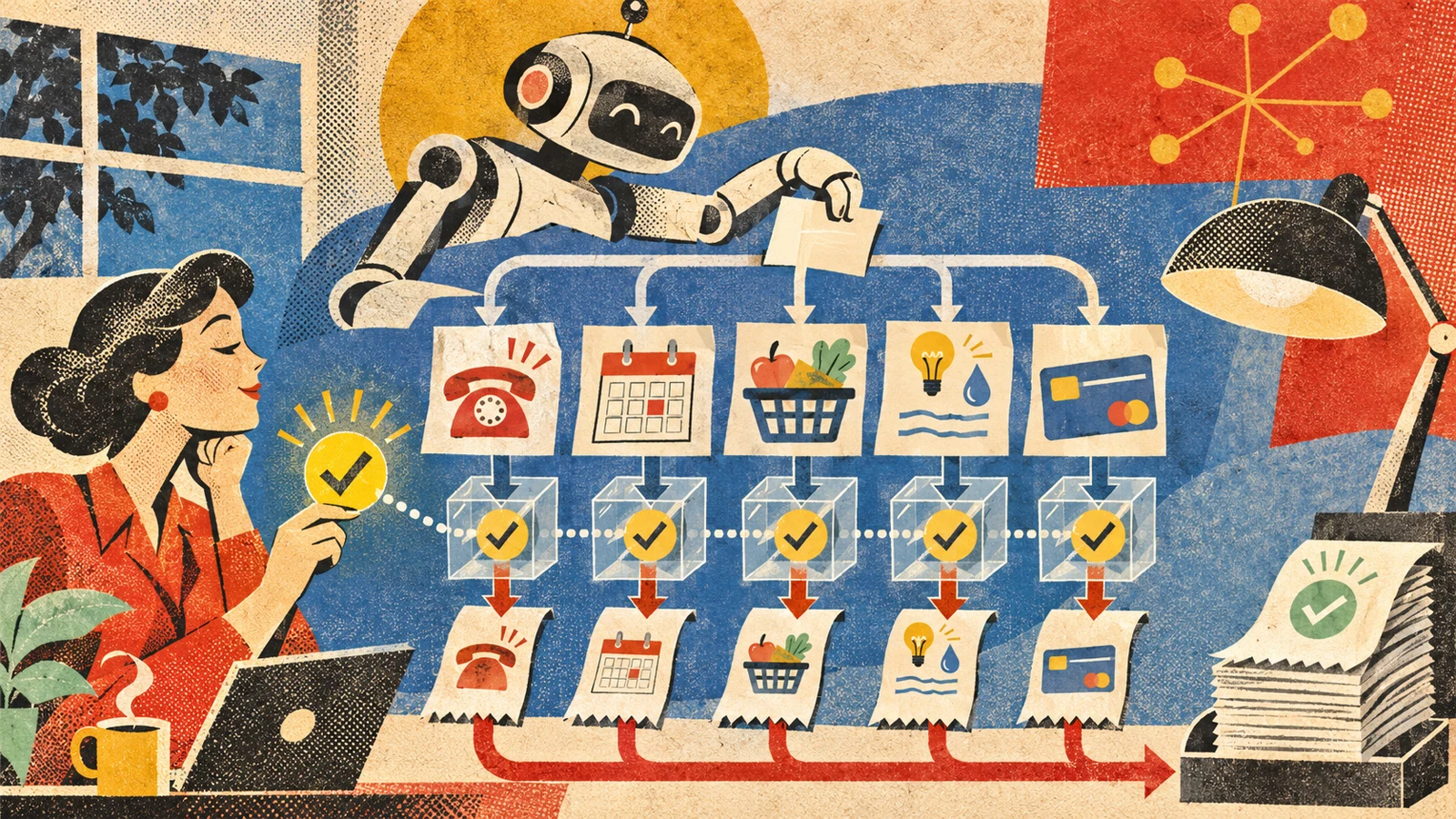
THE SIGNAL IN ONE SENTENCE
Google is removing the subscription tollbooth from one of Gemini's most consequential features. Tasks in Gemini is rolling out to people without a paid AI plan in the United States, Japan, South Korea, Canada, Australia and India. Google says the system, powered by Gemini 4 Hydrogen, can call a business, book an appointment, compare products, use Google Pay, analyze a bill, update a calendar and work through connected services. That is not merely a cheaper chatbot. It is a much larger population gaining access to software that can change the state of the world outside the chat box. Google says hundreds of millions of people can gain access through this rollout. The exact experience varies by country, account and integration, but the direction is clear. Personal agents are moving from premium showcase to ordinary utility. The useful response is not to treat every automated grocery order like a mission to Mars. It is to recognize that a purchase, booking, phone call or calendar change needs a better record than a friendly green checkmark. Give every consequential task a receipt. Not the merchant receipt alone. That proves a transaction happened, eventually. The agent also needs a consequence receipt that explains what it intended to do, what information it used, which permissions it exercised, what it disclosed, which outside system changed, what confirmation came back and how the user can recover if the result is wrong. Start before the action. The agent should restate the goal in plain language. It should identify the account, merchant, date, amount, people and constraints that matter. If the user asks for a dentist appointment next Tuesday, the plan should show the clinic, acceptable time range, insurance assumptions, cancellation policy and whether the agent may confirm immediately or must return with options. This is not bureaucratic decoration. It is where ambiguity becomes visible while the consequence is still cheap to change. Then show the data boundary. Google's help material says Tasks can draw on connected apps, past chats, websites, Personal Intelligence and location. A remote browser can process cookies, page content, code and files. The system may share information needed to complete a task with a third-party site, including a name, address, contact details or other sensitive information. That can make an agent useful. It can also make a vague request surprisingly revealing. The user should see which sources the task will read and which facts will leave Google. A booking may need a name and phone number. It probably does not need years of email history. A grocery order may need a delivery address. It does not need access to the family calendar unless delivery timing truly depends on it. The permission should be attached to the job, not granted to the general idea of helpfulness. Google says Tasks can run inside a hardware-isolated virtual machine dedicated to the account. It also describes prompt-injection filters, Safe Browsing and confirmations or pre-approvals before critical steps. Those are sensible protections. They do not answer every product question. A dedicated virtual machine can isolate one task environment from another. It cannot decide whether the wrong clinic was selected. A prompt-injection filter can catch some malicious instructions on a page. It cannot know that a user meant the neighborhood hardware store rather than a similarly named chain forty miles away. A spending cap can limit damage. It cannot make an unwanted purchase wanted. Safety controls need a semantic layer: what the person meant, what the agent is about to commit and what evidence proves the outside world accepted it. Separate planning from commitment. An agent can research options, draft a message, fill a cart or prepare an appointment without crossing the final boundary. Those are reversible stages. Sending the message, placing the order, paying the bill and confirming the appointment are commitments. The interface should mark that boundary clearly. For low-risk routines, the user may pre-authorize a narrow commitment. Buy the same bag of coffee from the same merchant when the price is under twenty dollars. Reschedule the recurring lawn service within the same week. Pay the electric bill from the usual account if the amount stays within a defined range. That is very different from always allowing purchases. An Always allow control should be scoped by task type, account, merchant, amount, frequency, recipient and expiration date. It should be easy to inspect and easier to revoke. Permission should decay when it is unused, when a password changes, when a household member leaves or when the task starts asking for new data. The receipt should make persistent authority obvious. It should say that this action was approved once, approved through a standing rule or manually confirmed at the moment of commitment. If a standing rule triggered, show the rule and the facts that satisfied it. If the price was $18.40 under a $20 ceiling, say so. If the merchant changed, the rule should stop. Phone calls need their own evidence. Google says its calling feature identifies itself as an AI assistant from Google on a recorded line and states the user's name. It can navigate menus, hold, manage appointments and ask businesses questions. Google also says the calling agent cannot contact emergency services, perform financial transactions, share sensitive personal or financial information or conduct telemarketing. Businesses can opt out. That is a useful starting boundary. The user still needs the call result in a form that can be checked. A call receipt should identify the business and number, when the call occurred, that the agent disclosed itself, the questions asked, the terms accepted, the name or role of the person who responded, the confirmation number and any uncertainty. If the business says the reservation is only tentative, the receipt should not upgrade it to confirmed because optimism looks nicer in a calendar. Keep the distinction between transcript, summary and external proof. A transcript shows what was said. A summary condenses it. A confirmation email, merchant record or appointment portal shows what the other system believes happened. When these disagree, the agent should surface the conflict instead of selecting the most convenient version. Shopping needs a similar chain. Record the requested product, considered alternatives, seller, price, taxes, delivery date, return terms, warranty, payment method, spending rule and final order identifier. If an advertisement or affiliate placement influenced the selection, disclose it. If a connected service substituted an item, show the substitution before purchase when possible and after purchase without fail. Google says Tasks can use Google Pay with spending caps and its Agent Payments Protocol. Protocol support is useful plumbing. It does not replace consumer judgment, local law, chargeback rights or a clear record of what the agent represented to the seller. Bills deserve extra care because the document can be both evidence and instruction bait. An agent analyzing a utility bill can identify a due date, compare usage or prepare payment. It should not treat arbitrary text inside the bill, email or linked page as authority to change accounts, reveal credentials or send money somewhere new. The system must keep user instructions above document instructions. For payment, independently verify the payee, account, amount and deadline. Use a known route rather than a payment link discovered inside an untrusted message. Record the source of each value. Ask again if the account or destination differs from history. Scheduled and offline tasks need narrower authority because the user is not present to catch drift. Google allows people to start tasks from Gemini, text messages and forwarded email. That convenience creates more entry points and more chances for the request to lose context. A forwarded message may contain an old thread, a changed date, a spoofed sender or instructions written for a human who understands the surrounding situation. Before an offline task commits anything, the system should check freshness, identity and scope. If the situation moved outside the pre-approved envelope, pause. A helpful agent that waits is less annoying than an autonomous agent that confidently books the wrong Thursday. Households make the permission problem especially interesting. One account may contain a partner's schedule, a child's school email, a parent's medical appointment and shared payment methods. Access to the account does not automatically establish authority over every person represented inside it. Receipts should identify who requested the task, whose data it used, who bears the consequence and who can cancel it. Medical, insurance, employment, education and legal tasks need stricter separation and human review. Convenience should not quietly erase role boundaries. Recovery belongs in the original plan. Before booking, record the cancellation window and fee. Before buying, record return eligibility and deadline. Before changing a calendar, preserve the previous event. Before sending a message, show the recipients. Before paying, show what can and cannot be reversed. After execution, the agent should offer the relevant next action: cancel, return, correct, contact the business, restore the event, dispute the charge or ask a human to intervene. An undo button that merely sends another request is not the same as reversal. The receipt should say whether recovery succeeded and verify the new external state. Google acknowledges that tasks can fail, miss the mark or hand control back when a site blocks automation. That candor matters. It should become part of the interface rather than a footnote in a launch announcement. Failure should be specific. The agent could not sign in. The merchant changed the price. The clinic did not answer. The site required a person. The payment was declined. The calendar updated but the confirmation email did not arrive. Each condition suggests a different response. Do not summarize all of them as something went wrong. The launch evidence also has limits. The performance and safety descriptions are Google's. The company does not publish an independent error rate for the new free rollout. Help pages may lag the launch and still describe older subscription eligibility. Availability differs by country, account and feature. Business calling is unavailable in Indiana, Louisiana, Minnesota, Montana and Nebraska. Third-party services keep their own rules and can change them. Those caveats do not make the feature uninteresting. They make measurement necessary. Users and organizations should keep a small acceptance set for agentic tasks. Include an ambiguous merchant, a changed price, a duplicate appointment, a cancellation fee, a connected app with stale data, a malicious instruction on a page, a request involving another person and a job that should stop. Measure task completion, wrong actions, unnecessary disclosure, confirmation quality, recovery time and human correction. Count the silent near misses, not only the spectacular failures. Free access will make personal agents ordinary faster than most policy documents can update. That can be genuinely useful. A person who hates phone menus can delegate the hold music. A busy caregiver can organize appointments. A household can compare a bill without building a spreadsheet at midnight. Small businesses can spend less time on routine coordination. The deal should be simple. The agent gets enough authority to finish the defined job. The person gets a readable plan before commitment, a narrow permission boundary, a receipt for every consequential step and a recovery path that works after the cheerful animation disappears. Let the agent do the errands. Keep the consequences legible.
01
WHAT ACTUALLY CHANGED
Google announced on November 17 that Tasks in Gemini is rolling out without a paid AI plan in the United States, Japan, South Korea, Canada, Australia and India.
The free rollout uses Gemini 4 Hydrogen and expands a capability that had previously been presented as a paid feature.
Google says Tasks can schedule appointments, analyze bills, shop, use Google Pay, call businesses, update calendars and work across connected services.
The launch article says Gemini can connect with more than 60 apps and services.
Users can begin tasks inside Gemini, by text message or by forwarding email to a Gemini address.
Google says task execution uses a hardware-isolated virtual machine dedicated to the account rather than shared with other users.
The company describes prompt-injection filtering, Safe Browsing and confirmation or pre-approval before critical actions.
Users can create standing approvals for some routines through an Always allow control.
Google says its calling agent identifies itself as an AI assistant on a recorded line and states the user's name.
The company acknowledges that tasks can fail, miss the mark or hand control back when automation is blocked.
02
WHY THIS MATTERS
Removing a subscription requirement can move action-taking agents from a premium experiment to a mass-market utility.
A call, purchase, booking or payment changes external state and needs stronger evidence than a chat summary.
Connected apps and remote browsers can combine useful context with private data that the user did not expect to share.
Infrastructure isolation reduces some technical risk but cannot determine whether the agent understood the user's intent.
A spending cap limits magnitude without proving that a purchase was correct or wanted.
Standing permission can turn one convenient approval into broad authority unless it is narrowly scoped and expires.
Phone transcripts, summaries and external confirmations can disagree and should remain distinguishable.
Scheduled tasks operate without immediate supervision and need tighter freshness, identity and scope checks.
Household accounts can contain data and obligations belonging to several people with different authority.
Recovery is part of task quality because many errors become expensive only after a cancellation or return deadline passes.
03
WHERE IT COULD HELP
- Show the goal, merchant, account, amount, date, recipients and constraints before an agent starts.
- List the connected apps, files, chats, cookies and location data the task will read.
- Preview which personal details will be disclosed to each third-party service.
- Separate research and drafting from irreversible commitment.
- Require manual confirmation for new merchants, new payees, changed prices and sensitive tasks.
- Scope standing approval by merchant, amount, frequency, account, recipient and expiration date.
- Record whether each action used one-time confirmation, a standing rule or no commitment authority.
- Create call receipts with disclosure, questions, terms, uncertainty and external confirmation.
- Create shopping receipts with seller, price, taxes, return terms, payment route and order identifier.
- Verify payees and account details through a known route before paying a bill.
- Treat text inside emails, bills and websites as untrusted evidence rather than user authority.
- Pause offline tasks when identity, price, timing or scope moves outside the approved envelope.
- Identify the requester, data subject, affected person and cancellation authority in household tasks.
- Preserve the previous state and cancellation window before changing anything.
- Verify the external system after execution instead of trusting the agent's completion message.
- Test ambiguous, adversarial, stale and irreversible cases before enabling broad autonomy.
KEEP A HAND ON THE WHEEL
The availability, capability and safety descriptions come from Google. The company has not published an independent error rate for the free rollout. Google says the rollout reaches hundreds of millions of people, but availability can still vary by country, account, age, language, app and connected service. The November 17 announcement says Tasks is rolling out without a paid plan in six countries. Some help pages checked on November 18 still described older paid-plan eligibility, so documentation may lag the rollout. Advanced capabilities and integrations are not identical in every market. Business calling is unavailable in Indiana, Louisiana, Minnesota, Montana and Nebraska. Third-party sites can block automation, change their terms, request handoff or return incomplete information. Google says critical steps require confirmation or pre-approval, but a user can also establish standing approval. Inspect how narrowly Always allow rules can be scoped, audited, expired and revoked. Remote browsing can process cookies, page content, files, code, connected-app data, Personal Intelligence and location. Necessary information may be shared with outside sites. Google advises users not to place sign-in, payment or other sensitive information directly in the task thread and warns against sensitive scheduled tasks. The calling agent discloses that it is an AI assistant on a recorded line. Google says it cannot call emergency services, make financial transactions, share sensitive personal or financial information or conduct telemarketing. Watch for independent evaluations, regional rollout changes, consumer complaints, business opt-outs, prompt-injection research, disputed purchases, cancellation failures, help-page updates and evidence that external state matches agent receipts.
04
TERMS WORTH KEEPING
SOURCES AND VERIFICATION STATUS
This article was written from the materials below. Product claims and dates were checked against those sources on November 18, 2026.
THE PUBLICATION ENGINE
WANT A SIGNAL OF YOUR OWN?
We build source-grounded publications, private briefings, and editorial systems for organizations with something useful to say.
WORK WITH US