THE SIGNAL IN ONE SENTENCE
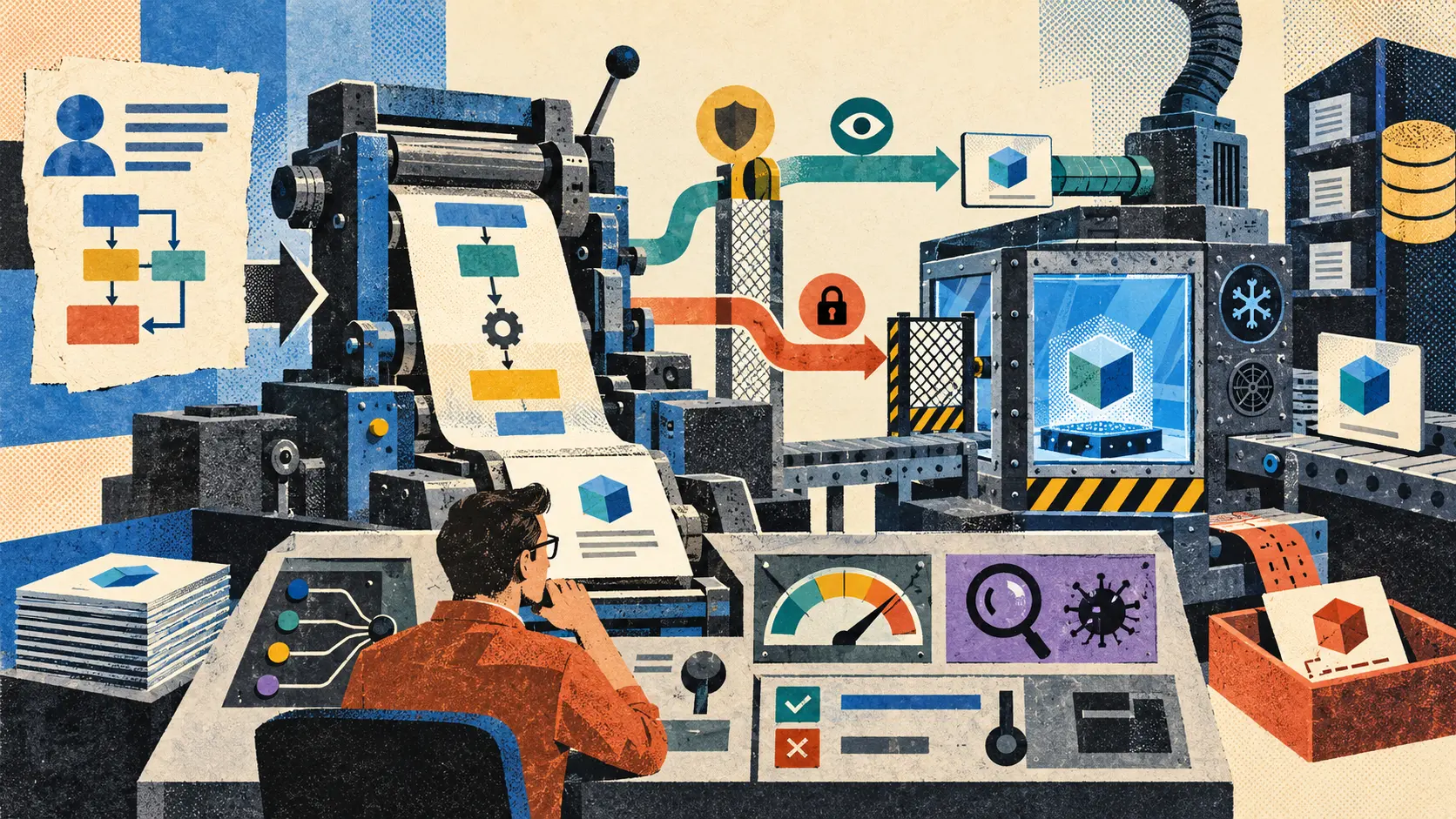
A Markdown file can look harmless. It is prose, a little frontmatter and a request such as: inspect failed CI runs, explain the likely cause and open an issue. Then a compiler turns that request into GitHub Actions YAML, a coding agent reads repository data, tools run on a hosted or self-hosted runner and an approved output may write something back. That is not a note anymore. It is an automation program wearing comfortable clothes. GitHub made Agentic Workflows generally available on October 28. The open-source project from GitHub Next lets teams define reasoning-based repository work in natural-language Markdown and compile it into standard Actions workflows. The examples are practical: triage issues, investigate CI failures, update documentation, write tests and propose changes. The general-availability release also adds or expands self-hosted runner support, budget forecasting, model selection, model routing and stronger isolation options. The plain-language signal is not that every repository should wake up with an autonomous coworker tomorrow morning. It is that agent work is becoming ordinary automation infrastructure. Ordinary infrastructure needs boring controls. Start with the boundary between the source and the artifact. The Markdown file expresses intent. GitHub's compiler produces a pinned, validated lock file in Actions YAML. That generated YAML is what actually runs. Review both. The prose tells you what the author wanted. The YAML tells you which jobs, permissions, actions, containers, networks and write paths the system received. Teams already understand this pattern in other places. A package manifest is not the dependency tree. Infrastructure source is not the cloud plan. A database migration generator is not the migration it emits. The generated artifact may be mechanically produced, but it still deserves a diff. Call that diff a control receipt. The receipt begins with identity. Record the source Markdown commit, compiler version, generated lock-file hash, coding-agent engine, selected model, runner image and every imported workflow or action. Pin what can be pinned. If recompiling the same source changes the YAML, stop and explain why before the new artifact reaches the default branch. Next, record authority. GitHub says agents run read-only by default. That is the right starting point, but a useful workflow often needs to produce something: a label, an issue, a discussion, a pull request or a review comment. Agentic Workflows uses safe outputs for that boundary. The agent proposes an output. A separate job validates it and applies only the declared write with its own permissions. That separation is much better than handing a coding agent a broad token and hoping it behaves. It does not remove the need to inspect the declaration. List every allowed output in the receipt. Name the token scope and repository scope used to apply it. Add an expiry where the feature supports one. Prefer a pull request over a direct commit, a draft over a merge and one repository over an organization. For a new workflow, turn on staged output first. GitHub documents a staged mode that previews an output without applying it. Use it on a canary repository filled with realistic mess: malformed issues, hostile comments, very large logs, renamed branches, missing secrets, flaky tests and a contributor who asks the agent to ignore its instructions. Do not test only the happy path. The dangerous input in a repository is often the input written by someone who does not share your security assumptions. GitHub's security design responds to that problem in layers. It describes compile-time validation, a sandboxed agent, credential isolation, integrity filtering, a separate threat-detection job and safe outputs. The general-availability announcement also names the Agent Workflow Firewall and optional Cloud Hypervisor or NVX micro-VM isolation. Those layers are meaningful. They are not a proof that a particular workflow is safe. Integrity filtering can block or transform untrusted content. Threat detection can reject a suspicious proposed output. A firewall can narrow outbound access. A micro-VM can strengthen workload isolation. None of those controls can decide whether the workflow's business purpose is sensible, whether a repository was in scope or whether a plausible change should be merged. That remains a policy and review problem. Keep a human gate before high-impact writes. A documentation pull request may be low risk. Changing a release workflow, dependency policy, access-control file or production configuration is not. Route those proposals to a named reviewer with the source prompt, generated YAML diff, agent evidence, tests, threat findings and rollback plan attached. Approval should describe the actual effect. Do not ask a maintainer to approve "the agent run." Ask them to approve a specific pull request, permission change or deployment action. Now add a cost boundary. The project supports limits on AI credits and turns, plus daily credit limits. GitHub says the no-longer-experimental forecast command includes threat-detection credits and monthly ranges. The documentation also exposes logs and audits for tokens, credits and turns. Use the forecast before enabling a schedule. Then set a per-run cap and a daily cap lower than the number that would ruin anyone's morning. Record both in the receipt. If a model router may choose different models by task difficulty, record the route selected for each run. Routing can improve cost or capability. It also changes reproducibility. Two runs with the same Markdown may behave differently because the router selected a different model or the provider updated one behind an alias. Pin a model when repeatability matters. When routing is allowed, compare outcomes by model and keep the selection visible in the run record. Self-hosted runners deserve their own review. The release adds support for Actions Runner Controller and Docker-in-Docker. That helps teams use existing infrastructure and reach private dependencies. It also moves the trust boundary into systems the team must maintain. Inventory what the runner can see before an agent lands on it. Can it reach internal services? Does it reuse a workspace? Are credentials injected at the host, container or job level? Does Docker-in-Docker create a wider privilege path than the hosted configuration? Is the runner destroyed after the job? Do not assume a sandboxed process is isolated from a generous host. The control receipt should name the runner group, network destinations, mounted paths, retained artifacts and cleanup result. Then keep a run-level evidence trail. For every execution, preserve the triggering event, source commit, lock-file hash, agent and model, tool calls, allowed network destinations, permissions, safe-output proposal, validation result, threat-detection result, cost, human approval and final applied effect. That sounds heavy until a scheduled workflow opens the wrong issue in 200 repositories. At that point, the receipt is the shortest path to understanding which version ran, what it saw and how far it reached. General availability deserves one more caveat. GitHub's announcement quotes striking Accenture results, including estimated time savings, higher velocity, a very high share of AI-authored commits and fewer production errors. These are named customer case-study claims, not a controlled reliability study of Agentic Workflows across ordinary repositories. Treat them as a reason to investigate, not as a baseline for your staffing plan. The project itself offers a healthier model: examine live runs. Its documentation publishes examples with outcomes, duration, token use, credit use and whether a run produced a change. One highlighted documentation workflow completed three recent runs successfully, and one of those correctly made no pull request because it found nothing to change. That last result matters. An agent that can decide not to manufacture work is useful. Your acceptance test should reward restraint too. Track false positives, unnecessary writes, duplicate issues, abandoned pull requests, reviewer time, cost per accepted change and how often the workflow reaches a human without enough evidence. Do not measure only activity. Finally, plan the stop button. Document how to disable the workflow, revoke its credentials, cancel a run, remove its safe outputs, restore the previous lock file and find every artifact it created. Test that path before the first unattended weekend. A natural-language workflow feels approachable because the source looks like a request to a colleague. The compiled YAML is still software. The runner is still a privileged computer. The model is still a variable dependency. And a recurring schedule is still a multiplier. Put the friendly Markdown under version control. Put the generated YAML under review. Put every permission, output and dollar in the receipt. Then let the agent earn a longer leash one measured run at a time.
01
WHAT ACTUALLY CHANGED
GitHub Agentic Workflows became generally available on October 28
Natural-language Markdown workflow definitions compile into standard GitHub Actions YAML
Teams can use GitHub Copilot or bring another supported coding-agent engine
Agents run read-only by default and declared writes pass through separately permissioned safe outputs
Threat detection scans proposed changes before they are applied
General availability adds stronger support for self-hosted ARC runners and Docker-in-Docker
The forecast command now includes threat-detection credits and monthly spending ranges
Workflows can select models or use routing based on task type and difficulty
Cloud Hypervisor and NVX micro-VM options provide stronger agent isolation
The default Copilot CLI engine requires a Copilot license
02
WHY THIS MATTERS
The generated Actions YAML, not the friendly Markdown alone, defines the executable authority
Recurring repository agents combine untrusted content, private context, tools, network access and write paths
Read-only defaults reduce risk but useful outputs still need narrow permissions and review
Model routing, provider updates and compiler changes can make identical-looking requests behave differently
Self-hosted runners move isolation, cleanup and network boundaries into infrastructure the team owns
Budget and activity metrics are not substitutes for accepted outcomes, restraint and reviewer effort
A durable control receipt makes each run explainable after the agent and its environment have changed
03
WHERE IT COULD HELP
- Commit the source Markdown and generated lock-file YAML together
- Review the generated YAML diff before enabling or updating a workflow
- Record compiler, action, agent-engine and model versions
- Keep the agent read-only and declare only the safe outputs the task needs
- Use staged outputs in a canary repository before allowing writes
- Test hostile issues, pull-request comments, malformed logs and missing credentials
- Require named human approval for high-impact repository or deployment changes
- Set per-run, daily and monthly cost boundaries before scheduling
- Log the selected model when routing is enabled
- Inventory networks, mounts, credentials and cleanup on self-hosted runners
- Measure accepted changes, false positives, duplicate work and reviewer time
- Practice disabling the workflow, revoking access and rolling back its lock file
KEEP A HAND ON THE WHEEL
General availability means GitHub supports the project for broad use on github.com, not that every generated workflow is correct or safe. GitHub's customer productivity figures are attributed case-study claims rather than controlled evidence. The default Copilot CLI engine requires a Copilot license. Alternate engines introduce their own provider terms and behavior. Self-hosted runners, Docker-in-Docker, cross-repository access and model routing create distinct security, reproducibility and cost boundaries. Watch for independent reliability evidence, incident reports, version-compatibility problems, changes to default budgets and permissions, and clear data-handling terms for every selected engine.
04
TERMS WORTH KEEPING
SOURCES AND VERIFICATION STATUS
This article was written from the materials below. Product claims and dates were checked against those sources on October 29, 2026.
PUBLICATION RECEIPT: This article covers the October 28 general-availability release, a material update to The Plain Signal's October 12 coverage of the project before version 1.0.
THE PUBLICATION ENGINE
WANT A SIGNAL OF YOUR OWN?
We build source-grounded publications, private briefings, and editorial systems for organizations with something useful to say.
WORK WITH US