THE SIGNAL IN ONE SENTENCE
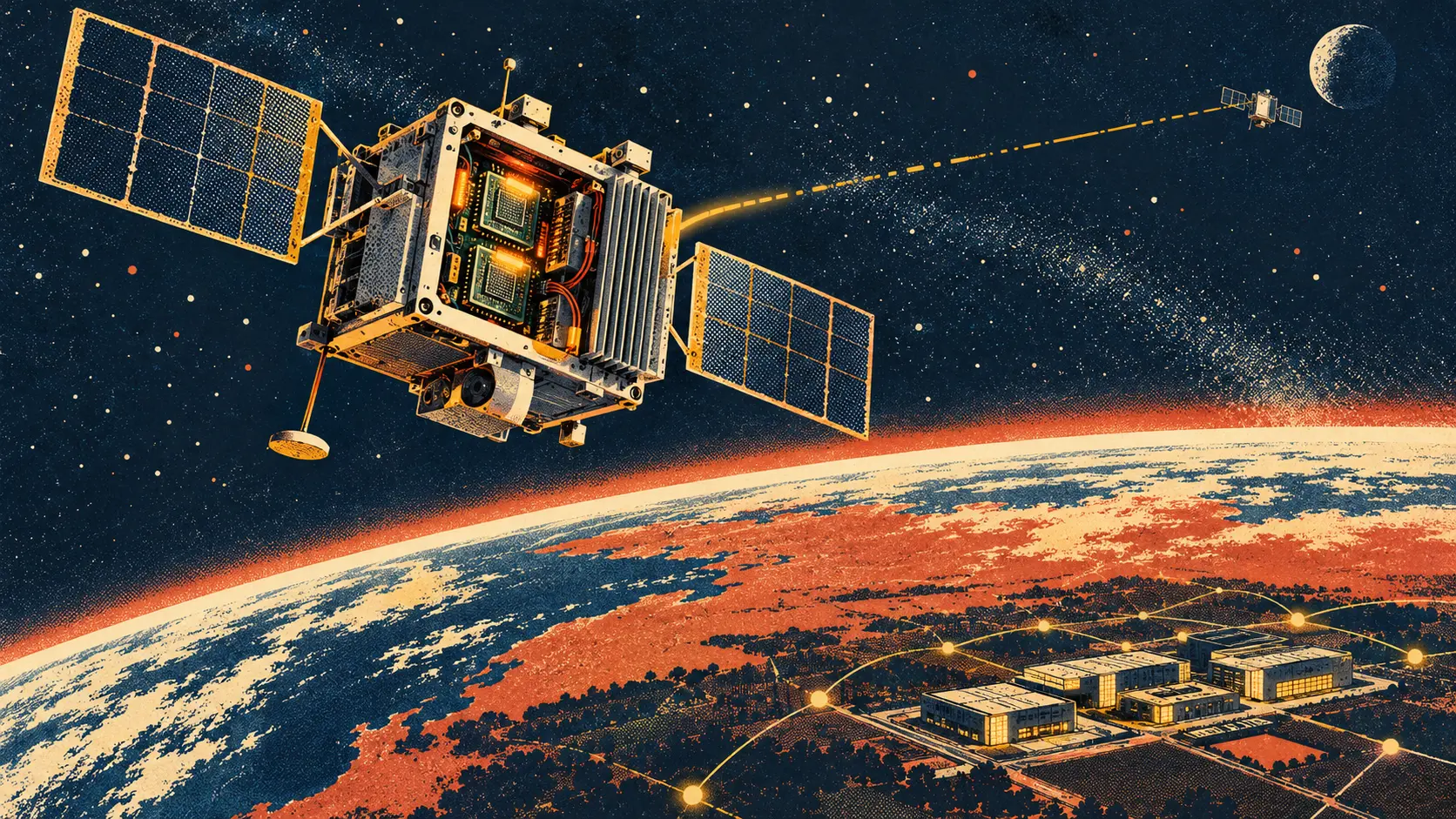
The newest piece of Google AI infrastructure is not answering prompts. It is circling Earth and trying not to cook itself. Google confirmed on October 1 that its Project Suncatcher prototype satellite launched aboard SpaceX's Transporter-18 rideshare mission. Planet built the spacecraft with Google. The company says it has established contact and the satellite is operating as expected. That is the verified event. The next part needs a much larger asterisk. Project Suncatcher is Google's research plan for putting machine-learning hardware on solar-powered satellites and eventually linking many satellites with optical connections. The long-range concept is an orbital computing system that can draw near-continuous solar energy in a suitable low-Earth orbit. The launch does not demonstrate that system. It begins a smaller experiment: expose Google's Tensor Processing Units, or TPUs, to the physical stress, radiation and thermal conditions of space, then measure what happens. The plain signal is that Google has moved one important question out of the laboratory and into orbit. The company has not moved a data center there. The distinction matters because the attractive part of the proposal is easy to explain. In its original research description, Google says a solar panel in the right orbit can be up to eight times more productive than one on Earth and can generate power nearly continuously. AI computing needs enormous amounts of electricity. Put the computers closer to the sunlight, the argument goes, and perhaps some future infrastructure can scale without placing every new megawatt on a terrestrial grid. Space then sends the bill. A rocket launch shakes hardware violently. Google says the spacecraft can experience sustained acceleration up to ten times gravity, while individual components can see 50 to 100 times gravity. Outside Earth's protective atmosphere, solar events and cosmic radiation can alter bits or damage electronics. Heat is another problem. A TPU concentrates power in a small area, but a vacuum has no air to carry that heat away. The satellite must move heat through pipes and radiate it into space. Google tested parts of this problem on Earth before launch. The company says it shook the satellite along three axes, ran Trillium TPUs in a proton beam at the University of California, Davis, and used a thermal-vacuum chamber to test its cooling system. Its research paper reports that the tested TPUs survived a total ionizing dose equivalent to a five-year mission without permanent failures and were characterized for bit-flip errors. Those tests are promising evidence about selected hardware under selected conditions. They are not a production service-level agreement. Orbit adds combinations, durations and failure modes that a laboratory cannot perfectly reproduce. That is why the current satellite exists. Over the coming weeks, Google says it will collect data on how the TPUs handle spaceflight stress, radiation and thermal extremes. The useful result may be a list of problems. A hot component, a radiation-induced error pattern or a cooling limit would tell engineers where the next design needs margin. A quiet flight would still need enough time and telemetry to show that quiet means robust rather than merely lucky. Even a perfect hardware-survival result would leave the harder system questions on the ground. Large AI workloads do not become useful just because several chips are nearby. Training and serving models require accelerators to exchange data at high bandwidth and low latency. Google's proposed satellites would fly in close formation and communicate through free-space optical links. Its research says data-center-like operation could require tens of terabits per second between satellites. A laboratory demonstration reached 800 gigabits per second in each direction, according to Google's earlier work, but keeping narrow laser links aligned between moving spacecraft is a different job. Google plans a two-satellite test in 2027. That mission is the first public milestone aimed at the networking problem. Until satellites exchange real workload data in orbit, the cluster remains a design, not a cluster. Then there is the workload path. Data must reach orbit, be processed, survive interruptions and return. Sensitive information needs protection in transit and at rest. Operators need a way to schedule jobs, replace failed capacity, update software and prove that a result was not corrupted by radiation. A satellite network also needs ground stations, launch providers, tracking, collision avoidance, licensing and debris plans. The data center may be in the sky, but its supply chain, control room and consequences stay stubbornly terrestrial. Economics are equally unfinished. Google's research argues that falling launch prices could make the concept competitive in the mid-2030s and models launch costs at or below $200 per kilogram. That is a projection built from a learning curve, not a price available today. The comparison must include launch, spacecraft manufacturing, failed missions, replacement cadence, ground links, insurance, operations and the energy used across the whole system. Terrestrial data centers are expensive and resource-intensive, but they are also reachable by trucks and technicians. A failed power supply can be replaced without booking a rocket. An orbital system trades some land, grid and water constraints for launch emissions, material throughput, space-traffic risk and hardware that is difficult or impossible to repair. The environmental case therefore needs a ledger, not a mood board. Count the energy collected in orbit, the energy and material required to manufacture and launch the system, the cooling and ground infrastructure, the expected hardware life, the replacement rate and the disposal path. Compare that with a realistic Earth-based alternative using the same workload and reliability target. A solar panel seeing more sunlight is only the first line of the spreadsheet. There are practical applications if the engineering works. An orbital cluster could run workloads whose power demand is difficult to place on a crowded grid. It could support space-based sensing or scientific instruments without sending every raw observation to Earth first. A modular satellite design could add capacity in increments rather than through one immense facility. Optical networking developed for the project might improve other spacecraft communications even if the orbital data-center vision never arrives. None of those applications has been demonstrated by this launch. That sentence is not pessimism. It is the job description of a prototype. The current mission should be judged by whether Google publishes enough evidence to separate survival from useful computing. How much TPU work runs in orbit? What kinds of errors appear under radiation? How does performance change across thermal cycles? How much power reaches the chips, and how much heat can the radiator reject? What fails first? How does the hardware recover? What telemetry will be public, and what will remain a company summary? The 2027 mission needs another set of questions. What throughput and latency do the two satellites sustain while moving? How often does the optical link drop? How much pointing power and mass does it require? Can a distributed workload make progress across the link, or does the network spend its life recovering alignment? Those measurements would turn a spectacular premise into an engineering record. Independent researchers would also need enough detail to reproduce the assumptions behind cost, energy, orbital formation and reliability claims. Google deserves credit for naming the current launch as an experiment. Its October 1 announcement says the satellite will gather data, refine designs and inform later missions. The company's September preview calls this first launch a hardware-survival test and says future satellites would carry dozens of TPUs. That is more useful than pretending a small prototype is an orbital cloud region. The tempting headline is that AI has gone to space. The more accurate one is that a few of AI's physical constraints finally have nowhere to hide. Radiation, vibration, heat, bandwidth, launch cost and orbital control do not care about a demo reel. They produce measurements. Project Suncatcher now has the first chance to collect them. The data center is still on Earth. The experiment is finally above it.
01
WHAT ACTUALLY CHANGED
Google confirmed that the first Project Suncatcher prototype satellite launched on October 1, 2026.
The Planet-built spacecraft flew aboard SpaceX's Transporter-18 rideshare mission.
Google says it established contact and the satellite is operating as expected.
The mission begins in-orbit testing of Google TPUs under radiation, thermal extremes and spaceflight stress.
Google says its peer-reviewed Project Suncatcher paper is now available in Joule.
Ground testing included vibration tests, proton-beam radiation tests and thermal-vacuum cooling tests.
Google reports that tested Trillium TPUs survived a modeled five-year total ionizing radiation dose without permanent failures.
The company plans a two-satellite optical-link test in 2027.
The current prototype does not demonstrate a production AI workload or an orbital data center.
02
WHY THIS MATTERS
The launch moves hardware-survival questions from simulated conditions into actual orbit.
AI infrastructure is constrained by electricity, cooling, land, networks and materials, not only model design.
Near-continuous solar exposure makes orbit attractive, but collecting power does not solve heat rejection or networking.
Radiation errors that are tolerable in a short test may become costly in a long-running distributed service.
A data-center-scale workload needs fast, stable communication among accelerators, which has not yet been shown in orbit.
Launch economics, replacement cycles and failure rates could erase an apparent energy advantage.
Space-based compute would still rely on terrestrial manufacturing, ground stations, operators and regulation.
Public measurements from this mission can clarify which parts of the concept are engineering problems and which remain speculation.
03
WHERE IT COULD HELP
- Measure TPU error rates during radiation events and thermal cycles.
- Compare in-orbit performance with the same hardware tested in proton beams and thermal-vacuum chambers.
- Improve heat-pipe and radiator designs for dense space electronics.
- Test safe recovery after bit flips, resets and communication outages.
- Develop optical links for high-bandwidth communication between nearby satellites.
- Process some Earth-observation or scientific data near the sensor before sending results to the ground.
- Model total system cost using real launch, failure, replacement and operations data.
- Publish an environmental ledger that includes manufacturing, launch, ground systems and end-of-life handling.
- Define workload gates that separate hardware survival from useful distributed computing.
- Use orbital telemetry to decide whether the next experiment should scale, change direction or stop.
KEEP A HAND ON THE WHEEL
Google confirms launch, contact and expected initial operation. It does not report a completed production AI workload, an operational satellite cluster or independent validation of the system concept. Hardware-survival results, radiation performance, thermal behavior and useful compute measurements have not yet been published from orbit. The eight-times solar-productivity figure, future satellite scale and mid-2030s launch-cost scenario come from Google's own research and assumptions. The planned 2027 optical-link mission is a future milestone. The current satellite should be evaluated as an experiment, not as proof that orbital AI infrastructure is technically, economically or environmentally superior to a terrestrial system.
04
TERMS WORTH KEEPING
OPEN GLOSSARY CARD
Firm power
Electricity capacity that planners expect to be reliably available when demand reaches its peak.
OPEN GLOSSARY CARD
Inference
The moment a trained model uses what it learned to produce an answer.
OPEN GLOSSARY CARD
Benchmark
A fixed test used to compare how systems perform on the same tasks.
SOURCES AND VERIFICATION STATUS
This article was written from the materials below. Product claims and dates were checked against those sources on October 2, 2026.
PUBLICATION RECEIPT: Original publication. Facts checked immediately before publication against Google's October 1 launch confirmation, September 24 mission preview, research overview and the project paper.
THE PUBLICATION ENGINE
WANT A SIGNAL OF YOUR OWN?
We build source-grounded publications, private briefings, and editorial systems for organizations with something useful to say.
WORK WITH US