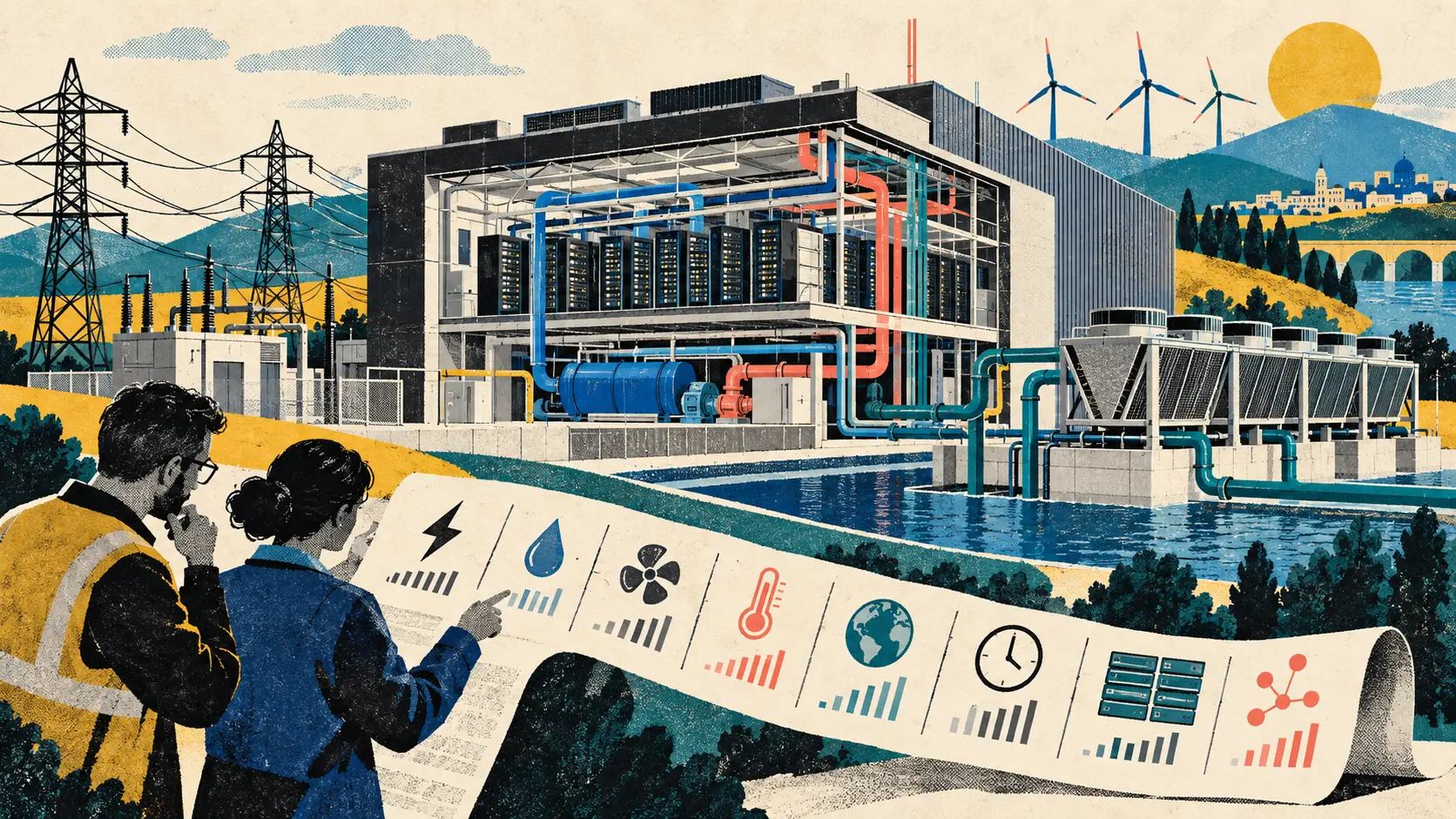
THE SIGNAL IN ONE SENTENCE
NVIDIA has a new answer for two questions following large AI data centers around Europe: how much power will they need, and how much water will they drink? The answer is not one number. It is a stack of designs and software called NVIDIA DSX. In an October 21 announcement from GTC Berlin, NVIDIA said DSX reference designs can connect liquid-cooled computing equipment to outdoor dry coolers. The closed loop carries heat out of the servers, and radiator-like equipment releases it into the air without the continuous evaporation used by conventional cooling towers. NVIDIA says that arrangement can reduce facility cooling-water consumption to near zero. It also says a two-gigawatt deployment could save 54 million liters a day compared with a cooling-tower-based design. That sounds enormous because it is enormous. It is also a modeled comparison published by the vendor, not a universal result from every site that might carry the DSX name. The announcement says local climate determines whether extra mechanical cooling is needed during the hottest periods. A dry cooler in Iceland does not face the same afternoon as one in southern Spain. Near-zero facility cooling water does not mean zero water across electricity generation, chip manufacturing, construction or the surrounding supply chain. It does not tell a town how much water a particular operating site withdrew last August. The power claim needs the same careful reading. NVIDIA says DSX MaxLPS dynamically reallocates power inside a fixed facility budget and can generate the same number of tokens with up to 30 percent less power. The software looks for headroom that static provisioning leaves unused and redistributes it across GPU groups. The company's documentation shows how facility readings, live GPU and rack telemetry, and power targets flow into that control loop. It also makes clear that workload mix matters. Training and inference do not draw power in the same pattern, and the available headroom changes with the jobs running at a site. NVIDIA reports several supporting trials. In a proof of concept on HGX B200 systems, Lambda produced 24 percent more cluster token throughput and ran 19 percent more GPU capacity within a fixed power budget. At an Nscale facility in Iceland, NVIDIA says an evaluation across four GB300 NVL72 racks produced 49 percent higher inference throughput and 37 percent more managed GPU capacity inside the same 264-kilowatt provisioned budget. Those results are interesting. They are also company and partner results, not independent audits of total facility consumption. The distinction matters because efficiency and scale can pull in opposite directions. A system that produces more tokens per watt can lower the resource cost of a fixed workload. The same improvement can also let an operator install more accelerators, serve more requests and sell more output without increasing its contracted power ceiling. NVIDIA presents that added capacity as a benefit. For a cloud operator, it plainly is. For the grid and the climate, the question is what happens next. If the facility keeps its annual electricity use flat while completing more useful work, the gain is real. If lower costs encourage much more usage, total electricity may still rise. If the operator fills every recovered watt with another GPU, the site can become more productive without becoming a smaller load. This is the rebound problem wearing a very nice cooling jacket. NVIDIA DSX Flex adds another useful possibility. It gives utilities and grid-facing systems a shared way to request a power limit for a defined period, while the facility decides how to respond using workloads, storage, onsite generation and other controls. In an early trial involving Emerald AI, EPRI, Nebius, the United Kingdom's National Grid and NVIDIA, the company reports that a Blackwell Ultra cluster reduced power draw by as much as 40 percent during simulated grid events while critical workloads kept running. Again, the verbs deserve attention. This was an early trial with simulated events. A flexible facility can help a strained grid, but the receipt must show what it actually did: the baseline, requested reduction, starting power, lowest power, duration, delayed work, recovery period and any rebound peak after the event ended. A percentage without that timeline can hide a lot of electrical mischief. The plain signal is that NVIDIA is trying to connect the server rack, cooling plant, electrical system and grid instead of treating them as separate worlds. That is sensible engineering. The next step is to publish evidence at the same boundary. Call it the facility receipt. The receipt starts with a named site. Give its location, climate zone, reporting period and operating status. State which buildings, tenants, backup systems and shared utilities sit inside the measurement boundary. Then define the baseline. If a new design saves water compared with a conventional cooling tower, specify the tower design, climate assumptions, heat load, hours of operation and water-quality requirements. If software saves power for the same token output, name the hardware, model, precision, batch size, context profile, service-level target and output-quality threshold. Measure electricity at several levels. Report total facility electricity, IT electricity, cooling and power-conversion overhead, average load, peak load and idle draw. Publish Power Usage Effectiveness, but do not let the ratio replace the megawatt-hours. A good ratio attached to a very large site can still produce a very large bill. Do the same for water. Separate withdrawal from consumption. Name the source, including whether it is potable, reclaimed, surface or groundwater. Report monthly totals and peak-day use. Show water used by cooling, humidification, cleaning, backup equipment and other facility operations. Add local basin stress so a liter in a wet season is not treated as identical to a liter during drought. Dry cooling belongs in that comparison, not on a pedestal. It can greatly reduce evaporative water use. Depending on climate and operating temperature, it can also change fan power, equipment sizing and performance during hot weather. Publish the hot-day curve. Now connect the workload. Tokens are convenient because the machinery already counts them. They are not a universal measure of useful work. One token might belong to a correct translation, a discarded marketing paragraph, a failed tool call or an agent retrying the same bad plan for the sixth time. A credible receipt should report workload class, requests completed, accepted outputs, latency, quality, failures and human corrections alongside token throughput. It should show utilization and the share of electricity consumed while equipment waits. Otherwise, higher token volume may be mistaken for higher public value. Grid timing is the next line. Annual renewable-energy matching cannot show which generator served a facility during a constrained hour. Report the location-based grid mix, hourly carbon intensity where available, demand-response events, onsite generation, battery charging and discharging, and backup-generator runs. For every flexibility event, disclose what work moved and what happened later. A queue that pauses at 5 p.m. and surges at 7 p.m. has shifted the problem. A queue that waits for a cleaner, less constrained hour may have reduced it. Finally, publish absolute totals year over year. Show whether better cooling, scheduling and power allocation reduced the site's electricity and water, held them flat while useful output rose, or simply supported faster expansion. This is practical information, not an environmental scrapbook. A cloud buyer can use it to compare two regions for a real workload. A utility can plan transmission and demand response. A local government can test permit promises against operating results. Residents can see whether a near-zero water claim applies to their facility and their summer. Investors can distinguish a reference design from a measured outcome. Engineers can learn which controls worked outside a demonstration. NVIDIA's announcement does not provide that full site ledger. It provides architecture, claimed potential and selected partner evidence. The release is clear that some organizations are exploring the software, some results come from proofs of concept or evaluations, and climate affects cooling. That is enough to take the design seriously. It is not enough to close the account. The best version of DSX could help operators use less water, recover stranded electrical capacity and cooperate with the grid. Those are worthwhile goals. But infrastructure this large should not ask the public to infer total impact from a handful of best-case ratios. Publish the watts. Publish the liters. Publish the weather, workload and waiting time. Publish the baseline and the rebound. Then we can see whether an efficient AI factory is also a smaller burden, a more useful machine, or merely a bigger factory with better manners.
01
WHAT ACTUALLY CHANGED
NVIDIA announced the DSX AI Factory Platform and European partner adoption at GTC Berlin on October 21, 2026
DSX reference designs connect liquid-cooled computing with closed-loop dry-cooler heat rejection
NVIDIA says dry-cooler-based designs can reduce facility cooling-water consumption to near zero
NVIDIA estimates that a two-gigawatt deployment could save 54 million liters of water per day compared with a conventional cooling-tower-based system
The announcement says local climate determines whether supplemental mechanical cooling is needed during the hottest periods
NVIDIA says DSX MaxLPS can generate the same number of tokens with up to 30 percent less power by dynamically allocating a fixed facility power budget
A Lambda proof of concept reported 24 percent more cluster token throughput and 19 percent more GPU capacity inside a fixed power budget
An Nscale evaluation in Iceland reported 49 percent higher inference throughput and 37 percent more managed GPU capacity across four racks inside a 264-kilowatt provisioned budget
DSX Flex coordinates time-bound grid power targets with facility-side workload, power and infrastructure controls
An early trial reported power-draw reductions of up to 40 percent during simulated grid events while critical workloads continued
02
WHY THIS MATTERS
Closed-loop dry cooling can reduce evaporative water use, but climate and hot-weather operation affect the result
Near-zero facility cooling water does not include water used by electricity generation, manufacturing, construction or other parts of the supply chain
Tokens per watt is an efficiency measure, not a report of total annual electricity use or useful work completed
Dynamic power allocation can improve throughput inside a fixed ceiling while encouraging operators to fill recovered capacity with more hardware
Higher efficiency can coexist with higher absolute consumption when demand and installed capacity grow faster than savings
Grid-flexible workloads can support reliability only if event baselines, duration, delayed work and rebound are measured
Proofs of concept and partner evaluations do not substitute for independent audits at full operating scale
Communities need site-level electricity, water, climate and peak-demand data to evaluate local consequences
Buyers need workload-specific quality, latency and output measurements to compare infrastructure fairly
A common facility receipt would let design claims be tested against operating results over time
03
WHERE IT COULD HELP
- Compare dry cooling with cooling towers under the actual climate and heat load of a proposed site
- Measure total facility electricity, IT load, overhead, peak demand, idle draw and annual consumption
- Report water withdrawal and consumption by source, month, peak day and local basin condition
- Publish Power Usage Effectiveness and Water Usage Effectiveness beside absolute totals
- Benchmark MaxLPS with a named model, hardware, precision, workload mix, quality target and service level
- Track accepted tasks, failed runs, retries and human corrections alongside raw token output
- Record utilization distributions so recovered capacity and idle equipment remain visible
- Schedule flexible workloads for cleaner or less constrained grid periods
- Verify demand-response events with baseline, reduction, duration, recovery and rebound data
- Compare annual renewable procurement with the hourly location-based grid mix
- Attach facility receipts to cloud procurement, permits, utility agreements and sustainability reports
- Use independent audits to test vendor and partner claims at representative operating scale
KEEP A HAND ON THE WHEEL
The October 21 announcement describes NVIDIA and partner claims, reference designs, proofs of concept, evaluations and an early trial. The up-to figures are not universal guarantees. Local climate can require supplemental mechanical cooling, and near-zero facility cooling water does not mean zero water across the full supply chain. More tokens per watt or more capacity inside a fixed power ceiling does not establish lower total annual electricity use. Watch for independently audited operating data from named facilities; complete electricity and water boundaries; hot-weather performance; monthly and peak measurements; workload and quality controls; utilization; hourly grid impact; demand-response rebound; construction and hardware impacts; and year-over-year absolute totals.
04
TERMS WORTH KEEPING
OPEN GLOSSARY CARD
Power usage effectiveness
A data-center efficiency ratio that divides total facility energy by the energy delivered to information-technology equipment.
OPEN GLOSSARY CARD
Absolute consumption
The total quantity of a resource used during a stated period, rather than a ratio describing use per unit of activity.
OPEN GLOSSARY CARD
Water stress
A condition in which demand for usable water is high relative to the supply available in a place and season.
SOURCES AND VERIFICATION STATUS
This article was written from the materials below. Product claims and dates were checked against those sources on October 22, 2026.
THE PUBLICATION ENGINE
WANT A SIGNAL OF YOUR OWN?
We build source-grounded publications, private briefings, and editorial systems for organizations with something useful to say.
WORK WITH US