THE SIGNAL IN ONE SENTENCE
Hyundai has put a two-track AI driving plan on the calendar. The first track uses Nvidia's vehicle computing platform and driving software to target Level 2+ production in the first half of 2028 and Level 2++ in the second half. The second track is Hyundai and 42dot's own Atria AI, now targeted for Level 2++ production in the second half of 2029. Reuters reports that the in-house arrival is two years later than originally planned. Hyundai calls the Nvidia work a bridge, not a surrender: deploy sooner, collect harder road cases, feed them into a loop of training and validation, and use that learning to improve Atria. One large clarification belongs on the windshield. Level 2 remains driver assistance. It can steer and manage speed together, but the person must stay engaged, watch the road, and remain responsible for driving.
01
WHAT ACTUALLY CHANGED
Hyundai Motor Group presented the roadmap at its autonomous driving media day at 42dot headquarters in Gyeonggi Province, South Korea, and published the details on September 13. It says the Nvidia-based Level 2+ system is targeted for production in the first half of 2028, followed by Level 2++ in the second half. Atria AI-powered Level 2++ vehicles are targeted for the second half of 2029.
Reuters reports that Hyundai had previously aimed to introduce its proprietary software in late 2027. The new schedule places Nvidia between the current development program and Atria production. Hyundai president Park Min-woo said the companies will co-design the technology and that data from the Nvidia-based system will help train and refine Atria. Those are plans and company claims, not completed production milestones.
The Nvidia track uses the DRIVE Hyperion 10 platform and is intended to standardize sensors across Hyundai Motor, Kia, 42dot, and Motional. Reuters says the initial setup favors cameras, radar, and ultrasonic sensors instead of more expensive lidar. Hyundai is considering lidar for Level 3 systems, but Park gave no Level 3 commercialization date.
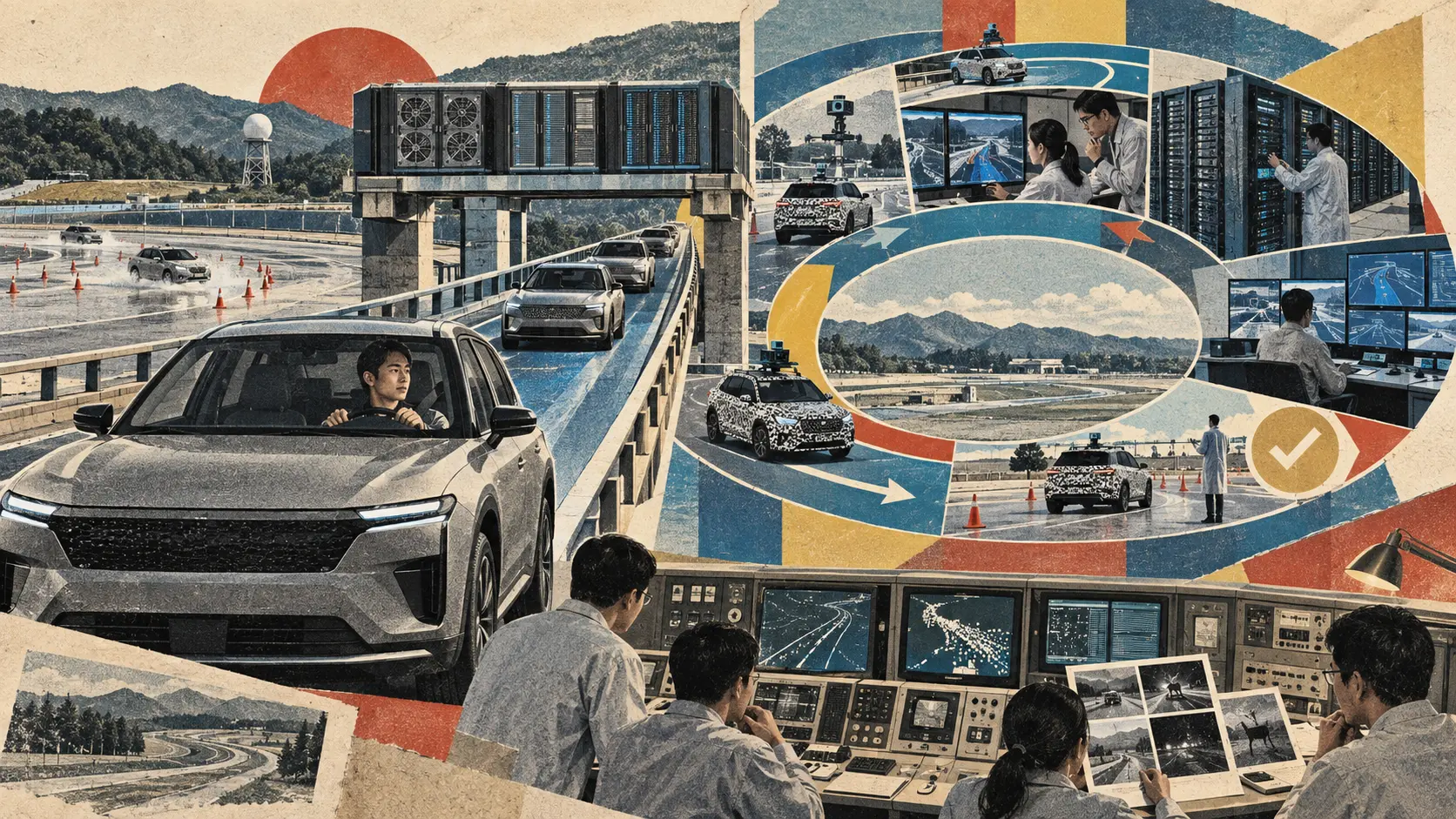
Hyundai says its data flywheel is now operating. The loop collects driving data, identifies hard examples, trains models, validates them in simulation and vehicles, deploys improvements, and starts again. The group currently says it runs about forty dedicated data-collection vehicles. Its annual sales of more than seven million vehicles across roughly 190 countries are potential scale, not a statement that every sold car is collecting training data.
Several pieces remain research or pilot work. Hyundai plans a real-world Level 4 pilot in Gwangju by the end of 2026 to collect validation data. Its vision-language-action model is still in simulation-based validation, with real-vehicle testing planned from late 2026 into early 2027. The published urban-driving footage is a demonstration, not a public safety benchmark or evidence of consumer-ready autonomy.
02
WHY THIS MATTERS
The bridge reveals an ordinary industrial truth hiding inside the AI race. A carmaker can want full control of its software and still need a supplier to reach customers on time. Using Nvidia may shorten the path to a production feature, while the resulting fleet data may strengthen Hyundai's own system. It also creates technical and commercial dependence that Hyundai will eventually have to unwind, maintain, or accept.
The plus signs need translation. SAE's standard taxonomy defines Level 2 as partial driving automation. It does not create official Level 2+ or Level 2++ categories. Companies use those suffixes to describe more capable assistance, often across highways or urban roads, but the underlying responsibility does not move with the extra punctuation. NHTSA's plain version is better: you drive, you monitor.
A data flywheel is only as good as what it notices. Millions of routine highway miles can repeat the easy answer. Construction zones, severe weather, abrupt lane changes, narrow streets, unusual road markings, emergency vehicles, cyclists, and pedestrians reveal where a model fails. Hyundai says it uses hard-example mining and virtual reconstruction to focus training. Readers should look for evidence that the loop improves rare cases without breaking familiar ones.
Fleet scale raises a second set of questions about consent, geography, and representation. Road video and sensor data can capture people, license plates, homes, storefronts, and location patterns. A global sales footprint could help a model learn different weather, signs, road designs, and driving behavior. It could also produce a vast collection system. Hyundai's announcement does not provide a country-by-country data policy, retention schedule, opt-out process, or public breakdown of training coverage.
The schedule matters beyond Hyundai. Automakers are deciding whether their differentiating intelligence lives inside the company or arrives with a chip and software supplier. That choice affects update control, repair, cybersecurity, data access, engineering talent, supplier bargaining power, and what happens when a platform changes. The winning demo is less important than the system that can be maintained for a vehicle's long life.
03
WHERE IT COULD HELP
- For buyers, verify the exact feature, roads, speeds, weather limits, attention requirements, subscription terms, and update policy instead of relying on a plus sign
- For developers, turn hard road events into a documented loop of capture, labeling, training, simulation, closed-course testing, road validation, regression checks, and controlled release
- For fleet operators, measure disengagements, false braking, missed hazards, driver-monitoring performance, software versions, and incident rates by operating condition
- For privacy teams, publish what exterior and cabin sensors collect, where the data travels, how long it remains, who can use it, and how people can object or request deletion
- For policymakers, require consumer language that separates supervised driver assistance from automated driving and makes responsibility visible at purchase, activation, and every software update
KEEP A HAND ON THE WHEEL
Hyundai's schedule, data-flywheel benefits, sensor plan, and demonstrations are company statements. Reuters independently reports the two-year change from the previous proprietary-software target, but the 2028 and 2029 dates remain targets rather than delivered vehicles. Level 2+ and Level 2++ are industry shorthand, not additional levels in SAE's six-level taxonomy. Both systems described here require active driver supervision and do not make the driver a passenger. The Atria footage does not publish route length, intervention count, comparison method, failure log, safety-driver behavior, software version, or repeatability. Forty dedicated collection vehicles are not seven million instrumented cars. The Gwangju Level 4 work is a planned pilot, not a consumer product, and Level 4 operation is limited to a defined operating domain. The vision-language-action system remains in validation. Watch for production specifications, regulator filings, driver-monitoring requirements, crash and disengagement data, privacy terms, independent testing, software support periods, and any further schedule change.
04
TERMS WORTH KEEPING
SOURCES AND VERIFICATION STATUS
This article was written from the materials below. Product claims and dates were checked against those sources on September 14, 2026.
PUBLICATION RECEIPT: Revision 1. Published September 14, 2026.
THE PUBLICATION ENGINE
WANT A SIGNAL OF YOUR OWN?
We build source-grounded publications, private briefings, and editorial systems for organizations with something useful to say.
WORK WITH US