THE SIGNAL IN ONE SENTENCE
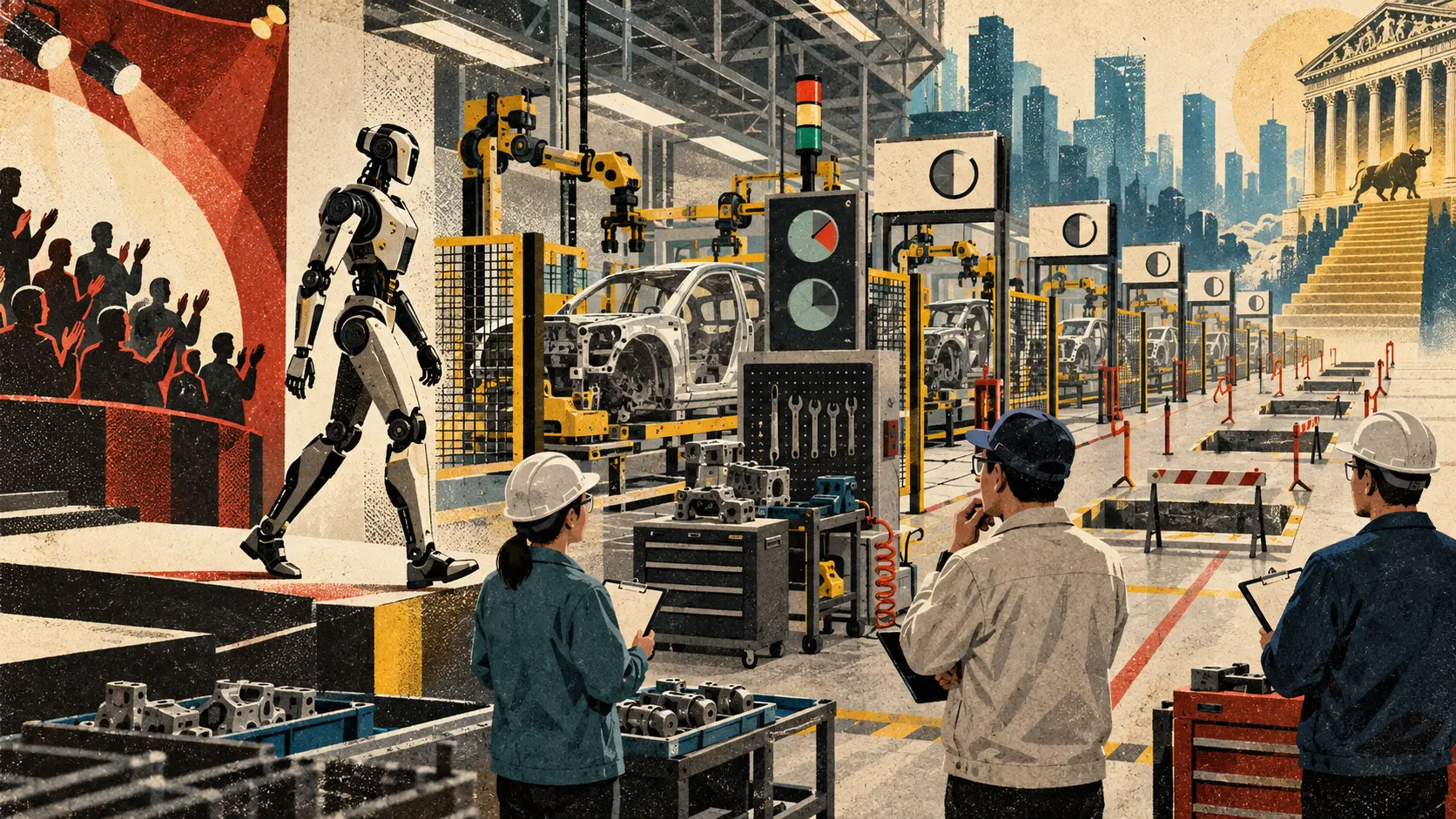
Boston Dynamics has a production version of Atlas, early deployments on its calendar, and one of the best-known robot demonstrations on Earth. It does not have a public IPO timetable, a profitable business, or evidence that Atlas is working at factory scale. Reuters reports that a senior Hyundai Motor Group executive said a 2027 listing would not be easy. That is not a cancellation because Hyundai never announced a date. It is a useful reality check. A humanoid becomes an investable industrial system only after the company can repeatedly build it, install it, keep it working, service it, train it for valuable tasks, protect nearby workers, and show customers that the savings exceed the full cost. The backflip was the opening act. Uptime is the audition that matters now.
01
WHAT ACTUALLY CHANGED
Reuters reported from Seoul on September 14 that a senior Hyundai Motor Group executive with direct knowledge of the matter considered a Boston Dynamics IPO in 2027 difficult. The executive asked not to be named because the matter is confidential and offered no detailed criteria. Hyundai has not publicly announced an IPO date or valuation target, and neither Hyundai nor Boston Dynamics provided Reuters with a same-day public response. The clean claim is therefore narrow: one informed executive has cooled expectations around next year, not a board has rejected a filed listing plan.
The reason given is more concrete than the calendar. Reuters says Boston Dynamics remains unprofitable and has not deployed Atlas at scale. It reports a 2025 loss of 528.4 billion won and cumulative losses of nearly 1.7 trillion won from 2021 through 2025, citing a Hyundai Glovis filing. Those figures describe the whole company, not Atlas alone, and accounting losses do not reveal the economics of a particular robot or customer deployment.
Boston Dynamics presents a nearer-term product story. In a September account of Atlas development, the company said it was already manufacturing the product version and had 2026 deployments scheduled at Hyundai and Google DeepMind. It described part sequencing as its first automotive application and said application readiness, reliability, gripper durability, perception, field service, and continuous operation were development priorities. The company did not publish unit counts, customer prices, uptime, intervention rates, repair frequency, safety incidents, or measured return on investment.
Hyundai published the longer industrial ramp in January. It plans to introduce Atlas into validated parts-sequencing processes beginning in 2028, extend work toward component assembly by 2030, and scale only as performance is validated. The group also targets a production system capable of manufacturing 30,000 robots per year by 2028. Capacity is not output, orders, or utilization. A factory able to make that many machines can still produce far fewer while customers, software, component yield, and service operations catch up.
Investor estimates are all over the factory floor. Reuters reports that Samsung Securities cited market valuations between 50 trillion and 100 trillion won, while IBK Securities projected 141 trillion won by 2030 alongside about 11 trillion won in revenue. Another analyst suggested 2029 or 2030 as a more plausible listing window. These are forecasts, not offers, audited results, or company guidance. Their width is itself information: the market is pricing a future business whose operating evidence is still thin.
02
WHY THIS MATTERS
Humanoid demonstrations compress the story into a body moving through space. A factory stretches it back out. The robot has to pick the correct part after thousands of repetitions, tolerate dust and vibration, recover when a bin is misplaced, avoid people and equipment, swap batteries, accept software updates, and return to work after maintenance. A smooth video can prove motion. It cannot prove a shift, a month, or a fleet.
The first task matters. Part sequencing means organizing components in the order an assembly line needs them. It is narrower than a general-purpose robot doing whatever a person asks, which is precisely why it is credible as an opening target. The environment can be constrained, the motions measured, and the cost of delay calculated. If Atlas cannot beat an existing automation method or human-assisted process on safety, quality, speed, flexibility, and total cost, its impressive range of motion is a very expensive party trick.
Manufacturing yield is a second robot hiding behind the first. Boston Dynamics must not only make Atlas work. It must make thousands of sufficiently similar Atlas units without rare actuators, tactile hands, sensors, batteries, or joints producing a repair queue longer than the production line. Hyundai brings automotive purchasing, component design, logistics, process control, and service experience. That is a serious advantage, but the 30,000-unit target still needs evidence in scrap rates, supplier capacity, cycle time, quality escapes, and delivered machines.
An IPO would convert uncertainty into a quarterly public argument. Investors would ask how many robots were shipped, how much recurring service revenue followed, what gross margin survived warranty work, whether software upgrades reduced labor or added support calls, and how concentrated demand remained inside Hyundai. Waiting for operating data can protect the company from selling a clean science-fiction curve before the dirty maintenance numbers exist.
Workers are not a footnote to the deployment plan. Hyundai says people will retain control while robots take repetitive, heavy, or higher-risk work and employees train and oversee them. Whether that becomes job improvement depends on staffing, retraining, work pace, injury reporting, bargaining, surveillance, and who benefits from productivity gains. A safe robot can still support a harmful labor design. A useful scorecard has to measure the people beside the machine, not only the machine.
03
WHERE IT COULD HELP
- For factory buyers, require a task-specific trial with baseline labor and automation costs, uptime, intervention frequency, quality defects, cycle time, energy use, safety events, and maintenance hours
- For robotics teams, separate a successful demonstration from pilot readiness, repeatable deployment, scaled manufacturing, field service, and profitable operation
- For investors, distinguish production capacity from actual output and analyst valuation scenarios from company guidance, audited revenue, or customer orders
- For workers and unions, negotiate task selection, training, staffing, data collection, safety authority, incident review, and how productivity gains are shared before fleet expansion
- For public agencies, require industrial robot risk assessments, documented stop and recovery procedures, near-miss reporting, cybersecurity controls, and clear responsibility across manufacturer, integrator, and operator
KEEP A HAND ON THE WHEEL
Reuters bases the 2027 IPO assessment on one unnamed Hyundai executive with direct knowledge, not a public board resolution, securities filing, or announced timetable. Hyundai has never disclosed an IPO date or valuation target for Boston Dynamics. The reported losses apply to Boston Dynamics as a company and do not isolate Atlas revenue, research spending, customer economics, or cash flow. Analyst estimates of a 50 trillion to 141 trillion won valuation and possible 2029 to 2030 timing are forecasts that may prove wrong. Boston Dynamics calls Atlas production-ready and says product manufacturing and initial 2026 deployments are underway, while Reuters says it is not deployed at scale. Both can be true: early product units are not a large operating fleet. Hyundai's 30,000-unit figure describes targeted annual production capacity by 2028, not present output, booked demand, or Atlas-only production. The company has not published Atlas pricing, fleet size, uptime, intervention rate, warranty cost, repair time, independent safety validation, customer return on investment, or production yield. Watch for named external customers, repeat orders, measured factory performance, incident disclosures, service economics, unit shipments, audited segment results, and any formal IPO filing.
04
TERMS WORTH KEEPING
OPEN GLOSSARY CARD
Manufacturing yield
The share of manufactured dies or devices that meet the required specifications after fabrication, assembly, and testing.
OPEN GLOSSARY CARD
Humanoid robot
A robot whose body arrangement resembles a person, often using a torso, two arms, and two legs to work in spaces and with tools designed for humans.
OPEN GLOSSARY CARD
Production capacity
The maximum output a manufacturing system is designed to produce over a period under stated operating assumptions.
SOURCES AND VERIFICATION STATUS
This article was written from the materials below. Product claims and dates were checked against those sources on September 14, 2026.
PUBLICATION RECEIPT: Revision 1. Published September 14, 2026.
THE PUBLICATION ENGINE
WANT A SIGNAL OF YOUR OWN?
We build source-grounded publications, private briefings, and editorial systems for organizations with something useful to say.
WORK WITH US