THE SIGNAL IN ONE SENTENCE
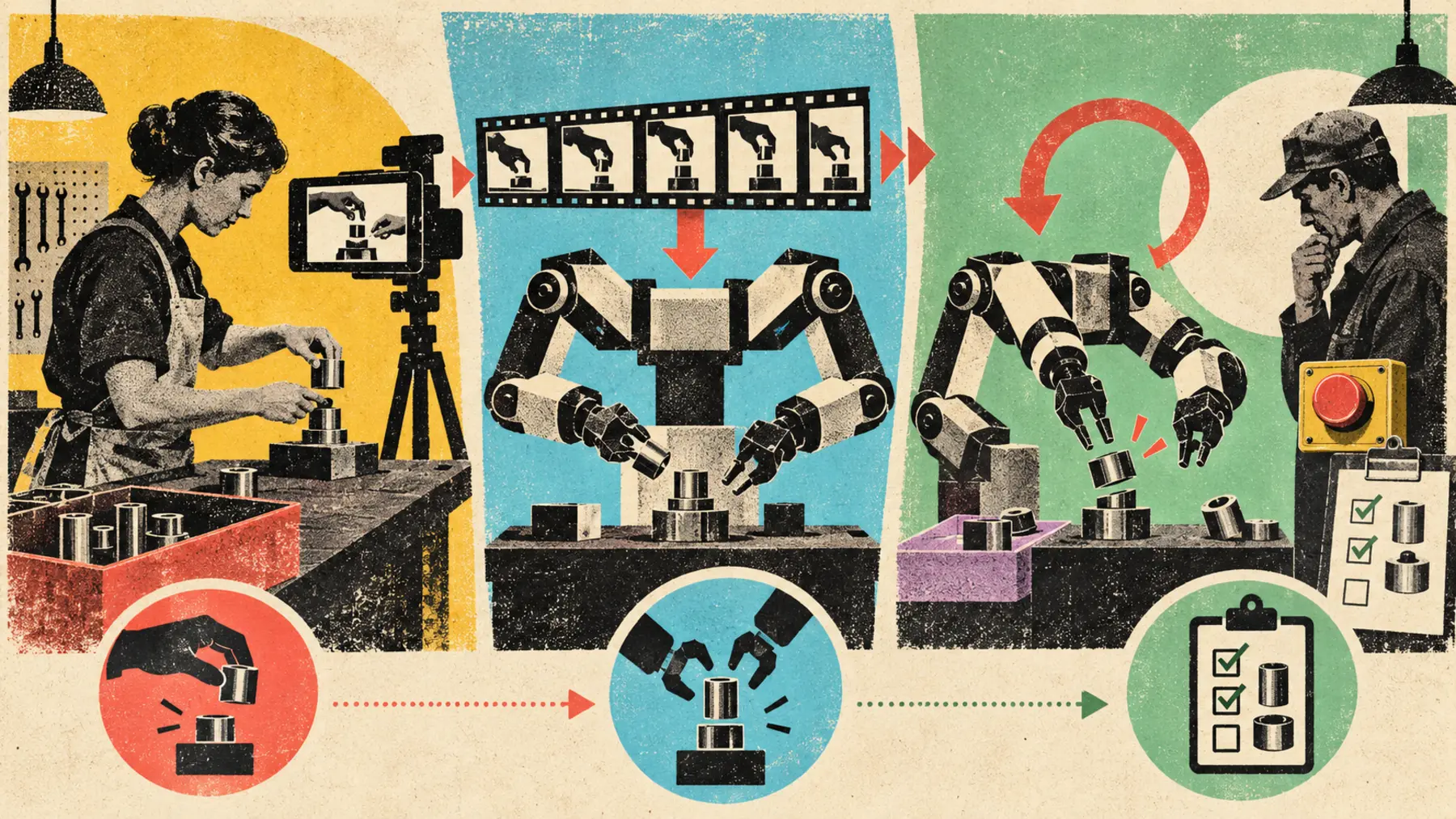
Skild AI built a robot model that can watch one video of a task, interpret the goal and sequence, then attempt the work on a robot without retraining for that specific job. The company shows tasks lasting up to ten minutes, including potting a plant, making a pancake, brewing coffee, and assembling a kit. This is closer to giving a robot a visual prompt than teaching it through hundreds of repeated demonstrations. It is also not a magic upload-and-walk-away machine. Skild reports a 66 percent cumulative per-step success rate on unseen tasks, with people intervening after failures so the evaluation could continue.
01
WHAT ACTUALLY CHANGED
Skild AI introduced S1 in August as an in-context learner for robotic manipulation. Nvidia published a detailed account on September 10 describing how the model fits into simulation, training, and factory deployment. An operator records a video demonstration and gives it to S1 as a prompt. The model uses the video to infer the intended task, objects, order, and motions, then maps that information onto the robot in front of it without changing the model weights or running task-specific post-training.
The demonstration can describe work that is awkward to compress into a sentence. Skild shows S1 attempting four long-horizon tasks that it says were absent from pretraining: potting a plant, cooking a pancake, making pour-over coffee, and assembling a kit. The tasks run as long as ten minutes and contain dozens of manipulation steps. Skild says the same model weights produced every example in its release.
One setup moved unusually quickly. Skild says its team recorded an egocentric plant-potting demonstration at 9:22 p.m. and started autonomous execution on hardware at 9:27 p.m., eleven minutes after the recording process began and after the physical scene had been arranged. That is a demonstration of setup speed in one company-run test. It is not a measured average deployment time across factories, robots, operators, or safety requirements.
The headline performance number needs its full label. Skild compared demonstration prompting with a language-prompted vision-language-action baseline using internal benchmark suites and matched training data, architecture, and compute. On unseen tasks at the largest tested pretraining scale, it reports a 66 percent cumulative per-step success rate for S1 and 9 percent for the baseline. Human intervention recovered the robot after failures so every later step could still be graded. A task with many steps can therefore receive partial credit even when the robot does not complete the full job by itself.
Nvidia says S1 is already involved in commercial work and describes a Foxconn workflow in which a dual-arm robot installs a busbar and limit block, fastens sixteen screws, and adapts to disturbances while assembling Nvidia systems. Nvidia also says Skild uses its infrastructure for training, synthetic data, simulation, and deployment. Those details come from the two collaborating companies. Neither source publishes an independent factory audit, injury record, full-task completion rate, or customer-defined production acceptance test.
02
WHY THIS MATTERS
Video is a practical interface for physical work. A skilled operator often knows exactly how a task should feel and unfold but may not know how to write robot code, specify coordinates, or describe every wrist angle. Recording one careful example can move some of that tacit knowledge into a format the model can inspect. The promise is not that expertise disappears. It is that expertise can become the prompt.
Keeping the weights fixed changes the deployment loop. Traditional learning for a new robot task can require teleoperated examples, a new dataset, training, and repeated validation. S1 tries to put the first attempt minutes after the demonstration instead. That can make prototypes, product changes, and low-volume work cheaper to explore. It does not remove validation. The faster a robot can learn a new motion, the faster a team must decide whether that motion is safe around tools, products, and people.
Per-step scoring is useful for research and dangerous in a sales headline. It reveals which parts of a long task the robot can perform, even after an earlier failure. A factory manager needs additional numbers: uninterrupted full-task completion, recovery without assistance, cycle time, damaged parts, near misses, stop events, and performance across shifts. Sixty-six percent of individually graded steps is not the same thing as a two-thirds chance that the finished product leaves the station correctly.
The release also shows why human oversight belongs inside the product rather than in a paragraph at the end. People choose the demonstration, prepare the workspace, define acceptable motion, recover the evaluation after failures, inspect output, and decide whether the robot can proceed. A useful system should make those roles explicit through preview, speed limits, protected zones, force limits, interruption controls, logs, and a staged path from supervised trial to production.
General-purpose robot intelligence will be judged by transfer, not party tricks. Brewing one coffee in a prepared demo is interesting. Working across different cups, lighting, layouts, robot arms, interruptions, and worn equipment is the real test. Skild reports better resilience when objects move or change and shows qualitative recovery examples. Independent repetition in unfamiliar environments will determine whether one-video teaching becomes a durable interface or an impressive setup that still needs a specialist hiding just outside the frame.
03
WHERE IT COULD HELP
- Let an experienced operator demonstrate a new assembly or handling task without writing robot code
- Prototype variable, low-volume work before investing in a task-specific data collection and training program
- Use simulation to test collisions, contact, force, object movement, and likely failure paths before physical trials
- Run supervised pilot attempts with reduced speed, protected work zones, logging, and an immediately reachable stop control
- Measure uninterrupted full-task completion, recovery, cycle time, damaged parts, interventions, and near misses before production approval
KEEP A HAND ON THE WHEEL
The S1 capabilities, demonstrations, benchmark results, deployment count, revenue run rate, time savings, robustness examples, and commercial claims come from Skild AI and Nvidia. The benchmark suites are internal and the work has not been independently replicated. The reported 66 percent result is cumulative per-step success on unseen long-horizon tasks, not a complete-task reliability rate, and Skild used human intervention after failures so later steps could be evaluated. Its estimate that one prompt demonstration is worth roughly 380 post-training examples comes from interpolation in a company-run comparison. No weight update for the prompted task does not mean no prior training, no future training, or no use of deployment data where agreements permit. Simulation reduces risk but cannot reproduce every real material, person, obstruction, sensor failure, or unexpected contact. Any physical deployment still needs task-specific hazard analysis, guarded trials, human authority to stop the system, and validation on the actual robot and workspace.
04
TERMS WORTH KEEPING
OPEN GLOSSARY CARD
In-context learning
Using examples or information supplied with the current prompt to perform a task without changing the model's stored weights.
OPEN GLOSSARY CARD
Vision-language-action model
A model that connects visual input and instructions with physical actions a robot can execute.
OPEN GLOSSARY CARD
Per-step success
A score that measures how often individual stages of a multistep task succeed, including partial progress when the complete task fails.
SOURCES AND VERIFICATION STATUS
This article was written from the materials below. Product claims and dates were checked against those sources on September 12, 2026.
PUBLICATION RECEIPT: Revision 1. Published September 12, 2026.
THE PUBLICATION ENGINE
WANT A SIGNAL OF YOUR OWN?
We build source-grounded publications, private briefings, and editorial systems for organizations with something useful to say.
WORK WITH US