THE SIGNAL IN ONE SENTENCE
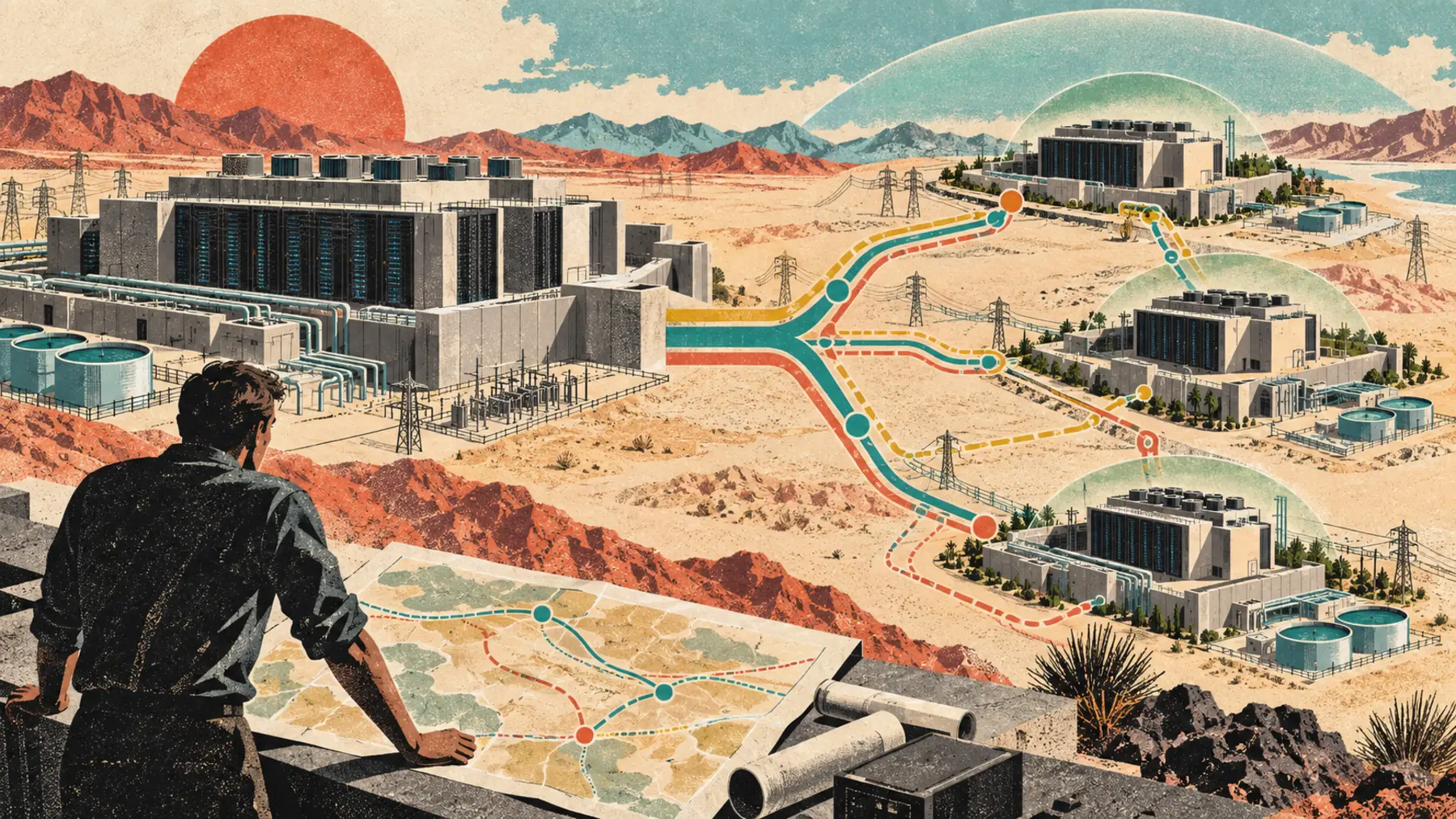
The United Arab Emirates planned one enormous AI data-center campus near Abu Dhabi. Reuters now reports that officials are considering spreading later phases across several locations, putting some sensitive facilities underground or inside mountains, and adding defenses against drones and missiles. The first 1-gigawatt phase is still under construction, and G42 says work is progressing as planned while project details receive continuous review. The change is not a completed redesign. It is a vivid lesson that national AI capacity needs the same physical resilience planning as power grids, ports, and military communications.
01
WHAT ACTUALLY CHANGED
Reuters reported on September 11 that six people familiar with the deliberations said the UAE is revisiting the physical design of its planned 5-gigawatt AI campus after Iranian missiles and drones struck Gulf countries that host American forces. Four sources said the original 10-square-mile campus near Abu Dhabi will likely become a network of data centers spread across the country. The news organization could not determine whether a new master plan is final or how any changes would affect cost and schedule.
The security options under discussion are unusually physical for an AI project. Sources told Reuters that officials are considering air-defense systems, electronic jamming, blast-resistant concrete, backup power and cooling, underground construction, and mountain locations for facilities holding especially sensitive data. These are reported possibilities, not announced construction specifications. The UAE advanced technology ministry and several project partners did not answer Reuters requests for comment.
The review follows real infrastructure damage. Reuters says two Amazon Web Services data centers in the UAE and one in Bahrain were damaged during attacks in March, and that regional cloud disruptions continued when the report was published. It also reports that Iran's armed forces released an April video naming Stargate UAE as a possible target. Those events turn a theoretical concentration risk into an operating concern for governments and companies that expect one complex to carry essential computing work.
The first phase is further along than the larger campus concept. Stargate UAE is a planned 1-gigawatt compute cluster inside the broader 5-gigawatt UAE-US campus. Construction began in 2025, with the first 200 megawatts due online in 2026. SoftBank's original partnership announcement identifies G42 as builder, OpenAI and Oracle as operators, Nvidia as the supplier of Grace Blackwell GB300 systems, Cisco as a networking partner, and SoftBank as a participant.
G42 did not confirm the reported redesign. In a statement to Reuters, the company said work is progressing as planned and that project specifics are continuously reviewed against the security, resilience, and operational standards expected for critical infrastructure at this scale. OpenAI said it was making progress with the UAE on infrastructure and adoption priorities. That leaves a narrow verified center: construction continues, resilience is being reviewed, and the detailed future layout has not been publicly settled.
02
WHY THIS MATTERS
AI infrastructure is easy to describe as cloud capacity because the word cloud makes concrete disappear. Five gigawatts is a physical system of substations, cooling plants, fiber routes, fuel supplies, warehouses, access roads, people, and very expensive chips. Concentrating that machinery can simplify operations and networking. It can also create one location whose failure removes an extraordinary amount of computing capacity at once.
Distribution trades efficiency for resilience. Several sites can keep part of a service alive when one location loses power, cooling, connectivity, or physical access. They also require redundant equipment, secure network links, more complicated workload placement, and careful decisions about which data may move between facilities. A backup site is useful only if it can accept the workload before the first site becomes unreachable.
The local stakes reach beyond model training. The original partners framed Stargate UAE as nation-scale computing that could connect government agencies and commercial institutions to advanced models. If hospitals, ministries, banks, logistics systems, or defense organizations eventually depend on that capacity, availability becomes a public-service question. The architecture must define which functions continue during an attack, who gets priority, and how operators recover without exposing sensitive information.
Hardening a data center can reduce some risks while creating others. Underground construction protects against certain strikes and weather conditions, but it complicates heat removal, emergency access, fire response, expansion, and evacuation. Air defenses and jamming can protect a site while affecting nearby communications or raising new safety questions. Security design needs independent engineering, local emergency planning, and transparent civilian safeguards, not just thicker walls.
The broader signal travels well beyond the Gulf. Countries are treating AI compute as strategic infrastructure while often building it in a few giant clusters. War is an extreme stress test, but the same concentration problem appears during grid failures, floods, wildfires, earthquakes, cable cuts, cyber incidents, and equipment shortages. A serious national AI plan needs an answer for degraded operation before the machines become indispensable.
03
WHERE IT COULD HELP
- Split essential AI services across physically separate failure zones
- Pre-position encrypted backups, spare capacity, network routes, power, cooling, and tested restoration procedures
- Classify government and commercial workloads by sensitivity, recovery time, and public-service priority
- Exercise regional failover under realistic power, cooling, network, staffing, and security disruptions
- Publish civilian emergency, environmental, grid, and community-impact plans before hardened facilities become operational
KEEP A HAND ON THE WHEEL
The distributed layout, underground or mountain facilities, air defenses, jamming, blast-resistant construction, and detailed cause of the review were reported by Reuters from unnamed officials, diplomats, and industry executives. No revised master plan, budget, construction contract, environmental review, or completion schedule has been published. G42 said work is progressing as planned and confirmed only that specifications are continuously reviewed against critical-infrastructure standards. Reuters reported damage to AWS facilities and ongoing service disruption, but the cited public AWS health page did not provide a complete facility-level damage record in the material reviewed. The first 200-megawatt phase is a target for 2026, not verified operating capacity. Five gigawatts describes the planned campus capacity, not current electricity consumption. Security details may remain confidential for legitimate reasons, but secrecy also limits independent scrutiny of cost, civilian risk, energy use, and resilience claims.
04
TERMS WORTH KEEPING
OPEN GLOSSARY CARD
Critical infrastructure
A system or facility whose failure would seriously disrupt public safety, essential services, government, or the economy.
OPEN GLOSSARY CARD
Redundancy
Deliberately keeping an independent backup path or component so one failure does not stop the whole system.
OPEN GLOSSARY CARD
Hyperscaler
A very large technology company that operates computing infrastructure at enormous scale and expands it rapidly across regions.
SOURCES AND VERIFICATION STATUS
This article was written from the materials below. Product claims and dates were checked against those sources on September 12, 2026.
PUBLICATION RECEIPT: Revision 1. Published September 12, 2026.
THE PUBLICATION ENGINE
WANT A SIGNAL OF YOUR OWN?
We build source-grounded publications, private briefings, and editorial systems for organizations with something useful to say.
WORK WITH US