THE SIGNAL IN ONE SENTENCE
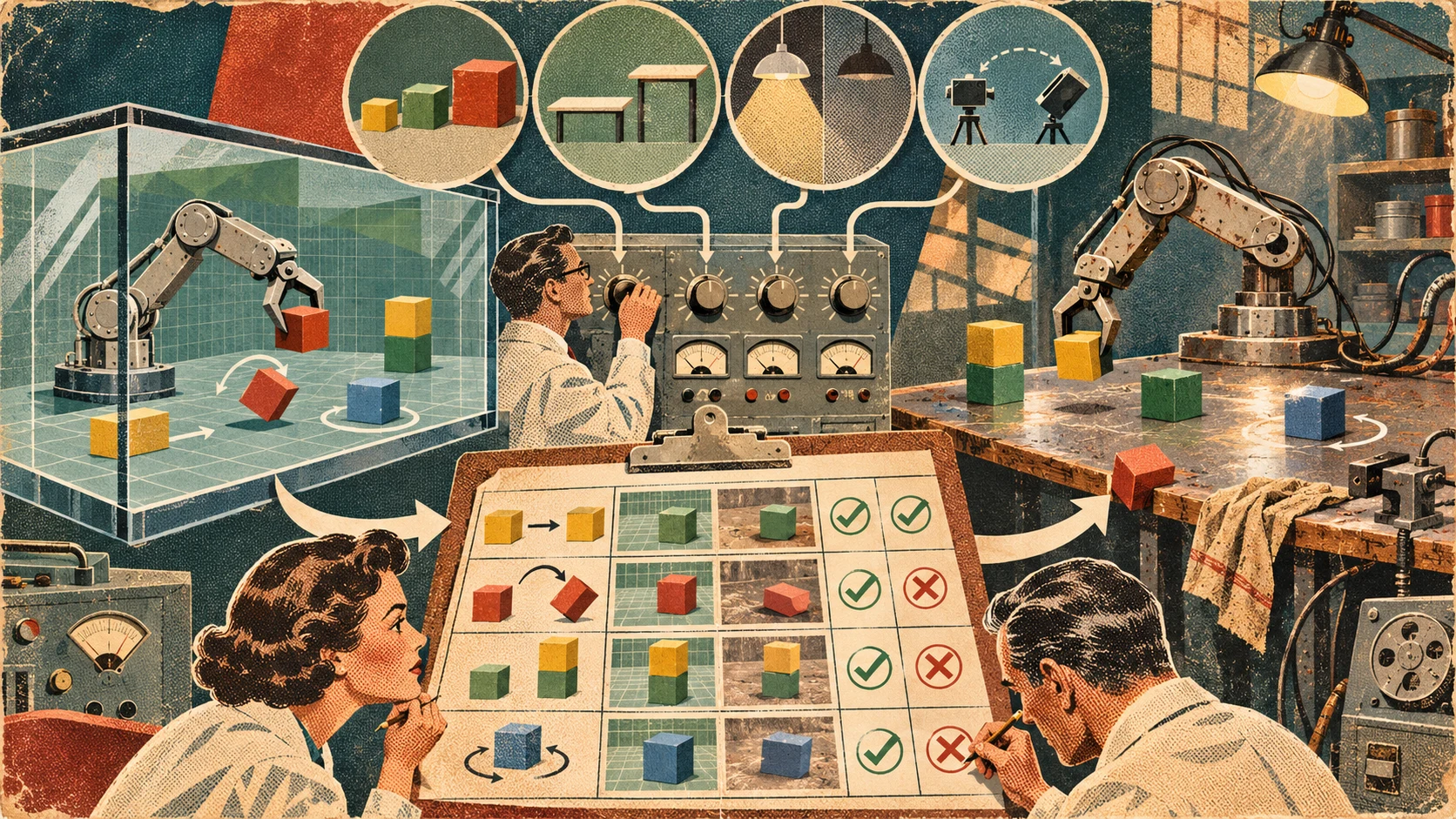
Robot demos have a terrible habit of looking like magic right up until the lighting changes, the block moves three inches or the gripper discovers that friction has opinions. Ai2's new ToyBlocks project tries to make those failures easier to study. Released November 6, ToyBlocks is an open simulation framework built around a robot arm and tabletop blocks. It is the first example of what Ai2 calls a FoundationWorld: a controlled simulated environment with automatic task generation, training demonstrations and evaluation tools. The setting is deliberately small. A robot pushes, flips, rotates, picks and stacks blocks. Some block faces carry letters or pictures, so the machine may need to turn an object before deciding where it belongs. Researchers can vary block size, table height, appearance, camera settings and other properties, then ask whether a policy still works. That smallness is the point. Real homes and factories contain an absurd number of objects, materials, people, shadows, cables and regrettable coffee spills. A failure in that open world can have dozens of possible causes. ToyBlocks narrows the stage so a researcher can change one part of the training data or model, repeat the test and trace what moved. Ai2 says the system can generate hundreds of task-and-motion plans in parallel on one graphics processor, reaching up to 24 times real-time performance in its setup. The initial release contains 85,336 long-horizon demonstrations, nearly 1,600 hours of simulated robot execution and 144 million frames. It also includes more than a data factory. The project connects task generation, policy training and closed-loop evaluation. A high-level model can decide what to do, a low-level policy can control the arm, and an oracle can replace either layer so researchers can isolate whether planning or execution caused a failure. The open repository includes simulation assets, procedural task and demonstration generators, training code, evaluation code, validation sets and trained examples based on Molmo 2 and ManiFlow. The data is recorded in the LeRobot format, which makes it easier to use with other robot-learning systems. That is the good news. The caution is printed right on the box: simulation is a model of reality, not a receipt for reality. Ai2 did run physical experiments. A ManiFlow low-level policy trained entirely in simulation achieved similar reported atomic-skill success in simulation and the real world, 80.0 percent and 81.1 percent. A hierarchical Molmo 2 plus ManiFlow system succeeded in 55.5 percent of 200 simulated episodes and 50.0 percent of 30 physical episodes in the easiest scene configuration. Those are encouraging proof points. They are not permission to replace a factory safety review with a block-stacking GIF. The practical signal is this: use a controlled world to identify causes, then keep a reality-gap ledger showing every simulator assumption, randomized property, hardware match, physical test and failure that did not transfer cleanly.
01
WHAT ACTUALLY CHANGED
ToyBlocks turns robot training into a controlled experiment rather than a pile of demonstrations. The framework automatically creates tasks and uses reinforcement learning plus motion planning to generate short skills and longer demonstrations. A task-and-motion planner selects and sequences skills, while Isaac Lab provides the simulation environment for training. Because the system owns the task specification, it can measure more than final success. Ai2 says evaluations can report execution speed, forces on objects and partial task progress. That makes it possible to distinguish a robot that nearly completed the right plan from one that confidently pursued the wrong block.
The hierarchy is designed to be taken apart. A high-level reasoning model selects skills and targets. A low-level model performs the motion. Researchers can replace either level with an oracle, a reference component that provides the correct plan or action, to isolate where the system failed. That matters because the phrase the robot failed is almost useless. Did the camera confuse two letters? Did the planner choose the wrong orientation? Did the action policy miss the block? Did a previously reachable object get pushed outside the workspace? ToyBlocks gives each question somewhere to land.
The release connects simulation to physical testing instead of stopping at a clean virtual demo. Ai2 reports zero-shot transfer experiments using a Franka FR3 arm, a Robotiq gripper and thirty physical scene configurations. The team tuned simulated joint friction and armature, randomized object and visual properties, and used front and wrist cameras on the physical setup. The reported simulation and physical success rates were similar in those selected experiments, but the physical long-horizon sample was small. Ai2 explicitly says more trials are needed for statistical confidence. That sentence deserves to travel with the headline numbers.
02
WHY THIS MATTERS
For robotics researchers, the framework offers something flashier demos rarely provide: causal leverage. If a model improves after adding more rotation examples, the controlled generator can reproduce the mixture and test held-out tasks. If it collapses outside the trained workspace, researchers can vary position while keeping other conditions stable. If a high-level planner succeeds only when an oracle handles motion, the bottleneck becomes visible. The experiment may still be imperfect, but at least it can be argued with.
For open-source builders, ToyBlocks lowers the cost of assembling a complete research loop. The code, assets, data, models and evaluation tools are available. The repository includes quick-start commands, data generation, policy serving, wrappers, evaluation and agentic robotics components. The Apache 2.0 license covers the main project, while Ai2 notes that submodules and downloaded assets have their own licenses. Open does not mean effortless. Isaac Sim, Isaac Lab, GPU capacity and robotics knowledge still create a real entry cost. But the starting line is more inspectable than a private demo stack.
For product teams, the work is a reminder that averages hide the handoff between reasoning and motion. A frontier model can produce an impressive plan and still confuse a letter, choose the wrong face or push a block beyond reach. Ai2's search-and-spell experiment reported successful completion or correct infeasibility detection on 63 percent of tasks. The most common reported errors included look-alike letters and incorrect orientation. That is not a verdict on every frontier model. It is a useful example of why physical systems need perception checks, state verification, skill budgets and a safe way to admit that a task is impossible.
For everybody watching robot videos, ToyBlocks offers a better question than did it work. Ask which conditions were controlled, which were randomized, which were held out, how many physical trials ran, what counted as failure and whether a human stopped unsafe motion. A robot can be marvelous inside its terrarium and still need a chaperone in the kitchen.
03
WHERE IT COULD HELP
- Keep a simulator assumption register. Record contact models, friction, mass, joint dynamics, latency, camera calibration, lighting, textures, object geometry and controller timing. Mark which values came from physical measurement and which were convenient guesses.
- Separate interpolation from extrapolation. Test new configurations inside the training range and conditions beyond it. A robot that handles a new position between familiar positions has not necessarily learned how to leave the neighborhood.
- Build matched simulation and physical episodes. Start from comparable poses, task specifications and camera views, then compare not only success but path, contact force, time, recovery behavior and operator intervention.
- Log every use of privileged simulator information. Exact object pose can produce excellent demonstrations, but a physical robot must estimate that pose from sensors. The gap belongs in the evaluation report, not under the rug.
- Use oracles diagnostically. Replace the planner, perception system or action policy one at a time. The component that stops the failure from occurring is a better lead than another round of random hyperparameter shuffling.
- Treat human intervention as a failure category with context. Record why the operator stopped the robot, the motion underway, the safety boundary crossed and whether the simulator produced an equivalent warning.
- Publish confidence intervals and trial counts beside transfer results. Thirty physical scenes can be a valuable proof point without being a universal reliability claim.
- Preserve failed states and feed them back into data generation. A block pushed out of reach or a camera fooled by a look-alike is useful training material if the recovery does not erase the original failure from the record.
KEEP A HAND ON THE WHEEL
ToyBlocks is an Ai2 release, and the performance figures come from Ai2's own selected experiments. The framework is open enough for other teams to inspect and reproduce, but independent replication has not yet accumulated. The world is intentionally narrow. Wooden blocks, a tabletop and one robot arm cannot represent cloth, deformable objects, liquids, cluttered homes, moving people or industrial wear. A controlled terrarium is powerful because it excludes complexity. The exclusion must stay visible when claims travel outside it. Domain randomization is useful, but randomized values are still chosen by designers. If the real failure mode is absent from the range, the model cannot learn robustness to it by vibes. System identification can make a simulator resemble one physical setup without proving transfer to another arm, gripper, camera or work surface. The reported atomic-skill transfer rates were similar, while the hierarchical physical evaluation used thirty episodes in the easiest scene configuration. Ai2 says further trials are needed. Treat that as a promising experiment, not a product reliability certificate. Watch for the larger dataset Ai2 says is coming, fully integrated reinforcement-learning support, independent reproductions and tests on more hardware. Most of all, watch whether researchers publish the mismatches. A reality-gap ledger is valuable only when the ugly rows survive the demo edit.
04
TERMS WORTH KEEPING
SOURCES AND VERIFICATION STATUS
This article was written from the materials below. Product claims and dates were checked against those sources on November 7, 2026.
THE PUBLICATION ENGINE
WANT A SIGNAL OF YOUR OWN?
We build source-grounded publications, private briefings, and editorial systems for organizations with something useful to say.
WORK WITH US