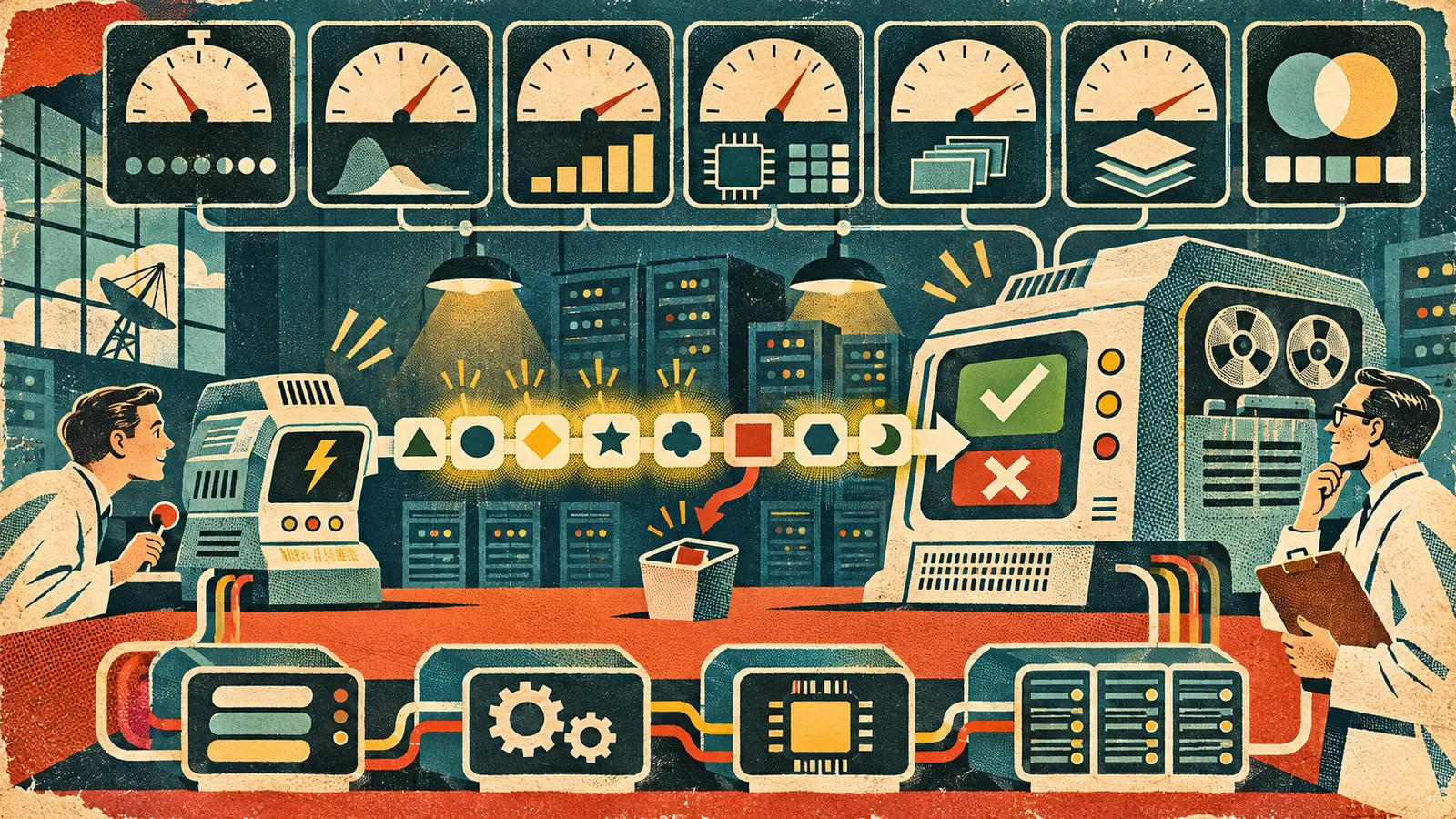
THE SIGNAL IN ONE SENTENCE
A draft model is the eager junior colleague of language-model serving. It guesses the next several tokens while the larger target model checks the work. When the guesses line up, the system accepts a longer stretch in one verification cycle. When they do not, the target model corrects the sequence and the drafter tries again. The idea is called speculative decoding. The promise is more output without replacing the model users actually asked for. Tencent has now released a DSpine draft checkpoint built for Qwen3.8-27B. The checkpoint is a five-layer model with about two billion parameters, a draft block of 16 tokens and an 8,192-token sliding window. Its weights are on Hugging Face under Apache 2.0, and Tencent's public DSpine repository contains the serving integration. DSpine's architectural trick is to keep drafting positions parallel while passing a predicted predecessor feature to the next position at every layer. That gives later guesses some causal information earlier in the network instead of waiting until the backbone has finished. The new model card reports longer accepted drafts than the official DFlash2 comparison across five general benchmarks and five agent benchmark families in the configurations shown. It also reports end-to-end output throughput for recorded agent conversations replayed through SGLang. In those selected agent tests, DSpine produced 2.71 to 3.84 times the autoregressive throughput under the low reasoning setting and 2.87 to 3.55 times under xhigh reasoning. The highest reported multiplier was 3.84 times on WorkBuddy Office at low reasoning. On SWE-bench Pro replay at xhigh, the card reports about 791 output tokens per second for DSpine, about 3.19 times the autoregressive baseline and above the listed DFlash2 result of about 712. Those are project-authored numbers from one declared setup. They are not a universal coupon for 3.84 times faster AI. The card used SGLang 0.5.22, BF16 precision, FlashAttention 3 and concurrency eight. DSpine proposed blocks of 16 tokens while the DFlash2 comparison proposed eight. General tests used xhigh reasoning and at most 4,096 new tokens. Agent tests replayed 20 recorded conversations per subset, used prefix caching and allowed up to 32,768 new tokens per request. Change the GPU, runtime version, attention backend, quantization, batch shape, concurrency, prompt distribution, output length, sampling settings, cache policy or tool loop, and the result can move. This is why speculative decoding should be benchmarked as a serving stack, not admired as a model card. Keep the exact target and draft revisions. Pin SGLang and its kernels. Record precision and memory settings. Measure draft acceptance as a distribution rather than one average. Separate time to first token from inter-token latency. Report median and tail latency beside throughput. Test short chats, long reasoning, code, tool use and the traffic mix people actually send. Then check answers. The target model verifies proposed tokens, which is the core safety valve in speculative decoding. A production test should still compare outputs or sampled distributions against the non-speculative baseline. Runtime bugs, parser changes, cache behavior and sampling configuration can break the comforting theory somewhere between the paper and the endpoint. Also count the cost of the helper. The draft model consumes memory and compute. A throughput win may still be a poor trade if it reduces batch capacity, increases operational complexity or helps only the longest outputs. Tencent's release is useful because it gives Qwen3.8-27B operators a concrete open checkpoint and code path to test. The paper behind DSpine was first posted September 28 and revised October 10. The new development on November 7 is the Qwen3.8-27B draft checkpoint and serving recipe. So, yes, let the small model guess farther. Just make the whole stack show its work.
01
WHAT ACTUALLY CHANGED
Tencent released a DSpine checkpoint specifically for Qwen3.8-27B. The Hugging Face model card describes a five-layer draft model with roughly two billion parameters, BF16 weights, a 16-token draft block and an 8,192-token sliding window. The target remains Qwen3.8-27B. The draft is not a standalone replacement for it. The checkpoint is licensed under Apache 2.0. The model card says no inference provider currently deploys this draft model, so operators need a compatible local or hosted serving stack of their own.
DSpine moves causal conditioning into the depth of a parallel draft network. Parallel drafters predict several future positions at once, which is fast but can make later positions inconsistent with earlier guesses. DSpine passes each predecessor's predicted feature to its successor after every layer. The network still updates positions in parallel while causal information travels across the block through depth. The underlying paper was submitted to arXiv on September 28 and revised October 10. It evaluated DSpine on Qwen3-4B and Qwen3-8B. The Qwen3.8-27B checkpoint and its separate model-card results arrived later, on November 7.
The new card reports higher acceptance lengths than DFlash2 in the displayed tests. Acceptance length is the average number of draft tokens accepted in one verification cycle. On GSM8K with greedy decoding, the card reports 7.20 for DSpine and 5.69 for DFlash2. On SWE-bench Pro agent replay at xhigh reasoning, it reports 4.77 and 4.00. The comparison is informative but not identical in every respect. DSpine drafts blocks of 16 tokens while the listed official DFlash2 setup drafts eight. A longer proposal can create more opportunity for accepted tokens and more work when later guesses fail.
Tencent also published end-to-end throughput from recorded agent workloads. The card defines throughput as total output tokens divided by concurrent replay wall time. With concurrency eight, reported DSpine speedups over autoregressive decoding ranged from 2.71 to 3.84 times at low reasoning and from 2.87 to 3.55 times at xhigh across WorkBuddy Code, Web and Office, SWE-bench Pro and tau-squared bench. These are output-throughput measurements for replayed conversations, not claims about complete user-perceived latency, tool execution time or production capacity under arbitrary traffic.
The serving recipe exposes how many components participate in the result. The published command pins the Qwen target, DSpine draft path, speculative algorithm, 16 draft tokens, BF16 precision, FlashAttention 3 for target and draft, a Triton linear-attention backend, ReplaySSM support, cache settings, memory allocation, context length, request concurrency, sampling backend, reasoning parser and tool-call parser. That is not clutter. It is the experiment. A speculative decoder is a relationship among models, kernels, caches, schedulers and traffic.
02
WHY THIS MATTERS
Serving cost is becoming a model feature. For high-output workloads, decoding time affects user experience, GPU capacity and price. An open draft checkpoint can let operators improve the economics of a capable target without retraining or replacing the target itself. The gain matters most when enough drafted tokens are accepted to repay the helper model's work.
A single speedup multiplier hides the shape of the win. Throughput can rise while time to first token stays flat, tail latency worsens or short requests see little benefit. Average acceptance can look healthy while a subset of prompts repeatedly rejects the draft. Production decisions need distributions, not a victory number with a multiplication sign.
Agent workloads make serving behavior less tidy. An agent alternates between model output, tool calls, observations and cached prefixes. Some turns are tiny. Others generate long reasoning traces or code. Recorded replays are useful because they preserve part of that structure, but they still do not include every live tool delay, retry, user interruption or changing prompt.
The draft model adds another compatibility surface. Target revision, tokenizer, parser, runtime, kernels, precision, cache layout and sampling policy have to agree. An upgrade that improves one component can invalidate the measured stack. Pinning versions and rerunning the matrix should be part of release engineering, not a heroic weekend ritual.
Output equivalence remains the admission ticket. Speculative decoding is designed so the target model verifies drafts. Operators should prove that their implementation preserves greedy outputs or the expected sampling distribution for the chosen configuration. Speed is not useful if a parser, cache bug or numerical shortcut quietly changes answers.
03
WHERE IT COULD HELP
- Freeze a baseline. Record the exact Qwen3.8-27B revision, tokenizer, non-speculative SGLang version, command line, precision and kernel stack before adding the draft.
- Pin the speculative stack. Preserve the DSpine checkpoint hash, repository commit, SGLang build, FlashAttention version, Triton version, sampling backend and parser revisions.
- Reproduce the published shape first. Match concurrency eight, BF16, FlashAttention 3, draft block 16 and the card's sampling settings before changing one variable at a time.
- Measure acceptance as a distribution. Report accepted tokens per verification cycle by workload, prompt length, output length, reasoning setting and sampling mode, including rejection-heavy tails.
- Separate latency metrics. Track time to first token, median inter-token latency, p95 and p99 request latency, tool-wait time and full task completion time.
- Measure throughput under real traffic. Test the concurrency, batch composition, prompt lengths, cache hit rates and output lengths seen in production instead of relying on one synthetic batch.
- Count memory and capacity. Record target and draft memory, key-value and state cache use, maximum running requests, out-of-memory events, power and cost per completed request.
- Run answer-equivalence checks. Compare greedy outputs byte for byte where appropriate, and test sampled output distributions, tool decisions and structured parses against the autoregressive baseline.
- Test failure and fallback. Disable the drafter, exhaust its cache, change a kernel and trigger incompatible inputs. Confirm that the endpoint falls back safely and exposes which path served each request.
- Publish the receipt with every result. Include hardware, driver, model hashes, runtime commits, commands, dataset or replay version, warm-up, repetitions, confidence intervals and raw measurements.
KEEP A HAND ON THE WHEEL
The Qwen3.8-27B DSpine model card, repository and paper are project-authored materials. The new checkpoint results have not yet been independently reproduced in the sources reviewed for this article. The model card reports SGLang 0.5.22, BF16, FlashAttention 3 and concurrency eight. It does not present one universal hardware-neutral speedup. GPU type, memory bandwidth, driver, kernels, batching and scheduler behavior can materially change throughput and latency. DSpine and DFlash2 use different listed draft block sizes in the new comparison: 16 and eight. Acceptance length and throughput remain useful observed outcomes, but the systems are not identical except for the drafting method. Operators should compare configurations that fit their own latency and memory goals. The agent tests replay 20 conversations per subset with recorded tool-decision prefixes, prefix caching and up to 32,768 new tokens per request. Replay improves repeatability. It does not reproduce live tool latency, changing external state, user pauses, failures or every scheduler interaction in a production service. The paper's peer comparison focuses on Qwen3-4B and Qwen3-8B and was posted before the Qwen3.8-27B checkpoint. Do not transfer every paper figure to the 27B model. Use the new model card for the new checkpoint and treat both sets of results as author-reported. The draft model has about two billion parameters and needs memory and compute beside the 27B target. A server that is already memory-bound may lose batch capacity or require a different placement. Cost per useful request matters more than tokens per second in isolation. Speculative decoding should preserve the target model's result under its stated algorithm, but implementation details still need testing. Numerical precision, sampling backends, parsers, cache logic and bugs can change observable output or tool behavior. Finally, the published usage command includes trust-remote-code. Review pinned code and dependencies before production use. An open license makes inspection possible. It does not perform the inspection for you.
04
TERMS WORTH KEEPING
SOURCES AND VERIFICATION STATUS
This article was written from the materials below. Product claims and dates were checked against those sources on November 8, 2026.
THE PUBLICATION ENGINE
WANT A SIGNAL OF YOUR OWN?
We build source-grounded publications, private briefings, and editorial systems for organizations with something useful to say.
WORK WITH US