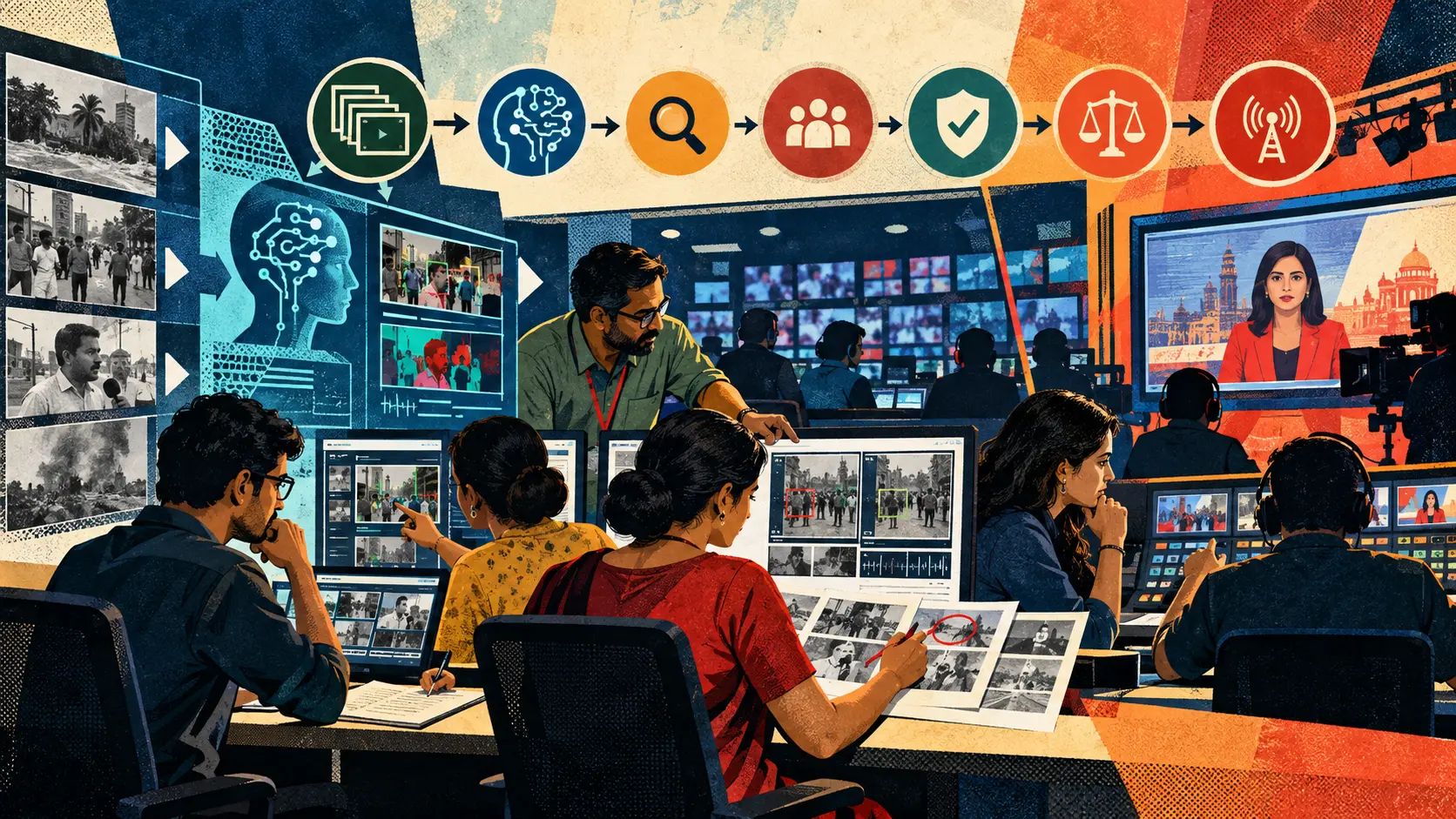
THE SIGNAL IN ONE SENTENCE
India has given private television newsrooms a deceptively simple instruction: keep AI in the assistant's chair. On October 21, Akashvani News, the public broadcaster's news service, reported that the Ministry of Information and Broadcasting had sent a letter to all private satellite television channels about their use of artificial intelligence. The ministry advised caution. It urged broadcasters to limit AI tools to an assistive capacity without compromising the accuracy, authenticity or sensitivity of news content, while continuing to follow the Programme Code. It also told channels to strengthen editorial and content review, make sure staff across news gathering, editing, production, transmission and telecast understand the Programme Code, and hold regular workshops and training. For scenes involving crime and violence, the ministry said telecasts should be based on verified facts and truth, with balanced and responsible reporting. That is the verified reporting. The practical question is what assistive means once a newsroom opens the software. AI can transcribe an interview, translate speech, search an archive, summarize a document, suggest a headline, clean audio, assemble a rough cut or generate an image. Those actions do not carry the same risk. They do not deserve the same review. The ministry's public guidance does not publish a technical definition of assistive use. It does not say that one named product is approved, one feature is banned or one disclosure label fits every use. So the plain signal is this: show where the editor intervened. A newsroom should be able to answer seven questions for any material use of AI. What was the source material? What did the tool do? What changed? Who reviewed it? What did they check? Was the use disclosed? What finally went to air? That is the editorial intervention log. The name sounds bureaucratic because it is a record. The record itself can be short. A producer does not need to write a memoir every time software removes background noise. But a consequential edit should not vanish into a button labeled enhance. Start with the source. Record the original video, audio, photograph, document or interview. Preserve the file identifier, origin, acquisition time and rights status already used by the newsroom. If the source arrived through social media or a messaging app, record what is known and what remains unverified. AI does not improve the provenance of weak material. A sharp-looking frame can still begin with an anonymous upload and a bad date. Then record the operation. Was the tool transcribing? Translating? Summarizing? Removing noise? Filling missing pixels? Generating a reconstruction? Suggesting language for a script? The operation matters because it tells the editor where new error can enter. A transcription system may mishear a name. A translation system may flatten a qualification. A summarizer may promote a minor claim into the main point. An image tool may add a face, object or gesture that never appeared in the source. A language model may produce a clean sentence with no clean evidence beneath it. Next, save the change. For text, keep the original and revised version. For audio, preserve the untreated recording. For images or video, preserve the source frames and export settings. When synthetic material is used for illustration, store the prompt, model, version and output selected. The goal is not to hoard every failed experiment. It is to preserve enough evidence to reconstruct the editorial decision. Then name the reviewer. Human oversight is not a mood floating over the newsroom. It is a person with responsibility and enough time to compare the output with the source. That comparison matters. An editor who only reads the AI-generated summary is not reviewing the source. A producer who watches only the cleaned clip may never hear the missing word. A presenter who receives a finished script may not know which sentence came from an unverified post. The log should say what was checked. Names, dates, locations, quotations, numbers and sequence deserve explicit confirmation. So do the elements that shape meaning: whether a clip is complete, whether a translation preserves uncertainty, whether an image has been altered and whether a violent scene is necessary to the report. This is where sensitivity joins accuracy. A news image can be factually real and still be handled irresponsibly. A crime scene can be authentic and still expose a victim, prejudice a proceeding or turn suffering into spectacle. The ministry specifically connected AI caution with crime and violence coverage based on verified facts, truth, balance and responsibility. An AI tool should not decide that threshold by itself. It can flag graphic content. It can identify faces for possible blurring. It can suggest a shorter clip. The responsible editor still has to decide what the public needs to see, what context is missing and who could be harmed. Then make a disclosure decision. Not every hidden technical process needs an on-screen banner. Automatic captions and routine audio leveling are different from a synthetic reconstruction of an event. The newsroom should define disclosure tiers before the deadline arrives. One tier could cover mechanical assistance that does not change meaning, such as transcription used only as an internal aid. Another could cover material transformations reviewed against an original, such as translated narration or restored audio. A third could cover synthetic visuals, voices or reconstructions that require clear audience disclosure and strong separation from documentary evidence. That tiered model is editorial analysis, not a ministry rule. The point is to avoid inventing the policy during a breaking story. Finally, preserve the broadcast result. The record should link to the script, segment and version that actually aired. If a correction follows, connect it to the same record. If the material appears across television, a website and social clips, note which versions changed. This is not surveillance of journalists. It is evidence that editorial responsibility remained attached to the work. The distinction matters because AI can make an old failure look new. Newsrooms have always used tools. Teleprompters, nonlinear editors, satellite feeds, automatic captions, color correction and search databases all shape what reaches viewers. AI is different where it generates plausible content, transforms evidence in ways that are hard to notice or compresses several editorial judgments into one opaque action. The assistant can become the author without anyone formally deciding that it should. That is why labels alone are not enough. A little AI-generated badge may tell viewers that a machine was somewhere in the process. It does not tell an editor whether the source was checked. It does not tell a regulator who approved the segment. It does not help a newsroom reproduce the mistake after a complaint. The intervention log does. India's guidance also lands inside an existing broadcast framework. The public report says an Inter-Departmental Committee established under the Cable Television Networks Amendment Rules of 2021 observed telecasts on various channels that did not conform to the spirit of the Programme Code set out under the 1994 rules. It also says the ministry may act on Programme Code violations under the Cable Television Networks Regulation Act of 1995. That context is important. The October 21 letter is not described as a new AI law. It is guidance telling broadcasters to use new tools without dropping existing editorial obligations. The caution should travel through the entire chain named by the ministry. For news gathering, reporters need a rule for generated research leads and synthetic tips. A lead can point toward reporting. It cannot become evidence because a model phrased it confidently. For editing, staff need comparison views that keep original and transformed material together. The easiest interface should be the one that reveals the change. For production, scripts and graphics need provenance. A generated map, quote card or reconstruction should carry its source and approval record into the control room. For transmission and telecast, the final operator needs a clear signal when a segment contains synthetic material or an unresolved verification condition. A warning buried in a production chat is not a control. For management, training needs examples. The ministry encouraged regular workshops and sensitization sessions. The useful workshop is not a slide deck announcing that AI can hallucinate. Everyone already knows the robot sometimes makes things up. The useful workshop gives staff a messy clip, a partial source, a rushed deadline and a tool that produces an attractive mistake. Then it tests whether the newsroom catches it. Run the exercise with local languages and dialects. Run it with names that sound similar. Run it with a clipped quotation, a reversed video, an old disaster image and a synthetic eyewitness account. Run it when the senior editor is unavailable. Measure the result. How many factual changes were caught? How long did review take? Did staff find the original source? Was sensitive material escalated? Could the team reconstruct the final decision afterward? Training becomes useful when it leaves evidence about the process that needs improvement. Viewers also need a repair path. If a channel uses AI in a way that changes a report, the audience should be able to flag a suspected error, find a correction and understand whether the original segment was replaced or amended. The intervention log gives the newsroom somewhere to start. It also protects legitimate reporting. When a real image is falsely accused of being generated, the original source and editorial record can help establish authenticity. When a translation is challenged, the newsroom can compare the source audio, transcript, model output and human revision. Provenance is not only a burden. It is a defense. There are limits to what the October 21 report tells us. The ministry's letter is summarized by Akashvani News, not reproduced in full on the page. The report does not name particular channels, identify a specific AI incident, define assistive capacity or publish a new technical enforcement test. Those gaps should remain gaps. They are not permission to write a more dramatic story than the evidence supports. The strongest response is operationally boring and editorially strong. Keep the source. Name the AI operation. Save the change. Assign the reviewer. Record the checks. Decide the disclosure. Link the final broadcast. Seven fields. One visible chain of responsibility. AI can help the newsroom move faster. It can help staff hear, search, sort, translate and assemble. It can also make a false thing look finished before anyone has earned the confidence. Assistive should mean the tool helps a journalist do the work. It should never mean the tool makes the editorial decision and a human arrives later to decorate it with accountability.
01
WHAT ACTUALLY CHANGED
India’s Information and Broadcasting Ministry advised private satellite television channels to use caution with AI in programme telecasts
The ministry urged channels to keep AI tools in an assistive capacity
The guidance says AI use must not compromise the accuracy, authenticity or sensitivity of news content
Channels were reminded to continue adhering to the Programme Code
Broadcasters were told to strengthen editorial and content review mechanisms
The ministry asked channels to sensitize staff across news gathering, editing, production, transmission and telecast
Regular workshops, training programmes and sensitization sessions were encouraged
Crime and violence coverage was specifically tied to verified facts, truth, balance and responsible reporting
The public report connects the guidance to existing Programme Code oversight and enforcement authority
The report does not publish a technical definition of assistive use or establish a separate AI law
02
WHY THIS MATTERS
Different AI operations introduce different risks into reporting
A human reviewer cannot verify an output without access to the original source
Generated or transformed media can conceal where meaning changed
Accuracy and authenticity do not automatically resolve questions of sensitivity and harm
A generic AI label does not document what was checked or who approved the result
News gathering, editing, production and transmission need connected controls rather than isolated policies
An intervention log can support corrections, complaints and internal investigations
Preserved provenance can also help defend authentic reporting against false synthetic-media claims
Training is more useful when it tests staff with realistic failure cases and measures what they catch
Existing editorial obligations still apply when a newsroom adopts a new tool
03
WHERE IT COULD HELP
- Preserve the original video, audio, image, document or interview behind every consequential AI-assisted edit
- Record whether the tool transcribed, translated, summarized, restored, generated or recommended
- Keep original and transformed versions together for review
- Name the editor responsible for comparing the output with the source
- Log checks for names, dates, locations, quotations, numbers and sequence
- Escalate graphic, violent or personally sensitive material to a responsible editor
- Define disclosure tiers for mechanical assistance, material transformation and synthetic reconstruction
- Link the editorial record to the exact script and segment that aired
- Connect later corrections to the same provenance record
- Carry source and approval information through graphics, production and transmission systems
- Run training exercises with local languages, reused footage, clipped quotations and attractive AI mistakes
- Measure verification performance, escalation behavior and the ability to reconstruct a decision
KEEP A HAND ON THE WHEEL
Watch for publication of the ministry letter in full; a formal definition of assistive AI use; newsroom-specific policies from Indian broadcasters; disclosure standards for synthetic audio, images and reconstructions; Programme Code cases involving AI; training materials or audits; tools that preserve original and transformed media together; public correction paths; research on local-language transcription and translation errors; independent evidence about how AI is already used inside Indian newsrooms; and examples showing whether stronger review changes what reaches viewers.
04
TERMS WORTH KEEPING
SOURCES AND VERIFICATION STATUS
This article was written from the materials below. Product claims and dates were checked against those sources on October 21, 2026.
THE PUBLICATION ENGINE
WANT A SIGNAL OF YOUR OWN?
We build source-grounded publications, private briefings, and editorial systems for organizations with something useful to say.
WORK WITH US