THE SIGNAL IN ONE SENTENCE
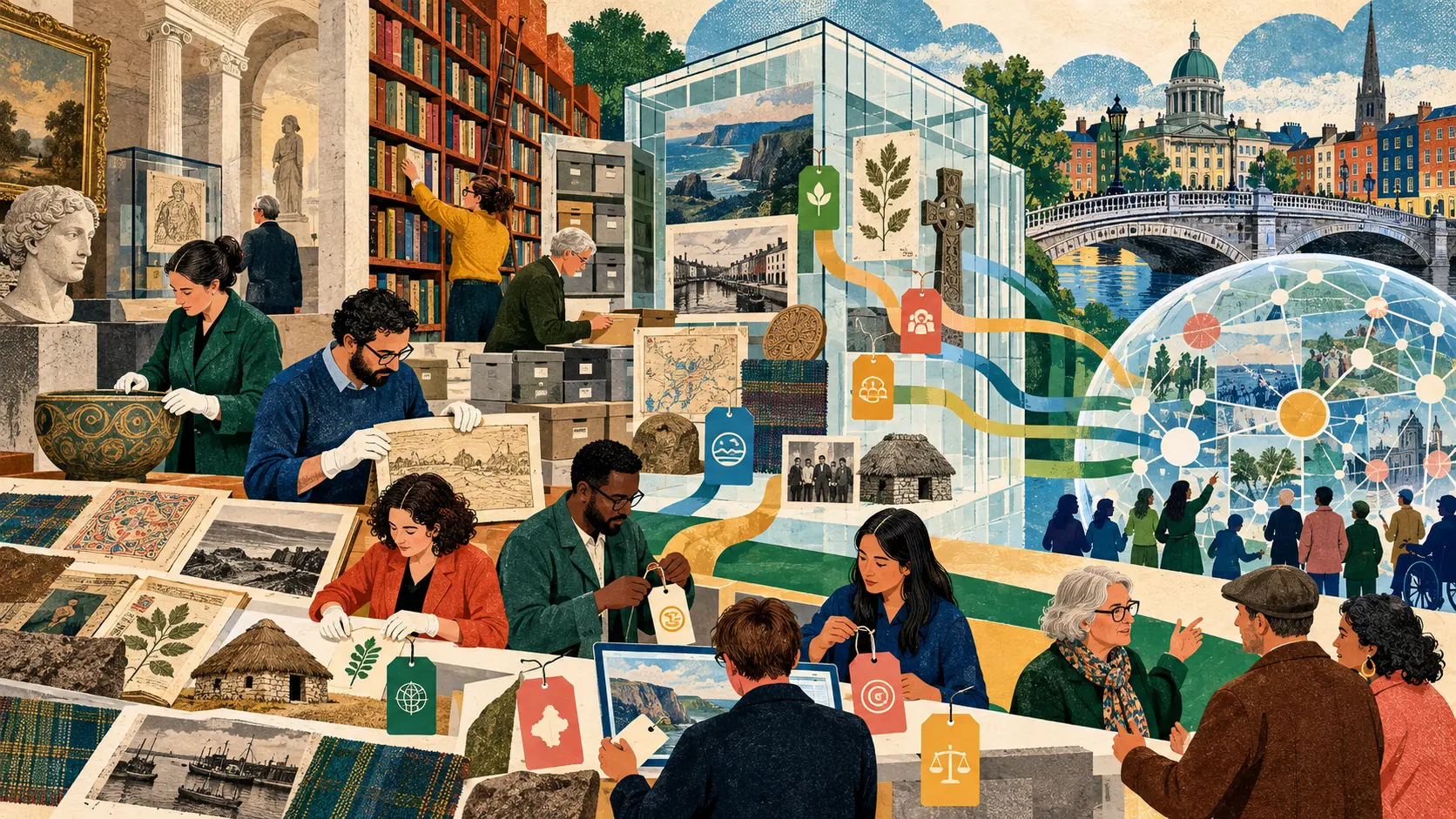
Ireland spent October 2 asking a useful question about artificial intelligence: if public AI needs a memory, who should be trusted to look after it? The question sat at the center of Winds of Change, a gathering at the Royal Irish Academy in Dublin during Ireland's presidency of the Council of the European Union. The Digital Repository of Ireland, the Irish Museums Association, the Royal Irish Academy and the Europeana Foundation organized the event around cultural heritage and public-interest AI. Representatives from the National Library of Ireland, Galway City Museum, Ireland's AI Office, European institutions and the wider heritage sector were on the program. The day included a panel, a workshop and a participatory discussion. This was not a model launch. It was not a new national AI strategy. The public materials do not contain a completed Irish deployment, a binding policy or measured results from the event. It was a meeting about the layer underneath those things: the records, images, descriptions, rights and institutional choices that determine what an AI system can remember and whose version of culture it repeats. The plain signal is that cultural data is not a sack of old pictures waiting to be poured into a model. Museums, libraries and archives hold objects and records together with the information that makes them intelligible. They preserve who created something, when it was made, where it came from, which collection holds it, how it was described, what rights apply, what remains uncertain and how later scholarship changed the interpretation. That surrounding information is metadata. The chain showing where a record came from and how it changed is provenance. Strip both away and a digitized object can become visually useful but historically unmoored. A model may reproduce a photograph without naming its collection, summarize a colonial record as neutral fact, translate a title without its local meaning or merge several traditions into a generic European aesthetic. The output may look polished while the memory underneath has been sanded smooth. The Dublin program was built around a newly published Europeana paper, The case for Public AI: making it happen with cultural heritage. The executive summary argues for a European AI ecosystem with public attributes, public functions and public control. Those phrases are more demanding than publicly funded. Public attributes include openness, accessibility and interoperability. Public functions mean serving needs such as knowledge sharing, cultural participation and civic engagement. Public control means governance that remains democratically accountable and sustainable rather than leaving the important decisions with one vendor. The paper says cultural institutions can contribute in four broad ways. First, they can provide high-quality data and the knowledge needed to keep it traceable, interpretable and reliable. Second, they can help shape smaller, domain-relevant AI systems and the rules governing how those systems are built and used. Third, they can manage access and reuse in ways that are fair and reciprocal. Fourth, they can strengthen AI literacy inside cultural institutions and across society. That is a serious agenda. It is also a position paper, not proof that Europe has built the system it describes. The common European data space for cultural heritage is the proposed infrastructure underneath much of this work. The European Commission's event page says it can help cultural institutions contribute trusted, diverse and openly accessible data to AI development while reflecting Europe's languages, cultures and values. The Europeana paper places that data space within a larger European push that includes AI factories, data labs and other computing infrastructure. It says the European Union's Data Union Strategy aims to make 30 million digitized cultural objects available for AI by the end of 2026. Thirty million is a volume target. Trust is not a volume property. A collection becomes useful for responsible AI when every object travels with enough information to answer practical questions. What is it? Who described it? Which rights statement applies? Is the image public domain while the catalog description remains protected? Was the object taken from a community under coercive conditions? Does the institution have authority to authorize model training? Is the record complete? Which terms are outdated or offensive but historically significant? What should be attributed if a model uses it? None of those questions is answered by adding another million files. Rights are particularly messy. A museum may own the physical object without owning copyright in the work. A photograph of that object may have separate terms. A database record may contain text written by staff. A community may have ethical or collective interests that ordinary copyright law does not capture. Some material may identify vulnerable people, describe sacred practices or document violence. Open access can serve the public. Treating openness as a universal permission slip can damage the same public mission. A trustworthy data space needs machine-readable rights statements that do not erase human judgment. It needs clear categories for public-domain works, licensed files, restricted material and records that should not enter a training pipeline at all. It also needs a way to update or withdraw access when new evidence changes the decision. Provenance should survive every stage. If a collection record moves from an Irish archive into the European data space, then into a training set, a retrieval system or a generated answer, the source link and rights information should remain attached. A person should be able to trace the output back to the institution and inspect the original record. That does not mean every model can reveal every training item. It means public-interest systems should be designed so that provenance is an operating requirement rather than a decorative citation added after release. Retrieval can help. Instead of asking a model to absorb everything into its weights, a system can search a governed collection and answer from selected records at the time of a request. The response can show sources, dates and collection notes. Retrieval is not an honesty machine. It can choose the wrong record, ignore a restriction, quote a description out of context or invent a connection between documents. The index, ranking system, permissions and answer still need evaluation. Language is another test. The Europeana paper warns that systems relying mainly on English risk sidelining Europe's linguistic and cultural diversity. Ireland makes that problem concrete. Irish-language collections cannot be treated as decorative translations of English records. Names, place terms, oral histories and local descriptions carry relationships that a generic model may flatten. A public AI system should document language coverage by collection and task. It should show where translation was automated, where a person reviewed it and where the system lacks enough evidence to answer. It should evaluate Irish separately rather than counting it inside a multilingual average. The same principle applies across Europe. A system that performs well on widely digitized national collections may struggle with regional languages, local archives or institutions that lack the staff and money to clean their records. Digitization itself is unequal. Large national institutions can maintain repositories, metadata standards, rights teams and technical partnerships. A local museum may have a spreadsheet, a part-time curator and boxes that have never been scanned. If public AI learns mostly from what is already easy to digitize, it will reproduce the imbalance while calling the result comprehensive. The data space should therefore fund the work before the model: scanning, cataloging, rights review, translation, accessibility, community consultation and long-term preservation. A new interface is not a substitute for the people who make a collection reliable. Reciprocity is the economic question. The Europeana paper argues that cultural institutions should influence how their information is reused and prevent value extraction that gives nothing back to the public infrastructure maintaining it. That does not require charging for every query. It does require a visible relationship between use and contribution. An AI developer using a public collection could preserve attribution, report which material was used, share evaluation findings, return improved metadata where appropriate, fund digitization or provide tools that institutions can operate without permanent dependence on the developer. Reciprocity becomes meaningless if the terms are optional, confidential or impossible to audit. Public control also needs an exit. If a museum builds a search tool on one commercial model, it should be able to move its records, metadata, evaluation set and user interface to another provider. The institution should control permissions and logs. It should know what happens to prompts and collection data. It should have a way to stop the system when an error affects people or cultural material. The public should have rights too. Artists, descendants, source communities, researchers and ordinary visitors need routes to challenge a record or generated description. A correction should reach the source data and the systems using it, not disappear into a customer-support form. This is where Ireland's Digital Repository of Ireland can contribute something practical. Digital preservation is already the work of keeping records usable, documented and authentic as formats and institutions change. That discipline maps directly onto public AI. A repository thinks about custody, versions, identifiers, access conditions and long-term maintenance. Those are exactly the boring, essential controls missing from many AI announcements. The Dublin gathering also placed Ireland's AI Office in the room. That matters because cultural institutions cannot carry the governance burden alone. Regulators and public bodies need to turn principles into procurement clauses, audit access, rights protection, funding and remedies. The next step should be an Irish cultural-data ledger. For every collection offered to an AI project, the ledger could record the institution, dataset version, object count, language coverage, rights categories, known gaps, community consultation, permitted uses, prohibited uses, attribution rule, access method, model or tool using the data, evaluation results, incidents and corrections. That record would let the public distinguish availability from permission and permission from trust. It would also improve evaluation. A museum assistant should be tested on whether it finds the correct object, preserves attribution, represents uncertainty, handles restricted material, works across languages and gives people a way to challenge the answer. A charming conversation is not enough. The event program says the workshop aimed to identify actions that could inform a national strategy for meaningful engagement with public-interest AI. At publication time, no resulting action list or national strategy was included in the primary materials reviewed for this article. That boundary matters. A thoughtful room is not yet public infrastructure. The strongest outcome would not be a declaration that Irish heritage is ready for AI. It would be a set of conditions under which particular collections can support particular systems without losing their context, rights or public purpose. Museums and archives do not hold a neutral memory. They hold records shaped by collection, power, survival, omission and changing interpretation. AI will not remove those choices. It can hide them behind fluent language or make them visible through better provenance and public control. Ireland asked the right question in Dublin. The next signal is whether the cultural sector receives the funding, authority and technical tools to answer it in public.
01
WHAT ACTUALLY CHANGED
A public-AI and cultural-heritage gathering took place at the Royal Irish Academy in Dublin on October 2, 2026.
The Digital Repository of Ireland, Irish Museums Association, Royal Irish Academy and Europeana Foundation organized the program.
The event connected Irish cultural institutions, the National Library of Ireland, Galway City Museum, Ireland's AI Office and European policy participants.
The program examined how cultural institutions can contribute trusted, diverse and openly accessible data to public-interest AI.
A Europeana executive summary frames Public AI around public attributes, public functions and public control.
The paper identifies four cultural-sector roles: reliable data, domain-relevant systems, fair and reciprocal access, and AI literacy.
The common European data space for cultural heritage is positioned as infrastructure for data access, governance, capacity building and alliances.
The paper says the EU Data Union Strategy aims to make 30 million digitized cultural objects available for AI by the end of 2026.
The Dublin workshop sought actions that could inform an Irish national strategy for engagement with trustworthy public-interest AI.
The reviewed primary materials do not yet publish a completed strategy, binding policy, deployed system or measured result from the event.
02
WHY THIS MATTERS
Cultural records need metadata and provenance to remain historically intelligible when models retrieve or generate from them.
A large object count does not establish lawful access, representative coverage, reliable context or public value.
Museums and archives can set conditions for AI reuse instead of serving only as raw-material suppliers.
Machine-readable rights can help systems enforce access rules, but difficult cultural and community questions still need human judgment.
Irish and other less represented European languages need separate coverage and evaluation rather than a multilingual average.
Smaller institutions require funding for digitization, cataloging, rights review, accessibility and long-term preservation.
Reciprocity can return attribution, funding, tools, metadata improvements and evaluation evidence to public institutions.
Public control requires portability, auditability, correction routes and the ability to stop or replace a supplier.
A transparent cultural-data ledger would let the public distinguish what is available, what is permitted and what has been tested.
03
WHERE IT COULD HELP
- Publish collection-level records covering provenance, languages, rights, known gaps and permitted AI uses.
- Attach stable identifiers, source links and rights information to records throughout retrieval and generation workflows.
- Build governed retrieval systems that return dates, collection notes and uncertainty with each answer.
- Evaluate Irish-language performance separately for search, translation, description and question answering.
- Create machine-readable categories for public-domain, licensed, restricted and excluded material.
- Fund local museums and community archives to digitize, catalog, translate and review rights before contributing data.
- Require AI developers to preserve attribution, report use, share evaluation and contribute to the infrastructure they depend on.
- Give artists, communities, researchers and visitors a visible correction and appeal route.
- Preserve portability of datasets, metadata, evaluations and interfaces so institutions can change suppliers.
- Track every cultural AI project in a public ledger with versions, access terms, results, incidents and corrections.
KEEP A HAND ON THE WHEEL
The October 2 Dublin gathering was a policy and sector convening, not a model launch, national strategy, procurement or completed deployment. The Europeana document is an executive summary and sector position developed through an Alignment Assembly that it says engaged more than 400 professionals. It does not establish independent model performance, lawful status for every cultural object, country-by-country implementation, funding for all participating institutions or a binding reciprocity mechanism. The 30-million-object figure is a policy ambition cited in the paper, not proof that every object is ready, representative or authorized for model training. Watch for a published Irish action list, collection-level rights and provenance records, specific funding, language and accessibility coverage, community governance, enforceable reuse terms, independent evaluations, correction routes, portability requirements and evidence that smaller institutions can participate.
04
TERMS WORTH KEEPING
OPEN GLOSSARY CARD
Public AI
An AI ecosystem designed to serve public purposes through openness, accountable governance and meaningful public control.
OPEN GLOSSARY CARD
Cultural heritage data
Digitized objects and records from museums, libraries, archives and communities, together with the context needed to understand and govern them.
OPEN GLOSSARY CARD
Provenance
A traceable record of where an object or dataset came from, who held or changed it and how it reached its current form.
SOURCES AND VERIFICATION STATUS
This article was written from the materials below. Product claims and dates were checked against those sources on October 2, 2026.
PUBLICATION RECEIPT: Reporting verified against European Commission and Europeana primary materials immediately before publication. The event is identified as a convening, and the proposed Public AI ecosystem is not described as a completed deployment.
THE PUBLICATION ENGINE
WANT A SIGNAL OF YOUR OWN?
We build source-grounded publications, private briefings, and editorial systems for organizations with something useful to say.
WORK WITH US