THE SIGNAL IN ONE SENTENCE
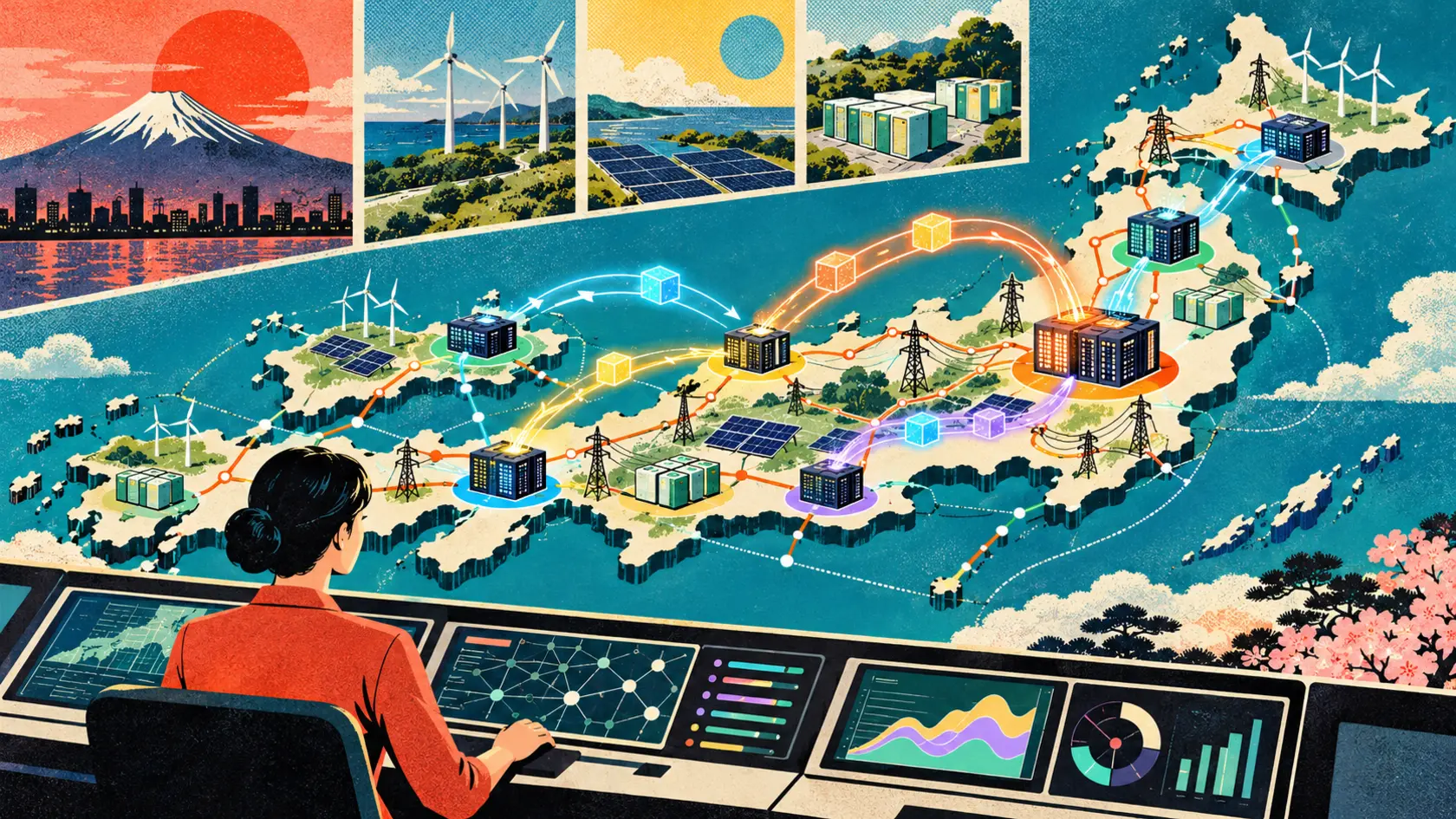
Data centers have addresses. Electricity has moods. That mismatch is becoming expensive. An AI training job may sit in a large urban data center while another region has renewable electricity it cannot use. A coastal storm may threaten one network route while computing capacity remains available elsewhere. One cluster may be packed, another idle, and the workload still waits because the infrastructure was designed as separate islands. Twelve Japanese organizations want to see whether those islands can behave more like one machine. The group includes MESH-X, NHK Technologies, Kyushu University, KDDI, SoftBank, Takaoka Toko, the University of Tokyo, TEPCO Power Grid, TEPCO Holdings, Fujitsu, Hokkaido University and Morgenrot. Together they have formed a consortium to demonstrate what they call a Virtual Hyperscaler. The phrase sounds like somebody fed a cloud conference to a vending machine. The underlying idea is more useful. Instead of concentrating AI work inside one enormous operator, the project aims to coordinate computing resources spread across Japan. An orchestrator would examine power supply and demand, electricity-market information, GPU use, battery status and network conditions, then decide where training or inference work should run. The workload moves toward the best combination of available compute, electricity and connectivity. At least, that is the hypothesis. The demonstration began in August 2026 and is scheduled to run through February 2027. It uses Japan's Science Information NETwork, known as SINET, together with dark fiber held by TEPCO Power Grid. The consortium also plans to test all-optical connections between some data-center sections. Academic and commercial clusters are supposed to participate. Early stages establish basic wide-area workload shifting among universities. Later stages are intended to test renewable generation, storage batteries and the central orchestration logic together. The project is not a new national cloud that has already swallowed a continent of servers. It is a technical, operational and business demonstration. That distinction matters because moving a workload is much harder than moving an icon on a map. An AI training run carries model checkpoints, datasets, container images, secrets, software dependencies and a large amount of state. Moving it can consume network capacity and energy. Interrupting it can waste hours of expensive computing. Restarting it elsewhere may change performance or numerical behavior. Some workloads can pause cleanly. Others behave like a soufflé in a moving van. Inference has a different problem. A request may need an answer in milliseconds. Shifting inference toward cheaper or cleaner power is useful only if the network path still meets latency, privacy and availability requirements. A batch translation job can wait. A hospital alert or industrial-control service may not. The orchestrator therefore needs more than a list of free GPUs. It needs a policy. Which workload may move? Which data may cross a region or provider boundary? What latency ceiling applies? How much carbon reduction justifies a migration? Who absorbs the electricity and network cost? What happens when market prices, weather and network congestion point in different directions? The consortium says the orchestrator will collect and analyze power, market, GPU, battery and network information. The announcement does not publish the scoring formula, control thresholds or full security model. Those are demonstration questions, not paperwork to finish later. A useful result would compare decisions against a clear baseline. How much renewable electricity would otherwise have been curtailed? How much total energy did movement consume? Did peak grid demand fall? What happened to job completion time, inference latency and failure rate? Did shifting lower cost after transmission, storage and restart overhead were included? Carbon claims need similar discipline. Moving a job to a region with available renewable generation can reduce emissions. It can also move the accounting while another customer consumes the displaced electricity. The project should publish the time and location method used to estimate emissions, including what it assumes about grid mix, battery charging and renewable curtailment. Otherwise a green arrow on a dashboard can become environmental mood lighting. Resilience is another major promise. Japan faces earthquakes, typhoons and other disruptions that can affect power, networks and facilities. Distributed computing could let important work continue when one region loses capacity. But a central orchestrator can also become a shared point of failure, and tightly connected systems can spread bad commands quickly. The demonstration should test ugly days, not just clean diagrams. Cut a network link. Feed the scheduler stale power data. Make two providers report capacity differently. Simulate a regional outage during a checkpoint transfer. Revoke a workload's permission halfway through a move. Confirm that operators can stop the system, understand the decision and return the job to a safe state. Recovery time matters. So does evidence. Every placement decision should leave a receipt: the workload identity, policy in force, data location, source signals, predicted benefit, actual result, providers involved and human override. That record is necessary for billing, security, incident response and public trust. It is also how the consortium can learn whether the orchestrator made a good choice or merely a plausible one. The sovereignty argument deserves precision too. The participating companies say Japan risks sending important data and computing demand overseas if domestic capacity cannot keep up. A network of Japanese data centers may give organizations more domestic options. Keeping compute inside national borders does not automatically make it sovereign. Customers still need to know who controls the scheduler, hardware, cryptographic keys, software supply chain, operations and emergency access. A service can be physically domestic while depending on foreign components or opaque control software. Sovereignty is a chain of control, not a postal code. The project has one especially promising goal: common interfaces across businesses. SoftBank and Fujitsu are each developing workload-shifting platforms. Other members contribute data centers, communications, university connections, power infrastructure, evaluation support and GPU-service studies. The consortium says it wants an open operational model, common interfaces, shared governance and eventually international open specifications. If those interfaces are genuinely portable, a customer could define a workload once and let several providers compete to run it under the same technical and policy rules. That could reduce lock-in and make regional infrastructure more useful than a set of incompatible clouds. The word open needs receipts as well. An open interface should include a public specification, versioning rules, test suites, security requirements, conformance results and a governance process that is not controlled by one vendor. A diagram showing two platforms talking is not interoperability. Nor is every workload a good candidate. Start with jobs that are large, interruptible and measurable. Model evaluation, offline inference, synthetic-data generation and checkpointed training may be easier than interactive services with strict latency or sensitive data. Universities can provide a useful test bed because they already connect through SINET and run varied research workloads. Then publish the failures. Which jobs would not move? Which transfers took too long? When did renewable availability conflict with network cost? How often did operators override the scheduler? Which provider boundaries created the most friction? Those details would make the demonstration useful beyond Japan. Countries everywhere are trying to reconcile AI demand with limited grid capacity, regional inequality and concentrated cloud infrastructure. A system that treats computing load as flexible energy demand could help absorb renewable generation, defer some infrastructure expansion and improve resilience. It could also create a new layer of complexity that hides costs and responsibility. Japan's consortium has assembled the right awkward mix of participants: telecom operators, power companies, universities, data centers, equipment firms and computing providers. No single industry can solve this problem by itself. Now the experiment has to show that coordination works when the weather changes, a cable fails, a job refuses to pause and two companies disagree about who pays. The map is compelling. The signal will be whether the workloads move safely, measurably and for reasons people can audit.
01
WHAT ACTUALLY CHANGED
Twelve Japanese organizations formed a consortium for a nationwide wide-area workload-shifting demonstration
The project combines academic and commercial data-center clusters with SINET, TEPCO Power Grid dark fiber and planned all-optical links
A central orchestrator is intended to place AI training and inference work using power supply, market, GPU, battery and network information
The demonstration runs from August 2026 through February 2027 and progresses from university connections to integrated renewable-energy and storage tests
The members plan to study common interfaces, an open operational model, shared governance and possible international open specifications
02
WHY THIS MATTERS
AI demand is colliding with urban data-center concentration, regional renewable curtailment and grid constraints
Moving flexible workloads could use available electricity and computing capacity more efficiently while improving disaster resilience
Training and inference have different latency, state, security and reliability requirements, so placement cannot depend on energy price alone
Domestic infrastructure can support data sovereignty only when control, keys, operations and software dependencies are also accountable
Common interfaces could reduce provider lock-in, but interoperability needs public specifications, tests and governance
03
WHERE IT COULD HELP
- Shift checkpointed model training toward regions with available power and spare GPU capacity
- Schedule offline inference, evaluation and synthetic-data jobs during periods of renewable surplus
- Keep approved workloads operating through a regional power, network or facility disruption
- Compare job placement using cost, carbon, latency, data-location and reliability policies
- Let universities and companies share distributed computing capacity through common workload interfaces
- Produce auditable placement receipts for billing, security review, incident response and performance evaluation
KEEP A HAND ON THE WHEEL
Watch for measured energy and emissions savings after transfer overhead, job completion time, inference latency, restart and failure rates, renewable-curtailment baselines, disaster and stale-data tests, workload and data-location policies, security boundaries, operator override rates, billing rules, public interface specifications, conformance tests, governance terms, and evidence that the proposed open model works across competing platforms.
04
TERMS WORTH KEEPING
OPEN GLOSSARY CARD
Workload portability
The practical ability to move an application, model, data, and operations between computing environments without prohibitive rewriting, delay, or quality loss.
OPEN GLOSSARY CARD
Sovereign compute
Computing capacity whose ownership, location, access, supply, security, continuity, and governing rules remain under the authority claimed by a country or institution.
OPEN GLOSSARY CARD
Energy flexibility
The ability to shift when electricity is produced or consumed so supply and demand remain balanced.
SOURCES AND VERIFICATION STATUS
This article was written from the materials below. Product claims and dates were checked against those sources on October 7, 2026.
THE PUBLICATION ENGINE
WANT A SIGNAL OF YOUR OWN?
We build source-grounded publications, private briefings, and editorial systems for organizations with something useful to say.
WORK WITH US