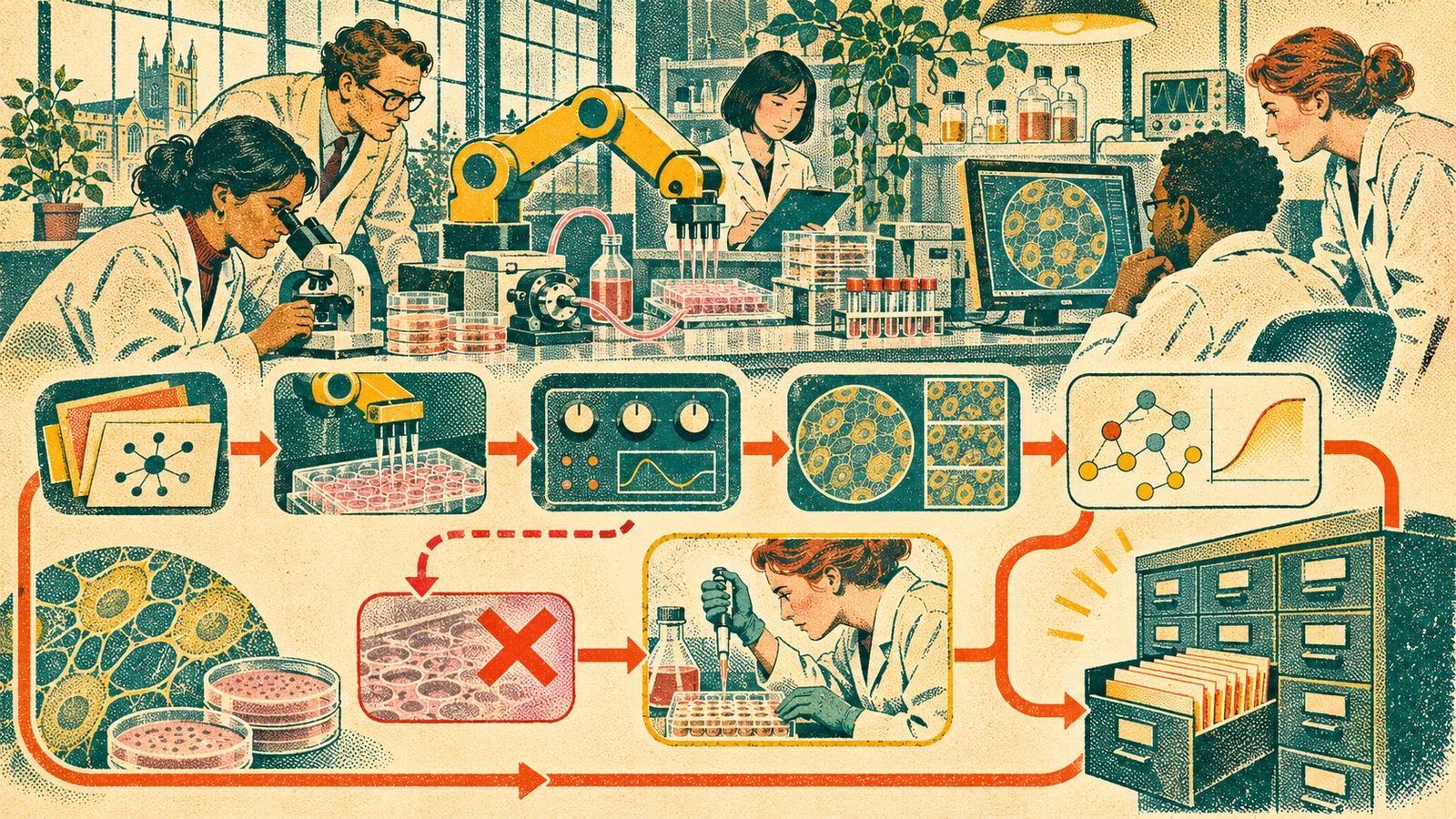
THE SIGNAL IN ONE SENTENCE
The robot is the photogenic part of an autonomous laboratory. It moves a plate, adjusts a pump, reads a sensor and makes the future look conveniently silver. The important part is much less camera-friendly. It is the record of why the system did each thing. King's College London used its November 12 Agents of Science summit to present King's Autonomous Labs, a cross-university initiative connecting artificial intelligence, laboratory automation, robotics, sensing, data and research computing. The university says these connected systems can perform experiments, analyse results and use emerging evidence to inform what happens next. Demonstrations at the summit showed AI agents working with robotic systems to design and carry out experiments, analyse results and guide the next step. One project described by Dr Miao Guo is exploring how an AI scientist system can generate hypotheses, use a robotic platform to test them, analyse results and decide what to investigate next. The example application is the conversion of low-value waste resources into sustainable microbial protein. That is a serious scientific loop. It is also a record-keeping problem disguised as a robot demo. The plain signal is this: keep the experiment trace longer than the machine. An autonomous laboratory should produce a stronger research record than a manual one, not a shorter one. Every proposed hypothesis, robot action, instrument setting, sample identity, raw observation, model version, failed branch, human intervention, stopping rule and next-step decision should remain inspectable after the hardware has changed and the model has been replaced. Start before the robot moves. The trace should name the scientific question, the responsible researcher, the system boundary and the safety boundary. It should record what the system was allowed to change, what required human approval and what condition would stop the run. Then preserve the candidate hypotheses. If an AI system proposes ten explanations and selects one, the record should not contain only the winner. Keep the full candidate set, the evidence available at the time, the selection rule and the reason the chosen hypothesis advanced. Otherwise a polished final paper can hide a large invisible search. That matters because the search itself changes how evidence should be interpreted. A system that tries enough combinations may find an exciting result by chance. If the discarded branches vanish, reviewers cannot see the real number of opportunities the system had to get lucky. Record the action layer next. For every robotic or automated step, keep the command, timestamp, instrument identifier, instrument configuration, calibration state, sample identifier, material batch, environmental condition and software version. Do not settle for a sentence saying the platform followed the standard protocol. The standard protocol is not what happened. The event log is what happened. If a pipetting robot repeated a transfer, if a sensor drifted, if a plate sat outside a controlled environment for four minutes or if an operator cleared a jam, those events belong in the scientific record. Human intervention is not an embarrassment to hide from an autonomy claim. It is data. King's is explicit that a self-driving laboratory is not a laboratory without people. Researchers remain responsible for the questions, objectives, boundaries and safeguards. The programme says its first projects will test individual parts of the experimental loop rather than pretend to be complete autonomous laboratories. Good. Put that boundary into the trace. Mark every moment when a person approves, rejects, pauses, edits, repairs or overrides an automated step. Record who acted, what they saw, why they intervened and what changed afterward. That gives later reviewers a usable answer to a basic question: did the system succeed, or did a skilled scientist quietly rescue it? Now preserve the observations. Raw sensor files, images, spectra, instrument outputs and environmental logs should be stored before cleaning or interpretation. Give each artifact a stable identifier and checksum. Link every processed result back to the raw input and every figure back to the transformation that produced it. Keep excluded observations too. If the system removes an image as low quality, flags a sample as contaminated or replaces a missing value, preserve the original item, the rule that excluded it and the model or person that applied the rule. Cleaning is part of the experiment. In living systems, it can be a large part. King's chose cells, organoids, tissues and microbial systems as the first grand challenge. The university notes that these experiments can be lengthy, variable, sensitive to their surroundings and able to generate multiple forms of evidence. Automated systems must distinguish biological change from technical failure, recognise uncertainty and know when human judgement is required. That is exactly why the trace needs context. A temperature shift may explain a biological result. A software update may change image segmentation. A new reagent lot may create a pattern that looks like discovery. A camera exposure setting may alter the apparent health of a culture. The result and the conditions belong together. Then record interpretation as its own layer. The model that reads an image or recommends the next experiment should have a version, configuration, input set and output record. Preserve its uncertainty estimate if it produces one. Preserve the decision threshold. Preserve alternative interpretations when the system considered them. Do not let the model's conclusion overwrite the measurement. Observation and interpretation are different things. The instrument may record a signal. A processing pipeline may turn it into a feature. A model may classify the feature. An agent may decide that the classification supports a hypothesis. A researcher may decide whether the next action is scientifically and ethically acceptable. Those are separate steps. The trace should keep them separate. The same rule applies to adaptation. When the system chooses what to test next, record the options it considered, the objective it was trying to improve, the constraints it obeyed, the evidence it used and the rule that ended the search. Stopping rules deserve special attention. An automated system can run after a human researcher would have gone home, which is useful. It can also keep searching until it finds something that looks publishable, which is less charming. Define the experiment budget in advance. That can mean a maximum number of cycles, a material limit, a time limit, an uncertainty threshold, a safety condition or a rule that requires human review after a surprising result. Put the stop event in the record. If the rule changes mid-run, keep the old rule, the new rule, the person who approved the change and the reason. Failed branches need equal dignity. Autonomous systems may make failure cheaper and faster. That can improve science if failed attempts become reusable evidence. It can damage science if only successful paths survive into the paper. Publish the negative branch map. It does not need to contain every byte in the article. It should show which hypotheses were tested, what action was taken, what evidence returned, why a branch stopped and where the underlying artifacts can be inspected by authorised reviewers. This is useful beyond reproducibility. It helps a laboratory learn which equipment fails, which model versions are brittle, which interventions recur and which safety rule catches real trouble. It helps a funder see whether expensive automation is creating reusable capability. It helps an ethics or safety board review what the system actually did instead of what the slide deck says it can do. The trace should be machine-readable and human-readable. Use an append-only event log for actions and state changes. Use stable identifiers for samples, instruments, models, software, people and files. Link each event to its inputs and outputs. Then generate a human summary that explains the scientific path in ordinary language. Do not make the summary the source of truth. Narrative is excellent at making a messy process understandable. It is also excellent at making the mess disappear. The event record should survive underneath. Keep enough of the execution environment to replay the analysis. Record software commits, package versions, model files, prompts or system instructions where disclosure is safe, hardware dependencies and data transformations. For proprietary or sensitive components, publish the boundary. State what cannot be shared, why it cannot be shared, who can inspect it and what independent evidence can substitute. A blank box labelled confidential is not provenance. It is a gap with better manners. Build three reproduction tests. First, replay the same analysis from the same raw data. This checks whether the computational path is recoverable. Second, repeat the experiment on the same platform with new samples. This checks whether the physical workflow produces a comparable result. Third, ask an independent team to reproduce the finding with its own equipment and implementation. This checks whether the claim travels beyond the original machine. Do not blend those tests into one reproducibility badge. A pipeline can rerun perfectly while the biological result fails in another lab. A second lab can observe the effect while being unable to reconstruct the original agent's path. Both facts matter. King's is beginning with a £150,000 internal fund for rapid six-month proof-of-concept projects involving living systems. The programme page says individual awards are approximately £10,000 to £30,000 and are meant to support pilot data, demonstrators, new capabilities and interdisciplinary collaboration. That is a sensible scale for building the trace alongside the experiment. Make trace completeness a funding deliverable. Before a project begins, define the minimum record for hypotheses, actions, observations, models, interventions and stops. During the project, test whether another researcher can follow the path. At the end, require a replay package, a failure map and a statement of what remains unavailable. Score the record separately from the scientific result. A project can produce an interesting result with a weak trace. It can also produce no positive result while building an excellent reusable experimental system. The second outcome may be more valuable to the next six projects. Do not reward a theatrical autonomy percentage. Measure how much of the loop is inspectable, how often people intervene, how quickly errors are detected, how completely raw evidence is preserved, how reliably analysis can be replayed and whether an independent team can reproduce the claim. The programme itself already points in this direction. King's lists validation, provenance, uncertainty, safety, ethics and human oversight among its aims. It says research computing support will address data governance, software sustainability, reproducibility and operational resilience. The hard part is turning those nouns into receipts. The new laboratories have not yet published results from the funded pilots. The university pages describe ambitions, demonstrations, existing platforms and an operating model. They do not establish that autonomous experiments are faster, more reliable or more reproducible than conventional work. That evidence has to arrive later. When it does, the experiment trace should arrive with it. The robot will eventually be replaced. The model will definitely be replaced. The software will update, the lab will reorganise and the people will move on. The scientific claim must remain inspectable after all of them. That is the useful promise of an autonomous laboratory: not just more experiments, but a better memory of how knowledge was made.
01
WHAT ACTUALLY CHANGED
King's College London presented King's Autonomous Labs at its November 12 Agents of Science summit and reported the event on November 18, 2026.
The cross-university initiative connects AI, laboratory automation, robotics, sensing, data and research computing.
Demonstrations showed AI agents working with robotic systems to design and carry out experiments, analyse results and inform the next step.
King’s describes a biomanufacturing project that could optimise the conversion of low-value waste into sustainable microbial protein.
The programme begins with a £150,000 internal fund for rapid proof-of-concept projects lasting up to six months.
Individual awards are described as approximately £10,000 to £30,000 for projects involving living systems.
King’s says the initial projects will test parts of the experimental loop rather than complete autonomous laboratories.
Researchers remain responsible for scientific questions, objectives, boundaries and safeguards.
The programme names validation, provenance, uncertainty, safety, ethics and human oversight among its aims.
No funded project results, shared benchmark or complete operating standard have been published yet.
02
WHY THIS MATTERS
A faster experimental loop can create more evidence, more failed branches and more opportunities for accidental selection bias.
Preserving candidate hypotheses makes the system’s search visible instead of showing only the winning path.
Robot commands and instrument settings are part of the scientific method when machines carry out the work.
Raw observations must remain separate from model interpretations so later researchers can challenge the analysis.
Human interventions reveal the real boundary between automation and expert rescue.
Living systems make context, uncertainty and environmental conditions especially important.
Explicit stopping rules prevent continuous automated search from quietly becoming a hunt for a publishable result.
A durable experiment trace can support replay, independent reproduction, safety review and institutional learning.
03
WHERE IT COULD HELP
- Assign stable identifiers to every sample, instrument, model, software build, person and data artifact.
- Record the full candidate hypothesis set, not only the hypothesis that advanced.
- Log the evidence and selection rule used to choose each next experiment.
- Preserve robot commands, instrument settings, calibration state, material batches and environmental conditions.
- Store raw observations before cleaning, exclusion, transformation or model interpretation.
- Link every processed result and figure back to the raw inputs and exact transformation.
- Keep rejected observations with the rule, model or person that excluded them.
- Mark every human approval, pause, repair, edit and override with a reason.
- Define experiment budgets and stopping rules before the autonomous loop begins.
- Record every mid-run rule change and the person who approved it.
- Publish a branch map showing failed and negative experiments as well as successful paths.
- Maintain an append-only machine-readable event log plus a plain-language research summary.
- Test computational replay, same-platform repetition and independent reproduction separately.
- Make trace completeness, replay packages and failure maps explicit funding deliverables.
- Evaluate inspectability, error detection, intervention rates and reproduction instead of an autonomy percentage.
KEEP A HAND ON THE WHEEL
King's Autonomous Labs is an ongoing research initiative, not evidence that complete autonomous laboratories are operating without people. King's says the initial living-systems projects test individual parts of the experimental loop. Researchers remain responsible for questions, objectives, boundaries and safeguards. The university describes demonstrations, existing platforms, a £150,000 funding programme and intended six-month pilots. It has not published results from funded projects, a common benchmark, comparison with conventional laboratories, an incident record or a complete technical and governance standard. Claims about faster discovery, improved reproducibility, lower cost or better reliability remain ambitions until measured results and reproducible artifacts are available. Detailed experiment traces may contain sensitive biological data, security-relevant procedures, personal information or commercially confidential methods. A responsible trace needs access controls and a public disclosure boundary, not indiscriminate publication. Watch for funded project names, protocols, model and equipment inventories, trace schemas, stopping rules, human intervention logs, negative results, safety incidents, replay packages, independent reproduction and evidence that the infrastructure remains usable after models or instruments change.
04
TERMS WORTH KEEPING
OPEN GLOSSARY CARD
Reproducibility
The ability of another qualified team to repeat a method with documented inputs and obtain results consistent with the original finding.
OPEN GLOSSARY CARD
Research provenance
A traceable record of the data, code, models, parameters, tools, environments, and human decisions behind a scientific result.
OPEN GLOSSARY CARD
Meaningful human oversight
Human review with enough information, time, authority, and practical ability to change or stop a system's action.
SOURCES AND VERIFICATION STATUS
This article was written from the materials below. Product claims and dates were checked against those sources on November 19, 2026.
THE PUBLICATION ENGINE
WANT A SIGNAL OF YOUR OWN?
We build source-grounded publications, private briefings, and editorial systems for organizations with something useful to say.
WORK WITH US