THE SIGNAL IN ONE SENTENCE
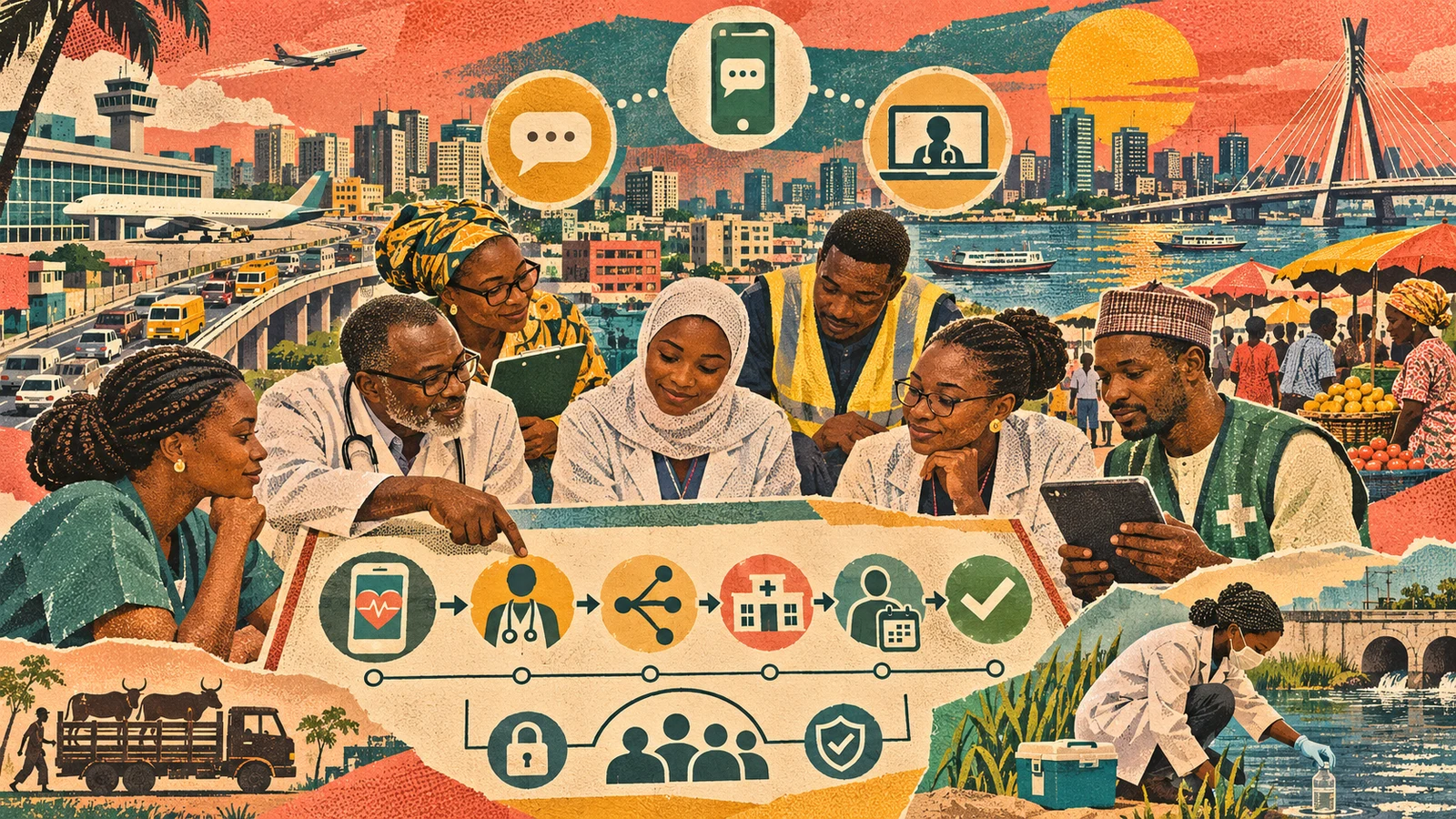
A public-health alert is not the same thing as a diagnosis. That sounds obvious until a city puts software between the first symptom and the first official decision. Lagos State has unveiled Bioshield, a digital biosecurity framework that combines traveller and event monitoring, telemedicine and AI-supported risk classification. The idea is to notice possible infectious-disease threats early enough to respond without bringing a vast, busy city to a halt. The framework has two reported layers. An outer layer looks for potential risks associated with people entering Lagos. An inner layer follows people who develop symptoms after arrival. Its Health Radar platform can register travellers or event participants and send daily check-ins through WhatsApp, SMS and email for up to 21 days. Someone who reports symptoms can be connected to a telemedicine assessment. Laboratory testing, referrals or specialised intervention may follow. Local reporting says AI helps classify risk and escalate suspected high-risk cases to the Ministry of Health and other public-health authorities. Lagos officials presented the system at the 11th African Conference on One Health and Biosecurity on November 24. They also described a pilot at CANEX WKND. The reported numbers are large enough to sound impressive: about 19,000 registered delegates, including 2,298 international visitors; 2,454 telemedicine consultations; 241 clinical referrals; and 219 people flagged for further attention. Those figures are not an accuracy study. They do not tell us how many alerts were correct, how many important cases were missed, how often a clinician changed the software's classification or what happened after a referral. The plain signal is this: keep the escalation ledger public. For every category of signal, publish the path from consent and check-in to risk classification, human review, referral, completed care and final outcome. Count false alerts, missed cases, overrides, delays and abandoned handoffs. Explain what data were kept, who could see them, when they were deleted and what could be shared across agencies or borders. Do that without publishing anyone's identity. Public health needs public trust, especially when the system asks a traveller or event participant to report symptoms through an ordinary phone. Start with the first message. What exactly is the person agreeing to? An invitation to complete a daily health check is not automatically informed consent for every later use of the answer. The check-in should state who operates the service, why the information is collected, which agencies may receive it, how long monitoring lasts and what happens if the person does not respond. It should also separate public-health authority from optional services. During a declared emergency, a government may have legal powers that do not depend on ordinary consumer consent. At a conference or airport, an organiser may also ask people to participate voluntarily. Those are different legal and ethical situations. The screen should not blur them into one cheerful button. Publish the legal basis for each use. Then record the signal itself. The reported Health Radar design can ask whether a person is well, unwell or needs a doctor. That simplicity is useful. It also compresses a messy body into a tiny form. Fever, fatigue, headache and stomach trouble can point toward many ordinary illnesses. Early symptoms of a serious infection can look mild. Language, literacy, disability, fear of isolation, phone access and the cost of missing work can all shape how someone answers. The ledger should therefore show the question, language, delivery channel, response options, missing-response policy and any accessibility support. It should count delivery failures and response gaps rather than treating silence as health. Next comes classification. The public reporting says AI supports risk classification. It does not publish the model, features, thresholds, training data, validation results or error rates. That boundary matters. An AI system might be a simple rules engine that weighs symptoms, travel history and exposure. It might use a statistical model. It might summarise a clinician's notes. It might do several of those things. The phrase AI does not tell a resident which one. Publish a model card written for public-health use. Name the inputs, outputs, version, owner, intended population, excluded uses and human decision point. State whether location, nationality, occupation, event attendance, travel route or contact history changes a score. Some of those factors can be epidemiologically relevant. They can also become proxies for social class, migration status or neighbourhood. A useful system needs a reason for every feature and a test for unequal consequences. The escalation ledger should report outcomes by channel, language, age group, gender, disability where lawful and useful, and other relevant population groups. Small counts should be suppressed so the receipt does not identify people. Human review is the hinge. If an algorithm marks a case as high risk, who sees it? How quickly? What qualifications do they have? Can they lower or raise the classification? Must they record a reason? What happens when no clinician is available? Publish the override rate in both directions. A high override rate may reveal a poor model, a changed outbreak, a confusing questionnaire or clinicians applying knowledge the system lacks. It is not automatically failure. Hidden overrides are the failure, because nobody can learn from them. The pilot totals need denominators too. If 219 people were flagged, flagged out of what? All registered delegates? All respondents? All people reporting symptoms? All telemedicine consultations? If there were 241 referrals, did some people receive more than one? How many referrals were completed? How many reached a general hospital, a laboratory or a specialist? How many were closed after clinical review? Operational counts become meaningful when the handoffs connect. Build the public receipt as a flow table: messages sent, messages delivered, people responding, symptom reports, telemedicine assessments, low-risk classifications, intermediate classifications, high-risk classifications, clinician overrides, laboratory orders, samples collected, results returned, referrals made, referrals completed, cases closed and people lost to follow-up. Add median and worst-case time at every step. Lagos officials say the system aims to identify potentially serious cases within 24 hours. That is a service target, not a measured result. Publish the clock. When did the symptom report arrive? When did a clinician review it? When was the person contacted? When was a sample collected? When did the result return? When did public-health action begin? An average can hide the person waiting longest. Show distributions and missed targets. False alerts need care rather than ridicule. Public-health surveillance is often designed to tolerate some false positives because missing a dangerous case can be costly. But false alerts still have consequences. A person may lose work, face stigma, travel across the city, enter isolation or worry their family. Count those burdens. At the same time, look deliberately for missed cases. Link later confirmed infections back to earlier check-ins when legally permitted and ethically governed. Review cases in which the person reported mild symptoms, did not respond or was classified as low risk. Sensitivity and specificity belong here, but they are not enough. A city also needs time to action, referral completion, access to care and clinical outcomes. A perfect alert that dies in an inbox is not a public-health success. Data retention is part of the intervention. Daily check-ins, travel details, phone numbers and health reports can create a sensitive longitudinal record. Publish a retention schedule for raw messages, derived risk scores, clinical notes, laboratory results and de-identified evaluation data. Deletion should be verifiable. If information moves into the Lagos State Smart Health Information Platform, the person should be told what becomes part of a medical record and what remains a temporary surveillance record. Cross-border sharing deserves its own gate. Lagos officials proposed a BioShield Alliance involving cities such as Cairo, Kinshasa, Johannesburg and Nairobi. Shared standards and training could help cities respond to outbreaks that do not respect municipal borders. Patient-level data should not move simply because an alliance exists. Publish the minimum data set, legal agreement, purpose, recipient, security controls and deletion rules for each kind of exchange. Prefer aggregate or de-identified information unless individual follow-up genuinely requires more. One Health expands the picture again. The conference and local reporting connect human health with animal movement and environmental conditions. Officials noted the large flow of cattle into Lagos and the city's role in international travel. A system built around One Health may eventually combine signals from clinics, laboratories, veterinary services, markets, transport and environmental surveillance. That can reveal risk earlier. It can also create a surveillance machine whose pieces were collected under different rules. The ledger should name each data source and the authority that governs it. Do not quietly repurpose veterinary, mobility or environmental data into individual risk scores without a public rule and a scientific reason. The strongest case for Bioshield is not that it uses AI. It is that Lagos is trying to build a practical chain from early report to care in a city where a blanket shutdown can devastate people who depend on daily income. That is a real design problem. The answer should be measured against human outcomes: earlier care, faster investigation, fewer dangerous exposures, less unnecessary disruption and fair access to follow-up. The reviewed public evidence does not yet establish those outcomes. The pilot figures come from officials and local reporting. There is no published technical or clinical evaluation showing sensitivity, specificity, privacy performance, causal health impact or readiness for citywide deployment. That does not make the project useless. It makes the next artifact obvious. Publish the escalation ledger. Let residents see how the radar turns a message into a decision, how people remain in charge, where the chain breaks and whether the person at the other end actually receives care. A health radar should not merely detect signals. It should leave a public receipt for what happened next.
01
WHAT ACTUALLY CHANGED
Lagos State unveiled Bioshield, a digital biosecurity framework combining traveller and event monitoring, telemedicine and AI-supported risk classification.
The reported Health Radar platform can send daily check-ins through WhatsApp, SMS and email for up to 21 days.
People reporting symptoms can be routed to telemedicine, laboratory investigation, referral or specialised public-health intervention.
Officials described two layers covering risks associated with entry into Lagos and symptoms that develop after arrival.
A pilot at CANEX WKND reportedly covered about 19,000 registered delegates, including 2,298 international visitors.
Officials reported 2,454 telemedicine consultations, 241 clinical referrals and 219 people flagged for further attention.
Lagos proposed a wider BioShield Alliance for data sharing, training and common preparedness standards among African megacities.
02
WHY THIS MATTERS
Early detection can connect people to care before a possible infection spreads through a dense and highly connected city.
Digital check-ins can reduce the need for symptomatic people to travel across Lagos merely to seek an initial assessment.
Risk classification can also produce false alerts, missed cases and unequal burdens if its inputs and thresholds are hidden.
Travel and health data are sensitive, especially when shared across event organisers, health agencies, laboratories or borders.
A referral only helps when the person completes it and receives appropriate care.
Lagos can offer a useful model for other megacities if it publishes both operational successes and failure modes.
One Health surveillance can connect human, animal and environmental evidence, but each data source needs a clear legal and scientific purpose.
03
WHERE IT COULD HELP
- Publish a de-identified flow table from messages sent through case closure, including denominators at every stage.
- State the legal basis, purpose, operator, recipients and retention period at the first check-in.
- Document the risk model, input features, thresholds, version, intended population and excluded uses.
- Require qualified human review for consequential classifications and record overrides in both directions.
- Measure delivery failure, response gaps and access differences across language, channel and relevant population groups.
- Report false alerts, missed cases, referral completion, time to action and clinical outcomes.
- Separate temporary surveillance records from permanent medical records and verify deletion.
- Publish the minimum data set and governance terms for any interagency or cross-border sharing.
- Suppress small counts and remove identifiers before releasing public accountability data.
- Version the questionnaire, model, thresholds, clinical protocol and data-sharing rules so changes remain auditable.
KEEP A HAND ON THE WHEEL
Watch for a public technical and clinical evaluation, the exact model and rules used for risk classification, legal authority, consent language, retention and deletion schedules, clinician override rates, sensitivity and specificity, missed-case reviews, referral completion, response times, independent privacy and security testing, evidence of equitable access, SHIP integration terms and any agreement governing the proposed BioShield Alliance.
04
TERMS WORTH KEEPING
SOURCES AND VERIFICATION STATUS
This article was written from the materials below. Product claims and dates were checked against those sources on November 26, 2026.
THE PUBLICATION ENGINE
WANT A SIGNAL OF YOUR OWN?
We build source-grounded publications, private briefings, and editorial systems for organizations with something useful to say.
WORK WITH US