THE SIGNAL IN ONE SENTENCE
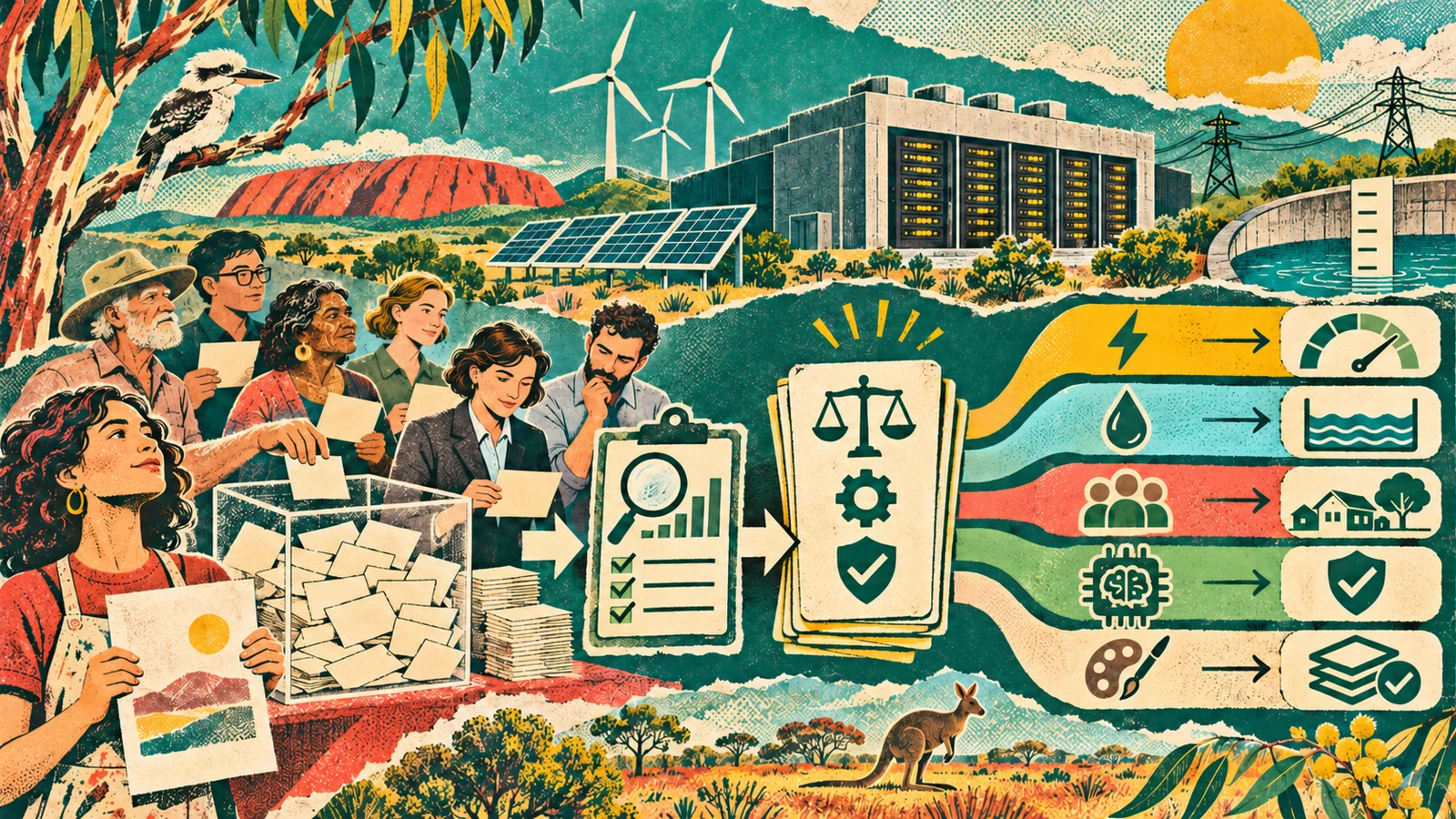
Public consultations are good at producing PDFs and bad at showing their working. Australia now has a chance to do better. On November 13, the Australian Government published the results of a consultation on national standards for large data centres and AI training. The Office of AI says it received 1,533 submissions. Individuals supplied 73 percent of them. Business and industry representatives supplied 12 percent, organisations and institutions 8 percent, and AI and technology representatives 6 percent. The feedback did not arrive as one tidy national opinion. It arrived as competing demands. People want investment and useful infrastructure. They also want energy bills protected, scarce water respected, communities heard, workers trained, advanced systems tested and Australian creators able to see and control how their work is used. The government says consultation findings will sit beside technical analysis, targeted consultation and cross-government policy work. Proposed requirements and implementation options come next. Final standards come later. That distinction matters. The November report is evidence about what people raised. It is not a final law, a settled threshold or proof that every submission will shape policy. The plain signal is this. Australia should publish a rule-to-evidence map while the standards are being designed. For every proposed rule, show the public concern, the supporting technical evidence, the groups affected, the competing view, the metric, the enforcement owner and the reason the government accepted or rejected it. That sounds like administrative plumbing. It is also the difference between consultation and theatre. Start with a simple public table. One row might begin with energy. The consultation report says energy impacts appeared in 78 percent of submissions. Common themes included new renewable capacity, storage and firming, grid reliability, protection against higher household and business costs, and locations where the energy system can handle additional demand. The corresponding rule should not stop at "be sustainable." Name the covered facility. Define the threshold. State when the obligation begins. Specify what counts as new generation, how much demand flexibility is required, which evidence must be public and which regulator can act when performance misses the mark. Then attach the reason. The consultation paper says data-centre electricity use in the National Electricity Market could rise from about 5 terawatt hours in 2025-26 to 34 terawatt hours in 2035-36 under the system operator's Step Change scenario. That projection is not destiny, but it is the kind of technical evidence a rule should cite. Show assumptions and dates. Link the dataset. Say what would trigger a revision. Water needs its own row, not a footnote under energy. Water appeared in 77 percent of submissions. People raised transparent reporting, recycled and non-potable sources, reduced reliance on drinking water, local conditions and cumulative pressure in water-stressed regions. The national picture can look modest while the local picture looks alarming. The consultation paper estimates that data centres used about 5.5 gigalitres for cooling in 2025, around 0.04 percent of national industrial water use. It also cites Sydney Water's estimate that data centres could consume up to 20 percent of Sydney's drinking water by 2035. Those numbers answer different questions. One describes a national share today. The other describes a potential local share later. Put them in the same evidence map with their boundaries intact. Do not let an average wash out a catchment. A water rule should disclose potable and non-potable use, peak demand, drought planning, local water stress, efficiency, cumulative use from nearby facilities and the infrastructure costs assigned to the operator. It should also show the tradeoff between water and power. A cooling system that saves water may use more electricity. A single efficiency score can make that trade disappear. Publish both. Community benefit needs more than a jobs promise. The consultation findings say people want early engagement, ongoing consultation, clear information and tangible local benefits. They also want standards to consider location, cumulative impacts and whether new facilities draw scarce workers away from housing, energy, telecommunications or defence. The rule-to-evidence map should therefore distinguish a commitment from an outcome. "We will create apprenticeships" is a commitment. The evidence is the number of funded places, completion rates, local participation, occupations, wages, partners and dates. "We will consult First Nations peoples" is a commitment. The evidence is when engagement began, who participated, which concerns changed the proposal, what remained unresolved and how consent or disagreement was recorded. The government should publish community-benefit agreements where possible, along with the operator, delivery date, baseline and remedy for failure. AI safety has a different evidence problem. The findings report strong support for mandatory safety and security requirements for advanced AI development. Proposals included risk management, cybersecurity, incident reporting, independent testing, human oversight and accountability. Those labels are broad enough to fit on any conference panel. The standards will need to turn them into gates. Before a frontier training run begins, who files the risk assessment? Which security controls must pass? Who performs independent evaluation? Which incidents are reportable? How quickly? Which model changes require another review? Who can halt a run or restrict deployment? The evidence map should connect each obligation to a test, an owner and a consequence. Safety evidence also needs version numbers. A model evaluated in March is not automatically the same system after new data, tools, fine-tuning or deployment changes in October. The public record should say what was tested and when. Copyright may be the hardest row because the disagreement is not hidden. The report says copyright and training data drew the most diverse and contested feedback, appearing in 64 percent of submissions. Creative-sector participants commonly sought visibility, consent and remuneration. Technology companies and businesses stressed certainty, scalable compliance, competitiveness and the risk of discouraging investment. That is not a consensus. Do not varnish it into one. Publish the conflict. If the government proposes a creator-rights rule, show which concern it addresses, which works and training activities it covers, what information an operator must disclose, how consent or control works, how remuneration is calculated, what exceptions apply and how a creator can challenge noncompliance. If a proposal is rejected, explain why. "Stakeholders had mixed views" is not an explanation. Representation belongs in the map too. The Office of AI reports 1,533 submissions, but a count does not prove a representative sample. Seventy-three percent came from individuals. Among submissions with an identified location, New South Wales, Victoria and Queensland supplied the largest shares. About 2 percent of identified submissions were international. The report does not claim that 1,533 submissions form a referendum. Good. The public dashboard should keep that humility. For each theme, show how many submissions mentioned it, who raised it, which regions were visible, which communities were missing and whether targeted engagement supplied additional evidence. Do not convert frequency into weight without saying how. A concern raised by a small remote community may matter more than a widely repeated general preference if that community carries the water, land or noise burden. Technical evidence may contradict a popular assumption. A legal obligation may constrain the available options. The map should show the reasoning, not pretend every input has the same role. There is a practical way to structure it. Give every proposed requirement a permanent identifier. Link it to consultation themes, technical studies and existing laws. Name the responsible agency. Publish the draft metric, reporting interval, threshold and proposed remedy. Record material changes as the rule moves through government consideration and legislation. Add a decision note. The note should say accepted, modified, deferred or rejected. It should explain why, cite the evidence and identify unresolved uncertainty. If the government changes course later, preserve the old note and add a new one. Version control is not only for software. The same discipline should follow a data centre after approval. Publish the plan, baseline and promised benefits before construction. Report actual energy, water, emissions, grid events, community complaints, local training and safety incidents during operation. Where commercial or security limits apply, explain the category of withheld information and publish an aggregate or independently assured result. Independent assurance matters because operator self-reporting has an obvious temptation built into it. An assurance statement should name the auditor, scope, period, method, exceptions and conflicts of interest. It should not be a glossy badge with no inspection trail. The government can also publish a machine-readable register. Researchers, councils, journalists, creators and communities should be able to compare promises with outcomes across facilities and years without scraping fifty PDFs. Use common definitions for energy, water, capacity, location, training activity, incident severity and local benefit. Publish the data licence and revision history. Provide a plain-language page beside the raw file. There is one more important boundary. The rule-to-evidence map should not expose security-sensitive infrastructure details or personal information from submissions. Public accountability does not require publishing precise network diagrams, vulnerabilities or private addresses. It does require explaining the rule, the evidence class, the accountable body and whether compliance was independently checked. Australia is still designing the standards. The Office of AI says consultation findings will be combined with technical analysis, targeted consultation and cross-government policy development before requirements and implementation options are settled. That means the useful accountability window is open now. Once a rule is written and a project is approved, reconstructing why each choice was made becomes slower, more political and much more expensive. So publish the map while the reasoning is alive. Show the concern. Show the counterargument. Show the data. Name the rule. Name the owner. Define the measure. Record the decision. Report the outcome. That is how 1,533 submissions become something sturdier than a stack of well-intentioned cards.
01
WHAT ACTUALLY CHANGED
Australia published the findings of a public consultation on national standards for large data centres and AI training on November 13, 2026.
The Office of AI reports 1,533 submissions, including 73 percent from individuals, 12 percent from business and industry representatives, 8 percent from organisations and institutions, and 6 percent from AI and technology representatives.
Energy impacts appeared in 78 percent of submissions and water management appeared in 77 percent.
Copyright and training data appeared in 64 percent of submissions and produced the most diverse and contested feedback.
Stakeholders broadly supported national standards but differed on mandatory rules, flexible outcomes, copyright controls and implementation.
Consultation findings will be combined with technical analysis, targeted engagement and cross-government policy work.
Proposed requirements and implementation options are still being developed.
Final standards, thresholds, enforcement rules and legislation have not yet been published.
02
WHY THIS MATTERS
Submission totals show participation but do not prove that the sample is representative or that each view will affect policy.
Energy and water impacts vary sharply by location, so national averages can hide local pressure on grids, catchments and communities.
The standards will distribute costs and benefits among data-centre operators, households, workers, creators, communities and governments.
A public evidence map can show why a rule was adopted, modified, delayed or rejected.
Permanent rule identifiers and revision history can preserve accountability as draft requirements move through legislation and implementation.
Metrics, owners and remedies turn broad goals such as sustainability, safety and community benefit into testable obligations.
Copyright feedback reveals a real conflict between creator control and technology-industry demands for scalable certainty.
Machine-readable performance data can help councils, researchers, journalists and communities compare promises with outcomes.
03
WHERE IT COULD HELP
- Give every proposed requirement a permanent identifier and public status.
- Link each rule to consultation themes, technical evidence, affected groups, competing views and existing law.
- Publish the reason for accepting, modifying, deferring or rejecting a proposal.
- Show submission frequency, participant type, geography, missing voices and targeted-engagement evidence without treating frequency as a vote.
- Define covered facilities, thresholds, start dates, reporting intervals, enforcement owners and remedies.
- Report energy demand, new generation, firming, demand flexibility, network costs and effects on household and business prices.
- Report potable and non-potable water use, peak demand, local water stress, drought resilience and cumulative catchment impacts.
- Publish community commitments beside delivery dates, baselines, actual outcomes and remedies for failure.
- Track apprenticeships, completions, local participation, occupations, wages and training partners instead of reporting jobs promises alone.
- Record when community and First Nations engagement began, which concerns changed a proposal and what remains unresolved.
- Turn AI safety labels into test gates, incident duties, independent evaluation, model-version records and stop authority.
- Define creator visibility, consent, control, remuneration, exceptions and complaint routes for training data.
- Keep decision notes and revision history when proposed requirements change.
- Require assurance statements to name the auditor, scope, method, period, exceptions and conflicts.
- Publish a machine-readable register with common definitions, data licence and change log.
- Protect personal and security-sensitive information while still disclosing the rule, evidence class, accountable body and assurance result.
KEEP A HAND ON THE WHEEL
The November 13 publication is a consultation summary, not a final AI standard. It reports themes and participant categories but does not establish that submissions were representative, equally weighted or adopted as policy. The Office of AI says consultation findings will be considered with technical analysis, targeted engagement and cross-government policy development. The government has not yet published final thresholds, compliance dates, agency responsibilities, enforcement powers or remedies. Energy was addressed in 78 percent of submissions, water in 77 percent and copyright in 64 percent. Those figures measure mentions, not agreement. Industry and non-industry participants often differed on whether obligations should be mandatory or outcome-based. Copyright views were expressly contested. The September consultation paper contains proposals, estimates and questions. Its figures on future electricity and water use depend on forecasts and local conditions. They should not be presented as observed future outcomes. Watch for draft legislation, covered-capacity thresholds, treatment of projects already in development, timing of renewable-energy obligations, public reporting rules, water metrics, cumulative-impact tests, community-benefit requirements, AI safety gates, copyright mechanisms, independent assurance and the regulator responsible for each obligation. Also watch whether the final framework publishes a traceable reason for each major choice. A consultation becomes accountable only when the public can see what evidence changed the rule and what evidence did not.
04
TERMS WORTH KEEPING
SOURCES AND VERIFICATION STATUS
This article was written from the materials below. Product claims and dates were checked against those sources on November 15, 2026.
THE PUBLICATION ENGINE
WANT A SIGNAL OF YOUR OWN?
We build source-grounded publications, private briefings, and editorial systems for organizations with something useful to say.
WORK WITH US