THE SIGNAL IN ONE SENTENCE
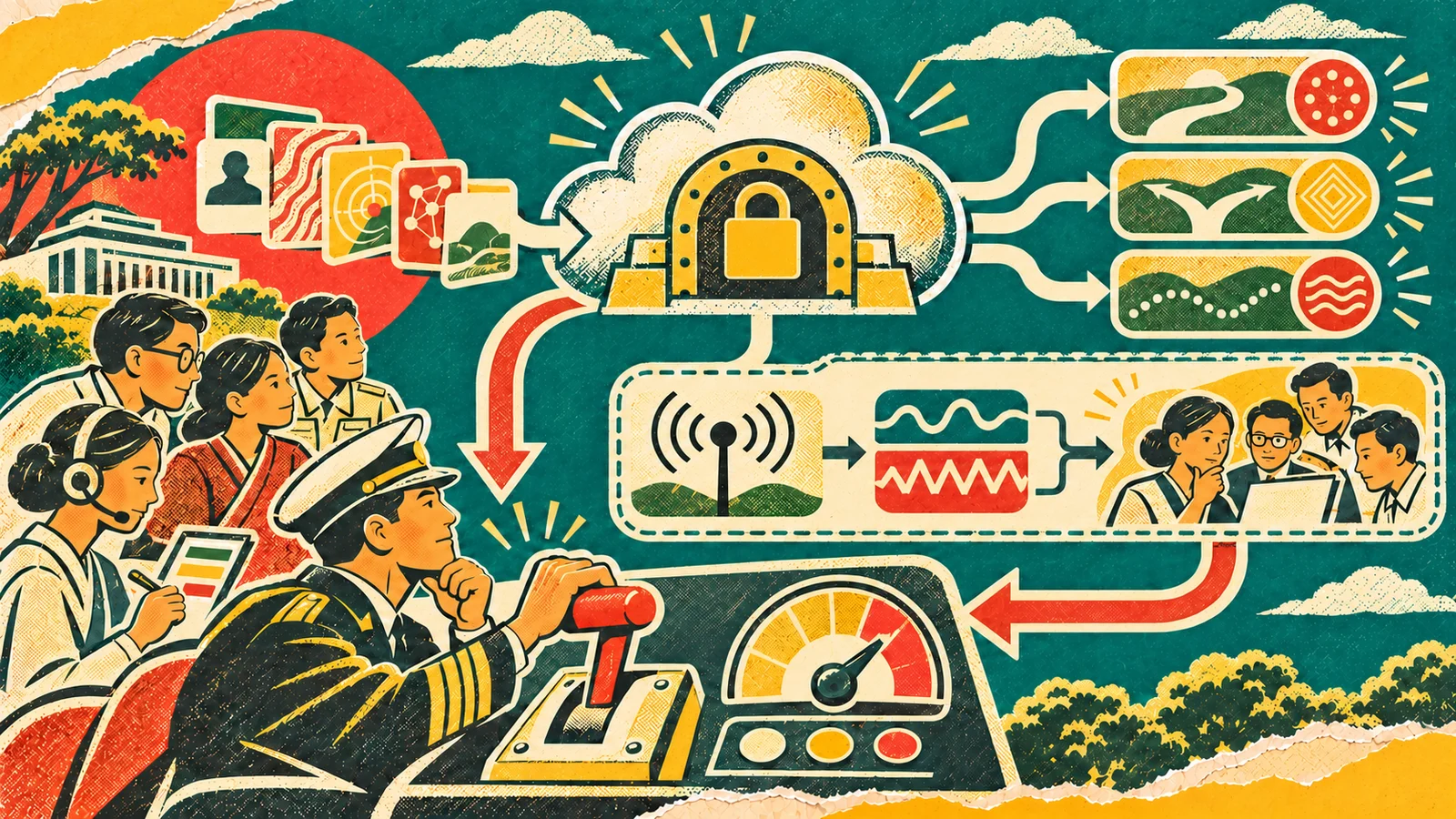
A human-responsibility rule sounds reassuring. The useful question is whether it still works at 3 a.m., with a broken data link, a confident machine recommendation and a decision clock that refuses to be polite. Japan's defense minister said on November 15 that the Ministry of Defense intends to publish a new Defense AI Vision by the end of the month. The Vision will revise the ministry's July 2024 policy as AI capabilities and cyber threats move faster than a policy document can comfortably age. The minister named three priorities. People will retain judgment and responsibility. Data will be turned into capability that protects Japan. Rapid implementation will be balanced with safety and security. The ministry also wants cloud infrastructure able to handle highly classified information. The minister said the ministry has not previously handled highly classified or specially designated secret information in the cloud, so standards and preparation matter. That is the announcement. It is not yet the final Vision, a procurement decision or evidence that a classified defense cloud has passed an operational test. The plain signal is this. Japan should turn its human-responsibility principle into a testable operating rule before sensitive data and AI-assisted decisions move into the same environment. Start by naming the decisions. "A human is responsible" is too broad to guide an operator. Each AI-supported workflow needs a decision card that says what the system may observe, what it may recommend, what it may never do, who has authority to decide, who may stop the workflow and what happens when communications or data fail. The card for an intelligence-analysis tool will differ from the card for logistics, cybersecurity, target identification or an unmanned system. A general principle cannot erase those differences. Japan's 2024 policy already identifies seven priority areas for AI: target detection and identification, intelligence collection and analysis, command and control, logistics support, unmanned assets, cybersecurity and office work. It says AI supports human judgment and that human involvement should be maintained. The new Vision can make that promise operational. For every use, define the boundary between information, recommendation and action. An AI system may sort reports, identify anomalies or present options. That does not automatically grant it authority to change a mission, deny access, direct an asset or use force. The system interface should show the boundary as clearly as it shows the recommendation. The operator needs more than a green light. Show which sources shaped the result, when each source was collected, what is missing, what conflicts, which model and software version produced the recommendation and what assumptions could change it. If the system is uncertain, stale or operating outside its tested conditions, make that visible before the person decides. A confidence score alone will not do the job. Ninety percent confidence can sound precise while hiding a bad sensor, a narrow training set or a question the model was never designed to answer. Pair any score with source freshness, coverage, known blind spots and a competing interpretation. Then test the human. Most safety exercises test whether the machine works. A human-responsibility exercise should also test whether a person can disagree with it. Feed the team a recommendation that is fluent, timely and wrong. Give the model two sources that conflict. Delay one sensor. Remove a network connection. Add an adversarial report. Let a junior analyst spot the problem before a senior commander does. See whether the interface invites challenge or turns the model's answer into the room's default. That is a test for automation bias, the tendency to follow an automated recommendation because it looks authoritative or saves time. The Joint Staff chief warned about exactly this class of risk in an October message on responsible AI use. He listed inaccurate outputs, training-data bias, misinformation, external attacks, sensitive-data leakage and excessive reliance on automation. He described AI's role as organizing and analyzing information and presenting options, while final decisions and responsibility remain with commanders and people. The word "final" needs company. Responsibility should not be dumped on the last person in a long technical chain. The data collector is responsible for provenance. The system owner is responsible for the approved use. The developer is responsible for known limits and change control. The security team is responsible for access and incident response. The operator is responsible for checking the evidence. The commander is responsible for the decision. Record those roles before an incident, not during the inquiry afterward. The stop mechanism must be independent and boring. An authorized person should be able to pause a recommendation pipeline, isolate a compromised source, revoke tool access, return to a manual process and preserve the record even if the AI service keeps running. The stop should work during degraded connectivity and should not require approval from the system being stopped. Practice the fallback. If a team cannot complete the essential task without the model during an exercise, it does not have a fallback. It has a sentence in a continuity plan. Run no-AI drills. Run stale-data drills. Run exercises where the cloud service is available but its identity provider is not. Test whether operators know which local data is current, which orders remain valid and how to rejoin the digital record after systems recover. The classified cloud makes these details more important. The minister said safety and security should match the classification of the information. That is a necessary baseline, but classification is only one dimension. Access should also reflect the person's role, device, location, mission, time and need to know. A user cleared for a category of information should not automatically gain every dataset or every AI tool that can infer from it. Use least privilege. Separate administrative access from operational use. Protect cryptographic keys under Japanese control. Log which identity opened which dataset, which model processed it, which tool was called, what moved between security zones and what the person decided. Logs should be tamper-evident and useful under pressure. A million unreadable events are not accountability. Every important recommendation should leave a compact receipt. The receipt should include the decision task, data sources, freshness, model version, tool access, recommendation, uncertainty, operator, responsible authority, action, override and reason. It should link to the fuller technical record without copying every classified detail into a second vulnerable system. Retention and deletion need rules too. AI services can create prompts, embeddings, caches, temporary files, telemetry and derived labels. Classifying the original document does not automatically manage all of those descendants. Map where each artifact is created, who can read it, how long it remains and how deletion is verified. Derived data can be sensitive even when it contains no copied paragraph. A pattern of queries can reveal a mission. A model output can reveal what sources were combined. A performance log can show when a unit was active. Treat the trail as part of the classified workload. Supply chains deserve the same discipline. Japan says it wants independent and autonomous operation and management of the environment. That should translate into a published control model for software updates, model weights, hardware, remote support, vulnerability reporting, key custody and emergency continuity. The ministry should know which external dependency can interrupt service or gain privileged access. Independence does not require building every component domestically. It does require knowing what cannot be operated, inspected, patched or recovered without someone else's permission. The ministry's responsible-AI guideline for defense-equipment research provides useful existing ground rules. It says systems should not use lethal force completely autonomously without human involvement. It calls for clear human responsibility, prevention of excessive reliance, fairness, verifiability, transparency, reliability, validity and safety. The new Vision should connect those research principles to deployment gates. Before an AI-supported defense workflow moves from a laboratory to an exercise, require a named owner, intended use, prohibited uses, threat model, test set, human-factors evaluation, security review and manual fallback. Before it moves from an exercise to operations, require evidence that the team caught wrong recommendations, stopped the system and reconstructed the decision. Do not grade only average accuracy. Measure the failures that matter: missed warnings, false alarms, wrong identities, stale tracks, hidden source conflicts, unauthorized access, slow overrides, failed stops and operator confusion. Break results out by scenario, data condition and system version. Record near misses. If an operator nearly accepts a wrong recommendation, that is evidence even when no harm follows. Review what the interface showed, what the person believed, what time pressure existed and which control failed to create doubt soon enough. The ministry can publish useful evidence without publishing secrets. It can disclose the categories of tests, the existence of independent review, the number of material failures by class, corrective-action status, audit ownership and whether a system passed its human-control gate. It can explain the rule for lethal force, degraded communications and classified-cloud access without revealing operational details. Public evidence matters because "responsible AI" is easy to announce and difficult to audit from outside. The November 15 statement is still a preview. The final Defense AI Vision may contain more detail, different language or concrete implementation rules. Until the document appears, the strongest verified claim is that the ministry intends to preserve human judgment and responsibility while expanding data use and classified cloud infrastructure. That is a sensible direction. Now make it survive contact with the shift change, the missing sensor, the compromised account and the machine that sounds certain when it is not. Name the decision. Show the evidence. Test the doubt. Prove the stop. Preserve the receipt. That is how a human-responsibility rule becomes more than a line in a Vision.
01
WHAT ACTUALLY CHANGED
Japan plans to publish a new Defense AI Vision by the end of November 2026.
The Vision will revise the Ministry of Defense policy published in July 2024.
The defense minister named three priorities: human judgment and responsibility, stronger use of data and a balance between rapid implementation and safety and security.
The ministry intends to build cloud infrastructure capable of handling highly classified information.
The minister said the ministry has not previously handled highly classified or specially designated secret information in the cloud.
The ministry wants independent and autonomous operation and management of the new environment.
Japan is responding to faster AI development, growing use of decision support and new cyber threats.
The final Vision, operational standards, procurement decisions and test results have not yet been published.
02
WHY THIS MATTERS
A general promise of human responsibility does not tell an operator which decisions may be delegated or how to challenge a recommendation.
Classified cloud services create new copies, logs, prompts, embeddings, caches and derived data that all require protection.
Automation bias can turn a recommendation into the default decision even when a person technically remains in the loop.
A useful human-control rule must survive stale data, conflicting sources, cyberattack, degraded networks and time pressure.
Responsibility exists across data collection, development, security, operations and command, not only at the final signature.
An independent stop and a practiced manual fallback are necessary when the AI service or its supporting identity system fails.
Tamper-evident receipts can reconstruct what information, model, tools and human judgment produced an important action.
Public reporting on test categories and corrective action can create accountability without disclosing classified operations.
03
WHERE IT COULD HELP
- Create a decision card for every AI-supported workflow with permitted recommendations, prohibited actions, responsible authority, stop owner and fallback.
- Separate information, recommendation and action permissions in both policy and interface design.
- Show source provenance, freshness, missing data, conflicts, model version, assumptions and uncertainty beside each recommendation.
- Test deliberately wrong, stale, conflicting and adversarial recommendations during exercises.
- Measure whether operators challenge the system, catch failures and recover after an override.
- Assign responsibility across the data collector, developer, system owner, security team, operator and commander.
- Provide an independent stop that works during degraded connectivity and does not depend on the service being stopped.
- Run no-AI, stale-data, identity-outage and reconnection drills for every essential workflow.
- Apply least privilege by role, device, location, mission, time and need to know.
- Separate administrative privileges, operational access and cryptographic-key custody.
- Create a compact receipt for each important recommendation, decision, override and reason.
- Map prompts, embeddings, caches, telemetry and derived outputs as parts of the classified workload.
- Test update control, remote support, vulnerability response, hardware dependence and emergency recovery across the supply chain.
- Require a deployment gate with intended use, prohibited uses, threat model, human-factors evaluation, security review and manual fallback.
- Measure missed warnings, false alarms, wrong identities, hidden source conflicts, failed stops and operator confusion by scenario and version.
- Publish nonclassified test categories, material failure classes, corrective-action status and independent-review ownership.
KEEP A HAND ON THE WHEEL
The November 15 ministerial press conference describes intended priorities for a Defense AI Vision that is scheduled for publication by the end of November. It does not provide the final document, a cloud architecture, deployment schedule, vendor list, budget, operational rules or test results. The July 2024 policy identifies seven priority areas for defense AI and says AI should support human judgment while human involvement is maintained. The ministry's research and development guideline separately prohibits completely autonomous lethal force without human involvement and calls for clear human responsibility, prevention of excessive reliance, verifiability, transparency, reliability and safety. The Joint Staff chief's October 16 message lists inaccurate output, biased training data, misinformation, external attack, sensitive-data leakage and automation bias as risks. It says AI should organize and analyze information and present options while humans retain final decisions and responsibility. Watch the final Vision for exact definitions of human authority, prohibited delegation, decision evidence, classified-cloud access, key control, data location, logging, stop mechanisms, degraded-network operation, manual fallback, testing, incident disclosure and independent review. Also watch whether deployment evidence is reported by scenario and system version. A principle is not yet an operational control, and a planned cloud is not yet a validated classified service.
04
TERMS WORTH KEEPING
OPEN GLOSSARY CARD
Human control
The practical ability and authority of people to understand, direct, interrupt or stop an automated process before unacceptable harm occurs.
OPEN GLOSSARY CARD
Least privilege
Giving a person or program only the access needed for its current job and no more.
OPEN GLOSSARY CARD
Audit trail
A durable record of actions, changes, identities, and times that lets someone reconstruct what happened.
SOURCES AND VERIFICATION STATUS
This article was written from the materials below. Product claims and dates were checked against those sources on November 15, 2026.
THE PUBLICATION ENGINE
WANT A SIGNAL OF YOUR OWN?
We build source-grounded publications, private briefings, and editorial systems for organizations with something useful to say.
WORK WITH US