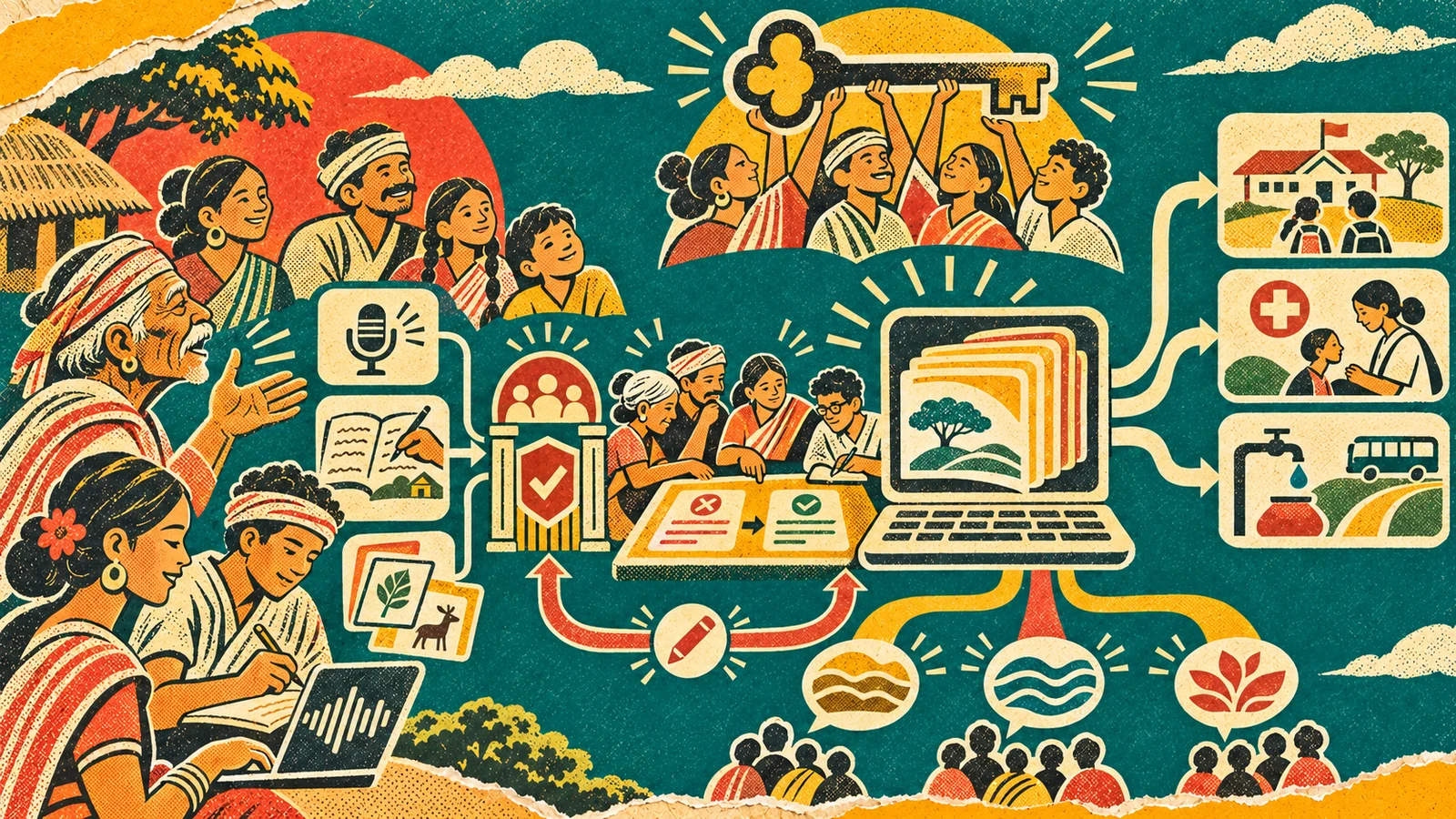
THE SIGNAL IN ONE SENTENCE
A language archive can preserve a voice. It can also freeze the wrong version of it forever. India's Ministry of Tribal Affairs published a new Adi Vaani backgrounder on November 15. The platform translates text in nine tribal languages and also offers speech tools, optical character recognition, video subtitling, dictionaries and more than 300 language primers. The bigger change is the direction of travel. The ministry's Working Group on Tribal Languages is considering Adi Vaani as a National Tribal Language Repository. That would make the platform more than an app. It could become common infrastructure for corpora, primers, dictionaries, oral traditions, community stories and educational material across a country with extraordinary linguistic variety. That is a worthy project. It is also where the governance gets serious. The plain signal is this. If a community contributes the voice, it needs the edit key. That key should not be a ceremonial promise that community members were consulted sometime before launch. It should be a durable set of rights: the right to see what was collected, know how it is used, correct the language, challenge a model output, limit sensitive material, receive local benefit and ask for an item to be amended or removed. The ministry says Adi Vaani was built with tribal communities and that native speakers contribute words, sentences and recordings through State Tribal Research Institutes and AdiKosh. Language experts review material before it trains models. The November backgrounder reports approximately 13.9 lakh text sentences across ten languages and around 300 hours of speech data. That is not just a pile of training material. Every sentence has a speaker, place, variety, purpose and history. A clean national repository begins with that context. For every contribution, record the community name, language name, local variety, script, speaker role, place, collection date, collecting institution, reviewer and intended use. Record whether the item is ordinary conversation, school material, a public-service phrase, a story, a song, ecological knowledge or culturally restricted material. Do not force every language into one tidy national label. Some languages cross state borders. Some names are used differently by government, researchers and speakers. A table that assigns one state and one script can be useful for administration while still failing to represent living usage. Let communities describe themselves. Preserve alternate names. Record where a variety is spoken and where it is not. Support more than one script where speakers use more than one. Keep the difference between a language, a variety, a project corpus and a government category visible. Then make consent specific. A person who records a sentence for a dictionary has not automatically agreed to have the voice used in every future speech model. A community that shares a folktale for a school archive has not necessarily approved commercial generation, biometric analysis or reuse outside its cultural context. The repository needs a use card for every collection. The card should say what can be translated, published, downloaded, used for research, used to train models or reused commercially. It should say whether the audio can be heard publicly, whether only a transcript may be shared and whether the item has a review or expiry date. Consent is not a single checkbox stapled to a microphone. It is a continuing agreement between people, institutions and uses that can change. The Working Group's October 15 meeting reached an important principle. The ministry said language resources developed with communities should continue to be owned by those communities. Good. Now ownership needs verbs. Who can approve a new use? Who represents a community when views differ? Who receives a request from a teacher, researcher or company? Who can correct a disputed spelling? Who can restrict a sacred story? Who can remove a recording after a contributor changes their mind? Who receives revenue or training when a dataset supports a paid service? If those actions are not defined, ownership becomes a plaque on a server rack. Build local review councils for each language or language cluster. Include fluent speakers, elders where appropriate, teachers, youth, community linguists and people who use the language in everyday services. Avoid treating one official, researcher or institution as the permanent voice of everyone. Give the council a real dashboard. It should show new contributions, pending reviews, disputed items, proposed uses, model errors, access requests and correction status. It should support public notes for ordinary material and restricted review for sensitive material. Every decision should have a date, reason and accountable person. This is especially important because translation quality is not one number. Adi Vaani works across text, speech, images and video. Each path can fail differently. A model may translate a school sentence well and miss a health instruction. Speech recognition may work for a quiet adult speaker and stumble with an elder, a child, background noise or a different regional variety. Optical character recognition may read one script and mangle another. A fluent output can still carry the wrong social register or cultural meaning. Publish a per-language evidence card. Show the material used for testing, the communities and varieties represented, the task, the error measure, the date, the model version and who reviewed the result. Separate text translation, speech recognition, speech synthesis, optical character recognition and subtitling. Include a small set of high-consequence tests for health, school and public-service language. Do not average nine languages into one cheerful percentage. An average can hide the exact community receiving the weakest service. The card should also show what is missing. If a variety has little speech data, say so. If children and elders were not included in testing, say so. If the system has not been tested in clinics or classrooms, say so. An honest gap is more useful than a smooth demo. The ministry's own numbers offer a small lesson in why provenance matters. The October 15 working-group release reported more than 48,000 Android downloads and about 6,500 monthly users. The November 15 backgrounder, describing the platform as of October 15, reported more than 35,000 Android downloads and the same monthly-user figure. Those counts may use different snapshots or methods. The releases do not explain the difference. That does not sink the project. It does mean public metrics need a date, definition and source. A repository that wants communities to trust its records should model that discipline in its own reporting. Use unique definitions for app installs, active devices, monthly users, translation requests, reviewed contributions and school deployments. Publish corrections when a figure changes. Keep old reports accessible. The same rule belongs inside the corpus. Every item needs provenance. Every transformation needs a link to the item before it. A recorded sentence may become a transcript, normalized spelling, translation, speech segment, model-training example and public dictionary entry. Preserve that chain. When a local reviewer changes a translation, keep the earlier version, the correction, the reason and the model versions affected. Do not silently overwrite the record and leave old model outputs circulating. Corrections need a clock. Let a user flag an error directly from the app. Route the report to a local language reviewer. Show that it was received. Set a response target based on consequence. A spelling error in a primer matters. A wrong sickle-cell instruction matters more quickly. When the correction is approved, update the public resource, add it to the next model evaluation and tell affected institutions. If the error appeared in a school pack or health campaign, record where that material went. This is not glamorous machine learning. It is the part that makes language technology useful after the launch photograph. Education is one promising path. The platform gives access to primers, dictionaries and other learning material. The National Education Society for Tribal Students has noted possible use across more than 525 Eklavya Model Residential Schools serving over 1.7 lakh students. Possible is doing work there. Before broad classroom use, run local pilots with teachers, students and parents. Test whether the language variety matches the students. Check whether scripts and examples are familiar. Give teachers a way to adapt material rather than accept a national template. Measure comprehension and participation, not only how many schools opened the app. Healthcare communication is another promising path and an even less forgiving one. The backgrounder points to translated awareness material on sickle cell disease. A health message should be reviewed by fluent speakers and medical professionals together. Test it with the people expected to use it. Preserve the original and translation. Make uncertainty visible. Keep a human route for questions. Never treat automated translation as consent for care, a diagnosis or an emergency interpretation service unless it has been separately evaluated for that exact use. Public services need similar boundaries. A translation tool can help people discover schemes, read notices and prepare questions. A person should still be able to reach an accountable official. If a translation affects eligibility, deadlines, benefits or legal rights, the service needs a correction and appeal route that does not depend on the same model that made the mistake. The repository can also create practical local work. The Working Group discussed district-level community resource groups with trained tribal youth as researchers. That is one of the strongest ideas in the plan. Pay people to record, transcribe, review, teach, evaluate and maintain their languages. Publish the roles, rates, training and decision authority. Do not call unpaid extraction participation. Let local teams own tools and skills that remain useful beyond one data-collection campaign. Provide recording kits, secure storage, documentation training, corpus tools and model-evaluation access. Support community archives that can federate with the national gateway instead of requiring every item to live in one central store. A federated design can keep control closer to the source. The national layer can publish common metadata, discovery and approved educational resources. A community archive can keep sensitive audio, manage permissions and decide what moves outward. Researchers and developers can request access under declared terms. The national gateway can record the request, decision, use and result. Security belongs in the design too. Voice recordings can reveal identity, place, age, health, relationships and cultural knowledge. Limit collection to what the use requires. Separate public and restricted material. Encrypt transfers and storage. Use role-based access. Log downloads and model-training exports. Set retention periods. Test restoration and deletion. Do not publish a voice dataset merely because the words in it seem harmless. Some knowledge should remain local. Some should be accessible only to a community. Some may be shared for education but not model training. Some contributors may want text preserved while audio is restricted. The repository needs all of those states. It also needs a public governance register. List the participating languages and institutions, community review bodies, data categories, permitted uses, model versions, evaluation cards, unresolved disputes, correction times, access requests, funded local roles and benefits returned to communities. Publish meeting dates and decisions for the national working group. Do not publish private contributor details or restricted cultural material. Transparency is not the same as exposure. The best success measures are local. Can a child find a school resource in the variety used at home? Can an elder correct a transcript without navigating an English-only portal? Can a health worker see that a translation was reviewed? Can a speaker learn where a recording went? Can a community pause a use it never approved? Are local reviewers paid and trained? Does a corrected item stop reappearing in the next model? Those questions tell us more than download totals. Adi Vaani has the bones of a useful public project: public institutions, research partners, language resources, community contributions and a plan to bring scattered work together. The national repository idea raises the stakes because a common platform can become the reference that schools, agencies, researchers and companies trust. Trust should not flow only toward the platform. Authority should flow back to the communities whose languages make it possible. Give every contribution a source. Give every use a purpose. Give every model a per-language evidence card. Give every correction a clock. And give every community the edit key.
01
WHAT ACTUALLY CHANGED
India published a new Adi Vaani backgrounder on November 15, 2026.
Adi Vaani supports text translation in nine tribal languages and works with 13 languages at different stages of corpus development.
The platform also provides speech translation, optical character recognition, video subtitling, dictionaries and access to more than 300 primers.
State Tribal Research Institutes have contributed approximately 13.9 lakh text sentences across ten languages and around 300 hours of speech data.
Native speakers contribute words, sentences and recordings through Tribal Research Institutes and AdiKosh, with language-team review before model use.
The first meeting of the Working Group on Tribal Languages discussed positioning Adi Vaani as a National Tribal Language Repository.
Proposals include a national language baseline, community digital archives, multilingual educational material and district-level resource groups with trained tribal youth.
The proposed roadmap includes a two-year action plan with quarterly reviews.
The ministry says language resources developed with communities should remain owned by those communities.
An upgraded Adi Vaani platform, iOS app and five additional languages were introduced at the August 24 National Conclave in Mysuru.
02
WHY THIS MATTERS
A national repository could become the reference used by schools, public agencies, researchers and technology developers.
Language data carries identity, place, cultural knowledge and speaker context that a generic dataset label can erase.
Community ownership is meaningful only when communities can approve uses, correct records, restrict sensitive material and request removal.
A single quality score can conceal weak performance for the language or variety with the least data.
Speech, text, image and video features fail differently and need separate per-language evaluation.
Health, education and benefit information can create real harm when a fluent translation is wrong.
Federated community archives can preserve national discovery while keeping sensitive control closer to the source.
Paid local documentation and review roles can leave durable skills instead of treating participation as free data collection.
Conflicting public download figures show why every metric needs a date, definition and source.
A visible correction and appeal process can make the repository improve after deployment rather than fossilize its first mistakes.
03
WHERE IT COULD HELP
- Attach community, language variety, script, place, contributor role, collection date and reviewer to every item.
- Create a use card that separates publication, research, model training, commercial reuse and public audio access.
- Support alternate language names, regional varieties and multiple scripts without collapsing them into one label.
- Form local review councils with speakers, elders where appropriate, teachers, youth and community linguists.
- Give review councils dashboards for contributions, disputes, proposed uses, model errors and corrections.
- Publish separate evidence cards for translation, speech recognition, speech synthesis, optical character recognition and subtitling.
- Report test coverage and errors by language, variety, speaker group, setting and model version.
- Add in-app error reporting with faster review targets for health and rights-related content.
- Preserve the chain from recording through transcript, normalization, translation, training example and public resource.
- Pilot school material with local teachers, students and parents before broad deployment.
- Require joint language and medical review for health translations and keep a human help route.
- Keep public-service appeals independent from the model that produced a disputed translation.
- Pay and train district-level community researchers, transcribers, reviewers and evaluators.
- Use federated archives so communities can keep sensitive material local while sharing approved metadata and resources.
- Encrypt voice data, limit access, log exports, set retention periods and verify deletion.
- Publish governance decisions, evaluation cards, correction times, access requests and benefits returned without exposing private contributors.
KEEP A HAND ON THE WHEEL
The Ministry of Tribal Affairs' November 15 backgrounder describes Adi Vaani's current functions, language coverage, reported corpus contributions, primers, dictionaries and possible uses in education, health communication, public services and cultural preservation. The October 15 Working Group release describes the proposal to position Adi Vaani as a National Tribal Language Repository. It records proposals for a national baseline, community digital archives, district-level resource groups, multilingual education and a two-year action plan. It also states that language resources developed with communities should continue to be owned by those communities. The August 24 National Conclave release confirms the upgraded platform, iOS app, five added languages and the Ministry's agreement with the Central Institute of Indian Languages on documentation and corpus development. The ministry reports approximately 13.9 lakh text sentences and around 300 hours of speech data from State Tribal Research Institutes. These are government-published figures. The October 15 release reports more than 48,000 Android downloads. The November 15 backgrounder reports more than 35,000 Android downloads while describing the platform as of October 15. The releases do not explain the difference, so this article does not use downloads as a success measure. The primary sources do not publish independent per-language accuracy, dialect coverage, consent terms, licensing, privacy controls, community governance rules, deletion procedures or measured outcomes in schools, healthcare or public services. The use cards, community review councils, per-language evidence cards, correction clocks, federated archive design, paid local roles and public governance register in this article are Plain Signal analysis. Latest backgrounder date: November 15, 2026. Working Group date: October 15, 2026. Upgraded platform launch date: August 24, 2026. Verified November 15, 2026.
04
TERMS WORTH KEEPING
OPEN GLOSSARY CARD
Provenance
The documented origin and history of material, including who created, edited, translated, funded or transmitted it.
OPEN GLOSSARY CARD
Provenance
A traceable record of where an object or dataset came from, who held or changed it and how it reached its current form.
OPEN GLOSSARY CARD
Data governance
The rules, roles and records that determine how data is collected, accessed, used, shared, retained and deleted.
SOURCES AND VERIFICATION STATUS
This article was written from the materials below. Product claims and dates were checked against those sources on November 15, 2026.
THE PUBLICATION ENGINE
WANT A SIGNAL OF YOUR OWN?
We build source-grounded publications, private briefings, and editorial systems for organizations with something useful to say.
WORK WITH US