THE SIGNAL IN ONE SENTENCE
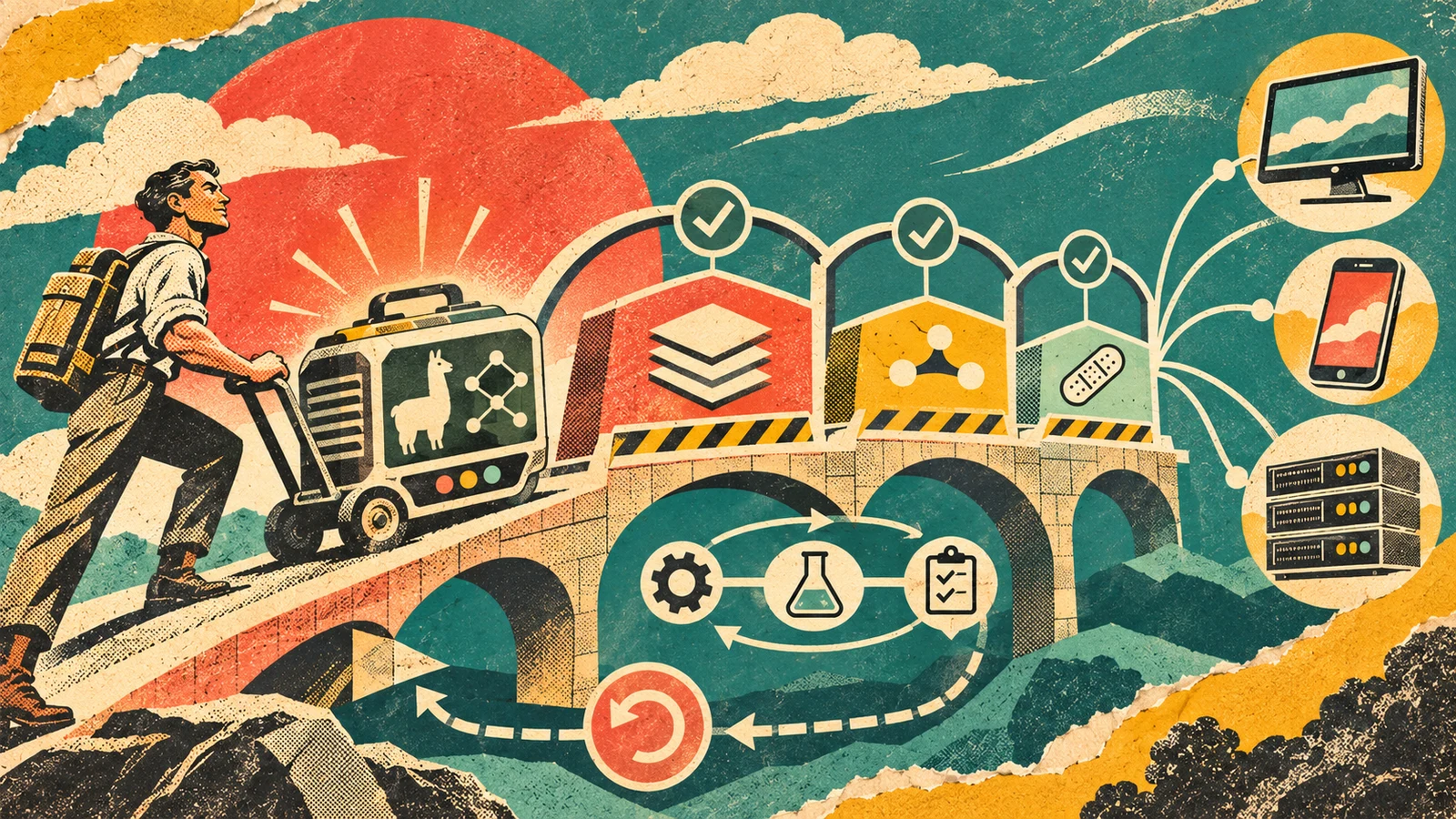
A version number finally has a job. The ggml-org team released llama.cpp 1.0.0 and ggml 1.0.0 on November 13. From here, the projects say a breaking change to the public C API will require a major version bump. Backward-compatible features, backend changes, model support and API additions belong in a minor release. Bug fixes without public API changes belong in a patch. That sounds like plumbing because it is plumbing. It is also a meaningful promise for the growing pile of desktop apps, mobile apps, servers, language bindings and private AI systems built on these libraries. A downstream team can now look at the version and make a better first guess about the migration risk. The useful phrase is first guess. The 1.0 contract covers the declared public C headers. It does not guarantee that every command-line flag, server route, model conversion, hardware backend, build option, performance characteristic or numerical output will remain unchanged inside a major version. So the plain signal is not that local AI infrastructure has become boring. The signal is that breakage has a clearer address. Treat that address as the beginning of an upgrade process, not permission to auto-merge every green dependency bot. llama.cpp is a portable C and C++ inference project that runs multimodal models across consumer computers, phones and enterprise servers. It uses quantization and specialized hardware backends to fit models onto a broad collection of machines. The team says the project currently supports more than 150 architecture variants and mainstream speculative decoding methods. Underneath it sits ggml, the tensor library that handles the low-level work across those backends. The 1.0 releases formalize versioning for libllama and libggml, with public headers in each project's include directory. The timing matters because llama.cpp is no longer a clever little weekend utility hiding in a terminal window. It has become infrastructure. Infrastructure gains users in layers. A person may install a desktop application that bundles llama.cpp without knowing the name. A developer may call a Python or JavaScript binding that wraps the C interface. A company may expose llama-server behind an internal product. A hardware vendor may maintain a backend. A mobile app may ship a specific binary and model together. Every layer inherits change from the one beneath it. Before 1.0, downstream developers could pin a commit or build number, but the version label offered a weaker contract about compatibility. Now maintainers are saying that API and ABI incompatibilities will be reflected in major-version changes. That is useful because a package manager can hold a major line. A library wrapper can declare the range it supports. A release gate can treat a patch, minor and major update differently. An operator can ask why a breaking change arrived without the required number moving. The contract also creates a responsibility for consumers. If the project has started labeling the size of the door, downstream teams should stop driving every upgrade through it with their eyes closed. Start with an inventory. List every product that embeds libllama or libggml directly. Then list the indirect consumers: language bindings, plugins, packaged desktop applications, containers, model servers, mobile frameworks, hardware-specific builds and tools that parse command output or assume a server route. A clean C API build does not prove that the whole product works. The application may depend on a removed command option. A wrapper may still call a deprecated function. A plugin may expect the previous ABI. A monitoring script may parse text that was never promised as an interface. A container may combine a new library with an old server binary. A remote worker may speak an incompatible RPC protocol. The 1.0 release itself is a good demonstration. llama.cpp 1.0.0 removes the deprecated public API, including llama_set_warmup and 35 other deprecated functions. It promotes the NextN speculative interface into llama.h, adds new context parameters and expands speech, model and server features. ggml 1.0.0 also prunes deprecated public interfaces and legacy operations. Its release bumps the RPC protocol to version 9 so incompatible peers are rejected instead of quietly pretending to understand each other. In other words, 1.0 is a stability promise delivered through a breaking cleanup. That is not hypocrisy. It is what a major release is for. It does mean a team should test the move to 1.0 as a migration, even if future 1.x updates can usually travel through a narrower lane. Pin the complete input set. Record the llama.cpp and ggml versions, source commit, build flags, compiler, target architecture, hardware backend, driver, operating system, container base, language binding and server configuration. Pair that with the exact model artifact, tokenizer, quantization, chat template, context settings and sampling configuration. The model file and runtime are a working pair. Upgrade one without naming the other and a failed result becomes a detective story with half the pages missing. Build every supported target. The official announcement lists distribution across Linux, macOS, Windows, Android and iOS through several channels. The project also supports dedicated backends that can be built as dynamic libraries and loaded at runtime. That breadth is a feature, but it makes the phrase works on my machine almost aggressively unhelpful. Compile the application on the actual operating systems and processor families it serves. Exercise CPU-only operation and every accelerated path the product claims to support. Verify dynamic backend discovery. Test the install and update path from the same package channel users receive, not only a source build on the maintainer's workstation. Then run a workload pack. Use small, medium and large models that represent the product. Include each supported quantization family. Test short prompts, long prompts, structured output, tool-call formatting, multimodal input, embeddings and speech only where the application exposes them. Do not require byte-for-byte identical generated prose across every backend unless the product has established that exact contract. Numerical kernels, scheduling and hardware can produce small differences that move sampling. Test the thing the user needs instead. Does the model load? Does the prompt fit? Does the server return the declared schema? Does the tool call parse? Does the image path work? Does a safety filter still receive the right content? Does the application preserve stop conditions, special tokens and chat roles? Does the answer remain inside an accepted quality range on a fixed evaluation set? Keep deterministic fixtures where the interface permits them. Keep outcome-based checks where generation is inherently variable. Record the seed, parameters and backend so a surprising change can be reproduced instead of discussed as a vibe. Performance belongs in the contract even when semantic versioning does not promise it. Measure model-load time, prompt processing, generation rate, time to first token, peak memory, disk use and failure rate. On laptops and phones, include power draw, temperature and throttling during a realistic session. On servers, include concurrency, queue time and the point where memory pressure changes behavior. A release can preserve the public C API and still make one product slower on one accelerator. That may be a perfectly reasonable trade for correctness or broader support. The operator still needs to see it before users do. Use a comparison report with the old and new stacks side by side. Name every regression, explain whether it is accepted and assign an owner when it is not. A single average can hide a backend that fell off a cliff while the faster machines pulled the chart upward. Canary the upgrade. Move a small, observable group of devices or requests onto the new stack. Keep the previous build available. Compare load failures, crashes, timeouts, output validation, latency, memory and user-visible completion. Separate the new library from a new model when possible so the cause of a change is not bundled with its alibi. Rollback must restore a compatible set. Keeping only the old shared library is not enough if the migration changed the server, binding, model conversion or configuration. Preserve a rollback bundle with the runtime, dependencies, build metadata, model manifest, templates and settings that were validated together. Test the rollback before promotion. A backup that has never been restored is merely an optimistic file. The new version rules can make routine updates less theatrical. A patch release can still run the automated compatibility pack and a small canary. A minor release should add checks for new models, backends or API surface and review whether the product actually enables them. A future major release should open a named migration project with an owner, impact map, compatibility window and retirement date for the old line. Do not turn that into superstition. A major number means a breaking public C API change may exist. It does not mean every application breaks. A patch number means the public API is unchanged. It does not mean the implementation cannot affect performance or behavior. The test plan should follow the product's exposure, not the drama of the digit. The maintainers are also investing in continuous integration across major hardware platforms. That improves the upstream safety net. It cannot reproduce every downstream wrapper, model, build option, device limit and product workflow. Upstream tests answer whether the project meets its own contract. Downstream tests answer whether your product still meets yours. That distinction is the whole migration plan. llama.cpp and ggml reaching 1.0 is a healthy sign for local AI. The projects are acknowledging that their interfaces now support a large ecosystem and that breaking changes need visible boundaries. The release also brings meaningful model, server, cache, security and backend work. The grown-up response is not to throw confetti at the number or fear it. Write the compatibility matrix. Pin the working stack. Test every backend that matters. Move a small group first. Keep rollback real. Version 1.0 is not the finish line. It is a better road sign.
01
WHAT ACTUALLY CHANGED
ggml-org released llama.cpp v1.0.0 and ggml v1.0.0 on November 13, 2026.
The projects now use semantic versioning for their declared public C interfaces.
A breaking change to the public C API requires a major bump, a backward-compatible feature or API addition requires a minor bump and a bug fix without an API change requires a patch bump.
The version contract applies to libllama headers in llama.cpp/include and libggml headers in ggml/include.
llama.cpp 1.0.0 removes llama_set_warmup and 35 other deprecated public functions.
The release promotes the NextN speculative API into llama.h and adds new model, speech, cache, server and web-interface capabilities.
ggml 1.0.0 removes deprecated public interfaces and legacy DIAG_MASK operations.
ggml 1.0.0 bumps its RPC protocol to version 9 and rejects incompatible peers.
The team reports support for more than 150 model architecture variants and a wide hardware-backend matrix.
The official distribution list spans Linux, macOS, Windows, Android and iOS through source, package, container and framework channels.
02
WHY THIS MATTERS
A visible major-version boundary gives downstream applications a clearer warning when the public C interface can break.
Language bindings, plugins, servers and packaged applications can declare supported major lines instead of relying only on moving build numbers.
Semantic versioning covers a defined interface and does not promise stable command-line behavior, server routes, model conversion, performance or numerical output.
The 1.0 release is itself a breaking migration because deprecated interfaces were removed.
A portable runtime can behave differently across processors, accelerators, drivers, operating systems and build flags even when the public API remains compatible.
Local AI products depend on a matched set of runtime, model, tokenizer, template and configuration, so rollback must restore the set rather than one file.
Upstream continuous integration cannot reproduce every downstream wrapper, device constraint, model and product workflow.
A clear version contract is most valuable when operators convert it into different test and approval lanes for patch, minor and major updates.
03
WHERE IT COULD HELP
- Inventory every direct and indirect consumer of libllama and libggml before upgrading.
- Pin the source commit, release tag, compiler, build flags, backend, driver, operating system and package channel.
- Pair the runtime record with the exact model artifact, tokenizer, quantization, chat template and sampling configuration.
- Compile and install the release on every processor family and operating system the product officially supports.
- Exercise CPU operation and each accelerated backend through the same packaging path users receive.
- Maintain representative tests for model loading, long context, structured output, tool calls, multimodal input, embeddings and speech where applicable.
- Use deterministic fixtures for interface behavior and outcome-based evaluations for variable generation.
- Measure load time, time to first token, prompt processing, generation rate, peak memory and failure rate.
- Include energy use, heat and throttling for mobile and laptop products.
- Compare regressions by backend and device instead of hiding them inside one fleet average.
- Canary the new stack on a small observable group before broad promotion.
- Keep model and runtime changes separate where possible so failures have a smaller search space.
- Preserve a rollback bundle containing the validated runtime, dependencies, model manifest, templates and settings.
- Test rollback before promotion and verify that incompatible RPC peers fail clearly.
- Require a named migration plan, compatibility window and old-line retirement date for future major upgrades.
KEEP A HAND ON THE WHEEL
The November 13 ggml-org announcement establishes semantic versioning for the public C headers of libllama and libggml. It says major versions signal breaking public C API changes, minor versions cover backward-compatible features, backend updates, model support or API additions, and patch versions cover bug fixes without public API changes. That promise does not cover every command-line option, server route, build flag, backend implementation, model conversion, performance characteristic or numerical result. The llama.cpp 1.0.0 release removes deprecated public functions and introduces model, cache, speech, server-security and interface changes. The ggml 1.0.0 release removes deprecated interfaces, changes legacy operations, adds backend work and moves its RPC protocol to version 9. The project reports more than 150 supported architecture variants and distribution across Linux, macOS, Windows, Android and iOS. Actual compatibility and performance depend on model, quantization, backend, compiler, driver, device and configuration. Inventory, workload packs, performance gates, canary rollout, version policy and rollback bundles in this article are Plain Signal analysis. Original release date: November 13, 2026. Announcement, release artifacts and release process verified November 15, 2026.
04
TERMS WORTH KEEPING
OPEN GLOSSARY CARD
Semantic versioning
A three-part versioning convention that signals breaking changes, compatible features and compatible fixes through major, minor and patch numbers.
OPEN GLOSSARY CARD
Regression test
A repeatable check that reveals whether a change broke behavior that previously worked.
SOURCES AND VERIFICATION STATUS
This article was written from the materials below. Product claims and dates were checked against those sources on November 15, 2026.
THE PUBLICATION ENGINE
WANT A SIGNAL OF YOUR OWN?
We build source-grounded publications, private briefings, and editorial systems for organizations with something useful to say.
WORK WITH US