THE SIGNAL IN ONE SENTENCE
A shared agricultural model can travel. The field cannot. That is the useful tension inside a new food-security project launched in Rome on November 3. The AI Hub for Sustainable Development and DeepLeaf, a Moroccan agritech company, say they have launched an AI foundation model that local agritech startups will use to build their own tools in seven countries: Morocco, Tunisia, Kenya, Ghana, Tanzania, Rwanda and Italy. UNDP says the shared model builds on DeepLeaf technology already validated in Kenya, Morocco and Italy. It also makes three important promises. Data will be shared with consent. Local teams will own the solutions they build. Open components will return to the wider ecosystem as digital public goods. Those are good promises. They are also the beginning of the work, not the harvest photo. The public announcement does not identify the exact model artifact, publish a model card for this shared system, list the country-level datasets, describe the consent process, provide benchmark protocols or report error rates. It gives no rollout calendar for each country and no evidence yet that the project changes yields, income, crop loss or food security. That is not a scandal. It is what a launch looks like before the field notes arrive. The danger is letting the launch language harden into evidence before anybody records the rain, the crop, the camera, the dialect, the diagnosis and the farmer who decided what to do next. Agricultural AI is unusually sensitive to local conditions because the label is only the first layer. A picture of a leaf may show a lesion. The useful answer depends on the crop variety, growth stage, recent weather, soil, irrigation, local pest pressure and what products are legally registered. A recommendation that makes sense for a tomato field in Morocco can be useless for a maize plot in Ghana. A model that understands standard French may stumble over Moroccan Darija. A confident diagnosis can be wrong because the camera compressed the image, the farmer photographed the wrong side of the leaf or two problems arrived together. Then there is the human question. Advice does not land in an empty field. It lands in a household with a budget, a water supply, a market date, a phone connection, a trusted extension officer and a tolerance for risk. The model can create evidence. It should not quietly inherit authority. The project gets one structural choice right on paper. Local agritech startups are meant to build their own solutions on the shared base rather than merely resell one distant app. That creates room for a team in Tunisia to adapt for its crops and languages, while a team in Rwanda builds around a different extension network and connectivity pattern. Local ownership can mean more relevant interfaces, faster correction and a better chance that skills, customer relationships and revenue stay in the country. It can also become a decorative phrase if the shared model, data pipeline, hosting account, update schedule and licensing decisions remain controlled elsewhere. Ownership needs a receipt. For every local adaptation, start with the field. Record the country, region, crop, variety, growth stage, season, farming system and intended user. A national average will not explain why a recommendation failed in one valley after an unusual week of heat. Then record the input. Was it one phone photo, a video, a voice note, satellite imagery, a weather feed, a soil sensor or an agronomist's observation? Store the device and capture conditions. A model should not receive credit for evidence it never saw. Attach the data permission. Name who contributed the record, what they agreed to, which use was approved, who can access it, how long it is retained and how consent can be withdrawn. If the image trains a shared model or becomes part of a public dataset, say that plainly before upload. Consent is not a checkbox that follows data forever. A farmer may agree to receive advice without agreeing to commercial training, cross-border sharing or an open release. A cooperative may have authority over its operational records but not over every member's photographs and voice notes. Next, freeze the model version. Name the base artifact, local adapter, retrieval library, language pack, agronomy tools and safety rules used for the recommendation. A shared foundation can produce very different behavior once a local team changes its crop library or connects it to a pesticide registry. Record the answer as evidence, not authority. Keep the predicted condition, confidence, alternatives considered, missing information and the source material used. If the model refuses because the photograph is poor or the crop is outside its tested range, count that as useful behavior rather than an embarrassing blank cell. Then write down the human review. Who checked the answer? A farmer, extension worker, plant pathologist, agronomist or nobody? What did that person change? Did they reject the diagnosis, request another image, choose a different action or decide to wait? The correction should flow back to the local team without automatically becoming training data for everyone. Finally, follow the result. Did the crop improve? Did the treatment waste money? Was the recommended product legal, available and affordable? Did an untreated control show that the original diagnosis was probably wrong? Did the farmer come back because the advice was useful, or disappear because the app burned trust? This is the field receipt. It turns a sweeping food-security claim into inspectable local evidence. It also helps teams compare what should be shared across borders and what should remain local. Some components deserve to travel. A capture-quality test can help every country reject blurry images. A method for logging uncertainty can be reused. A bug fix for a translation interface can return to the common stack. A schema for recording crop stage may become a digital public good. Other material needs stronger boundaries. Raw farm coordinates can reveal land use and household patterns. Voice recordings can identify a farmer. A crop-loss history can affect insurance or credit. A community's local knowledge may be valuable precisely because it has not been scraped into a global dataset. Open is not one switch. Model weights, code, training data, evaluation data, crop references, language resources and field records can each have different licenses and rights. A project that promises open components should publish an inventory showing exactly what returned to the commons, under which license, after whose review. DeepLeaf's related public materials illustrate why the distinction matters. The company describes an Agronomist model family that combines images with field, weather, soil and satellite information and can call specialist tools. Its public repository for an open four-billion-parameter model currently describes a specification, evaluation protocol, licenses and responsible-use documents, while stating that the model, dataset and training code are still being prepared for release later in November. The reviewed announcement does not establish that this exact repository is the shared seven-country foundation model. It does show why a project-specific artifact list matters. A company can have a hosted product, an announced open model and a new partnership model at the same time. Readers should not have to guess which one entered the field. The AI Hub is co-led by Italy's Ministry of Enterprises and Made in Italy and UNDP. It says its broader work spans data, computing access, talent, trust, safety and financing across African partner countries. Earlier this year, DeepLeaf also signed a research and validation partnership with Italy's Fondazione Edmund Mach. Those connections can provide useful infrastructure and agronomic review. They can also create a familiar development-project problem: everybody owns a piece of the partnership, while nobody owns the boring job of recording failures after the launch event. Give that job to named local operators. Each country should publish who maintains its adaptation, which crops and languages are in scope, where farmers report harm, how corrections are shipped and who can pause deployment. Local ownership should include the power to say no to a model update, remove a dataset and keep operating if a foreign partner leaves. Measure value locally too. Count advice that reached farmers with weak connectivity. Count cases where the model asked for more evidence. Count false diagnoses, unsafe recommendations and successful overrides. Measure time saved for extension workers without pretending that speed is the same as better farming. Track whether local startups hire agronomists and language specialists, not only engineers. Show which open components other teams actually reused. The seven countries should not be forced into one leaderboard. Their crops, seasons, languages, institutions and reporting capacity are different. The shared model is valuable if it lets each local team start farther ahead while keeping the right to adapt, inspect and refuse. That is a more interesting definition of scale. Not one answer copied into seven markets. One shared base, seven local owners and enough field notes to prove where it helped, where it failed and who still held the decision.
01
WHAT ACTUALLY CHANGED
The AI Hub for Sustainable Development and Moroccan agritech company DeepLeaf announced a shared AI foundation model for food security on November 3.
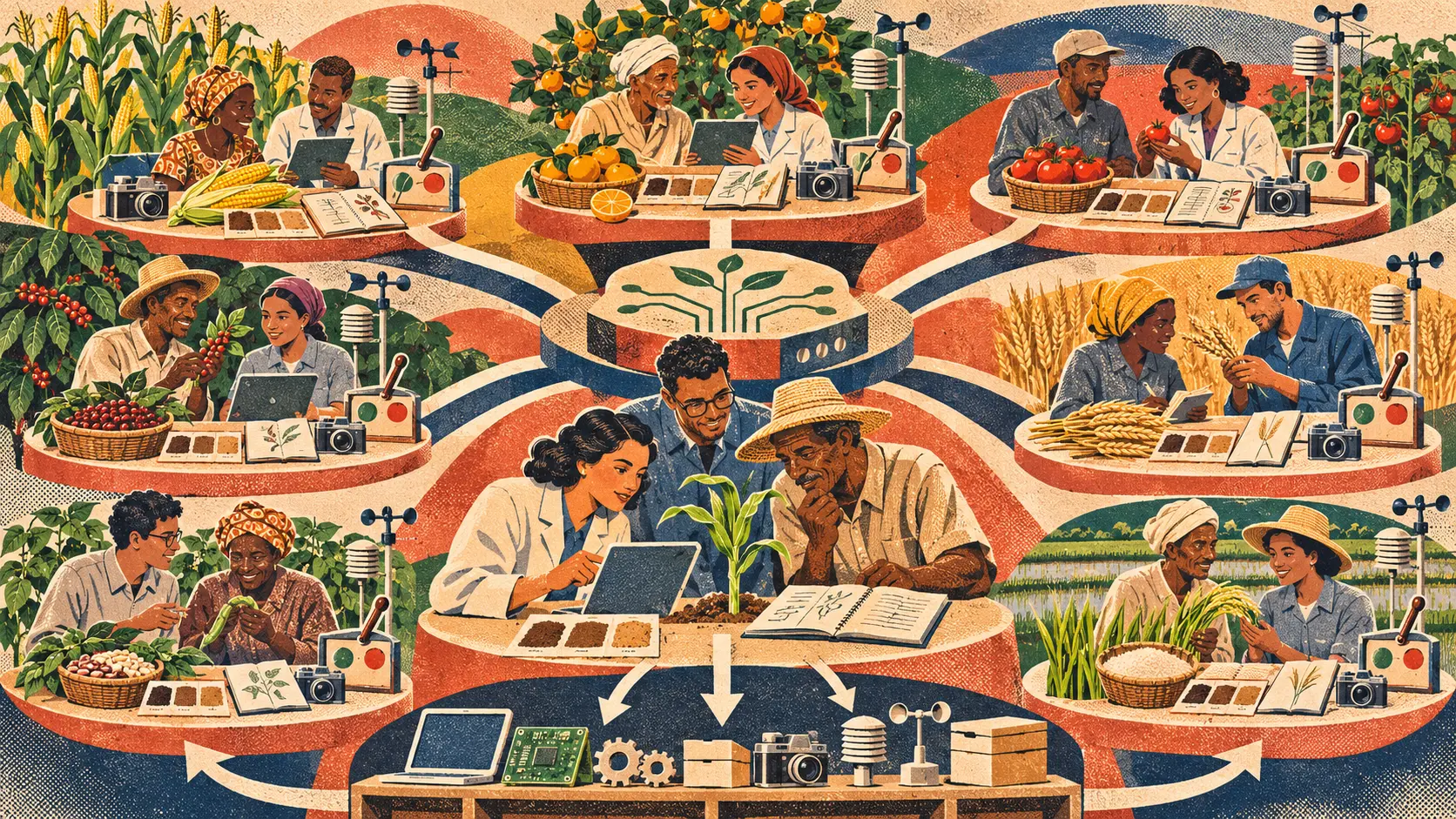
Local agritech startups in Morocco, Tunisia, Kenya, Ghana, Tanzania, Rwanda and Italy are expected to build their own solutions on the shared model.
UNDP says the foundation builds on a DeepLeaf model already validated in Kenya, Morocco and Italy. This is a partner claim, not independent outcome evidence.
The partners say data will be shared with consent, resulting solutions will remain locally owned and open components will return as digital public goods.
The launch was announced at an AI Hub event at Luiss Guido Carli University in Rome.
The reviewed announcement does not identify the exact model artifact or publish the project-specific model card, datasets, benchmarks, rollout schedule or results.
02
WHY THIS MATTERS
A shared foundation model could let local teams spend less time rebuilding common infrastructure and more time adapting for local crops, languages and services.
Agricultural recommendations depend on weather, soil, crop stage, law, input availability and farmer context, so country-level adaptation is operationally necessary.
Local ownership can keep skills, customer relationships, correction loops and economic value near the people providing field data and agronomic knowledge.
Consent must distinguish advice, model training, cross-border sharing and open publication rather than treating one upload as permission for every use.
Open components can become useful public infrastructure only when the project identifies the exact artifact, license, steward and contribution history.
A field receipt makes failures, human overrides and real outcomes visible before a launch claim is mistaken for food-security impact.
03
WHERE IT COULD HELP
- Create one field receipt for every recommendation, local adaptation and evaluation case.
- Record country, region, crop, variety, growth stage, season, farming system and intended user.
- List every input, including photos, device conditions, voice, weather, soil, satellite data, sensors and agronomist observations.
- Attach purpose-specific consent, retention, access, withdrawal and cross-border sharing terms to each contributed record.
- Freeze the model, adapter, language pack, crop library, retrieval sources, tools and safety rules used for each answer.
- Store confidence, alternative diagnoses, missing evidence, refusal behavior and the sources supporting the recommendation.
- Record the reviewing farmer, extension worker or agronomist, along with every correction, rejection and final decision.
- Follow the outcome through crop response, cost, legal compliance, availability, farmer trust and any reported harm.
- Publish separate licenses and stewardship records for weights, code, datasets, evaluation cases, crop references and language resources.
- Give each local operator the power to pause an update, remove governed data, report incidents and keep serving users if a partner exits.
KEEP A HAND ON THE WHEEL
This is a UNDP and partner announcement, not an independent agronomic evaluation. The public release does not provide the project-specific model card, exact model identifier, training-data inventory, benchmark protocol, country rollout dates, consent forms, farmer compensation terms, error rates, crop coverage or evidence that the shared system improves yields, income or food security. DeepLeaf's public materials describe several model and platform components, and the reviewed sources do not establish which exact artifact underpins the seven-country project. Company capability, coverage and validation claims remain vendor-reported. Watch for country-level operators, field protocols, language and crop evaluations, incident reporting, agronomist review, artifact licenses, withdrawal tests and measured outcomes after deployment.
04
TERMS WORTH KEEPING
SOURCES AND VERIFICATION STATUS
This article was written from the materials below. Product claims and dates were checked against those sources on November 4, 2026.
THE PUBLICATION ENGINE
WANT A SIGNAL OF YOUR OWN?
We build source-grounded publications, private briefings, and editorial systems for organizations with something useful to say.
WORK WITH US