THE SIGNAL IN ONE SENTENCE
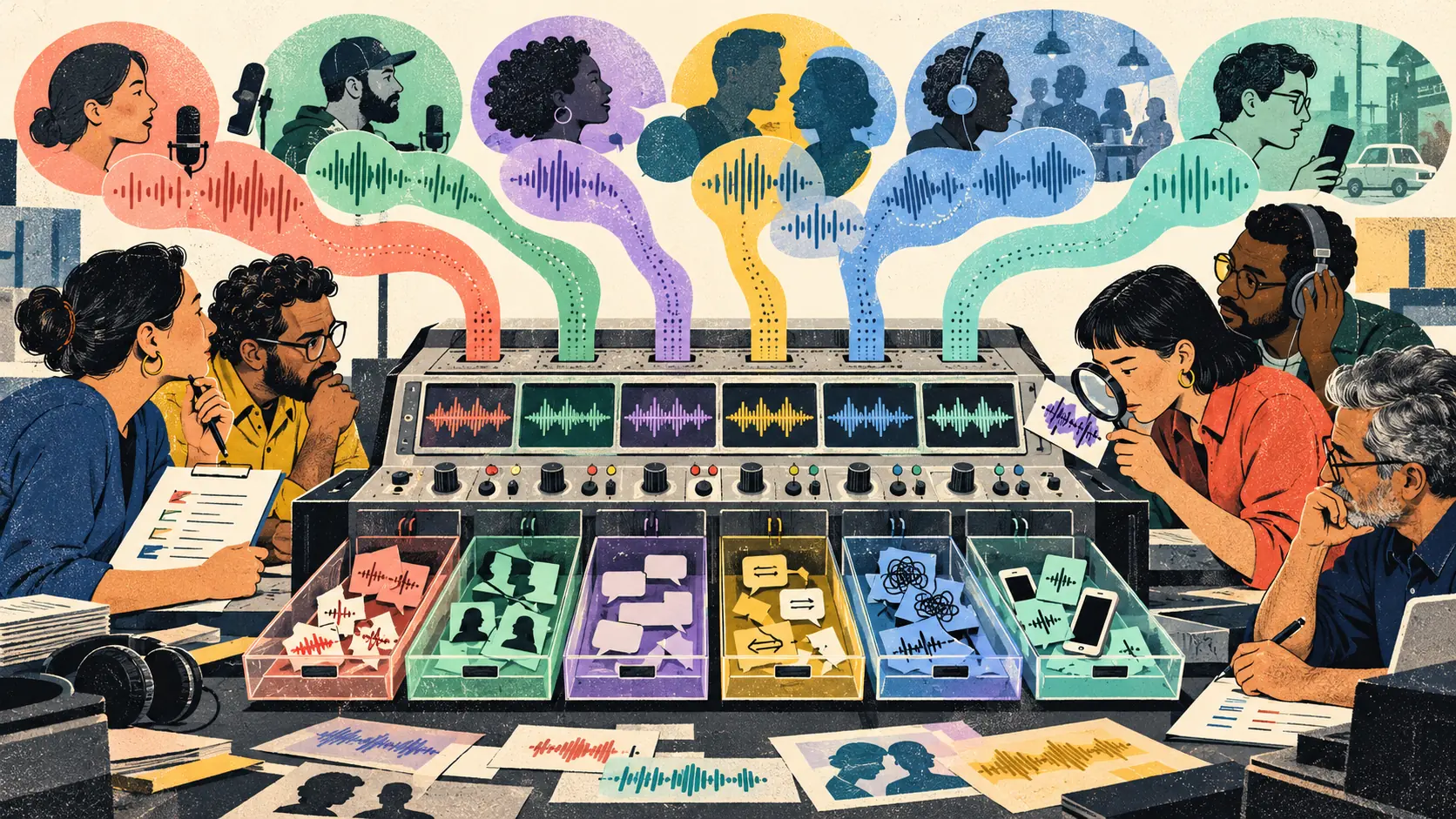
A transcript can look clean and still be wrong in exactly the place that matters. The medication name becomes a common noun. The second speaker disappears into the first. The interpreter's sentence is assigned to the patient. The local place name is replaced with a more familiar one. The model removes a hesitation that carried uncertainty, or adds punctuation that makes a tentative answer sound final. Then somebody exports the transcript, searches it, summarizes it and treats the neat paragraph as a record of what happened. This is why speech recognition needs more than one impressive average. NVIDIA released Nemotron 3.5 Transcribe on October 28 as an open-weight, offline speech and audio model. Its model card lists transcription in 40 languages, recordings up to one hour and a 65,536-token context. The system combines a speech encoder, a speaker encoder and a Nemotron language-model backbone. Roughly 4.3 billion parameters are active during inference, according to NVIDIA. The interesting change is not merely another speech-to-text model. It is the prompt. A developer can ask for verbatim speech with fillers, a cleaned transcript, numbers written in a particular style, contextual vocabulary, speaker tags, timestamps, translation or an answer grounded in the recording. The same model can be steered toward different transcript conventions instead of requiring a separate pipeline for each one. That sounds small until you have argued over whether a transcript should preserve every "um," write "twenty twenty-six" as words or digits, distinguish four meeting participants, or keep a product code exactly as spoken. Formatting is not frosting on speech recognition. It changes what the output means and whether another system can use it. Nemotron 3.5 Transcribe also supports audio questions, language identification and speaker-attributed transcription. NVIDIA describes it as an offline model, which means a recording is processed as a unit rather than through a real-time streaming service. Speaker labels distinguish voices inside a recording. They do not identify the real people behind those voices. The model arrives with Granary v2, a public multilingual speech-data release and curation pipeline built with NVIDIA NeMo Curator. NVIDIA says the public manifests cover 463,062 hours, 48 languages and 16 source corpora. They contain transcript variants, translations, contextual terms, quality information, provenance and other task labels. Those figures describe the public Granary v2 release. They do not describe the complete training mixture for Nemotron 3.5 Transcribe. The model card says the broader recipe contains about 1.72 million hours and 372 million unique audio examples, including public and third-party corpora, web-derived material, pseudo-labels, constructed multi-speaker mixtures and synthetic data. English has the largest share. This distinction matters because a downloadable dataset card is not a full census of everything a model learned from. NVIDIA reports strong benchmark results. On its model card, the system posts a 4.71 percent mean word error rate across nine public English sets and 4.62 percent across a multilingual benchmark covering seven languages. It also reports speaker-attributed and long-form results. These are vendor-reported measurements captured on specific datasets, prompts, decoding settings and hardware. They are useful evidence. They are not a travel visa for every language, accent, room, microphone or profession. The model card itself says language and task support vary. Audio understanding, reasoning and spoken instruction following were evaluated only in English and may not work reliably in other languages. A system that transcribes a language does not automatically answer questions about that language with the same reliability. This is the part a single leaderboard number can hide. Average word error rate counts substitutions, insertions and deletions across a test set. It can tell you whether one system made fewer word-level mistakes than another under the benchmark conditions. It cannot tell you which people were repeatedly misheard. It cannot tell you whether the missing words were greetings or drug names. It cannot tell you whether the model performed well on studio speech and badly on a cheap phone beside a bus stop. It cannot tell you whether overlapping speakers caused the person with the quieter voice to vanish. It cannot tell you whether a cleaned transcript erased a meaningful pause, repetition or change of language. For that, you need an error ledger. The ledger should begin before procurement. Write down the real recording conditions. List the languages, regional varieties, code-switching patterns, age groups, speech impairments, devices, rooms, background sounds, speaker counts and domain vocabulary the product will encounter. Do not label a row "Spanish" and congratulate yourself on diversity. Spanish spoken in a quiet office in Madrid is not the same evaluation condition as a fast bilingual call from a noisy kitchen in Bogotá. The same principle applies to Arabic varieties, Indian English, Indigenous languages, workplace jargon and every other speech community flattened by a broad label. Each test clip needs a reference transcript created or reviewed by someone qualified for that language and domain. If reasonable transcribers disagree, preserve the disagreement. Speech is not always a puzzle with one divinely correct string. Then record the basic errors. Count substitutions, insertions and deletions. Break them down by language and condition. Measure punctuation and number formatting separately if those choices matter. Track named entities such as people, places, medications, legal terms, account numbers and product codes. A transcript that gets every small word right and the dosage wrong is not 98 percent useful. It is dangerous in one concentrated spot. Speaker attribution needs its own page in the ledger. Did the system detect the correct number of speakers? Did it assign the words to the correct anonymous speaker tag? What happened during interruptions? Did the quieter participant lose more words? Were short acknowledgements attached to the wrong person? The model's speaker labels should remain anonymous unless a separate, consented identity system exists. "Speaker 2" is a segmentation result, not proof that the speaker was Maria. Translation needs another page. Compare meaning, not only word overlap. Record omitted negation, changed tense, altered uncertainty, lost honorifics, mistranslated names and terminology that becomes more generic. Ask a fluent reviewer whether the translated sentence preserves the original speaker's intent and level of confidence. The prompt belongs in the ledger too. Nemotron can be instructed to produce verbatim or cleaned text, use contextual terms and follow formatting conventions. That means the prompt is part of the transcription system, just like the model version and decoding settings. Pin it. If the prompt changes, run the evaluation again. NVIDIA's release article includes a medical adaptation case study using an open benchmark of speech from Indian doctors and medical students. The reported full-set word error rate fell from 30.8 percent out of the box to 23.8 percent after a prompt named English and the Latin alphabet, then to 11.8 percent after fine-tuning. The cleaner held-out comparison used 2,764 clips from speakers not used to choose the prompt or checkpoint. NVIDIA reports that fine-tuning reduced word error rate from 22.44 percent for the prompt-tuned baseline to 12.17 percent. That is a useful demonstration of why instructions and domain adaptation matter. It is not evidence that the system is safe for clinical records. The study used a selected benchmark, synthetic medical speech and public accented and medical recordings. It also found a small decline on a general English test and remaining weakness on exact brand-name matches. Real clinical deployment would need privacy review, consent, local recordings, qualified reference transcripts, workflow testing and a human correction path. The error ledger should make those tradeoffs visible. One column tracks the domain gain. Another tracks what got worse elsewhere. That matters because adaptation can teach a model to expect the new vocabulary so aggressively that it starts hearing specialized terms where none were spoken. A context list can rescue a rare name. It can also tempt the system into inventing that name from weak audio. Test near-misses. Put similar drug names, street names and customer surnames in the same evaluation. Include silence, clipped audio and speech the model should decline to guess. Measure hallucinations separately from ordinary substitutions. The same rule applies to audio questions. If a user asks, "Did the customer agree to the refund?" the system is no longer merely transcribing. It is interpreting a record. The evaluation should require a quoted or timestamped evidence span and allow "not clear from the audio" as a valid answer. Never let a smooth summary erase the uncertain transcript underneath it. For public meetings, schools, customer service, journalism and accessibility tools, publish a compact version of the ledger. Show the tested languages and conditions. Show sample counts. Show error ranges rather than one average. Name the model, prompt and date. Explain whether humans reviewed the transcript before publication. Provide a correction route for people whose words were misrepresented. For internal systems, keep the full receipt. Store the audio identifier, consent and retention rules, model and precision, prompt, decoding settings, language choice, timestamps, transcript, reviewer edits and downstream uses. Log when a transcript enters search, a case file, a summary or a decision system. The ability to self-host an open-weight model can help organizations keep audio inside their own environment. It does not make privacy automatic. Local systems can still retain sensitive recordings too long, give broad employee access, leak transcripts into logs or feed errors into irreversible decisions. Self-hosting changes the boundary. It does not remove the need to govern it. Granary v2 is useful here because the release includes an inspectable curation pipeline and per-record metadata. Developers can see how transcript variants, translations, contextual terms and quality filters were produced, then adapt the pipeline to recordings they are authorized to use. The source audio remains under each original corpus license and must be downloaded separately. A public manifest does not erase those terms. The best outcome is not a universal transcript machine that claims to hear everyone equally. It is a system that knows which instructions it followed, which voices it has tested, which words it tends to lose and when a person needs to take over. Promptable transcription gives teams more control over the output. The error ledger makes them accountable for what that control still misses.
01
WHAT ACTUALLY CHANGED
NVIDIA released Nemotron 3.5 Transcribe and Granary v2 on October 28, 2026
Nemotron is an open-weight offline speech and audio model that supports transcription in 40 languages and recordings up to one hour
Text prompts can request verbatim or cleaned transcripts, contextual vocabulary, speaker attribution, timestamps, translation and audio answers
The model card reports approximately 4.3 billion active parameters and BF16, FP8 and NVFP4 releases
Granary v2 publishes manifests covering 463,062 hours across 48 languages and 16 source corpora
The public Granary v2 release is part of the training recipe, not a complete description of the model training mixture or sampling weights
NVIDIA published benchmark and medical adaptation results alongside explicit language, task and deployment limitations
02
WHY THIS MATTERS
Promptable transcript conventions can make one model useful across meetings, media, accessibility, translation and domain-specific workflows
An aggregate word error rate can hide systematic failures by language, accent, device, speaker, noise condition and vocabulary type
Speaker-attributed transcripts can misassign words during overlap and should not be treated as verified speaker identity
Audio questions turn transcription into interpretation and require evidence spans plus an honest uncertainty option
Domain adaptation can improve specialized vocabulary while reducing general performance or increasing false matches
Self-hosting can change the privacy boundary but does not govern retention, access, review or downstream decisions
03
WHERE IT COULD HELP
- Create a representative test set by language, regional variety, device, noise, speaker count and domain before deployment
- Measure substitutions, insertions and deletions separately for every important cohort and recording condition
- Track named entities, numbers, negation, uncertainty and domain terms in addition to overall word error rate
- Evaluate speaker counts, overlap, attribution and missing speech without treating anonymous speaker tags as identity
- Pin the model version, precision, prompt, decoding settings and language choice for every evaluation and production transcript
- Require timestamped evidence and an uncertainty response for questions answered from audio
- Use held-out speakers and real recordings when measuring prompt changes or fine-tuning gains
- Test near-miss vocabulary and silence to measure false contextual matches and hallucinations
- Keep audio consent, retention, reviewer edits and downstream uses in the transcript audit receipt
- Publish a compact language error ledger and a correction path when transcripts affect the public
KEEP A HAND ON THE WHEEL
NVIDIA reports the accuracy, throughput and adaptation results in its own release materials. The measurements depend on selected datasets, prompts, hardware, scoring methods and decoding settings. Language support is uneven, English is the largest share of the training mixture, and audio understanding was evaluated only in English. The medical case study uses a selected benchmark plus synthetic and public adaptation data and is not a clinical validation. Speaker tags do not establish identity. Self-hosting does not solve consent, retention or access control. Watch for independent multilingual evaluations, detailed results for low-resource languages, real-world overlap and noise tests, disclosure of prompt sensitivity, and evidence that domain gains do not create new false matches.
04
TERMS WORTH KEEPING
SOURCES AND VERIFICATION STATUS
This article was written from the materials below. Product claims and dates were checked against those sources on October 30, 2026.
PUBLICATION RECEIPT: Model capabilities, dataset figures, training disclosures, benchmark results and medical adaptation measurements are attributed to NVIDIA release materials and model or dataset cards. The language error ledger, evaluation protocol and deployment recommendations are Plain Signal analysis.
THE PUBLICATION ENGINE
WANT A SIGNAL OF YOUR OWN?
We build source-grounded publications, private briefings, and editorial systems for organizations with something useful to say.
WORK WITH US