THE SIGNAL IN ONE SENTENCE
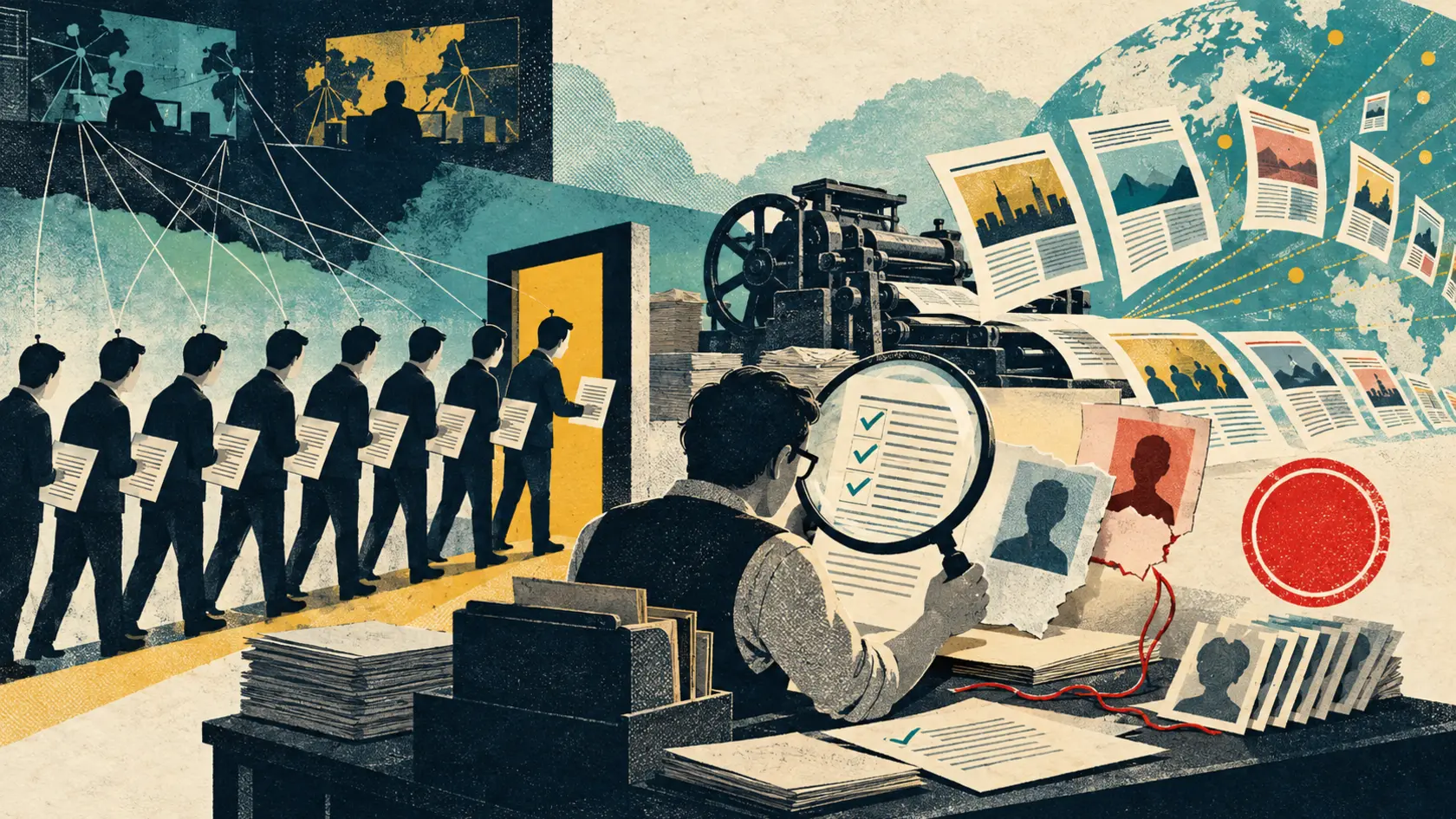
A polished article can survive an edit while its author fails the most basic identity check. OpenAI reported on October 8 that an Iran-origin influence operation used seven invented journalist personas to pitch long-form articles to online publications. The company says it found almost 100 articles published or syndicated under those bylines across more than a dozen outlets between July 2025 and October 2026. The subjects were familiar editorial territory: international affairs, the Middle East, human rights, conflict and the war involving Iran and the United States. The biographies presented the writers as Western journalists, usually American. One claimed to be based in New Zealand. Some personas had supporting accounts across X, Facebook, Instagram, Threads or Medium. The furniture of credibility was there. OpenAI says the people behind the accounts used ChatGPT to refine English-language drafts, compare them with a specific outlet's submission rules and prepare email pitches. One persona's biography was also drafted with the model. The operation did not need a magical propaganda machine. It needed serviceable prose, plausible packaging and an editor willing to accept the handshake. That handshake is the real story. Newsrooms often verify what a contribution says more carefully than who is offering it. An editor checks grammar, citations, tone and fit. A clean draft arrives with a short biography, a social profile and links to earlier publication. The writer answers email. The pitch meets the section's needs. On a strained publication schedule, that bundle can feel like identity. It is not identity. It is a collection of claims. OpenAI dubbed the Iran-linked campaign Bogus Bylines. It says the operation originated from accounts in Iran that connected through virtual private networks and prompted in Persian and English. Seven named personas submitted the work. Some profile transparency settings pointed to Iran even when the biography claimed an American identity. Meta had already removed one of the Instagram accounts in August, according to OpenAI's report. The articles were the successful lane. The same operation generated batches of social comments, often about the conflict involving Iran, the United States and Israel. OpenAI found that the comments it could identify usually drew only single-digit or double-digit engagement and generally remained a minority of the replies around them. The bylined work crossed a different boundary. The publications supplied real distribution, real branding and, at least by implication, real editorial judgment. At least some outlets promoted the pieces through their own social accounts. One publisher that ran the operation's material had almost 2 million Facebook followers, almost 355,000 followers on X and more than 544,000 on Instagram as of August, OpenAI says. That distinction explains the report's impact scores. The social commenting was assessed at Category 2 on the six-level Breakout Scale, with activity on multiple platforms but little evidence of broader pickup. The article-placement work was assessed at Category 4 because it repeatedly broke into established media outlets. The scale was designed by researcher Ben Nimmo to compare the observable reach of influence operations. Category 4 does not mean every planted article persuaded a large audience. It means the operation escaped its own channels and gained amplification from mainstream media. That is an important difference. Publication is evidence of distribution, not a measurement of belief. OpenAI also cautions that not all of the placed content was generated with its models. It investigated activity on its own service, banned the associated accounts and shared information with relevant authorities. It says the pattern looked consistent with a commercial actor running an influence campaign for hire, but it could not identify the particular actor. The report does not reveal every person involved, every publication affected or the actual audience impact of each article. Those limits should not soften the operational lesson. An outlet can fact-check a sentence and still lend authority to a false source. AI text detectors will not solve that problem. They can misclassify human work, miss edited model output and offer no proof about who controlled an account. A human operator can write some paragraphs, ask a model to polish others and then revise the result. Even a perfect origin label for the prose would not reveal whether the named contributor exists, whether a sponsor is hidden or whether the author is acting for someone else. The better defense is to separate content review from contributor verification. Start with an independent identity channel. A first-time contributor making consequential geopolitical claims should not be authenticated only by the email address, biography and social links supplied in the pitch. Ask for a short live conversation. Verify a professional affiliation through the institution's own directory or a known office number. If the contributor claims freelance status, ask for an editor or colleague who can be reached through an independently found address. Then check the biography as a set of testable statements. Does the writer's claimed location align with publication history and public records? Do prior outlets confirm the relationship? Does the same portrait appear under another name? Were all social accounts created in a burst? Do the accounts mostly promote the contributor's own pieces? A reverse-image search or profile-location indicator can produce a lead, not a verdict. Any single mismatch can have an innocent explanation. A stack of mismatches deserves a pause. Next, make provenance part of the submission. Ask who conceived the article, who drafted it, who edited or translated it, what tools materially shaped it and whether anyone paid for placement or production. Require disclosure of clients, political organizations, governments and advocacy groups with a relevant interest. The point is not to ban assistance or translation. The point is to know whose work and incentives the publication is carrying. Preserve the trail. Keep the original pitch, drafts, revision history, source links, identity checks and conflict disclosures with the article record. A newsroom that retains only the finished copy loses the evidence it needs when a pattern emerges six months later. Repeated wording, coordinated submission timing, recycled biographies and similar account behavior become visible only across cases. Small outlets do not need an intelligence unit. They need a reliable intake lane. A lightweight version can fit on one page: verify the person through an independent route, confirm claimed affiliations, record conflicts and compensation, inspect provenance, check sources, preserve the revision trail, and assign an editor to approve publication. High-risk topics should receive stronger checks. Anonymous contributors require a documented reason and a responsible editor who knows the identity, not an honor system with a blank byline. The workflow should continue after publication. If a source platform, researcher or another newsroom flags a contributor, search the archive immediately. Link related bylines, email domains, portraits, phrasing and submission patterns. Freeze queued pieces while the review runs. Correct, annotate or remove affected work according to a published policy, and tell readers what changed without repeating the operation's claims for spectacle. There is a human consequence on both sides of this failure. Real freelance journalists already have to prove themselves repeatedly, especially when reporting across borders or working outside dominant institutions. A careless crackdown can turn accent, geography or limited online presence into suspicion. That would punish exactly the reporters who bring local knowledge to international coverage. Verification must rely on consistent evidence and an appeal path, not vibes or nationality. Editors are also targets, not merely gatekeepers who failed a test. Small publications operate with limited time, low budgets and a constant demand for fresh material. An influence operator can study the outlet's guidelines, adapt a piece to its style and exploit the same openness that allows new writers to enter journalism. The answer is a process that helps an editor say yes safely, not a permanent wall around the contributor form. OpenAI's report describes a second, Russia-origin operation across Latin America that pushed the false-front model further. The company says operators controlled a purported research platform through a fake persona while local staff apparently worked in good faith, unaware of the Russian connection. Much of that operation's AI use went into internal reports, not public content. OpenAI assessed it at Category 5 after finding open-source evidence that some false stories drew fact checks, official denials and political comment. The two cases underline the same uncomfortable point. The dangerous output is not always a synthetic paragraph. It can be a relationship that looks normal long enough for real people and real institutions to carry the message. The plain signal is simple: inspect the article, but authenticate the handshake. A newsroom does not need to prove that a machine wrote the words. It needs reasonable evidence that the contributor is who they claim to be, that hidden sponsors are disclosed and that the path from pitch to publication can be reconstructed later. If those checks are missing, fluent prose is not reassurance. It is camouflage with spellcheck.
01
WHAT ACTUALLY CHANGED
OpenAI banned accounts tied to two false-front influence operations and published its findings on October 8
The Iran-origin operation used seven invented journalist personas to pitch articles to small and medium online outlets
OpenAI identified almost 100 published or syndicated articles under the operation's bylines across more than a dozen publications
The operation used ChatGPT to refine drafts against outlet guidelines, prepare pitches and, in one case, write a persona biography
OpenAI assessed the article-placement lane at Category 4 on the Breakout Scale, while its low-engagement social commenting remained Category 2
A separate Russia-origin operation used a false research platform and unwitting workers in Latin America, according to the same report
02
WHY THIS MATTERS
A real publication can give a false persona distribution and implied legitimacy that an operation cannot manufacture on its own channels
Content review can catch weak claims while missing the concealed identity and incentives behind a polished submission
AI detectors cannot prove authorship, control of an account or the existence of a hidden sponsor
Small and medium outlets are attractive targets because open contributor pipelines coexist with thin verification resources
Overbroad suspicion can harm legitimate international freelancers, so checks must be consistent, evidence based and appealable
Retained pitch and revision records let newsrooms find coordinated patterns and respond after publication
03
WHERE IT COULD HELP
- Verify a first-time contributor through a live or independently sourced communication channel
- Confirm claimed employment, education or publication relationships through the institution rather than supplied contact details
- Require disclosure of sponsors, clients, compensation, political interests, translation and material AI assistance
- Review portrait reuse, account age, profile-location indicators and publication history as clues rather than standalone proof
- Preserve pitches, original drafts, revisions, source links and verification notes with the published article record
- Escalate identity checks for high-consequence claims, geopolitical conflicts and coordinated bursts of submissions
- Give anonymous contributors a documented protected-source process with an accountable editor who knows the identity
- Search the archive for related bylines, domains, portraits and phrasing when one contributor is flagged
- Publish a correction, annotation and removal policy that explains what readers will be told after a deceptive placement
KEEP A HAND ON THE WHEEL
OpenAI produced the investigation and assessed activity on its own service. It says it could not identify the specific actor behind the Iran-origin operation, and not all published content connected to the two operations was generated with OpenAI models. The company's open-source findings do not establish the complete set of participants, publishers or audience effects. Publication and follower counts indicate potential reach, not persuasion. Profile location, reverse-image matches and AI-output scores are investigative leads, not proof of deception. A fair newsroom process needs corroboration, consistent rules and a path for legitimate contributors to resolve errors.
04
TERMS WORTH KEEPING
OPEN GLOSSARY CARD
False front
A person or organization presented as independent while its real controller, sponsor or purpose is concealed.
OPEN GLOSSARY CARD
Provenance
The documented origin and history of material, including who created, edited, translated, funded or transmitted it.
OPEN GLOSSARY CARD
Breakout Scale
A six-category framework for comparing how far an influence operation travels across platforms, communities, media and public action.
SOURCES AND VERIFICATION STATUS
This article was written from the materials below. Product claims and dates were checked against those sources on October 10, 2026.
THE PUBLICATION ENGINE
WANT A SIGNAL OF YOUR OWN?
We build source-grounded publications, private briefings, and editorial systems for organizations with something useful to say.
WORK WITH US