THE SIGNAL IN ONE SENTENCE
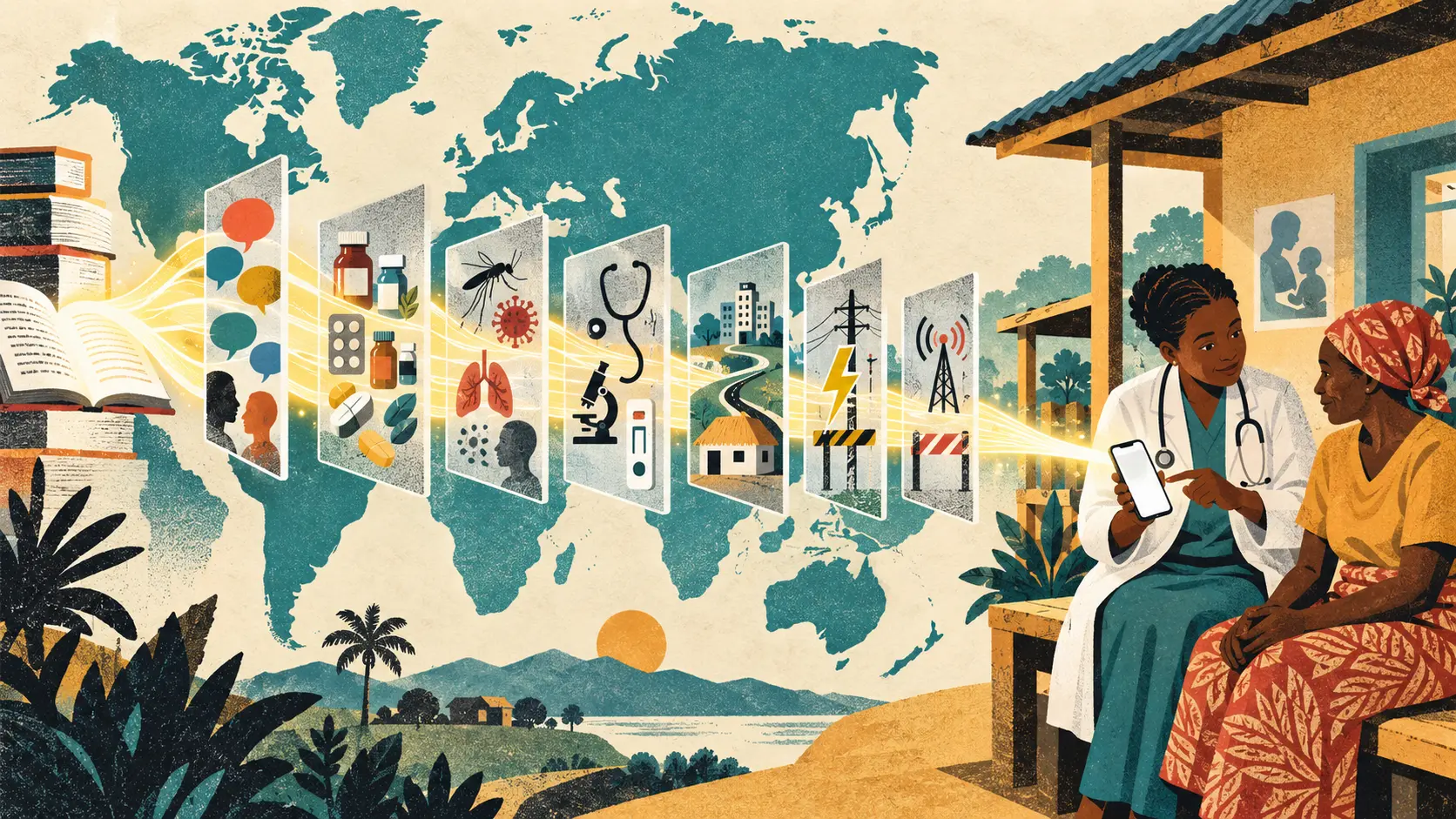
OpenEvidence and Anthropic say they are bringing a specialized clinical decision-support product to healthcare providers in about 100 low- and middle-income countries. OpenEvidence will provide the medical knowledge layer and adapt it by region. Anthropic will provide technology behind the service. The companies say clinicians will be able to use it for free. Reuters reports that the rollout includes Uganda, Angola, Sudan, Haiti and Mongolia, based on a country list supplied by OpenEvidence. That is an ambitious access promise, and access matters. A clinician with a smartphone may be able to search peer-reviewed studies and treatment guidelines that sit behind expensive subscriptions or far from the point of care. But a medical answer does not become locally useful just because it crosses a border. The same diagnosis can meet different medicines, laboratory equipment, referral routes, language, disease prevalence, electricity, privacy rules and staffing. A recommendation that assumes an MRI, a stocked pharmacy or a specialist downstairs can be technically supported and practically useless. OpenEvidence says the new system will account for regional infrastructure and points to earlier adaptation work with health organizations in Rwanda and Botswana. The public record still lacks the full country list, launch timetable, local clinical partners, validation protocols, supported languages, data-governance terms and outcome measures. The companies also did not disclose financial terms. OpenEvidence founder Daniel Nadler says US clinicians consulted the service 42 million times in August. That figure measures consultations with a product. It does not measure correct answers, changed treatment, avoided harm or better patient outcomes. The plain signal is that free distribution is the beginning of clinical access, not the end. A trustworthy rollout needs a local receipt for every market: who validated the system, which guidelines it uses, what resources it assumes, how recent the evidence is, what happens when it is uncertain and who remains responsible when the answer is wrong.
01
WHAT ACTUALLY CHANGED
Reuters reported the collaboration on September 22 after speaking directly with OpenEvidence founder Daniel Nadler, Anthropic president Daniela Amodei and clinicians familiar with the access problem.
The companies describe a specialized version of OpenEvidence for healthcare providers in low- and middle-income countries. It is intended to be available to clinicians without a subscription fee.
OpenEvidence supplied Reuters with a list covering about 100 countries. The report names Uganda, Angola, Sudan, Haiti and Mongolia as examples, but the complete list was not public before publication.
OpenEvidence says its existing service answers clinician questions using peer-reviewed medical research and treatment guidelines. Its current model family assigns different amounts of search and reasoning time to different clinical questions.
Anthropic will provide back-end technology. The companies did not identify every model, routing policy, hosting region, service-level commitment or safeguard that will support the international version.
OpenEvidence says it will tailor the product by region and account for healthcare infrastructure. That claim has not yet been accompanied by a public country-by-country adaptation specification.
Reuters reports that OpenEvidence previously worked with health organizations in Rwanda and Botswana on settings where disease patterns, diagnostic resources and available treatments differ from wealthier countries.
Nadler said US clinicians consulted OpenEvidence 42 million times in August. He also made a broader estimate about the number of Americans treated by a clinician who used the system. Both are company claims, not independently audited patient-outcome measures.
The companies did not disclose the financial terms, the funding source for free access, the duration of the commitment or what happens if usage grows faster than the program budget.
No complete public rollout timetable, local partner register, language list, regulatory map, privacy notice, incident process, external validation report or country-level performance dashboard was located before publication.
The World Health Organization says health AI should place ethics and human rights at the center of design and use while keeping public and private actors accountable to health workers and affected communities.
WHO regulatory material also emphasizes risk-benefit assessment, performance evaluation and monitoring across different global and regional settings. Those duties continue after deployment because clinical context and model behavior can change.
02
WHY THIS MATTERS
Medical literature is not evenly distributed. Journal access, specialist consultation and continuing education can be expensive, slow or unavailable. A phone-based evidence tool can shrink the distance between a clinical question and relevant research.
The strongest use case is decision support, not replacement. A clinician can use the tool to find guidelines, compare options, check contraindications and identify questions that deserve escalation. The clinician still has to connect the answer to the person, facility and moment in front of them.
Localization is much more than translation. A polished answer in the correct language can still recommend an unavailable medicine, a nonexistent diagnostic test or a referral that requires a journey the patient cannot make.
Disease prevalence changes the meaning of evidence. A symptom pattern can point toward different likely causes in different regions. Local epidemiology, vaccination, nutrition, climate, endemic infections and population characteristics belong in the evaluation plan.
Clinical infrastructure changes the safe next step. An algorithm trained around hospitals with continuous power, advanced imaging and deep specialist coverage may need a different recommendation path for a clinic with intermittent connectivity and a limited formulary.
Guidelines can conflict. Global recommendations, national protocols, professional-society guidance and a facility's actual supplies may not agree. The product should identify the source, jurisdiction, date and resource assumptions instead of blending them into one confident paragraph.
A free product still has a business model. Somebody pays for inference, medical content, hosting, security, local review and support. The durability of the access promise depends on funding terms that the companies have not disclosed.
Usage is not effectiveness. Forty-two million consultations can show demand and operational scale. It cannot tell readers whether the answer was correct, whether a clinician followed it, whether treatment changed or whether a patient did better.
The risk is not limited to a spectacular hallucination. A technically plausible answer can omit a local disease, cite an outdated guideline, assume the wrong drug concentration or fail to notice that the user cannot perform the recommended follow-up.
Privacy rules and clinical data practices vary across countries. A safe rollout needs to say what enters the system, where it is processed, how long it remains, who can inspect it and whether data from one market improves models used elsewhere.
Language support must include medical meaning, not only conversational fluency. Drug names, abbreviations, symptom descriptions and consent language can shift across regions and professions. Local clinicians should test the exact interface used in care.
Responsibility cannot disappear into the partnership. Clinicians need to know whether OpenEvidence, Anthropic, a local institution, a regulator or the individual user handles complaints, corrections, incidents and withdrawal of a dangerous recommendation.
The global value could be substantial if the rollout produces a reusable method for adapting evidence tools without treating poorer health systems as a giant beta test. That method should be inspectable and shaped by the people who deliver care locally.
03
WHERE IT COULD HELP
- Publish the complete country list, eligibility rules, launch sequence, supported languages and local clinical partners before access opens.
- Create a country profile that lists approved guidelines, essential medicines, diagnostic capacity, referral routes, connectivity limits and emergency contacts used by the system.
- Show the source, publication date, jurisdiction and evidence strength beside every consequential recommendation.
- Let clinicians select their facility type and available resources so the answer does not assume equipment or treatments they cannot access.
- Validate the service prospectively with local clinicians on realistic cases before using it in routine care, then publish performance and important subgroup results.
- Measure unsupported claims, omitted diagnoses, unsafe recommendations, citation accuracy, response time, clinician correction and downstream patient outcomes separately.
- Build an offline or low-bandwidth mode that preserves source dates and clearly states when the evidence package was last updated.
- Provide a one-tap way for clinicians to flag a dangerous, outdated or locally impossible recommendation and receive a traceable response.
- Keep patient-identifying information out of prompts unless it is necessary, consented, protected and covered by clear local data terms.
- Fund independent monitoring and local advisory groups instead of asking already stretched clinicians to donate all of the adaptation labor.
- Publish incident reports and correction notices across every affected market when one shared model, guideline or routing rule creates a repeated error.
- Treat free access as a durable service obligation with disclosed funding, uptime targets, support and an exit plan that does not strand clinical workflows.
KEEP A HAND ON THE WHEEL
This initiative is a company-announced rollout reported through direct Reuters interviews, not a completed public-health program. About 100 countries is an approximate figure based on a list supplied by OpenEvidence. The complete list, launch dates, local partners, supported languages, model stack, clinical validation, regulatory approvals, privacy terms, uptime promises, funding structure and country-level outcome measures were not publicly documented before publication. The named countries are examples, not proof of nationwide availability. The 42 million August consultations and the estimate of patients whose clinicians used OpenEvidence are statements from the company founder and do not demonstrate diagnostic accuracy, treatment quality, patient benefit or safety. Peer-reviewed source material does not guarantee that a generated answer is complete, current or locally appropriate. WHO principles are governance guidance, not certification of this product. Watch for local validation protocols, national medical guidance, independent performance studies, data-processing terms, incident reporting, language coverage, offline capability, financial durability and evidence that clinicians and patients in each market helped define what context adaptive actually means.
04
TERMS WORTH KEEPING
SOURCES AND VERIFICATION STATUS
This article was written from the materials below. Product claims and dates were checked against those sources on September 23, 2026.
PUBLICATION RECEIPT: Revision 1. Published September 23, 2026.
THE PUBLICATION ENGINE
WANT A SIGNAL OF YOUR OWN?
We build source-grounded publications, private briefings, and editorial systems for organizations with something useful to say.
WORK WITH US